
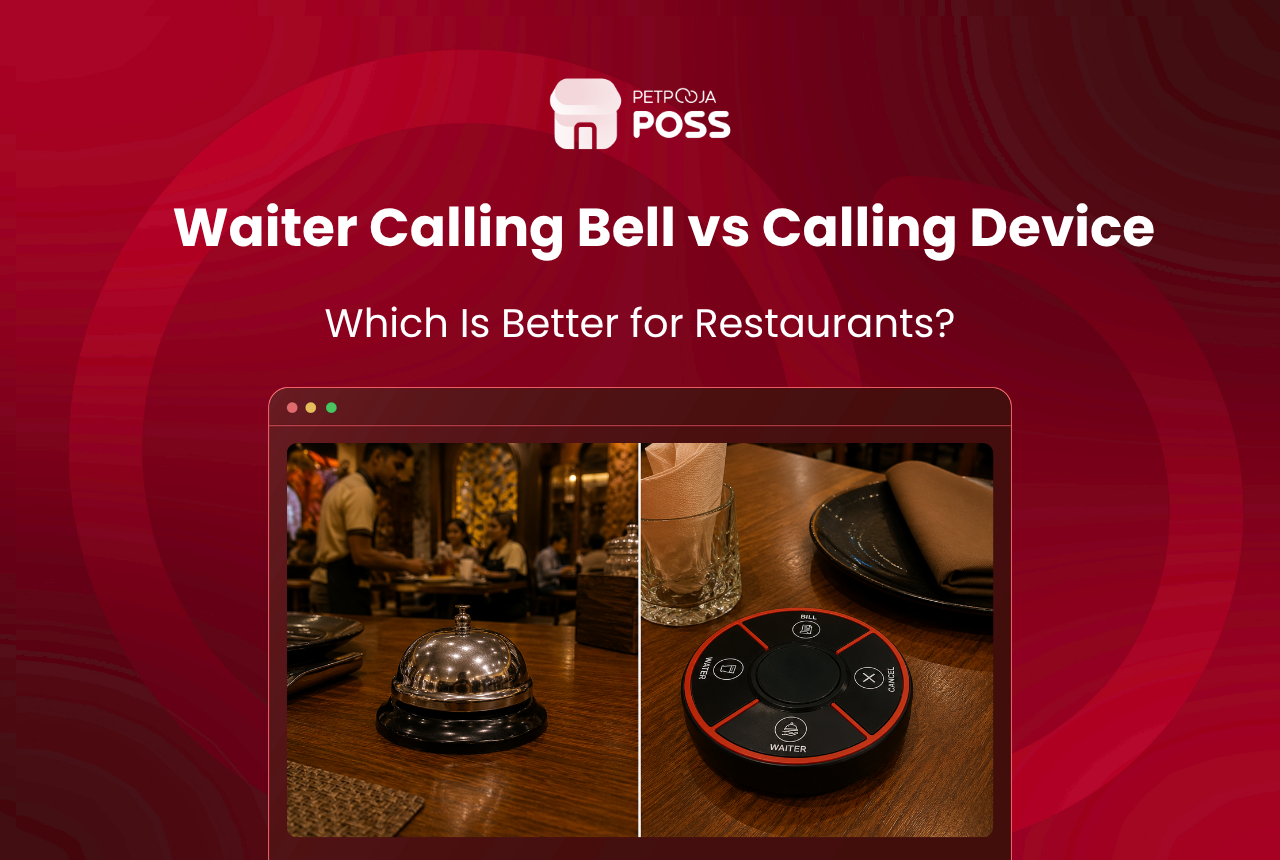
A waiter calling bell is a manual brass or steel bell that guests ring to get attention. A waiter calling device is a wireless electronic unit with tagged buttons that sends alerts directly to your POS, captain’s tablet, or a wall-mounted screen. The bell tells your staff that someone needs something. The device tells them exactly who needs what, at which table, and logs it.
Whether you run a 30-cover cafe in Indiranagar or a 90-seat family restaurant in Vastrapur, both options call the waiter. But the way each one handles that call, and what happens after, is where the gap sits.
Key Takeaways
- A calling bell produces sound but gives staff no information about what the guest needs or which table rang
- A wireless calling device sends a tagged, silent alert (Water, Waiter, Bill, Cancel) to POS, Captain App, and a display screen
- Bells have no tracking, no response-time data, and no accountability trail
- Devices log every request with a timestamp, table number, and request type
- For outlets seating 20 or fewer covers, a bell may still be practical; beyond that, the limitations compound fast
How Does a Traditional Calling Bell Work?
The concept has not changed in decades. A small metal bell sits on the table. When a guest needs something, they ring it, and a nearby waiter walks over.
That is the entire system. No table identifier, no request tag, no record that the bell was rung at all. A calling bell produces an audible ring but carries no information about which table rang first or what the guest needs, leaving staff to walk over and ask.
In a 15-table chai shop in Maninagar, Ahmedabad, this works well enough. But consider this example: in a 50-cover restaurant during a Saturday dinner rush, three tables ring their bells within ten seconds. The nearest waiter hears a sound but cannot tell which table rang first. They walk to the closest one, and by the time they reach the second table, the guest has flagged down a different server. The third table is still waiting.
How Does a Wireless Calling Device Work?
A wireless calling device is a flat, battery-powered unit mounted on each table. It connects to the outlet’s Wi-Fi and communicates with the restaurant’s POS system without needing active internet.
Petpooja’s Wireless Calling Device (WCD), for example, has four buttons: Water, Waiter, Bill, and Cancel. When a guest taps one, the request appears as a tagged ticket on three screens at once: the POSS billing terminal, the captain’s tablet via the Captain App, and a wall-mounted Android TV near the service station. The ticket carries the table number and request type.
The device charges once every 15 to 20 days, covers a 20-metre range, and mounts with an adhesive pad that has a tamper-resistant release key.
Side-by-Side Comparison
| Factor | Calling Bell | Wireless Calling Device |
|---|---|---|
| Alert type | Audible ring (no specifics) | Silent tagged alert (table + request type) |
| Staff knows request type | No | Yes (Water, Waiter, Bill, Cancel) |
| Works during noise | Poorly | Yes (visual alerts on screen) |
| Offline capability | Yes (no power needed) | Yes (Wi-Fi, no internet needed) |
| Response tracking | None | Timestamped log per request |
| Setup cost per table | ₹50 to ₹200 | Higher (hardware + subscription) |
| Battery or power | None needed | Rechargeable, 15 to 20-day battery |
| Guest effort | Pick up and ring | Single tap on a button |
| Theft risk | Low (cheap to replace) | Low (adhesive mount with release key) |
| Multi-table identification | Not possible | Automatic (tagged by table number) |
Where Do Bells Fall Short in Busy Restaurants?
In restaurants seating 50 or more covers, traditional calling bells become unreliable. Ambient noise during peak service makes them inaudible beyond two to three metres, staff cannot identify which table rang, and there is zero accountability for missed calls. Three specific problems stand out.
Noise drowns the ring. A Friday dinner service at a 60-cover restaurant in Baner, Pune generates enough ambient sound that a small table bell becomes inaudible beyond two or three metres. Staff at the far end of the floor miss it entirely.
No request context. A bell tells the waiter to come to the table, not whether the guest wants water, the bill, or a menu change. That means two trips minimum for every request that could have been routed directly.
Zero accountability. If a guest rings a bell and nobody comes for four minutes, there is no record. No manager can pull up a report of unattended requests during the lunch shift.
For example, picture a 45-table biryani restaurant in Madhapur, Hyderabad with 6 waiters during peak hours. With bells, each waiter is scanning 7 to 8 tables visually while listening for rings. With a wireless device, the waiter serving Table 12 can see on the captain’s tablet that Table 18 needs water and Table 22 wants the bill, and cover the floor in one pass instead of three trips. If you want to put a number on the labour cost of those extra trips, try the Restaurant Staff Cost Calculator.
Does the Calling Bell Still Make Sense?
Not every restaurant needs to replace its bells. A bell still works when:
- Your outlet has fewer than 20 covers with an open floor plan visible from the counter
- You run a counter-service or takeaway-heavy model where guests rarely sit for extended periods
- Your service cycle is under 10 minutes and the staff-to-table ratio is 1:5 or better
For example, a juice bar in Bopal, Ahmedabad with 8 tables and 2 staff does not need a wireless system. The waiter sees every seat from behind the counter, and a ₹150 brass bell on the counter does the job.
When Does Upgrading to a Device Become Worth It?
The tipping point sits around 25 to 30 covers and 3 or more waiters on the floor. A study of 94,404 customers at a popular Indian restaurant by IIM Ahmedabad researchers found that eliminating wait time could increase restaurant revenue by nearly 15%. At scale, the problems described above start costing real money.
Missed bill requests slow table turns. If a guest is ready to pay and nobody attends for 3 extra minutes, that table sits occupied longer than it needs to. Across 4 such delays in an evening, you lose one full table turn. For a table averaging ₹1,200 per cover, that is ₹1,200 gone from the night’s revenue. You can estimate the impact for your own outlet with the Table Turnover Rate Calculator.
Service delays drive negative reviews. A KPMG India Customer Experience study found that only 42% of QSR customers feel satisfied with the brand they visit frequently, and slow response to basic requests is a recurring complaint.
Staff exhaustion during peak hours. Close to 60% of restaurant operators in India already face shortages in both kitchen and service staff, according to the NRAI India Food Services Report. In a bell-based setup, the staff you do have spend a large portion of each shift on “scanning rounds,” walking the floor listening for bells and checking for raised hands. With tagged alerts, the same waiter can respond to tickets in order, covering the floor with fewer steps.
What Should You Look For When Switching?
If you are moving from bells to a wireless system, four checks matter:
- Wi-Fi coverage across the full dining area. The device runs on your router, so dead zones mean missed alerts. Walk the floor with your phone before ordering. A restaurant in Electronic City, Bangalore had to add a range extender because their router could not reach the outdoor patio 16 metres away.
- POS integration. A standalone buzzer kit gives you sound, but not tracking. Make sure the device feeds into your restaurant POS system so every request is logged with a table number and timestamp.
- Battery life above 10 days. Devices that need daily charging become a staff burden. Set a fixed weekly charging schedule, for example, every Tuesday after closing.
- Tamper-resistant mounting. Table-mounted hardware takes a beating. Check that the mount uses adhesive or screws with a release key, not a rubber pad that slides off.
How Does Petpooja’s WCD Fit into a Larger Setup?
Petpooja’s Wireless Calling Device integrates with the same Petpooja POSS ecosystem as the restaurant POS hardware, kitchen display system, and reservation management.
Every WCD alert carries a table number that ties back to the same table map used for billing, QR-based scan-and-order, and order management, giving the floor team one screen for both food orders and service requests.
At Petpooja, we have seen outlets that adopted the WCD alongside the Captain App reduce their average request-to-response gap within the first two weeks, because the waiter’s tablet shows both order tickets and service requests on one screen. The WCD is available as a paid add-on for outlets on Petpooja Electron POS or LOCAL POS. It is not available on Android POS or Lite.
Conclusion
A calling bell is a zero-cost, zero-information tool. A wireless calling device tells staff exactly which table needs what, logs the request, and routes it to the right screen. For outlets with 15 tables or fewer, bells work fine. Beyond that, the lack of tracking and context turns into lost revenue and slower service.
If your floor seats 30 or more covers and your waiters spend half their shift scanning tables instead of serving food, a wireless system pays back in faster table turns and fewer missed requests.
Frequently Asked Questions
Generic buzzer kits on Amazon and IndiaMart work with a receiver box and produce an audible beep, but do not integrate with any POS system. You lose tracking, table tagging, and response-time data. For a deeper look at how the WCD fits into a full restaurant setup, read Petpooja Waiter Calling Device: Small Upgrade, Big Growth.
A brass calling bell costs ₹50 to ₹200 per unit. Wireless devices cost more and may include an annual maintenance charge. For Petpooja’s WCD pricing, contact their sales team at getposs@petpooja.com.
No. A wireless device sends a silent visual alert to the POS screen, captain’s tablet, and a wall-mounted display system. Only the staff member looking at the screen knows a button was pressed. Pair it with a staff shift schedule template to make sure every shift has enough coverage to act on alerts.
The WCD operates on the local Wi-Fi network and does not need active internet. As long as your router is powered on and devices are within 20-metre range, alerts keep reaching your POSS and Captain App. If the router loses power, devices cannot transmit until it comes back.
Probably not. At 10 tables, your staff can see the entire floor from the counter. The device becomes worth it once seating crosses 25 to 30 covers and your peak-hour floor gets loud enough that bells become unreliable. It matters more for fine dining setups where silent, prompt service is part of the experience.
Petpooja’s POSS lets you mute a specific table’s device directly from the billing screen. If Table 7 is pressing the Water button every 30 seconds, the manager can mute that table for a set duration and attend to it in person.








