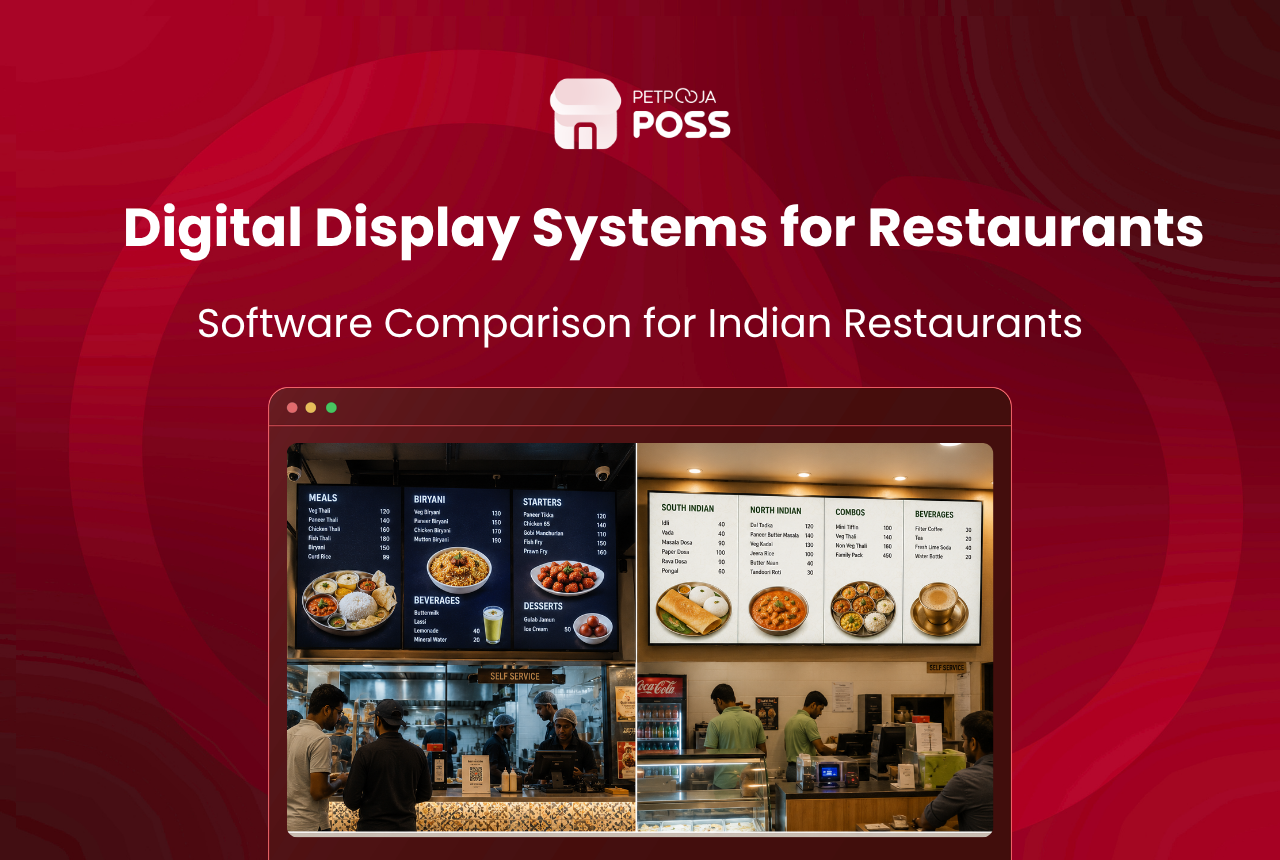
Indian restaurants shopping for a digital menu board in 2026 have five realistic options. Two are built in India, three are global platforms that happen to work here. The right pick depends on which POS the restaurant already runs, whether it needs signage beyond just the menu, and how many outlets it operates.
Petpooja’s Digital Display System sits inside POSS, so the menu board and billing share one dashboard. Pickcel runs as a standalone signage platform with an office in Bangalore and a free single-screen plan. Yodeck, NoviSign, and OptiSigns are headquartered in Greece, Israel, and the US respectively, with support hours and integrations geared toward those markets.
Every feature and price below is based on publicly available information as of June 2026.
Key Takeaways
- Petpooja’s Digital Display System lives inside POSS. Sold-out tags and price changes sync to the TV without any separate action. Best for restaurants already on Petpooja POSS.
- Pickcel manages over 1,50,000 screens across 70+ countries and has a free single-screen plan with no time limit, per Pickcel’s product page.
- India’s digital signage market stands at USD 1.29 billion in 2026, growing at 10.6% CAGR through 2033, per Coherent Market Insights.
- Yodeck’s free tier with a Raspberry Pi keeps total hardware cost under ₹4,000, making it the cheapest entry point for a solo outlet.
Side-by-Side Comparison
| Feature | Petpooja DDS | Pickcel | Yodeck | NoviSign | OptiSigns |
|---|---|---|---|---|---|
| Origin | India (Ahmedabad) | India (Bangalore) + US | Greece | Israel | US |
| Pricing | Bundled with POSS | Per screen/month; free 1-screen plan | Per screen/month; free 1-screen plan | ~₹1,500+/screen/month | ~₹900+/screen/month |
| POS sync | Native (built into POSS) | API only | API only | API only | API only |
| Offline mode | Yes (Android TV cache) | Yes (local cache) | Yes (Raspberry Pi cache) | Yes | Yes |
| Hardware | Android TV v7.1.1+ | Android TV, Fire TV, Chromecast | Raspberry Pi, Android | Android, Windows | Android, Fire TV, Windows |
| India support | 24×7 multilingual | Bangalore office + phone | Email/chat only | Email/chat only | Email/chat only |
Pricing as publicly listed or approximate. Verify with vendors before purchasing.
Petpooja Digital Display System
A restaurant owner in Vastrapur, Ahmedabad, running 4 outlets on Petpooja POSS does not need to evaluate signage vendors at all. The display feature already sits inside the same app used for billing, KOT, and inventory.
What makes this different from every other option on the list: the POS and the menu board are the same system. When paneer tikka goes from ₹280 to ₹310 in the billing module, the TV behind the counter shows ₹310 within seconds. When the Satellite Road kitchen runs out of mutton biryani at 2 PM on a Saturday, one tap in the POS pulls the dish off the screen. No second dashboard, no manual sync, no API configuration.
Each screen gets a name (“Vastrapur Counter”, “SG Highway Entrance”), a playlist, and a daypart schedule. All visible from one login. The system runs on any Android TV version 7.1.1 or higher and caches content locally, so a Wi-Fi drop does not blank the screen.
At Petpooja, we built this for a problem we kept seeing: the operations manager spent half a day coordinating with a designer and printer every time a price changed, while the POS had the new price sitting right there. The digital menu board just needed to read from the same source.
The catch: this only works for restaurants on Petpooja POSS. Different billing system means this option does not exist.
Pickcel
Pickcel started in Bangalore, now operates out of HSR Layout with a US office in New York. The platform manages over 1,50,000 screens globally and carries SOC 2 Type II and ISO 27001 certifications. It is not built specifically for restaurants, but 50+ restaurant menu templates and daypart scheduling make it work for the food business without much customisation.
The free plan is genuinely useful: one screen, no time limit, no credit card. For a fine dining place in Bandra, Mumbai, that wants to test a digital board at the entrance showing the tasting menu and wine list, this is a zero-risk starting point. Paid tiers unlock multi-screen and multi-location management.
Hardware flexibility is broad: Android TV, Fire TV, Chromecast. Content pushes from a cloud CMS with offline caching. The Bangalore office means a restaurant chain in Indiranagar or Electronic City can get in-person support, which none of the three global-only platforms offer.
Where Pickcel falls short for restaurants is the POS gap. Menu updates happen in the Pickcel dashboard, not in the billing system. If the kitchen marks an item sold out in the POS, someone still needs to open Pickcel separately and remove it from the display. That double-handling adds friction for QSR chains running 150+ orders an hour.
Yodeck
The budget play. Yodeck is a Greek platform that offers one screen free forever, and the screen can run on a ₹3,500 Raspberry Pi connected to any existing monitor or TV.
For example, a momos stall in Vashi, Navi Mumbai, with a 24-inch monitor already screwed into the wall can add a rotating digital menu for under ₹4,000 total. No Android TV purchase needed. The owner uploads images through a browser-based editor, sets up a playlist, and the Raspberry Pi pulls content over Wi-Fi.
That affordability comes with trade-offs a restaurant owner should know before committing. Raspberry Pi hardware puts out far less brightness than a commercial Android TV panel. Under the tube lights of a busy QSR counter, the display can look washed out, especially near windows. The Pi also lacks the processing headroom for smooth video loops, so motion content stutters on some setups.
Support runs on European time zones. A screen issue at 11 AM IST lands in an inbox that opens at 1:30 PM IST. For a single outlet, that delay is manageable. For a 10-outlet chain in Pune needing same-day fixes, it is not.
Yodeck works as a proof-of-concept tool. Test whether a digital board moves the needle on dessert sales or queue speed, then graduate to a POS-integrated system if it does.
NoviSign
NoviSign targets restaurants that care about design polish. The Israeli platform ships 400+ templates and 50+ drag-and-drop widgets, which means a bakery chain in Jayanagar, Bangalore, can build a professional-looking pastry display board without hiring a graphic designer.
Pricing sits at the higher end of this comparison, around ₹1,500 per screen per month. A 6-outlet deployment runs roughly ₹9,000 monthly in software alone, before hardware.
The platform also supports interactive touchscreen content, which overlaps with self-service kiosk territory. A dessert counter where guests tap the screen to see calorie counts or allergen info before ordering is a use case NoviSign handles that the other four do not. Whether that feature justifies the premium depends on the restaurant’s format.
No India office. No native integration with Indian POS systems. The template library is the entire value proposition. If design templates are not a priority, the price-to-feature ratio does not hold up against Pickcel’s free tier or Petpooja’s bundled approach.
OptiSigns
OptiSigns is the platform that shows up on every “best digital signage” global listicle. US-based, around ₹900 per screen per month as listed on Capterra India’s digital signage directory, compatible with Android, Fire TV, and Windows hardware.
The standout feature is POS integration, but with a caveat that matters for Indian restaurants: the integrations cover Square, Toast, and Lightspeed. Those POS systems have minimal footprint in India. A cloud kitchen in Whitefield, Bangalore, or a QSR chain in Bopal, Ahmedabad, almost certainly runs Petpooja, Posist, or Restroworks, none of which OptiSigns connects to natively.
If the restaurant operates across India and the UAE with a global POS, OptiSigns can unify signage across geographies from one account. For a domestic Indian chain, the value gap is hard to ignore when Pickcel offers local support at a comparable price and Petpooja bundles the display into the POS.
How Should You Pick a Digital Display System?
For most Indian restaurants, the shortlist is two names, not five.
A restaurant on Petpooja POSS picks the built-in Digital Display System because no standalone signage tool can match the depth of POS-to-screen sync. A menu pricing calculator helps decide which high-margin items deserve the prime rotation on the board.
A restaurant on a different POS, or a business that needs signage for both restaurant and non-restaurant locations, picks Pickcel for the local support and free entry tier.
Yodeck fills the gap for a solo outlet on a ₹4,000 budget. NoviSign and OptiSigns are niche fits most Indian restaurants will never need.
Conclusion
Five digital display systems serve Indian restaurants in 2026. Petpooja’s built-in system wins for restaurants on POSS because the POS and menu board share one dashboard. Pickcel wins for chains needing standalone signage with local support. Yodeck is the cheapest way to test a digital board at a single outlet. NoviSign and OptiSigns fill narrower roles. The right pick depends on which POS the restaurant runs, how many outlets it has, and whether it needs signage beyond the menu board.
Frequently Asked Questions
Petpooja’s Digital Display System if the restaurant already runs POSS. Yodeck if it does not, because the free tier and Raspberry Pi hardware keep total cost under ₹4,000.
Yes. Every platform on this list caches the last playlist locally. If Wi-Fi drops, the screen keeps playing. Updates sync once connectivity returns. The restaurant opening checklist should include a screen status check each morning to catch any overnight disconnections.
Not natively with Indian billing systems. Pickcel operates as a standalone content management system. If a menu item sells out in the POS, someone needs to open the Pickcel dashboard separately and update the display. For POS-synced menu boards, Petpooja’s built-in system is the only option on this list that handles it without API work.
No. It is a feature inside POSS, not a standalone product. Restaurants running other billing systems need to choose from the remaining four options.
Hardware: ₹14,000 to ₹22,000 for a 43-inch Android TV with wall mount. Software: bundled at no extra charge (Petpooja), free for one screen (Pickcel, Yodeck), or ₹900 to ₹1,500 per screen per month (OptiSigns, NoviSign). A single outlet lands between ₹14,000 and ₹24,000 in year one depending on the software path chosen.