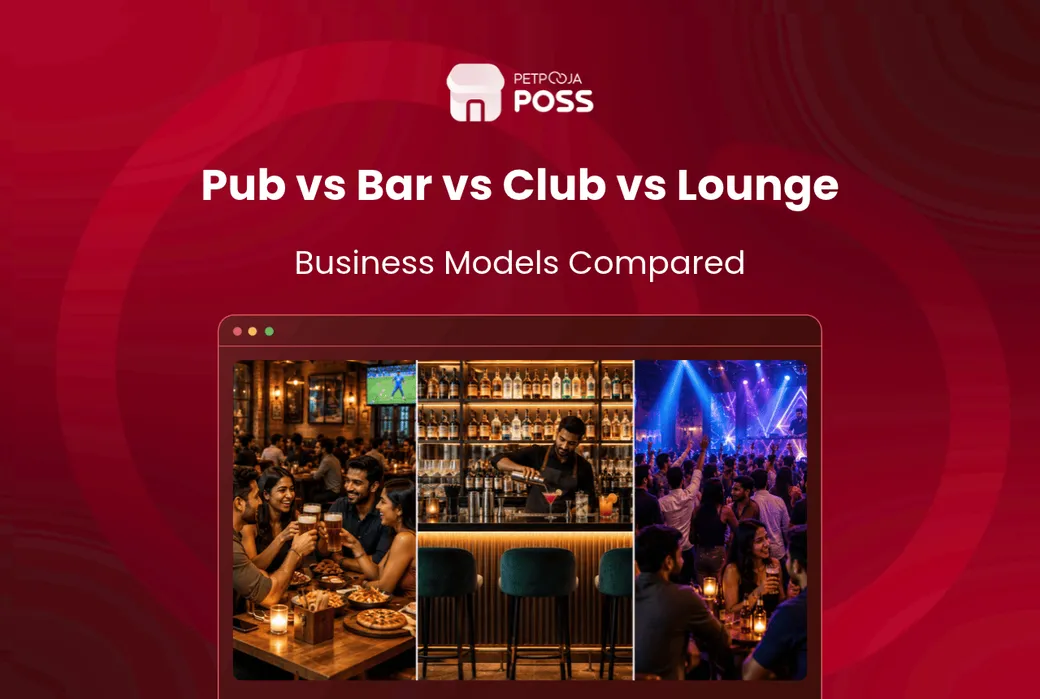



Pub vs bar vs club vs lounge: what is the difference? It is mostly what you sell besides the drink. A bar sells drinks at a counter, and a pub adds food and a long, easy evening. A club adds dancing or a members-only door, and a lounge sells comfort at a higher price.
In law, the four are much closer than their names suggest. Delhi’s excise department has no “pub” or “lounge” licence at all. So the format you pick decides your fit-out, your staff and your crowd, while the licence mostly depends on the kind of premises.
This post compares the four side by side. It covers what each one is, the licence each needs in Delhi and Maharashtra, what drives the cost, and which one suits your location.
Key Takeaways
- A pub sells a long evening with food; a bar sells drinks at the counter. A pub usually means a kitchen.
- A pub, bar, lounge and nightclub get no excise licence of their own in Delhi and Maharashtra.
- A lounge or nightclub usually costs more to fit out, so it needs guests who pay for the room.
Pub vs Bar: Food, Seating and Drinks
The difference between a bar and a pub is the food and the pace. A bar is built around the drinks counter, while a pub is a place to eat, drink and stay for the evening.
The Oxford definition of a pub calls it “a building where people go to drink and meet their friends”. Pubs “often also” serve food, it adds. The word is short for “public house”.
In India, the line shows up in three places:
- The menu. A pub runs a full kitchen with food that sells alongside the beer. A bar may serve only snacks.
- The seating. A pub has tables for groups who stay for hours. A bar puts more people at the counter.
- The drinks. Many Indian pubs lead with draught beer or craft beer. A bar leads with spirits and cocktails.
None of this is a legal rule. A place can call itself a pub and run like a bar.
What Is the Difference Between a Pub and a Club?
The difference between a pub and a club depends on which “club” you mean. The word covers two very different businesses in India.
A Nightclub: Dancing and Late Nights
In a nightclub, the dance floor, the DJ and the sound system are the product. Food matters far less than in a pub. The Oxford Learner’s Dictionary sums it up: “a place that is open late in the evening where people can go to dance, drink, etc.”
A Members’ Club: A Private Door
A members’ club is a registered body that serves its own members, and in Delhi it gets a licence of its own. The L-28 licence goes to a club registered with the Registrar of Firms or of Cooperative Societies. It allows service of foreign liquor “to its members only.”
So a pub is open to any adult who walks in. A nightclub is too, though it may charge entry. A members’ club is not.
What Makes a Lounge Different From a Bar?
A lounge is a bar built for comfort, and it charges for it. The Oxford Learner’s Dictionary describes a lounge bar as “more comfortable than the other bars and where the drinks are usually more expensive”.
In the UK, a lounge bar is a room inside a pub. In India, a lounge is usually a place of its own, built on the same idea.
It sells sofas, low light, music you can talk over, and often a view. Guests stay longer and spend more per drink, but they also take up more floor space per head.
Pub vs Bar vs Club vs Lounge: Side by Side
Put side by side, the four formats differ most in food, music and who gets through the door. Club appears twice, once for each meaning.
| Pub vs Bar vs Club vs Lounge | What You Sell | Food | Music | Who Gets In |
|---|---|---|---|---|
| Bar | Drinks, mostly at the counter | Snacks or a short menu | Background | Anyone of legal age |
| Pub | Drinks and a long evening with food | A full kitchen | Background, sometimes live | Anyone of legal age |
| Nightclub | Dancing and a night out | Very little | The main product | Anyone of legal age, often with an entry fee |
| Members’ club | A private space for members | Varies | Varies | Members only |
| Lounge | Comfort and a premium setting | Small plates | Soft, talk-over | Anyone of legal age |
The table shows the formats as most guests see them. The licence your premises needs is a separate question, which the next section answers.
Pub vs Bar Licence in Delhi and Maharashtra
In Delhi and Maharashtra, a pub, a bar, a lounge and a nightclub have no excise licence of their own. They are licensed as a restaurant or a hotel, and only a members’ club has a separate licence. Here is how each state does it.
Delhi: Licensed by Premises, Not by Name
Delhi’s list of excise licences runs from L-1 to P-13. It contains no pub, lounge or nightclub licence. Instead, it licenses the premises:
- L-16: a bar or restaurant inside a star-classified hotel.
- L-17 and L-18: an independent restaurant approved by the Department of Tourism, in a commercial area with adequate parking.
- L-28: a registered club, for members only.
The fees are set differently: a restaurant pays by seat covers, a club by members.
For 2025-26, the latest year the department’s pages show, an L-17 for up to 50 covers cost ₹14,90,756 a year. An L-28 for a club of up to 800 members cost ₹2,35,386 a year. Check the current year’s fee before you apply.
Maharashtra: Restaurant Bars and Clubs
Maharashtra’s types of licence follow the same pattern. FL-III covers sale at a restaurant or hotel, and FL-IV covers sale at a club. Form E allows beer only, on the premises of a hotel, restaurant, canteen or club.
None of the 42 licence forms on that page is called a pub, a lounge or a nightclub. Our guide to the liquor licence rules of Delhi and Maharashtra covers the fees and paperwork in each state.
Bar Pub Lounge Nightclub Restaurant or hotel bar licence Delhi: L-16 (hotel) or L-17/L-18 (restaurant) Maharashtra: FL-III, or Form E for beer Members’ club Club licence, members only Delhi: L-28 Maharashtra: FL-IV A bar, pub, lounge and nightclub have no excise licence of their own. Only a members’ club is licensed differently (Delhi and Maharashtra excise lists, checked 22 October 2026).Other states use their own codes, so check your state before you sign a lease. Our Karnataka liquor licence guide is one example; we cover Punjab, Goa and other states too.
Which Costs More: Pub, Bar, Nightclub or Lounge?
A nightclub and a lounge usually cost the most to set up, because the room itself is the product. A bar usually costs the least, because it needs the least space and kitchen.
We found no official source that prices the four formats, so here is what drives the cost in each.
- Bar: a counter, back-bar shelving, glass washers and chillers. The smallest kitchen of the four.
- Pub: a full kitchen with exhaust and fire safety, plus draught beer taps if you sell beer on tap.
- Lounge: sofas, lighting design and soundproofing. More floor space per guest, so more rent per seat.
- Nightclub: a dance floor, a professional sound and light system, and more security staff at the door.
The licence fee sits on top of all four. As the licence section shows, the name of the format does not change the licence, except for a members’ club. Our bar opening guide gives cost ranges, and our bar equipment planner helps you list what your format needs.
Music Licences and Late Hours
Music is the running cost that catches new owners. The Indian Performing Right Society says on its licensing page that “all places where music is played publicly need an IPRS license”. It lists pubs, clubs, bars and lounges by name.
Late hours add staff costs, and the law sets the closing time. In Delhi, Rule 55(1) of the Delhi Excise Rules, 2010 leaves the selling hours to an order of the Excise Commissioner.
As of August 2024, clubs and restaurants serving liquor could stay open until 1 am, Restaurant India reported. So at the time, a nightclub on a restaurant licence closed at 1 am like any other restaurant bar.
Where a Pub, Bar, Club or Lounge Works Best
The right format is the one your street already wants. Match the crowd you can see on an ordinary evening, not the one you hope for.
| Your Location | The Crowd | The Format That Usually Fits |
|---|---|---|
| Office district, such as Cyber City in Gurugram or Bandra Kurla Complex (BKC) in Mumbai | After-work groups, early evenings | Pub, with food and draught beer |
| High street with nightlife, such as Indiranagar in Bengaluru | Young groups, late nights, weekends | Bar or nightclub |
| Rooftop or hotel with a view | Couples, small groups, higher spend | Lounge |
| Residential neighbourhood | Regulars and local groups | Pub with a strong kitchen |
| Gated community or institution | A fixed membership | Members’ club |
Check two things before you commit. First, your state’s rules on how close a bar can be to schools and places of worship. Second, its dry days, which apply to every format that serves liquor. Our bar licensing guide lists what to check in more detail.
What POS Features Do a Pub, Bar, Club and Lounge Need?
Every format needs liquor stock control, but each one stresses a different part of the system. A pub needs a fast kitchen and a nightclub needs fast bar billing at the peak. A lounge needs individual tabs for guests who stay for hours.
Petpooja’s bar POS records liquor stock item by item and tracks consumption and pilferage. It also runs several billing counters at once, so drinks and food can be billed from different stations. Multi-counter billing runs on its Local and Electron POS versions.
- Pub: station-wise kitchen order tickets (KOTs), so bar and kitchen orders print separately and do not overlap.
- Nightclub: multiple billing counters for the rush, plus quick billing and happy-hour sales reports.
- Lounge: individual tabs for each guest, bills split in different ways, such as by percentage or by amount, and separate bills for food and drinks.
- Bar: item-wise inventory that tracks liquor stock and the consumption rate.
What I could recommend from my end. Set up every drink as its own item with its pour size before your first night. Give the bar and the kitchen separate billing stations. Then the consumption report shows from day one where your liquor is going, whatever you call your format.
Conclusion
In the pub vs bar choice, the real difference is what you sell around the drink. A pub adds food, a nightclub adds dancing, a members’ club adds a private door and a lounge adds comfort.
In Delhi and Maharashtra, all of them except a members’ club need a restaurant or hotel bar licence, set by your premises.
So choose the format your location and crowd will pay for, then plan the fit-out it needs. In these two states, the licence follows the premises, not the name on the sign.
Whichever format you choose, set up your bar POS for the way it bills. A pub needs kitchen tickets, a nightclub needs fast counters, and a lounge needs individual tabs.
Frequently Asked Questions
Do I Need a Separate Licence for Live Music?
No separate IPRS licence: one IPRS licence covers both live and recorded music. Recorded songs may also need a licence from their owners, such as Phonographic Performance Limited (PPL). A live band or a DJ night may also need permission from the local police or the city. Ask both before you announce the night.
Can a Bar Add a Dance Floor Later?
In Delhi, there is no separate nightclub licence for liquor, so the excise licence does not change. But discotheques need a licence of their own. That job moved from Delhi Police to the civic bodies in June 2025, the Press Trust of India (PTI) reported. Check fire safety too, because a dance floor changes how many people stand in the room.
Is a Microbrewery the Same as a Pub?
No. A microbrewery brews its own beer on site, which needs a separate licence to brew, and the rules vary by state. Our guide to microbrewery licences covers what that takes.
Thanks. This helps us make the next article better.

Ashwiniba Vaghela is Senior Executive – Content at Petpooja and the editorial reviewer, which means she also helps in reviewing blogs. She writes the explainers and comparisons people read before they know what to search for: what a category actually is, what it costs to keep doing the job by hand, and which differences between two tools matter once you are running a business rather than evaluating one. Much of her work is built on Petpooja's own numbers rather than borrowed industry reports, and with 1,50,000+ businesses, the patterns in that data answer questions no public survey covers. If you are trying to understand something before you commit money to it, Ashwini is writing for you, and if you have read anything else on this blog, she has already checked it.