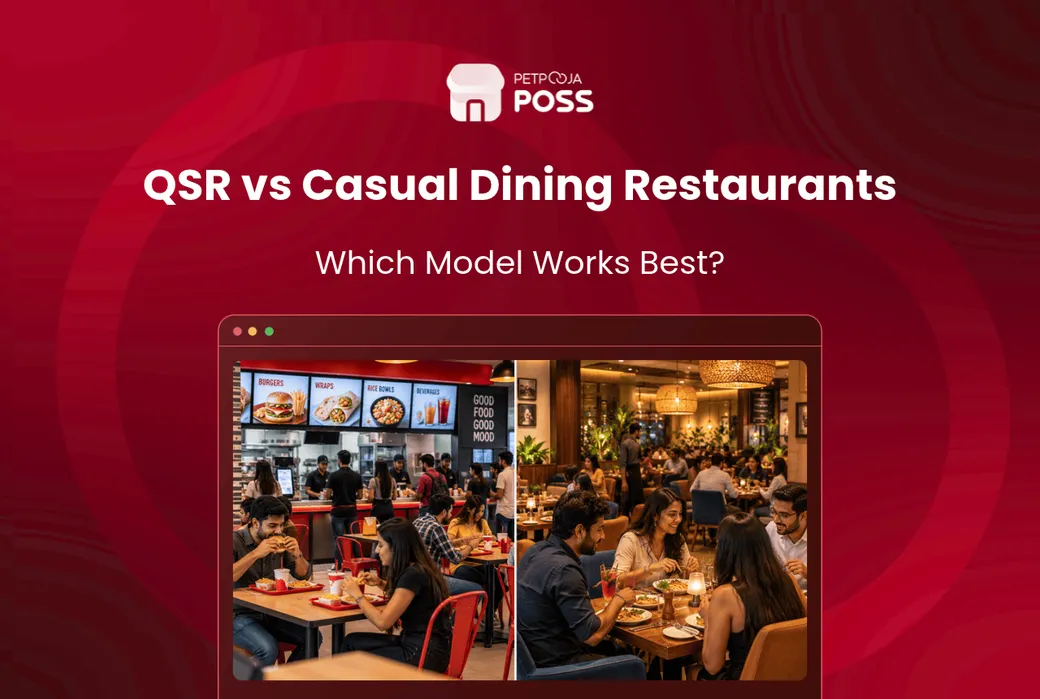



QSR vs casual dining: which should you open? A quick service restaurant (QSR) sells a short menu fast, mostly at a counter, and usually costs less to build. A casual dining restaurant sells a sit-down meal with table service, and is built to earn more from each table.
What decides it for you is your budget, the space you can rent and how much service you want to run. One trade estimate puts a small QSR build at ₹15 lakh to ₹30 lakh, and a casual dining room at ₹45 lakh to ₹1 crore.
This post compares the two on build cost, running costs, licences and technology. It ends with a way to choose for your budget and city.
Key Takeaways
- A QSR is usually the cheaper way in, but it needs steady footfall every hour.
- Casual dining asks for more money, space and staff up front. The bigger bill at each table has to pay that back.
- Decide on alcohol before you sign the lease. In Delhi, the liquor licence is for an approved restaurant.
What Is the Difference Between QSR and Casual Dining?
The difference between QSR and casual dining is service. A QSR hands the food over a counter in minutes, while casual dining brings it to your table and lets you stay. The rating agency ICRA treats them as separate segments.
It says QSRs have “standardised menus and focus on delivery”. Casual dining, it says, offers “sit-down multi-cuisine dining”.
What Is a QSR Restaurant?
A QSR is a quick service restaurant: a burger counter, a pizza takeaway, a momo or rolls outlet. The menu is short and standard, so the kitchen can cook fast and the same way every time. Guests order at the counter, at a kiosk or online, and many take the food away.
What Is a Casual Dining Restaurant?
A casual dining restaurant is a sit-down place with table service and a wider menu. It is cheaper than fine dining. Think of a family restaurant or a multi-cuisine diner, where guests stay longer and pay one bigger bill.
| QSR vs Casual Dining | Quick Service Restaurant | Casual Dining |
|---|---|---|
| How guests order | At the counter, a kiosk or online | From a waiter at the table |
| Menu | Short and standard | Wider, often multi-cuisine |
| Space | Small; a counter plus a few seats | Larger; a full dining room |
| Staff | Fewer, mostly in the kitchen | More, with waiters and captains |
| What drives sales | Many orders an hour | A bigger bill per table |
The table shows the two as most owners run them. A fast casual outlet sits between them. Guests order at a counter, but the menu is more like a sit-down place. With few seats, plan it like a QSR. With many seats, plan its space and staff like casual dining.
QSR vs Casual Dining: Which Costs Less to Open?
A QSR usually costs less to open. On the trade estimate below, the QSR range ends below where casual dining starts. The biggest visible difference is space: a QSR needs 100 to 500 sq ft, while a dining room needs 1,000 to 2,000 sq ft.
Those ranges come from Restaurant India, a trade magazine, for metro cities:
QSR: ₹15 lakh to ₹30 lakh Casual dining: ₹45 lakh to ₹1 crore ₹0 ₹25L ₹50L ₹75L ₹1 cr Build cost ranges for metro cities, published by Restaurant India in May 2024. The QSR range leaves out the franchise fee, royalty, kitchen and real estate.These figures were published in May 2024, so costs may have risen since.
The QSR range also leaves out the franchise fee, royalty, kitchen and real estate, so your real bill will be higher. The source does not say whether the casual dining range includes them. Get quotes for your own site. Add them up in our startup cost estimator first.
At the top end, one listed casual dining chain shows how large the number can get. Barbeque Nation put the average capital spend of its matured outlets in India at ₹2.8 crore each, in its September 2025 investor presentation.
QSR vs Casual Dining: Running Costs and Payback
A QSR usually spends less each month. It rents less space and needs fewer staff, but it needs a steady crowd. Casual dining spends more on rent and staff, and counts on a bigger bill per table to cover it.
Where the Monthly Money Goes
Three costs make up most of the monthly bill.
- Rent. You pay for every square foot. A dining room needs far more of them per guest than a counter does.
- Staff. A QSR is mostly kitchen staff and a cashier. Casual dining adds waiters, captains and someone to manage the floor.
- Food cost. Both models have to control it. A short menu means fewer ingredients to buy and track.
How Long Payback Takes
Payback depends on your own sales, so treat any figure as a rough guide. For its matured outlets in India, Barbeque Nation’s presentation puts payback at 3.5 to 4 years. That is one chain’s figure for its own restaurants, not a rule for yours.
We could not find a QSR payback figure to set beside it, so work out your own from your sales plan. A break-even calculator shows the sales you need each month to cover your costs.
Which Licences Do QSR and Casual Dining Restaurants Need?
QSR and casual dining restaurants need mostly the same licences. The main difference is alcohol. To serve it, you need a liquor licence. In Delhi, that licence is for an approved restaurant.
The Licences Both Models Need
These apply whichever model you open.
- FSSAI. The FSSAI order of 13 March 2026 sets registration for turnover up to ₹1.5 crore. A state licence covers turnover above ₹1.5 crore and up to ₹50 crore. These limits apply from 1 April 2026.
- A health trade licence from your city. In Delhi, the Municipal Corporation lists the health trade licence for eating places on its portal.
- Fire safety. Ask your local fire office whether your seating or floor area needs a fire No Objection Certificate (NOC). The rules differ by city, and more seats can change the answer.
- An eating house licence in Delhi. The city now issues it, not the police (see below).
- GST registration once your turnover crosses the GST registration limit.
If you play music, you need a music licence too, in either model. The Indian Performing Right Society (IPRS) says eating places, restaurants and cafes need an IPRS licence. Its page adds that recorded songs also need a licence from their owners, such as Phonographic Performance Limited (PPL).
The Liquor Licence: For Approved Restaurants
If you want to serve alcohol, you need a liquor licence. In Delhi, the L-17 licence is for a restaurant that the Department of Tourism, Government of India, has approved. It must be in a commercial area with enough parking. Our guide to Delhi and Maharashtra liquor rules covers the fees.
Eating House Licences: What Changed in Delhi in 2025
Delhi Police no longer issue eating house licences. An order of 19 June 2025 moved that job to the city’s civic bodies, the Press Trust of India (PTI) reported. If an older checklist tells you to apply to the police, it is out of date.
Technology for QSR and Casual Dining Restaurants
Both models need a POS for billing, stock and reports. Beyond that, a QSR needs tools that speed up the counter, and casual dining needs tools that run the floor.
Technology for a QSR
These tools speed up ordering at the counter.
- A self-service kiosk, so guests order without queuing at the counter.
- A kitchen display system (KDS), a kitchen screen that shows orders instead of printed tickets.
- A token display that calls out orders when they are ready.
Technology for Casual Dining
These tools help waiters run the floor.
- A captain ordering app, so waiters take orders at the table on a phone or tablet.
- A table reservation manager to take, cancel and track bookings.
- A floor plan on the POS, to move, merge and split tables.
Petpooja runs all of these tools on its Local and Electron POS versions. Our comparison of Petpooja POS types shows which version fits which outlet.
What I could recommend from my end. Choose your POS version for the model you open on day one. A QSR without a KDS or token display loses the speed it was built for. A casual dining room without a captain app slows down at the table.
QSR or Casual Dining: Which Suits Your Budget and City?
The right model is the one your budget can carry for a full year, in a location that brings the guests it needs. Use this table as a starting point.
| Your Situation | Better Fit | Why It Fits |
|---|---|---|
| A tight budget | QSR | Its trade estimate starts at ₹15 lakh, though kitchen and rent come on top |
| A busy road, metro station or college area, such as near Andheri station in Mumbai | QSR | Many guests pass every hour |
| A residential area with families, such as Aundh in Pune | Casual dining | Families come for a sit-down meal |
| A mall food court | QSR | The space is built for counters |
| A high street with evening crowds | Casual dining | Guests have time to sit and spend |
| You want to serve alcohol | Usually casual dining | In Delhi, the liquor licence needs a restaurant approved by the Department of Tourism |
In a smaller city like Nashik or Mysuru, rent may be lower. Get local quotes before you rule out casual dining.
Our guides on opening a casual dining restaurant and opening a QSR walk through the steps for each.
Conclusion
In QSR vs casual dining, a QSR usually costs less to build and runs on volume. Casual dining costs more and needs more staff and space, so each table has to bring in a bigger bill.
Start with your budget and the guests your location already brings. Then plan your licences. Either model needs a music licence if you play music. Add a liquor licence only if your dining room will serve alcohol.
Whichever you open, set up a restaurant POS that matches the way your guests order.
Frequently Asked Questions
Can a QSR Add Seating and Become Casual Dining Later?
Yes, but plan for it. Table service needs waiters, a floor plan on your POS and often a captain app, which may mean moving to another POS version. If you take bookings, look at table reservation software too. Check your fire safety needs again before you add tables.
Can One Outlet Run a QSR Counter and a Dining Room Together?
Yes. Some outlets sell takeaway at a counter and seat guests in a dining room at the same time. A POS with several billing counters and a table plan can bill both, and you see the sales from both in one report. On Petpooja, that is the Local or Electron version.
Is a Cloud Kitchen a Type of QSR?
Not quite. A cloud kitchen has no counter or seating and sells only through delivery. It shares the QSR’s short menu and fast kitchen, but has no walk-in guests.
Thanks. This helps us make the next article better.

Ashwiniba Vaghela is Senior Executive – Content at Petpooja and the editorial reviewer, which means she also helps in reviewing blogs. She writes the explainers and comparisons people read before they know what to search for: what a category actually is, what it costs to keep doing the job by hand, and which differences between two tools matter once you are running a business rather than evaluating one. Much of her work is built on Petpooja's own numbers rather than borrowed industry reports, and with 1,50,000+ businesses, the patterns in that data answer questions no public survey covers. If you are trying to understand something before you commit money to it, Ashwini is writing for you, and if you have read anything else on this blog, she has already checked it.