
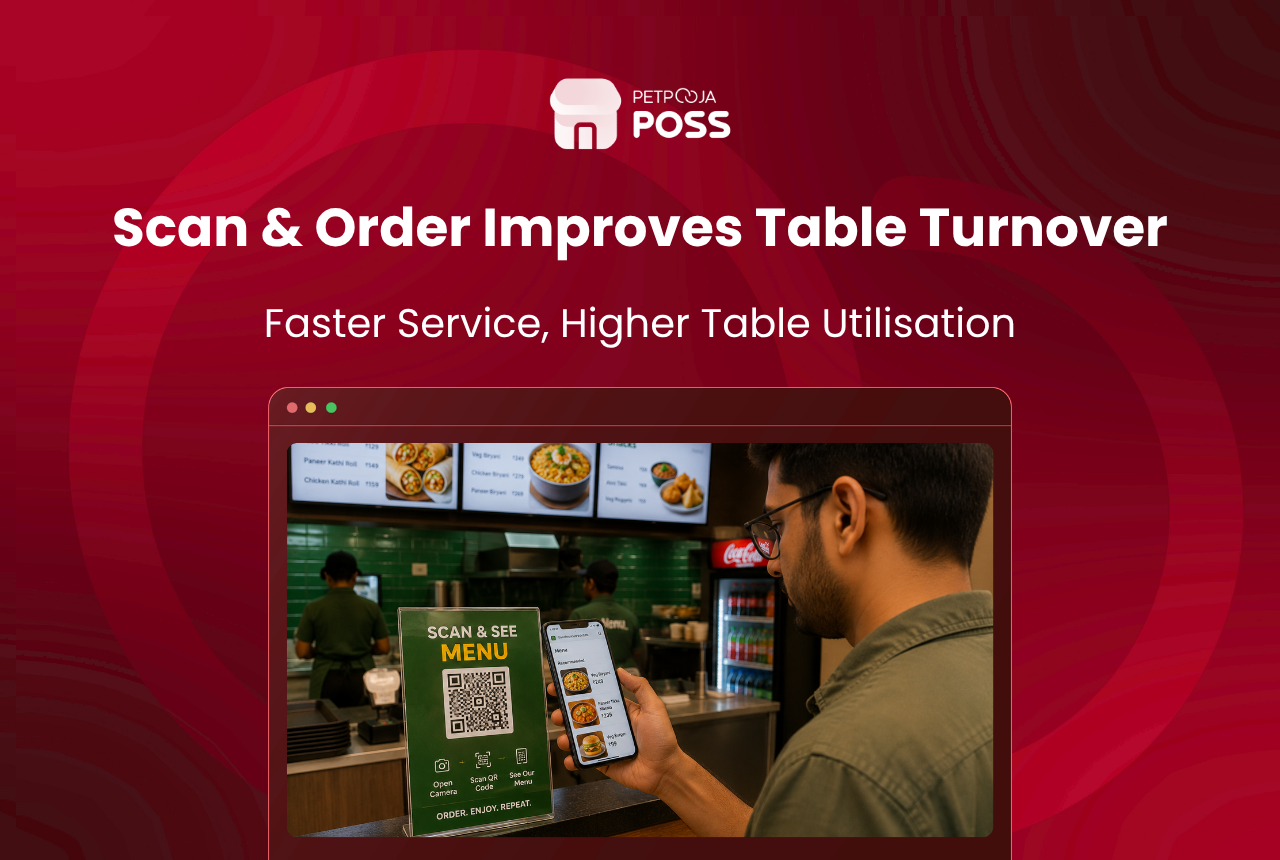
Scan and order increases table turnover by removing the two biggest idle-time blocks in a dine-in service: the wait to place an order and the wait to settle the bill. In a typical 50-minute casual dine meal, 8 to 12 minutes go to waiting for a waiter to take the order and waiting for the bill after the meal. Scan and order collapses both gaps. The diner orders from their phone the moment they sit, and the bill is ready on-screen the moment they finish.
A Wharton School and SMU Cox study published in Management Science found that tabletop ordering technology reduced meal duration by close to 10% and lifted overall sales productivity by about 11%. That 10% on a 50-minute table means roughly 5 fewer minutes per cover, which across a 40-table restaurant on a Friday night adds up to an extra full turn.
Key Takeaways
- Scan and order targets idle time (waiting for a waiter, waiting for the bill), not eating time
- Research from Wharton School and SMU Cox shows tabletop tech reduces meal duration by about 10%
- The reorder effect pushes average check values up because diners add items they would have skipped
- QSRs, food courts, and cafes with 30+ covers see the most measurable turnover gains
- Fine dine is the exception: table-side service matters more than speed in that format
What Is Table Turnover and Why Does It Matter?
Table turnover rate is the number of times a single table gets occupied by a new party during a service period. Use our free table turnover calculator to measure yours. The formula is simple: divide total parties served by total tables available.
Consider this example: a casual dine restaurant in Bopal, Ahmedabad, with 30 tables that serves 75 parties in an evening has a table turnover rate of 2.5. If that same restaurant serves 90 parties without adding a single table, the rate jumps to 3.0. That extra 0.5 turn, multiplied by an average check of ₹650, means an additional ₹9,750 in revenue from the same floor space on a single evening.
According to The Restaurant HQ, the industry benchmark is 2 to 3 table turns per evening service for most dine-in formats. QSRs and fast-casual outlets often push 4 to 5 turns because meal durations are shorter.
The reason table turnover matters more in Indian metros right now is rent. A 1,200 sq ft restaurant in Indiranagar, Bengaluru, paying ₹1.8 lakh per month in rent needs every square foot generating revenue for as many hours as possible. Our explainer on what scan and order is and how it works covers the basics of the system before we get into its turnover impact.
Where Does Time Disappear During a Dine-In Service?
A standard casual dine meal in an Indian restaurant breaks down into five phases. Not all of them involve food.
The orange bars are the ones scan and order targets. The blue bars (kitchen time and eating time) stay the same regardless of how the order is placed. At Petpooja, we have observed this pattern consistently across casual dine outlets running 30 to 60 covers: the idle phases account for 13 to 19 minutes of a 50-minute meal, and scan and order compresses most of that gap.
How Does Scan and Order Cut Idle Time?
Three mechanics are at work. Each one shaves a few minutes off the total table time.
The ordering gap drops to near zero. In a waiter-served model, the diner sits, waits for a waiter to notice them, waits for the waiter to arrive, browses the menu while the waiter stands there or walks away and comes back, and then dictates the order. With scan and order, the diner scans the digital menu QR code the moment they sit, browses at their own pace, and submits when ready. The order hits the POS and the KOT fires to the kitchen after staff validation. The 8-to-12-minute ordering window shrinks to the time it takes the diner to browse and tap, which is typically 2 to 4 minutes.
The bill is already running. Because items accumulate on a live bill tied to the table, the diner does not need to flag a waiter to “get the bill.” The bill is visible on the POS at all times. Settlement happens through the standard billing flow or, in some setups, through phone-based payment. The 5-to-7-minute bill-wait window can drop to under 2 minutes.
Reorders happen without waiter involvement. A table that wants an extra round of drinks or a dessert does not need to catch a waiter’s eye, wait, and repeat the order. They scan the same QR code, add items, and submit. This is also where the check-value effect kicks in. According to industry data compiled by Restroworks, Indian restaurants that implemented digital menus and QR codes saw 10-20% higher average check values, partly because the friction of reordering disappears.
What Does the Published Research Say?
Two findings from published research are worth noting here.
The Wharton School and SMU Cox study mentioned earlier, published in the journal Management Science, measured the impact of tabletop ordering technology across restaurant locations. Meal duration fell by close to 10%, and sales productivity rose by about 11%. The productivity gain came from a combination of faster turns and slightly higher per-check spending, because diners who could order on their own added more items.
A Deloitte study, cited in the same Paytronix analysis, found that consumer spending rises by around 20% when guests order through digital tools. Browsing a visual menu on your own phone, without a waiter hovering, leads to more add-ons and impulse orders.
Neither study was conducted in India specifically. Indian dining behaviour has its own patterns: longer meal durations in family-format restaurants and a cultural preference for waiter interaction in certain demographics. The directional findings (shorter idle time, higher check values) hold, but the exact percentages will vary by format and city.
Which Restaurant Formats See the Biggest Gains?
Not every format benefits equally. Our blog on turning tables faster without rushing covers format-specific floor strategies. For scan and order specifically, the hierarchy looks like this.
QSRs and fast-casual outlets see the largest turnover improvement. Consider, for example, a burger chain in Wakad, Pune, with 45 covers and a 20-minute average meal time. If the ordering wait drops from 6 minutes to 2 minutes, that 4-minute saving per table means one additional full turn across the floor during a 3-hour dinner rush.
Food courts and cafes benefit because meal durations are already short (15-25 minutes) and footfall is high. In food courts, scan and order removes the physical queue at each counter. Diners order from the table, the kitchen display system routes the order to the right station, and the diner picks up when their token flashes. In cafes, consider this example: a cafe in Viman Nagar, Pune, with 20 tables and a steady flow of laptop-and-coffee guests can serve 2 to 3 extra turns per afternoon by letting diners reorder from their phone without interrupting their work.
Fine dine is the exception. Guests paying ₹2,500 or more per head expect a captain to present the menu and recommend dishes. Table turnover is not the goal in fine dine. A table-side POS via the Captain App fits this format better than scan and order.
What Scan and Order Does Not Fix
Table turnover depends on more than just ordering speed. Three bottlenecks sit outside scan and order’s reach.
Kitchen speed. If your kitchen takes 25 minutes to fire a main course, removing 5 minutes from the ordering wait barely moves the needle.
Table clearing. A slow bussing team adds 5 to 8 minutes between parties. You still need staff trained to spot a finished table and reset it within 2 to 3 minutes.
Reservation management. If your restaurant runs walk-in-only with no queue system, tables sit empty between parties even when people are waiting outside. Our guide on managing reservations without double booking covers how to reduce this gap.
Conclusion
Scan and order increases table turnover by compressing the idle phases of a dine-in meal: the wait to order and the wait for the bill. Published research shows tabletop ordering tech can reduce meal duration by about 10% and lift sales productivity by around 11%. In Indian restaurants, the added reorder convenience pushes average check values up by 10-20%.
The gains are largest in QSRs, food courts, and cafes where speed matters and meal durations are already short. Fine dine sits outside this model. Petpooja’s Scan and Order runs as a POSS add-on on Electron POS and LOCAL POS.
Frequently Asked Questions
Divide the number of parties served during a service period by the number of tables. Consider this example: if you served 90 parties across 30 tables in an evening, your table turnover rate is 3.0. Track this number daily to spot trends over time.
No. Scan and order reduces idle time: the gap between sitting down and placing an order, and the gap between finishing a meal and settling the bill. Eating time stays the same. The diner is not rushed through their food.
Fine dine is the one format where scan and order usually does not fit. Guests paying a premium expect a captain to present the menu and recommend dishes. A table reservation management system paired with a Captain App serves the fine-dine format better than QR ordering.
The industry benchmark is 2 to 3 turns per evening service for casual dine. QSRs and fast-casual outlets often hit 4 to 5 turns because meal durations are shorter. If your casual dine restaurant is below 2.0 turns on a Friday or Saturday evening, there is room to improve.
Not if the time saved comes from operational steps rather than the dining experience itself. Scan and order removes waiter wait time and billing delays. The meal, the conversation, and the dessert stay untouched.








