
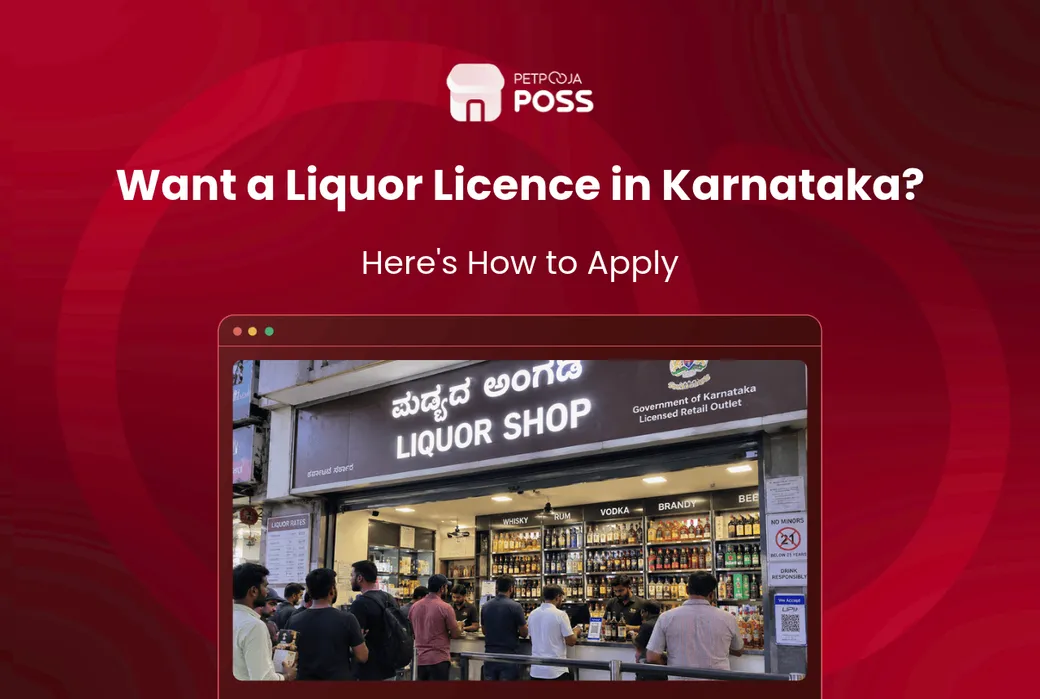



How do you get a liquor licence in Karnataka? For a new shop or bar, you first win the licence at the state’s online auction, then apply to open it on the excise department’s website. Bidding starts between ₹70 lakh and ₹1.5 crore, and the licence runs for five years.
What you pay depends on two things. The first is the type of town your shop or bar sits in, because Bengaluru starts highest. The second is how hard other bidders push the price up on the day.
On top of the winning bid, you pay a yearly licence fee from the second year. It runs from ₹6 lakh in a small town to ₹11.25 lakh for a bar in Bengaluru.
This post covers how to apply step by step, the licence types, how the auction works, what it costs and who can bid. It ends with the rules after you open and what a breach costs.
Key Takeaways
- A new shop or bar licence is won at the state’s online auction first. Only the winner applies to open it, on the excise website.
- Bidding starts at ₹70 lakh to ₹1.5 crore, and the yearly fee starts from year two, so budget for both before you bid.
- Every step runs to a fixed date. Miss a payment and you lose what you have already paid.
How to Apply for a Liquor Licence in Karnataka
There are seven steps, from registering on the portal to paying the last of your bid. This section takes them in the order you will meet them.
- Register on the auction portal well before bidding opens. It is run by MSTC Limited, a Government of India company. In the first round, registration opened on 3 July 2026. Keep your Permanent Account Number (PAN), GST number and bank details ready. The details must match your documents exactly, because the portal will not let you correct them later.
- Fund your wallet two working days early. The portal gives you a virtual account number. Money you send takes about four to six hours to show, so leave time for it.
- Pay the ₹50,000 application fee for each licence you want, and keep its Earnest Money Deposit (EMD), 2% of the licence’s base price, in your wallet. The EMD stays blocked for as long as you lead the bidding.
- Bid in ₹2 lakh steps, starting from the licence’s base price.
- Pay at least 50% of your winning bid in the window the notice sets. In the first round that was 3 to 11 August 2026. Once you have paid, the department issues a Letter of Acceptance.
- Apply to open the licence. File Form 1A on the state’s excise services website, addressed to the Deputy Commissioner (Revenue) of your district. Finding and fitting out the premises is your job.
- Pay the rest of the bid by the final date. In the first round that is 31 October 2026.
These steps and dates come from the Karnataka Finance Department’s e-auction notification of 1 July 2026 and the department’s e-auction FAQ. The department gives no extra time and no refund if you cannot find a building. Settle the premises question before you bid, not after.
Karnataka is one of several states that now license through an online portal, so most of this happens on a screen.
The guide to opening a bar in India covers the rest of the setup beyond the licence.
What are the Liquor Licence Types in Karnataka?
Karnataka names each licence by a CL code. Two of them matter most to a food business, and each now has an auctioned version. This section explains both.
- CL-2 is the retail shop licence. You sell bottles over the counter, and nobody drinks on the premises.
- CL-9 is the bar licence, called a refreshment room. You serve liquor along with meals or snacks, so food is part of the licence.
- CL-2A and CL-9A are the new auctioned versions of those two. The day-to-day rules for CL-2 and CL-9 apply to them too, plus some extra ownership rules covered further down.
Hotels and clubs have their own codes too. CL-7 covers hotels and boarding houses, CL-6A covers star hotels and CL-4 covers clubs.
The state created the CL-2A and CL-9A codes in its e-auction notice of 1 July 2026.
If you are still working out which one you need, the types of bar licence guide explains what each category lets you serve.
How Does the Karnataka Liquor Licence E-Auction Work?
The auction is where every new shop or bar licence now starts. Karnataka sells licences it has not yet given to anyone this way, instead of granting them on application. This section explains how that sale runs.
The change came from the state budget of March 2025. The rules were amended in November 2025 and June 2026.
The government then notified the first auction on 1 July 2026, listing 483 CL-2A shop licences and 96 CL-9A bar licences. Four of the shops were held back over penalty cases and three of the bars over court cases, so 479 shops and 93 bars went to auction.
Who runs it and for how long
The auction runs on the MSTC portal described in the steps above. A licence won in this first round runs for five licence years, from 2026-27 to 2030-31. A later round will set its own dates, so read that round’s notice.
Live bidding for this first round ran from 24 to 31 July 2026. Any licence that does not sell, or is later cancelled or given up, goes back into the pool for a future auction. So if you missed this round, the next notice is the one to watch.
What the bidding looks like
Each licence has its own base price, and bidding cannot start below it. Every bid must raise the price by ₹2 lakh or a multiple of ₹2 lakh.
An auction slot lasts two hours. If anyone bids in the last 8 minutes, the slot extends by another 8 minutes. The highest bid when the clock finally stops wins, and a bid cannot be withdrawn once placed.
The auction rules and fees in this section and the next come from the same notification and FAQ as the steps above.
How Much Does a Liquor Licence in Karnataka Cost?
A new licence costs its winning bid, plus a yearly fee from the second year. Bidding opens at ₹70 lakh to ₹1.5 crore. This section covers the base prices first, then the yearly fee, then the smaller charges.
Base prices for the auction
The base price depends on what kind of town or city the licence is in. The notification sets a price for each licence one by one. The table shows the figure most licences in each type of area carry.
| Type of area | CL-2A shop base price | CL-9A bar base price |
|---|---|---|
| Greater Bengaluru Authority (GBA) area | ₹1.5 crore | ₹1.5 crore |
| City corporation | ₹1 crore to ₹1.1 crore | ₹1 crore to ₹1.1 crore |
| City municipal council | ₹90 lakh | ₹1 crore |
| Town municipal council | ₹80 lakh | No bar licences listed |
| Town panchayat | ₹70 lakh to ₹80 lakh | No bar licences listed |
The base price is only the opening bid. In a busy part of Bengaluru, the winning bid can land above it. Plan your budget around what you are willing to pay, not around the floor.
The yearly licence fee
The winning bid does not replace the yearly fee. In the first round you are excused from it only in the first year, 2026-27. For the four years after that, you pay the normal CL-2 or CL-9 fee every year.
| Type of area | CL-2 shop, yearly fee | CL-9 bar, yearly fee |
|---|---|---|
| GBA area | ₹9,00,000 | ₹11,25,000 |
| City corporation | ₹7,50,000 | ₹9,00,000 |
| City municipal council | ₹6,75,000 | ₹7,50,000 |
| Town municipal council | ₹6,00,000 | No bar licences listed |
| Town panchayat | ₹6,00,000 | No bar licences listed |
The yearly fee also comes with an additional licence fee, which the notification names but does not price. Your district excise office can tell you what it comes to for your licence.
These are the normal CL-2 and CL-9 fees for each type of area, so an existing licence in the same kind of area pays the same when it renews. The notification lists the yearly fee against every auctioned licence, so check the row for yours.
The smaller charges
These are small next to the bid, but some of them are gone for good the moment you pay.
- Registration on the auction portal: ₹1,000 plus GST, so ₹1,180. It is valid for one year and is not refunded.
- Application fee: ₹50,000 for each licence you bid on. It is not refunded, even if you lose.
- EMD: 2% of the base price, paid into your auction wallet before you bid. It comes back if you lose, and counts towards the price if you win.
- Transaction fee: 0.42% of the winning bid plus GST, paid to MSTC within 7 working days if you win.
There is no discount on any of these for reserved-category bidders.
What five years cost for a Bengaluru bar
The headline price leaves out more than ₹46 lakh. Here is a bar in the GBA area that wins at the base price and nothing more (an example). It assumes GST at 18% on the transaction fee, the rate the department’s FAQ applies to the registration fee.
Winning bid, at the base price ₹1,50,00,000 Yearly fee, ₹11,25,000 x 4 years ₹45,00,000 Transaction fee, 0.42% plus 18% GST ₹74,340 Application and registration fees ₹51,180 Five years, before additional fee ₹1,96,25,520 From the notification and FAQ; GST assumed at 18%. What a CL-9A bar in the GBA area pays over five years if it wins at the base price (an example).So a ₹1.5 crore licence is closer to a ₹1.96 crore commitment, and that is before the additional licence fee or any bid above the floor.
What I would do first. I would decide the highest bid I can afford before the auction opens, and write it down. The bidding moves in ₹2 lakh steps and every late bid adds 8 minutes, so the price can climb fast. A written limit is easier to hold than one decided in the last minutes.
Who Can Bid for a Liquor Licence in Karnataka?
Most people and businesses can bid, but a short list of problems rules you out. This section covers who may bid and what disqualifies them.
Who may bid
An individual can bid, and so can a partnership firm, a Limited Liability Partnership (LLP), a trust, a society or a company. You must be at least 21 years old. When a firm bids, it bids in its own name, and every partner is liable for the full bid, the fees and any excise dues.
In all, 18% of licences are reserved. Karnataka splits Scheduled Castes into three groups, A, B and C, for this.
The split is 5.25% each for Scheduled Caste A and B, 4.5% for Scheduled Caste C, and 3% for Scheduled Tribes. For a firm to claim a reserved licence, every partner must belong to that category.
What rules you out
You cannot bid, or later renew, if any of these apply to you:
- You owe unpaid excise dues on liquor you sold before.
- You cannot show an income tax clearance certificate, or proof that you filed your latest return.
- You hold a paid post under the state or central government, known as an office of profit.
- You are bankrupt and not yet cleared by a court, or of unsound mind.
- You have been convicted of a serious listed offence, including any offence under the narcotics law.
For a firm, this list applies to the person running the business. If that person is disqualified, the firm is too.
The list is Rule 4-B of the Karnataka Excise (Sale of Indian and Foreign Liquors) Rules, 1968. The July 2026 notification repeats it in full, and bidders must sign an undertaking against it.
Where and When You Can Sell Under a Karnataka Liquor Licence
Two limits follow you after you win. One is where the licence can sit, and the other is how late you can serve. This section covers both.
Where the shop or bar can be
The licence is tied to a range, which is an excise area inside a district. You can place it anywhere in that range, but Rule 5 of the Karnataka Excise (General Conditions of Licences) Rules, 1967 still applies.
Under Rule 5, a licence cannot sit within 100 metres of a place of worship, a school or college, a hospital, or a government office.
Near a state or national highway the gap is 220 metres, but that gap does not apply inside towns of 20,000 people or more. Inside city limits, the Deputy Commissioner of Excise can relax the 100 metres to as little as 50.
You may later move the licence to new premises under Rule 23 of the same rules.
How late you can serve
Bars in Bengaluru city limits can open from 10 AM to 1 AM, under a government order of 29 July 2024. Hotels, star hotels and clubs there can open from 9 AM to 1 AM. The News Minute reported the order when it was issued.
The report covers Bengaluru only. For the rest of the state, confirm your hours with the district excise office before you plan staff shifts.
Restaurant owners we work with tell us the hours are easy to follow. The harder part is showing an inspector that the stock behind the bar matches what was sold. Matching what you sold against what you bought is the job Petpooja does, and a bar and brewery POS tracks consumption against purchases.
What If You Break the Karnataka Liquor Licence Rules?
Karnataka’s auction rules add money you can lose on top of the usual penalties. This section covers the auction side first, then the Karnataka Excise Act.
Losing the money you paid
The e-auction notification is strict about when you lose your money, and it catches people who have done nothing criminal.
- Miss a payment and you lose your EMD, any part of the bid already paid, and every fee paid so far. The licence is cancelled, and you can be blacklisted from future auctions.
- A partner or shareholder leaves your firm during the five years, and the licence counts as cancelled. The state keeps everything you paid.
- Your licence is suspended or cancelled for breaking a rule, and you get none of the bid or fees back. The same applies if you give it up.
- You claimed a reserved licence and cannot produce the certificate. The bid is cancelled and the money is kept.
What the Excise Act says
Under section 29 of the Karnataka Excise Act, 1965, the licensing authority can suspend or cancel a licence. It can do so for unpaid fees, a breach of its terms or a conviction under the Act. It must give you a hearing first.
Section 36 of the same Act sets imprisonment and a fine for misconduct by a licensee, such as a breach of licence conditions.
I could not find a current consolidated copy of the Act on a government website. So this post does not quote the amounts, and your excise office or a lawyer can confirm them.
Conclusion
To get a liquor licence in Karnataka for a new shop or bar, you register on the auction portal, win the licence at auction, and then apply to open it. Bidding opens at ₹70 lakh in a small town and at ₹1.5 crore in Bengaluru.
You start paying the yearly fee from the second year, so put it in your budget from the start.
So start with three numbers. The first is the base price for your licence. The second is the highest bid you would pay, and the third is the yearly fee for each year you pay it.
Once the licence is live, owners tell us the harder part is showing that the stock behind the bar matches the sales. Keeping every bottle tied to a bill is the job of your restaurant billing and inventory system.
Frequently Asked Questions
Can I sell my auctioned licence to someone else?
No. A licence won at this auction cannot be transferred during its term. The one exception is death, where it can pass to legal heirs.
Can I bid on more than one licence?
Yes. Each licence needs its own application and its own ₹50,000 fee and EMD. If bidding gets too high on one licence and you move to another, you pay a fresh ₹50,000 application fee for it. So keep some spare money in your wallet.
I already hold a CL-9 licence. Do I need to bid?
No. The auction is for new licences only. An existing licence renews at the normal CL-2 or CL-9 fee for its area. The yearly licence fee table covers the areas in this auction, and your excise office covers the rest.
What does a licence cost outside Karnataka?
The method differs as much as the price. Telangana licence fees are set by population, while Rajasthan licence fees for a shop are a share of the yearly revenue guarantee the state sets for that shop. Madhya Pradesh licence fees are published flat by city, and Haryana licence fees cover 21 months rather than a year. Our state-wise cost guide sets the charges for every state side by side.
Can I pay the whole bid at once?
Yes. Half is only the minimum for the first payment. You can pay the whole winning bid in one go, and your EMD is then adjusted against that full payment.
Thanks. This helps us make the next article better.

Avani Joshi is a Content Writer at Petpooja, where she writes about payroll, billing, and the everyday software that keeps Indian SMEs running. She has a knack for taking complicated topics and explaining them in plain language for business owners who don't have time to decode jargon.
Comments
Loading comments…