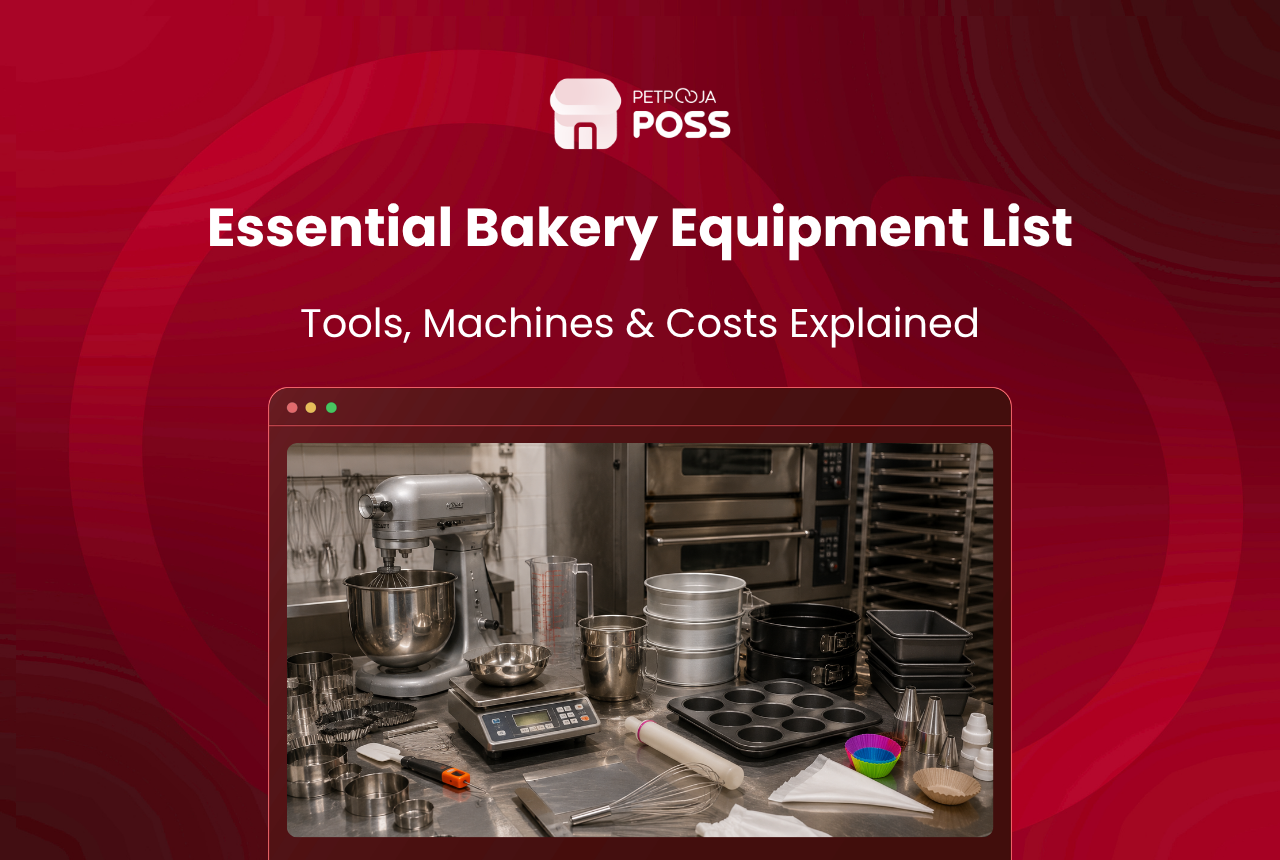
A home bakery needs 8-10 items. Total bill: Rs 14,000-50,000. A retail storefront needs 20-25 items and the total climbs to Rs 2.5-5 lakh. The gap between these two numbers is mostly one machine: The oven. A 45-litre OTG that sits on your kitchen platform in a 2BHK in Surat costs Rs 8,000. A commercial deck oven that needs its own gas connection and a dedicated circuit breaker in a shop in Kothrud, Pune costs Rs 65,000.
Everything else on this bakery equipment list follows the oven. The mixer matches the oven’s capacity. The fridge matches the mixer’s output. The display counter matches the fridge’s stock. Get the oven wrong and every purchase after it is either too much or too little.
Prices below are Indian market rates for 2026, sourced from IndiaMART supplier listings and Truffle Nation’s equipment guide.
In Brief: Home bakery: 8-10 items, Rs 14,000-50,000. Retail: 20-25 items, Rs 2.5-5 lakh. Oven and mixer eat 60-70% of the budget. Buy those first, add the rest from revenue.
Which Oven Do You Need and What Does It Cost?
A home bakery in India needs an OTG oven (40-60 litres, Rs 6,000-22,000), while a retail storefront requires a commercial deck oven (Rs 50,000-2.15 lakh), per Arise Equipments India and IndiaMART 2026 supplier data. Most first-time retail bakery owners on the Petpooja network spend Rs 60,000-75,000 on a single-deck gas unit.
Nobody reads a bakery equipment list for the spatula recommendations. They read it for the oven. So here it is, split by format.
Home bakers: an OTG in the 40-60 litre range. Rs 6,000-22,000. Morphy Richards and Bajaj are the two names that keep coming up in bakery circles, and the reason has nothing to do with baking quality. It’s because their service centres exist in practically every district town in India. A baker in Vadodara bought a Chinese-brand OTG online for Rs 4,200. It worked beautifully for five months and then the thermostat died. The nearest authorised repair was in Ahmedabad, 110 km away. They ended up buying a Bajaj the following week.
Retail storefronts need a commercial deck oven that meets BIS safety standards for commercial kitchen appliances. Single-deck gas starts near Rs 50,000, per Arise Equipments India’s catalogue. Double-deck with a built-in proofer reaches Rs 1.2-2.15 lakh. Across the Petpooja network (we work with 1,00,000+ food businesses), most first-time bakery owners spend Rs 60,000-75,000 on a single-deck gas unit. That handles bread, cakes, and pastries. The Rs 1.5 lakh double-deck is for a bakery that’s already selling 40+ items a day and needs both decks running simultaneously. Buying it in month one, before you know whether 40 customers a day is even realistic for your lane, is how operators end up unable to cover rent by month four.
Why Do Rs 3,500 Mixers Keep Burning Out?
Domestic mixers priced at Rs 3,500-4,000 on Amazon are built for weekly home use, not daily commercial kneading. Their motors burn out within three months of commercial bakery operations. A proper 10-litre commercial planetary mixer at Rs 15,000-25,000 is the minimum for a bakery handling more than 8-10 cake orders per week.
The format gap with mixers is wider than people expect. A Philips hand mixer at Rs 1,500-2,500 is perfectly fine for a home baker handling 5-8 cake orders a week. Past 8-10 orders, the wrist starts protesting and a stand mixer becomes unavoidable.
Stand mixers split into two tiers. Domestic models like the Usha Myx (Rs 12,000-16,000) work for home bakers who’ve outgrown the hand mixer. Commercial planetary mixers in the 10-20 litre range, Rs 15,000-45,000, are what retail bakeries need. We said this in the bakery cost breakdown (published earlier this week) and it’s worth saying again: those “5-in-1” domestic mixers on Amazon for Rs 3,500 are designed for someone who bakes once a fortnight. Put them through daily commercial kneading and the motor gives up within three months. The replacement cost (buying the same mixer twice) is more than a proper Rs 15,000 commercial unit would have cost in the first place.
What Else Goes on the Bakery Equipment List?
Beyond the oven and mixer, a retail bakery in India needs a refrigerated display counter (Rs 80,000-1.2 lakh at roughly Rs 7,500 per running foot per Truffle Nation’s data), cold storage (Rs 35,000-1,00,000), a voltage stabiliser (Rs 1,500-3,000), and hand tools and pans (Rs 3,000-5,500). Total accessory spend: Rs 1.5-3.5 lakh.
Before your first order
A digital weighing scale. Rs 500-1,500. A tablespoon of flour measured by hand looks different in every kitchen, and in baking that inconsistency ruins batches. Equinox and Atom are the go-to brands. Never buy a used scale; Truffle Nation’s guide flags this specifically because accuracy drifts over time and you can’t test for it without a calibration weight.
Baking pans: a starter set (Fat Daddio’s or Nordic Ware, Rs 1,500-2,500) with round tins, a rectangular pan, and loaf moulds covers most product types for the first six months. Buying individual pans is cheaper if your menu is narrow, but most bakers end up needing the variety anyway.
Hand tools collectively cost Rs 1,500-3,000: spatulas, bowls, whisk, cooling racks, sieve. Not worth overthinking. Order a mid-range set online and focus your decision energy on the oven instead.
Before your shop opens (retail only)
The refrigerated display counter. Rs 80,000-1.2 lakh for a standard 6-foot curved-glass model, priced at roughly Rs 7,500 per running foot per Truffle Nation’s equipment guide. This is the first thing a customer sees. The oven can be scratched and dented, nobody cares; the display counter can’t be.
Cold storage depends on what you bake. Cake-heavy shops need a 300-400 litre fridge (Rs 20,000-35,000) and a chest freezer for butter and cream (Rs 15,000-25,000). Past 15 cakes a week, a double-door fridge at around Rs 75,000 makes sense, per Truffle Nation’s equipment data (linked in the intro). Bread-heavy bakeries can often skip the large fridge but need a proofing cabinet at Rs 15,000-40,000 instead.
A voltage stabiliser. Rs 1,500-3,000. This gets left off every bakery equipment list published online, which is baffling given how many oven control boards get fried by summer power surges in cities like Nagpur, Lucknow, and Indore. Truffle Nation calls it “non-negotiable” for gear worth over Rs 20,000. Based on what we’ve seen across our network, that’s accurate.
Week one onwards (as revenue allows)
Decoration tooling (Rs 1,500-5,000) only if custom cakes are on the menu: turntable, offset spatulas, piping bags, bench scraper. A bread slicer (Rs 8,000-15,000) if you’re selling sliced loaves. Packaging materials (cake boxes, carry bags, stickers, ribbon) at Rs 2,000-10,000 for the first month.
Packaging deserves a separate mention because it’s not equipment but the cost is real. Any packaging that touches food must be FSSAI-compliant, which rules out random plastic bags from the local market. We’ve seen bakeries in our network (this is an actual pattern, not a hypothetical) open for business without boxes. The first customer’s Rs 1,200 cake goes out in aluminium foil. That kind of thing gets photographed and shared in the housing society WhatsApp group, and not in a way that generates repeat orders.
Do You Actually Need a Billing System for a Bakery?
Not legally required below Rs 40 lakh turnover. But bakeries on the Petpooja network that set up POS software before opening day report cleaner books, less ingredient spoilage, and fewer customer disputes than those that added billing four months late.
Most bakery owners don’t think of a POS system as equipment. They file it under “admin” and plan to deal with it later. “Later” typically arrives in week three, when there are 30 orders with no record of who paid cash versus UPI, no GST trail, and the February Tally entry is a nightmare waiting to happen.
A system like Petpooja POSS logs transactions, tracks perishable stock with different expiry windows (flour keeps for weeks, cream for days), and generates invoices. The subscription costs less per month than what disappears through unrecorded spoilage in week one. And running the food cost calculator before you open tells you which products are profitable and which ones lose money on every order.
Quick Reference: Bakery Equipment List with Prices
| Equipment | Home | Retail | When |
|---|---|---|---|
| Oven (OTG / Deck) | Rs 3,500-22,000 | Rs 50,000-2,15,000 | Day one |
| Mixer (hand / planetary) | Rs 1,500-16,000 | Rs 15,000-45,000 | Day one |
| Digital scale | Rs 500-1,500 | Rs 500-1,500 | Day one |
| Pans + hand tools | Rs 3,000-5,500 | Rs 3,000-5,500 | Day one |
| Display counter | N/A | Rs 80,000-1,20,000 | Before opening |
| Fridge + freezer | N/A | Rs 35,000-1,00,000 | Before opening |
| Voltage stabiliser | Rs 1,500-3,000 | Rs 1,500-3,000 | Day one |
| Packaging (month one) | Rs 2,000-4,000 | Rs 5,000-10,000 | Before first order |
| POS / billing | Optional | Required | Day one |
Home total: Rs 14,000-50,000. Retail total: Rs 2.5-5 lakh. Full cost context in our bakery opening cost guide.
Where Should You Buy Bakery Equipment in India?
Items under Rs 20,000 (OTG ovens, mixers, scales, pans) work well on Amazon or Flipkart. Transparent pricing, easy returns, delivery to most pin codes. Equipment above Rs 20,000 is a different story. Deck ovens, display counters, commercial mixers: you want to see these in person before paying. Local dealers or IndiaMART let you inspect the unit, haggle on price, and lock in servicing from someone who’s a phone call away rather than an email into the void. Wholesale markets in the Dadar belt (Mumbai), SP Road (Bangalore), and parts of Khan Market area (Delhi) carry bakery equipment at 40-60% below retail.
Second-hand from OLX, Facebook Marketplace, or industrial resellers in Bhosari MIDC (Pune) and Naroda (Ahmedabad) saves 30-50% on ovens and mixers. The one thing to never buy used: digital scales. No way to verify accuracy without a calibration weight.
Our older bakery equipment checklist covers the basics. Planning a bakery-cafe hybrid? The coffee shop equipment guide lists the overlap gear (espresso machine, grinder, frother) you’d need on top of this list.
Conclusion
Most of this bakery equipment list falls into two spends: the production core at Rs 50,000-2 lakh (oven, mixer, fridge, counter) and the accessory layer at Rs 10,000-30,000 (pans, tools, packaging, stabiliser). Buy the core before opening. Add accessories from revenue. The bakery startup guide covers the full sequence, and the FSSAI compliance checklist sorts out the licence side.
Frequently Asked Questions
Rs 14,000-50,000 for home. Rs 2.5-5 lakh for retail. Oven and mixer eat 60-70% of either number.
The oven. Full stop. Everything else on the bakery equipment list is built around what the oven can produce and how fast.
Thousands of home bakers do. Rs 6,000-22,000 for a 40-60 litre OTG, add a hand mixer, a scale, and pans. Under Rs 20,000 total. You’ll hit a ceiling around 8-12 cakes a week, at which point a stand mixer and possibly a second OTG become necessary.
Ovens and mixers: second-hand saves 30-50%. Scales: always new. Display counters: new, because compressor repairs on refrigerated units are expensive and unpredictable.
Bread is more gear-intensive than cakes. A deck oven with steam injection (Rs 70,000-1.5 lakh), a spiral or planetary mixer, a proofing cabinet (Rs 15,000-40,000), bannetons for shaping, a scoring lame, and a slicer if you’re selling by the loaf. That’s Rs 1-2.5 lakh in bread-specific additions on top of the base bakery equipment list.
Not legally, below Rs 40 lakh turnover. Practically, yes. The bakeries in our network that set up billing before opening day have cleaner books, less spoilage, and fewer customer disputes than the ones that added it four months late. It’s the least exciting item on this list and probably the one with the highest return.