
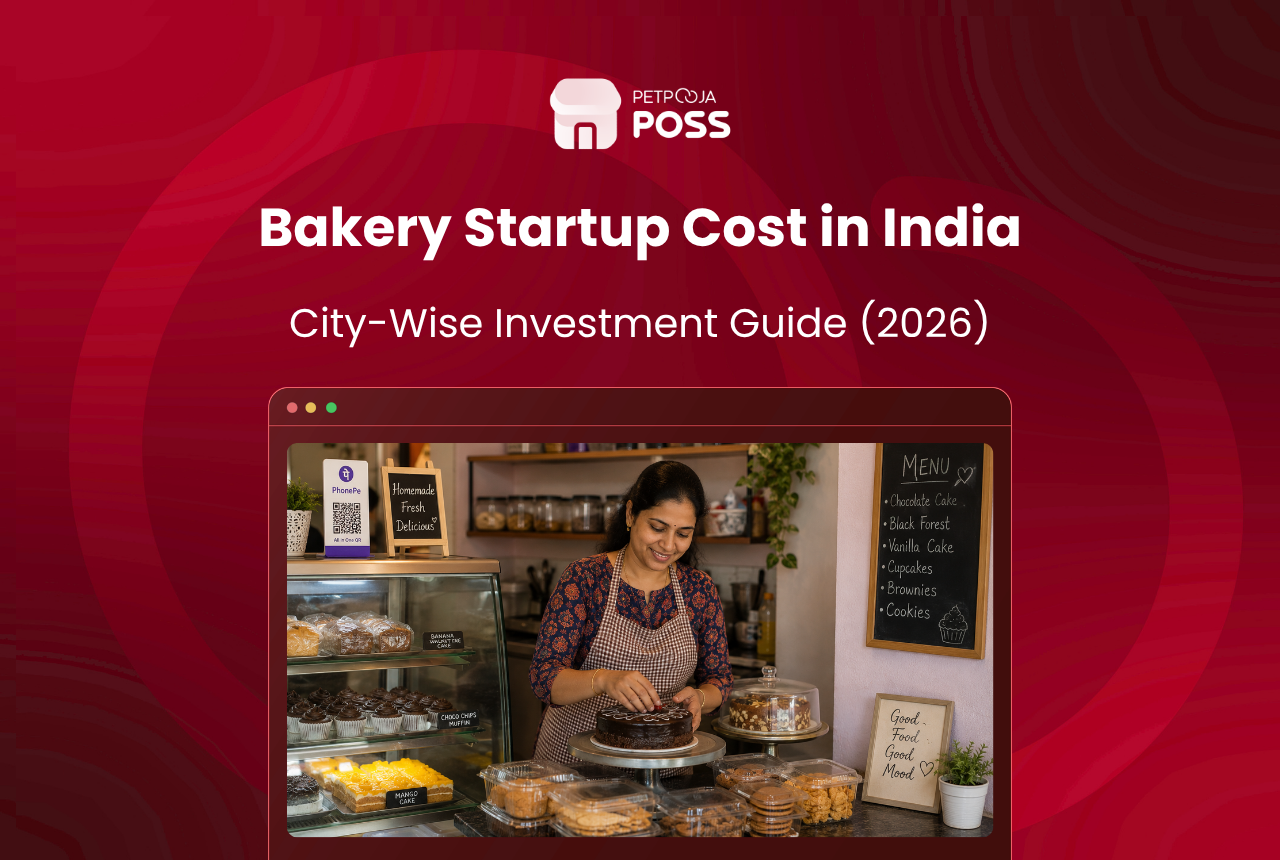
The cost of opening a bakery in India falls between Rs 50,000 and Rs 30 lakh. A woman running a cake business from her flat in Surat spends under Rs 1.5 lakh. A chap signing a lease for a 500 sq ft shop near Linking Road in Mumbai is looking at Rs 20 lakh-plus before a single customer walks in. Both get called bakery owners. The difference in their budgets comes down to three decisions: home or storefront, which city, and whether there’s seating for customers inside.
Retail storefront? Rs 10-30 lakh. Home baking? Rs 50,000-1.5 lakh. Cloud kitchen with no shopfront? Rs 2-5 lakh. Margins for bakeries in India land between 20% and 40% according to Truffle Nation’s 2026 analysis.
Rent and interior work together eat 50-60% of the retail figure, and those two line items swing wildly between cities. A 400 sq ft commercial space in Vastrapur, Ahmedabad goes for about Rs 18,000 a month. That same footage near Greater Kailash in South Delhi? Past Rs 80,000. Ovens, mixers, licences, flour: roughly the same everywhere. Your pin code decides whether this is a Rs 12 lakh venture or a Rs 25 lakh one.
In Brief: Home: Rs 50,000-1.5 lakh. Cloud: Rs 2-5 lakh. Retail: Rs 10-30 lakh. Equipment (oven, mixer, counter, fridge): Rs 2.5-5 lakh. All licences combined: Rs 13,000-55,000. Margins: 20-40%.
What Does Rs 10-30 Lakh Get You in a Bakery?
A retail bakery storefront of 400-800 sq ft in India costs Rs 10-30 lakh to open, per 2026 supplier and rental data compiled from Truffle Nation and IndiaMART. Rent and interiors account for 50-60% of the total, with equipment (Rs 2.5-5 lakh) and licences (Rs 13,000-55,000) making up the rest.
Most people Googling “cost of opening a bakery in India” are picturing a storefront, not a kitchen in their flat. Counter at the front, production area behind, maybe three stools by a window. The table below is built for that picture.
| Cost Head | Range (Rs) | What Drives It |
|---|---|---|
| Security deposit | 1,50,000-6,00,000 | Landlords want 3-6 months upfront |
| Monthly rent | 18,000-1,00,000 | City and lane matter more than sq ft |
| Interiors | 3,00,000-6,00,000 | Flooring, counter, shelving, lights, board |
| Equipment | 2,50,000-5,00,000 | Oven, mixer, proofer, display, fridge |
| Licences | 13,000-55,000 | FSSAI + trade + shop act + fire NOC |
| Raw materials (first stock) | 25,000-50,000 | Flour, butter, sugar, eggs, packaging |
| Salaries (month one) | 30,000-80,000 | Baker, helper, counter person |
| Branding, signage | 15,000-40,000 | Board, menu cards, Instagram page |
| Working capital (3 months) | 1,50,000-4,00,000 | Cushion before breakeven |
Home bakers skip six of those nine rows. Their bill is an OTG oven, a stand mixer, moulds, packaging, and FSSAI basic registration at Rs 100 a year. We covered how each bakery format compares in a separate guide. If you’re still weighing small bakery vs industrial bakery, that comparison affects the budget more than any single line item in the table above.
City-Wise Breakdown: Mumbai vs Delhi vs Bangalore vs Pune vs Ahmedabad
The same 400-500 sq ft bakery costs Rs 18-28 lakh in Mumbai, Rs 16-25 lakh in Delhi, Rs 15-23 lakh in Bangalore, Rs 12-19 lakh in Pune, and Rs 10-17 lakh in Ahmedabad, per 2026 estimates compiled from Truffle Nation, GenZCFO, and IndiaMART supplier data. Rent drives roughly 70% of the city-level variance.
Same bakery, same menu, same oven. Completely different bill because of rent. The chart below shows estimated first-year total cost for a 400-500 sq ft retail bakery on a mid-traffic commercial lane, not a high street or mall.
Bundled in: 12 months of rent, deposit, interiors, equipment, licences, materials, staff, three months of working capital.
Mumbai sits on top because of deposits. Landlords in Andheri West, Malad, and Borivali charge Rs 50,000-90,000 rent and demand six months upfront. That deposit, Rs 4-5 lakh by itself, is already bigger than the entire equipment budget. And then the interiors contractor sends a quote that makes you reconsider your life choices.
A bakery costing Rs 22 lakh in Malad would come together for about Rs 13-14 lakh in Bopal, Ahmedabad, where rent is Rs 15,000-30,000 and deposits are two or three months. Interior work there runs 20-30% less for comparable fitout. Maninagar and Satellite in Ahmedabad are in that same band.
Kothrud (Pune) and Whitefield (Bangalore) fall somewhere between the two extremes: Rs 25,000-50,000 rent for spaces that work for a bakery. This city-level gap is the single biggest factor in the cost of opening a bakery in India, and it’s the one most first-timers underestimate.
What Do Equipment and Licences Cost for a Bakery?
Bakery equipment in India costs Rs 2.5-5 lakh for a full set: deck oven (Rs 50,000-1.5 lakh), planetary mixer (Rs 15,000-45,000), and refrigerated display counter (Rs 80,000-1.2 lakh per Hadala Kitchen Equipment’s IndiaMART listings). All government licences combined (FSSAI, trade, shop act, fire NOC) total Rs 13,000-55,000 per the FSSAI FoSCoS portal.
The oven question
Most first-time operators we’ve spoken to across the Petpooja network (we work with over 1,00,000 businesses) spend Rs 60,000-75,000 on a single-deck gas oven. That’s the workhorse that handles bread, cakes, and pastries without wrecking the budget. Electric double-deck models with steam injection cross Rs 1.2 lakh, and single-deck gas starts near Rs 50,000 at the lower end. One pattern we keep watching play out: someone walks into the dealer, falls in love with the Rs 1.5 lakh oven, and by month four can’t cover rent. Buy for this quarter’s output, not for the production volume you’re hoping to hit in year three.
Mixers, counters, and the stuff nobody budgets for
Those Rs 3,500-4,000 domestic mixers that show up on Amazon? They’re designed for someone making cake batter on a Sunday afternoon. Commercial kneading loads destroy the motor inside three months, sometimes sooner. A proper 10-litre commercial planetary mixer costs Rs 15,000-25,000 and will still be running when the cheap one is in the bin.
Display counters work differently because they’re priced by the foot. Curved-glass refrigerated models run about Rs 7,500 per running foot on IndiaMART, per Hadala Kitchen Equipment’s catalogue. Six feet of counter: Rs 80,000-1.2 lakh.
Then there’s the long tail of items everyone forgets until money is already tight. Commercial fridge, 300-litre, Rs 20,000-30,000. Chest freezer for butter and dough, Rs 15,000-25,000. Trays, moulds, piping bags, digital scale, scrapers: another Rs 15,000-30,000 that creeps up despite appearing on every equipment list ever written. Second-hand gear from resellers in Bhosari MIDC (Pune) or the Naroda belt (Ahmedabad) costs 30-40% less. Check heating coils and motor bearings before paying. Plenty of bakery owners in our network started with used equipment and upgraded once revenue was steady.
Licences: the cheapest line item
Nobody believes this until they see the numbers. Retail bakery total for all licences: Rs 13,000-55,000. Home bakers: under Rs 500.
Per the FSSAI FoSCoS portal and GenZCFO’s licence breakdown, FSSAI basic registration is Rs 100/year if turnover stays below Rs 12 lakh. State licence above that: Rs 2,000-5,000/year. Municipal trade licence is the widest range at Rs 5,000-25,000, because Mumbai’s BMC charges substantially more than Ahmedabad’s AMC for the same floor area. Shop and Establishment registration under the respective state Shops and Establishments Act costs Rs 1,000-5,000. Fire NOC: Rs 2,000-10,000. GST registration is free on gst.gov.in, though a CA might charge Rs 1,000-3,000 to handle it. Eating house licence (Rs 5,000-15,000) only applies when customers dine inside.
One shortcut most new bakery owners miss: the GST Composition Scheme lets businesses under Rs 1.5 crore turnover file quarterly at a flat 1% instead of monthly. That saves roughly 8-10 hours of accountant time per quarter, which matters when you’re probably reconciling the books yourself on a Sunday night. Our FSSAI compliance checklist covers every document and deadline you need to track after registration.
What Does It Cost to Run a Bakery Each Month?
A 400-500 sq ft retail bakery in India spends Rs 1-2.8 lakh per month after opening. Raw materials consume 35-40% of revenue at Rs 40,000-80,000 monthly. At 30-35% net margin, most retail storefronts need Rs 2.5-4 lakh in monthly sales to break even and recover their Rs 10-25 lakh investment in 18-24 months.
The monthly number that actually matters
Everyone obsesses over the opening budget. The number that kills bakeries is the monthly burn. A 400-500 sq ft retail shop in a mid-range locality spends Rs 1,00,000-2,80,000 per month, and if that outflow isn’t covered by sales within eight or nine months, the working capital dries up and the owner starts borrowing from family.
Raw materials are the biggest surprise for people who haven’t run a food business before. Flour, butter, eggs, sugar, and packaging alone consume Rs 40,000-80,000 a month, which works out to 35-40% of revenue.
Our food cost calculator can help you estimate this number for your specific menu before you open. Rent you already know about. Staff wages for two to four people (baker, helper, counter staff) land between Rs 30,000 and Rs 70,000 depending on the city. Power bills sit at Rs 5,000-12,000; ovens and refrigerators pull more electricity than most people expect. Packaging, disposables, small repairs add Rs 8,000-18,000 on top.
At 30-35% net margin, the bakery needs roughly Rs 2.5-4 lakh in monthly sales to hit the break-even point.
What breakeven looks like in practice
An illustrative example: a 450 sq ft bakery in Aundh, Pune. Rs 14 lakh invested to open. Rent Rs 28,000. Two bakers at Rs 18,000 each. Raw materials around Rs 55,000 a month. Monthly outflow: about Rs 1.4 lakh. Weekday sales averaging Rs 8,000-10,000, weekends higher. At that pace, the Rs 14 lakh gets recovered in roughly 18-20 months.
That timeline assumes the operator avoids two traps we see go wrong repeatedly across our network. First: Rs 7 lakh interiors in an untested neighbourhood. This is a pattern from our direct experience; one bakery in Electronic City, Bangalore sank that kind of money into imported tiles and designer lighting, and the lane simply didn’t have enough foot traffic for premium cakes. Second: no billing system at all. Handwritten receipts hold up for maybe two weeks, and then a customer disputes a charge and there’s no record to check. No GST trail either, which becomes a proper headache when the accountant shows up in March. The gap between paper receipts and a POS system gets impossible to ignore once tax season rolls around.
How Can You Cut Bakery Startup Costs by 25-30%?
Starting as a cloud-only bakery (Rs 2-5 lakh total) and buying second-hand equipment from industrial resellers at 30-40% below new prices are the two most effective cost-cutting measures for Indian bakery startups, based on patterns observed across 1,00,000+ businesses on the Petpooja network.
The most aggressive cost cut is skipping the storefront entirely for the first 6-12 months. A 200 sq ft rented kitchen, a Swiggy and Zomato listing, and a WhatsApp number for direct orders. Cloud bakeries open at Rs 2-5 lakh total. The retail shop comes later, paid for by revenue instead of savings or a loan from a relative.
If you do go retail, talk to the landlord about revenue-share rent. A few tier-2 city landlords will accept lower base rent plus 5-8% of monthly sales, which shrinks the deposit and keeps those first slow months from turning into a cash crisis. Not every landlord agrees, but it’s worth asking; the worst they say is no.
We’ve watched bakeries on our network lose Rs 8,000-12,000 every month through unrecorded spoilage and missed inventory during the first quarter alone. A billing system like Petpooja POSS captures each sale, monitors perishable stock, and prints GST invoices on the spot. The subscription costs less in a year than what vanishes in a single month when nobody’s watching the numbers.
Last thing, and this sounds obvious but gets ignored with alarming regularity: buy mid-range equipment. Not the cheapest, not the premium import. The biggest financial trap we see across our network is operators who put Rs 2-3 lakh extra into top-end gear in month one and then can’t afford maida and butter by month three. Upgrade from profits, not from hope.
Conclusion
What you plan to bake barely moves the number. Where you bake it, and in what format, moves it by lakhs. Home operation in a tier-2 town: under Rs 1 lakh. Retail storefront in Mumbai: past Rs 25 lakh without breaking a sweat. The different bakery models that exist in India give enough room to fit the spend to what your bank balance can handle.
Format first. City and lane second. Equipment and leases come last.
Frequently Asked Questions
Rs 50,000-1.5 lakh. That covers a home setup with an OTG oven, stand mixer, moulds, packaging, and FSSAI basic registration at Rs 100/year. No rent, no interiors, no staff salaries.
Ahmedabad, among the big metros. Rent for 400-500 sq ft of commercial space runs Rs 15,000-30,000, and interior contractors charge 20-30% less than Mumbai. Surat, Jaipur, and Lucknow cost even less, though comparing a tier-2 town to a metro isn’t really a fair fight.
Rs 100 a year. That’s the basic registration rate for bakeries with turnover under Rs 12 lakh. Above that, a state FSSAI licence costs Rs 2,000-5,000 annually. Published rates are on the FSSAI FoSCoS portal (linked in the licences section above).
Start with a deck oven at Rs 50,000-75,000 and a 10-litre planetary mixer at Rs 15,000-25,000. Add a commercial fridge, a refrigerated display counter, baking trays, moulds, and a weighing scale. Budget Rs 2.5-4 lakh for the full set. The bakery startup guide linked earlier in this post has the detailed equipment list with prices.
Depends entirely on format. Home bakers recover the investment in 2-4 months because the outlay is tiny. Cloud kitchens take 10-14 months. Retail storefronts with Rs 15-25 lakh invested: 18-24 months, give or take, and that number balloons if raw material waste isn’t tracked from week one.
Technically, no. Not until annual turnover crosses Rs 40 lakh. But here’s the catch: hotels, caterers, and corporate accounts ordering cakes in bulk tend to buy exclusively from GSTIN-registered vendors. So while registration is voluntary below the threshold, skipping it means losing access to B2B revenue that could make up 15-20% of monthly sales for some bakeries. Registration itself costs nothing on the government portal. Once registered, use our GST return filing checklist to stay on top of deadlines.








