
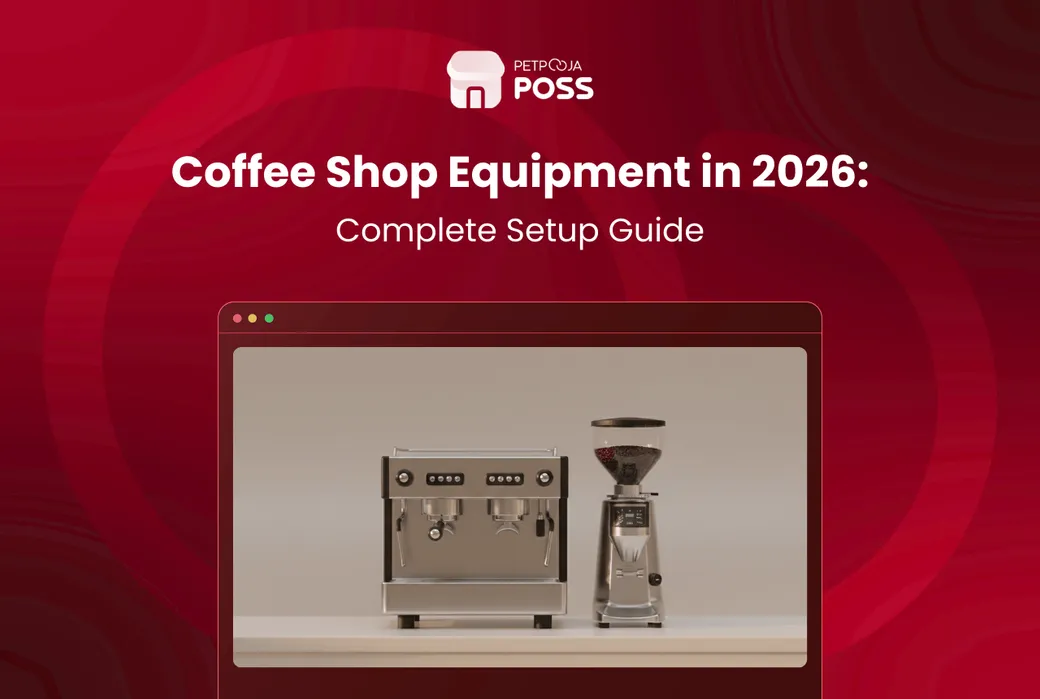



A coffee shop kit in India starts at about ₹2 lakh for a small counter and runs past ₹15 lakh for a specialty cafe. The espresso machine is the single biggest line, and it is the one most first budgets get wrong.
The short version: a genuine commercial espresso machine starts near ₹1 lakh, and a branded single group is closer to ₹1.4 lakh. Not ₹60,000. Machines below that figure are home or prosumer units, and they are not built to pull 150 shots a day.
Everything below is priced against supplier listings current in September 2026.
Key Takeaways
- Start with the espresso machine: ₹1 lakh to ₹1.9 lakh, for 40 to 80 cups a day.
- Then the grinder, from ₹31,000. A good grinder improves the cup more than a costlier machine does.
- Next, milk, ice and water treatment: ₹40,000 to ₹1.1 lakh.
- And budget ₹2 lakh for a small counter, ₹15 lakh and up for a specialty cafe.
- Size on your busiest hour, not your daily total.
What Is on the Essential Coffee Shop Equipment List in 2026?
Seventeen items across five groups, and six of them carry most of the budget. Those six are priced below, running from ₹10,000 for a milk boiler to ₹8 lakh for a high-volume coffee machine. Every figure is a current supplier listing or a published supplier band, checked in September 2026.
| Equipment | Price in India (2026) | Notes |
|---|---|---|
| Espresso or coffee machine | ₹1 lakh to ₹8 lakh | By cup volume, broken out below |
| Commercial burr grinder | ₹31,000 to ₹1.2 lakh | ₹31,000 entry, ₹1.2 lakh at 10 kg/hr |
| Ice machine | ₹20,000 to ₹55,000 | The practical band for a cafe |
| Under-counter refrigeration | ₹12,000 to ₹85,000 | ₹32,000 for a 300 litre beverage cooler |
| Electric milk boiler | ₹10,000 to ₹25,000 | 5 to 20 litre |
| Water treatment | ₹10,000 to ₹31,000 | Softener, the most skipped line |
Machine tiers come from Kaapi Solutions, and the model prices from Kaapi Machines.
Ice equipment is priced against the ICE BOY 2026 guide. Grinder, refrigeration, milk boiler and softener figures are live listings on IndiaMART and TradeIndia.
If you want the wider cafe kit rather than the coffee gear, including crockery, seating and small wares, our cafe equipment checklist covers that ground.
A. Brewing Equipment
- Espresso machine
- South Indian filter coffee setup
- Drip brewer
- French press or pour-over kit
The espresso machine sits at the centre of this group, and its price tiers are broken out further down. Alongside it most Indian cafes carry at least one filter or manual method, because not every order wants a shot pulled.
A South Indian filter coffee setup costs very little next to an espresso machine and sells a drink many customers prefer. A French press or pour-over kit covers the specialty end for a few thousand rupees.
A drip brewer earns its place once you are selling black coffee in volume, because it holds a batch rather than making each cup to order.
B. Grinding Equipment
- Commercial burr grinder
One commercial burr grinder is the minimum. Two is better, because a separate grinder for decaf or a second bean saves a purge every time you switch.
Blade grinders are cheaper and wrong for a cafe. They chop rather than mill, so particle size varies within the same dose and extraction goes with it.
The figure that matters on a spec sheet is burr diameter, then motor rating. A 10 kg per hour unit at about ₹1.2 lakh is built for continuous service; a ₹31,000 unit is fine for a counter doing under 100 cups.
C. Milk and Beverage Preparation
- Electric milk boiler
- Under-counter milk fridge
- Ice machine
- Blender
- Syrup pumps and sauce rail
An electric milk boiler runs ₹10,000 to ₹25,000 for a 5 to 20 litre unit, and a refrigerated under-counter unit keeps the working milk within reach of the steam wand.
Cafes selling cold drinks need an ice machine at ₹20,000 to ₹55,000, plus a blender for frappes. Syrup pumps and a sauce rail cost little and save seconds on every order, which matters at peak.
D. Storage and Utility Equipment
- Bulk refrigeration for the back
- Water softener
- Airtight bean storage
- Knock box
- Weighing scale
Refrigeration comes in two jobs. The working milk sits at the counter, in the fridge listed under milk and beverage above; the bulk stock sits in the back. Under-counter units start near ₹12,000, and a 300 litre beverage cooler sits around ₹32,000.
Water treatment is the line most often cut and the one that costs most to skip. Where the supply is hard, scale builds inside the boiler, and a boiler replacement costs several times what a treatment setup would have. Ask your supplier what the machine warranty requires, because most specify a water standard.
Airtight bean storage, a knock box, a weighing scale and cleaning chemicals round the group out. None is expensive; all of them are noticed when missing.
E. Coffee Shop Furniture
- Counter and back bar
- Seating
Seating, counters and the back bar are priced by your interior budget rather than by a spec. They move with city and rent more than anything else on this page.
The one operational point: the counter layout decides how many steps a barista takes per drink. Grinder beside machine, milk fridge within arm’s reach, knock box under the grinder.
What Is the Coffee Machine Price in India?
A commercial coffee machine in India costs between ₹1 lakh and ₹8 lakh. What decides the figure is how many cups a day it has to make, not the brand on the front.
| Tier | Price | What it is | Daily capacity |
|---|---|---|---|
| Entry | About ₹1 lakh to ₹1.9 lakh | Single group semi-automatic, or a compact automatic with one boiler | 40 to 80 cups |
| Mid | About ₹1.9 lakh to ₹3.2 lakh | Two group, dual boiler or heat exchange | 150 to 300 cups |
| High volume | About ₹4 lakh to ₹8 lakh | Multi-boiler, PID control, pressure profiling | 500 cups and above |
Entry to high volume is roughly four times the money for about six times the cups. So the cost per cup of capacity falls as you go up. Each tier is worked through below.
Entry-Level Coffee Machine Price (Small Cafe Setup)
About ₹1 lakh to ₹1.9 lakh buys a single group semi-automatic, or a compact automatic with one boiler. That is rated for 40 to 80 cups a day, which suits a kiosk, a bakery counter or an office cafe.
A semi-automatic single group lists at ₹1,40,266 on IndiaMART, and the Budan Maestro single group tops the band at ₹1,89,999. This is the tier where home machines get mistaken for commercial ones, so check the duty rating.
Commercial Coffee Machine Price (Mid-Range Cafe)
About ₹1.9 lakh to ₹3.2 lakh gets two groups with a dual boiler or heat exchange, rated for 150 to 300 cups a day. This is the working tier for most standalone Indian cafes.
The Budan Maestro 2 Group lists at ₹2,12,399 and the Budan M300 at ₹2,29,099. Both carry two groups, which is what separates this tier from the one below.
Industrial Coffee Machine Price (High-Volume Outlet)
About ₹4 lakh to ₹8 lakh, for multi-boiler machines with PID temperature control and pressure profiling, rated at 500 cups a day and above. Specialty cafes and hotel outlets sit here.
The Budan M400 lists at ₹4,09,999. Above ₹8 lakh you are buying consistency at volume rather than more cups.
What Affects Coffee Machine Price?
Group heads, boiler count and boiler size, in that order.
A second group roughly doubles throughput, which matters most where the peak hour is the constraint rather than the day. Our guide to managing a cafe covers reading that pattern.
A dual boiler lets you steam and extract at the same time, and it is the thing that gives way first on a busy counter when it is missing.
Boiler size decides how long the machine holds temperature through a run of drinks. A larger boiler is what separates two machines with the same group count and a different price. Brand matters less than any of it, so match the cup count before the badge.
Can You Use a ₹60,000 Coffee Machine in a Cafe?
No, not for daily service behind a counter. Anything under ₹1 lakh is a home or prosumer unit, built for two or three drinks in a row rather than a morning rush.
Such a machine carries a small boiler and a plastic portafilter, and it needs recovery time between shots. Pull 40 drinks through one on a Saturday and the steam pressure drops away by mid-morning.
That is a buying decision rather than a price question, so the full cost of getting it wrong is set out in the mistakes section below.
Which Coffee Machine Type Suits Commercial Use?
Semi-automatic suits most Indian cafes, and this section sets it against the other two types. The barista keeps control of the shot, the pump handles the pressure, and a local technician can repair it. Fully automatic earns its higher price where a trained barista is hard to keep.
Espresso Machine vs Automatic Coffee Machine
A traditional espresso machine needs a barista. A fully automatic grinds, doses, tamps and extracts on one button.
Automatic units cost more for the same cup volume, and they earn it back where you cannot keep a trained barista. For a kiosk or an office counter, that is usually the right trade.
Commercial Coffee Machine vs Industrial Coffee Machine
The words get used loosely. In practice “commercial” covers anything built for continuous duty, which starts at the entry tier in the price section above.
“Industrial” is the top band: multi-boiler, plumbed in, built to run all day without recovery gaps. The difference you feel is the tenth consecutive cappuccino, not the first.
Manual, Semi-Automatic, or Fully Automatic?
Semi-automatic is the default in Indian cafes. The barista controls the shot, the pump handles the pressure, and the machine is repairable locally.
Manual lever machines are a specialty choice. Fully automatic suits volume without skill on the floor.
Which Machine Suits Your Cafe?
Cafe owners we speak to almost always size the machine on their daily total, and it is the wrong number. Count your busiest hour, not your day. A cafe doing 200 cups spread evenly is a different machine from one doing 120 cups with 60 of them between 8am and 10am.
The format decides the shape of that curve. A kiosk, a dine-in cafe and a delivery-led brand peak at different times, and our coffee shop concepts guide sets out how each one trades.
Buy for the peak.
7 Coffee Shop Equipment Mistakes to Avoid
Most of the money lost on a first cafe kit goes the same seven ways, and all of them are decided before anything is delivered.
1. Buying Home Machines for Commercial Use
The mistake this whole page exists to prevent. If a price looks too good against the tier table in What Is the Coffee Machine Price in India?, check the duty rating before anything else.
A home machine has a single small boiler sized for two or three drinks in a row. Commercial units carry a larger boiler, or two, because the load is continuous. The give-away is recovery time: a home machine needs a minute between steaming and the next shot, which is invisible at home and fatal at 9am.
The warranty is the second trap. Most home-machine warranties exclude commercial premises outright, so the first repair is yours at full cost.
2. Ignoring the Coffee Grinder
An inconsistent grind wastes good beans on every shot. A ₹31,000 commercial burr grinder does more for the cup than ₹50,000 more of espresso machine.
Grind size controls how fast water moves through the puck, which controls extraction. Vary the particle size within one dose and part of the coffee over-extracts while the rest under-extracts, in the same cup. No machine corrects for that.
On a spec sheet, look at burr diameter first and motor rating second. Blade grinders chop rather than mill and have no place on a cafe counter.
3. Choosing Low Capacity Machines
Capacity matters more than saving ₹20,000 upfront. A machine run at its limit fails sooner, and it fails during service rather than on a quiet afternoon.
The cup ratings in the tier table are honest working numbers, not maximums. A single group rated at 40 to 80 cups will physically produce more, but the boiler stops keeping up and shot quality drifts through the rush.
If a third of the day’s cups land between 8am and 10am, that hour is the specification, not the daily total.
4. Underestimating Maintenance
Descaling, gasket replacement, burr replacement and water filters all recur, and none of them appears on the quotation you are comparing.
Group gaskets harden and start leaking within a year of heavy use. Burrs dull gradually, so the grind drifts coarser and nobody notices until the coffee tastes thin. Filters have a litre rating, not a time rating, which means a busy outlet gets through them faster than the supplier’s default schedule assumes.
Ask every supplier for the annual service contract price before you choose, and compare that alongside the machine.
5. Underestimating Water Treatment
Water treatment is the line most often cut from a first budget, and at ₹10,000 to ₹31,000 it is one of the cheapest on it.
Hard water deposits scale inside the boiler and on the heating element. The machine keeps working while it builds, then loses temperature stability, and the repair is a boiler job rather than a service call.
Scale damage is usually excluded from the machine warranty, which tells you what the manufacturer expects. Most specify a water hardness range in the manual, so confirm what yours needs and test your supply before you skip the softener.
6. Not Planning the Workflow
Grinder, machine, milk fridge and knock box belong within one turn of each other. A counter laid out without that in mind adds steps to every drink.
The cost is invisible on a quiet morning and painful at peak. Three extra steps per drink across 200 drinks is roughly an hour of service time, spent exactly when the queue is longest.
Map the barista’s movement before the counter is fabricated, not after. Changing a layout later means cutting into a counter that already has plumbing and power running through it.
7. Overspending on Features You Don’t Need
Pressure profiling, PID control and app connectivity are worth paying for in a specialty cafe chasing a particular shot. In a 120-cup neighbourhood cafe they are money that should have gone to the grinder.
The features that pay back at every volume are the plain ones: boiler size, group count and build quality. Those decide whether the machine holds up through a rush.
A useful test before adding a feature to the quotation is whether a customer would notice its absence. Most of the time, at that volume, they would not.
What Does a Full Coffee Shop Setup Cost?
About ₹8 lakh in a tier-3 city and ₹35 lakh or more in a metro, for a 500 square foot, 30-seat cafe.
Equipment is one line of that number, and the total moves with city and rent far more than with machines. Our cafe setup cost breakdown works through it by city tier with two real case studies, and it is the better page for that question.
Licensing sits alongside it. The cafe licence guide covers what you need before you open.
What Technology Should a Cafe Not Ignore in 2026?
A POS that ties billing to stock is the one piece of software a cafe cannot skip. The kit gets you the cup, but it will not tell you which cup made money, and that gap is where most cafe margin quietly goes.
A cafe running 200 covers a day cannot track wastage on paper. Milk spoils, syrups run out mid-service, and the loss shows up as a thin month rather than a specific mistake.
1. POS System for Cafes
A cafe POS system ties billing to stock, so a flat white deducts its milk and its beans as it is sold.
Coffee is a modifier-heavy format. One drink can carry a milk choice, a shot count, a syrup and a temperature. A counter system that makes those four taps slow costs you more at peak than any machine.
2. Inventory Management
Milk is the fastest-moving perishable in a cafe and the easiest to lose track of. Stock that deducts as you sell tells you what a busy Saturday actually consumed, rather than what you assumed it did.
The gap between those two numbers is your wastage, and on milk it is rarely small. Free pouring, remakes and a jug steamed for one cappuccino that served none all land in it.
Petpooja runs inventory on its own dashboard, covering stock, purchases, wastage and cost of goods sold. The variance then shows up as a line you can act on, rather than a number that only appears at stock-take.
3. Recipe Standardisation
A heavy hand on the milk jug is invisible until the month closes. Recipe-level stock fixes each drink to a defined quantity, so the variance shows up as a number rather than a feeling.
Coffee is unusually exposed to this. An 18 gram dose and a 20 gram dose taste different and cost different. Across a few hundred drinks a week, that gap is a real line in your food cost.
A defined recipe also makes a new barista useful faster, because the target is written down rather than learned by watching.
4. Integrated Billing and Reporting
Petpooja POSS handles recipe-level stock, so the counter and the store agree at the end of the shift.
The point of joining the two is that one number checks the other. Sales say you sold 180 coffees; stock says you used milk for 210. That discrepancy is worth more than either figure on its own.
A day-end summary that runs in a few minutes is what turns all of this into something you act on, rather than a report nobody opens until the accountant asks.
What Else Does a Coffee Shop Need Beyond Equipment?
The best machine on the counter will not fix a menu priced below its cost, and it will not tell you that your 4pm hour loses money.
Equipment sets your ceiling. What you sell, at what margin, and how little you waste getting there decides where you land under it. Cafes that survive their second year are usually the ones that learned their cost per cup early, not the ones that bought the biggest machine.
Conclusion
A coffee shop equipment list is only useful if the prices on it are real. Get the espresso machine right and most of the budget follows. Start from your busiest hour, match the machine tier to that number, then let the grinder take the next largest share.
The equipment decides what you can serve. What you actually earn on it comes down to knowing your cost per cup, which is a numbers problem rather than a hardware one.
Frequently Asked Questions
What is the minimum equipment needed to start a coffee shop in India?
An espresso machine, a commercial grinder, a milk boiler, refrigeration and water treatment. Taking the lowest line of each, that comes to about ₹2 lakh before furniture and interiors.
How much does a commercial coffee machine cost in India?
About ₹1 lakh to ₹1.9 lakh for a single group rated at 40 to 80 cups a day. A two group at 150 to 300 cups runs ₹1.9 lakh to ₹3.2 lakh, and anything above that is ₹4 lakh to ₹8 lakh.
Can I use a home espresso machine in my cafe?
No. Home machines are not rated for continuous duty, the warranty usually excludes commercial use, and steam pressure falls away under a morning rush.
Which is more important, the machine or the grinder?
The grinder, once you are past the entry tier. Grind consistency affects every shot, and a good commercial burr grinder starts around ₹31,000.
Does a cafe need billing software as well as a POS?
They are the same purchase in practice. A cafe POS handles billing, and billing software with inventory adds the stock side, so milk and beans deduct as drinks are sold.
How much should I budget for maintenance?
Ask each supplier for the annual service contract before buying. A softener at ₹10,000 to ₹31,000 is the cheapest way to avoid the largest repair.
Thanks. This helps us make the next article better.

Fatema Rasiwala is a growth marketer & content writer at Petpooja. She likes to define herself as a wordsmith of the digital page, keeping up with restaurant industry trends, and crafting tales of mirth with a sharp wit. Reach her at fatema.rasiwala@petpooja.com
Comments
Loading comments…