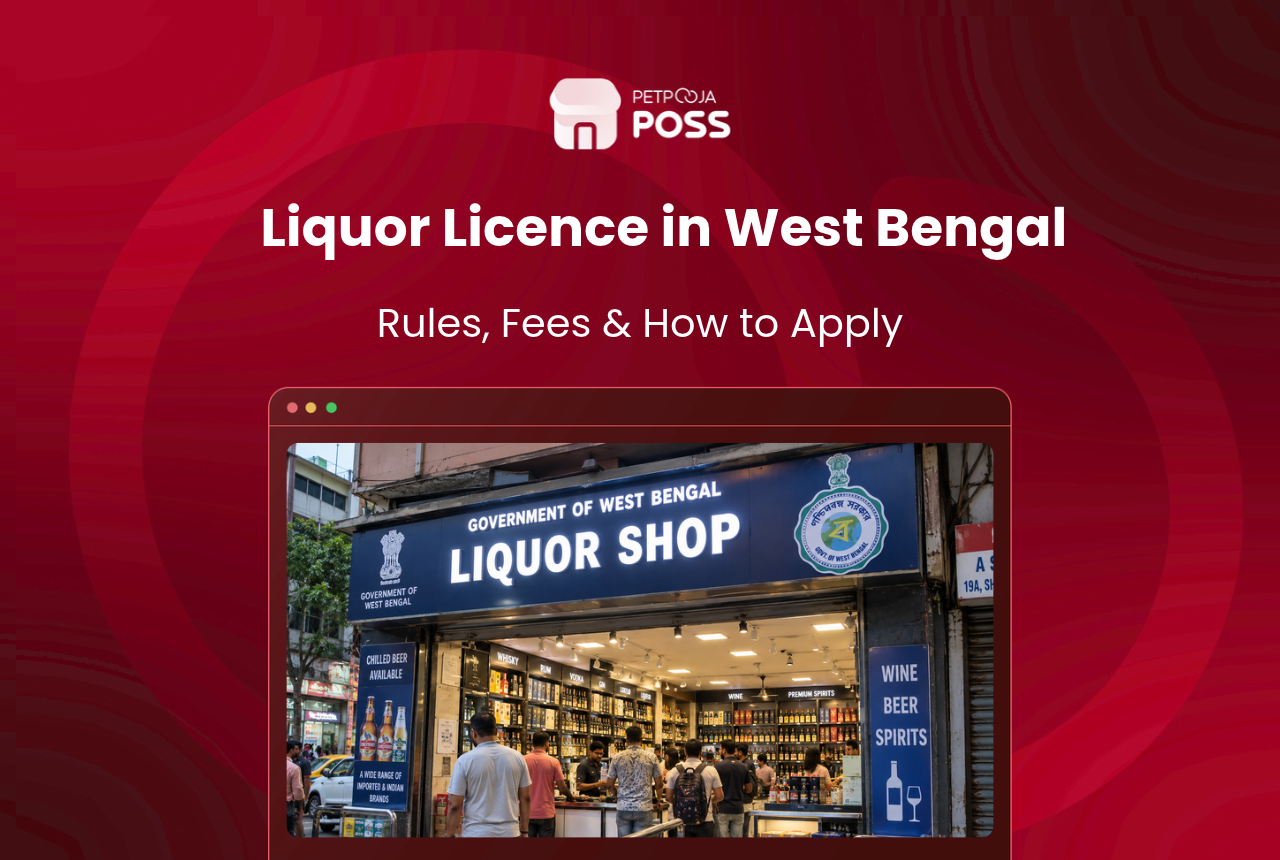
How do you get a liquor licence in West Bengal? For a restaurant bar, you apply to the Collector of your district. The Collector checks the site and your eligibility, and the state government gives the final approval.
The cost depends on where you are. A new bar first runs on a temporary licence, at up to ₹20,000 a month. The regular licence then has a first grant fee of ₹4 lakh in a panchayat area. In a city corporation such as Kolkata, that fee is ₹10 lakh.
The rules also changed in September 2026. A new bar in a town now has to sit at least 500 metres from a school, place of worship or hospital, up from 1,000 feet.
This post covers how to apply, the licence types, what each one costs, who is eligible, and what a breach costs.
Key Takeaways
- You apply to your district Collector, who checks the site, the local demand and your eligibility before granting anything.
- A new bar usually runs on a temporary licence for up to six months first. Then the state government decides on a regular one.
- Check the new distance rule before you sign a lease. For a restaurant bar, it is now at least 500 metres in a town and 1 km elsewhere.
How to Apply for a Liquor Licence in West Bengal
A bar licence in West Bengal is granted in two stages, a temporary licence and then a regular one. This section takes the steps in order, from the first application to the regular licence.
- Check the site against the distance rule. It must be far enough from a recognised school or college, a traditional place of worship and a public hospital. The distance is set out below.
- Apply to the Collector of your district. Use the form the rules set, with proof that you paid the application fee. You also give an estimate of how much foreign liquor the site will sell each month.
- Wait for the Collector’s enquiry. An officer checks the local demand, the distance rule and whether you are eligible. The Collector may also take public opinion in the area into account.
- Run on a temporary licence. If the Collector is satisfied, you get a licence for up to six months. You pay the monthly fee for the whole period in advance, as the fee section below shows.
- Let your sales make the case. The Collector looks at your average monthly sale during the temporary period. The rules call this the “revealed demand”.
- Wait for the government’s decision. If the Collector recommends a regular licence, the file goes to the Excise Commissioner and then to the state government.
- Pay and receive the regular licence. Once the government approves, the Collector grants the regular licence after you pay the fee for a new licence.
These steps come from the state’s site selection rules published by the Excise Directorate. Several states now take these applications through an online portal, and West Bengal takes its fees online.
What I would do first. I would measure the walk from the site’s door to the nearest school, place of worship or hospital before anything else. Since September 2026 that walk must be 500 metres in a town. A site that fails it cannot be fixed later.
The guide to opening a bar in India covers the rest of the setup beyond the licence.
What are the Liquor Licence Types in West Bengal?
West Bengal names its licences by where people drink and what kind of place sells. These are the ones most food businesses need.
- Restaurant-cum-bar is the licence for a restaurant with an attached bar. This is the one most restaurants want.
- Hotel-cum-restaurant-cum-bar and hotel-cum-bar are for hotels, priced by star rating.
- Foreign liquor “on” shop is a bar without a hotel or restaurant attached.
- Foreign liquor “off” shop is a shop selling liquor to drink off the premises.
In West Bengal’s licence names, “foreign liquor” includes Indian made foreign liquor such as brandy, gin and beer. You need a separate licence for each category you sell. The department lists every category on its licence categories page.
If you are still weighing which one fits, the types of bar licence guide explains what each category lets you serve.
Liquor Licence Fees in West Bengal for Restaurant Bars
A restaurant bar pays three main fees and a deposit, plus a monthly fee while it runs on a temporary licence. The amounts depend on the type of area. This section explains the parts first, then gives the figures.
What each fee is for
- Application fee: paid when you apply, and not refunded.
- Fee for the first grant: paid once, when the licence is first granted.
- Yearly fee: paid each year after that, for the next period of settlement.
- Security deposit: one third of the first grant fee, paid before the licence is granted.
The fees are paid online through the state’s Government Receipt Portal System (GRIPS).
Restaurant bar fees by area
| Type of area | Application fee | First grant fee | Yearly fee after |
|---|---|---|---|
| Panchayat area | ₹20,000 | ₹4,00,000 | ₹60,000 |
| Municipal or notified area | ₹50,000 | ₹6,00,000 | ₹2,00,000 |
| Municipal corporation area | ₹1,50,000 | ₹10,00,000 | ₹5,00,000 |
The restaurant bar row also covers a club, theatre or other place of public entertainment with an attached bar.
These figures come from the West Bengal Excise fee rules, 2005. The rules were last changed in December 2022. The notices the department issued in 2025 and 2026 do not change these fees.
Temporary licence fees
A new bar first runs on a temporary licence, and that has its own fee. It is set per month, but you pay all the months of the licence in advance. If you run more than one bar on the premises, each extra bar pays the second column.
| Type of area | Temporary bar licence, per month | Each extra temporary bar, per month |
|---|---|---|
| Panchayat area | ₹5,000 | ₹3,000 |
| Municipal or notified area | ₹10,000 | ₹8,000 |
| Municipal corporation area | ₹20,000 | ₹15,000 |
The government may not decide within six months. If so, the Collector can issue another temporary licence, and the monthly fee carries on.
What a regular licence costs in Kolkata
Here is what a restaurant bar in Kolkata pays to reach a regular licence (an example). It assumes one six-month temporary period.
So the ₹10 lakh grant fee turns into about ₹16 lakh by the time you hold the regular licence. After that, you pay ₹5,00,000 a year.
Hotel and Shop Liquor Licence Fees in West Bengal
Hotels pay by star rating, and shops pay much less than a bar. This section covers both, from the same 2005 fee rules.
Hotel bar fees
| Hotel type | Panchayat area | Municipal area | Municipal corporation |
|---|---|---|---|
| Below 3 star, or hotel-cum-bar | ₹7,00,000 then ₹1,00,000 a year | ₹10,00,000 then ₹2,50,000 a year | ₹12,00,000 then ₹5,00,000 a year |
| 3 or 4 star | ₹15,00,000 then ₹2,50,000 a year | ₹20,00,000 then ₹4,00,000 a year | ₹22,00,000 then ₹10,00,000 a year |
| 5 star and above | ₹20,00,000 then ₹15,00,000 a year | ₹20,00,000 then ₹15,00,000 a year | ₹25,00,000 then ₹20,00,000 a year |
Each first figure is the first grant fee, and each second figure is the yearly fee after it. The application fee runs from ₹20,000 to ₹3,00,000 on top.
Shop and “on” shop fees
| Licence and area | Application fee | First grant fee | Yearly fee after |
|---|---|---|---|
| “Off” shop, panchayat area | ₹8,000 | ₹50,000 | ₹12,000 |
| “Off” shop, municipal area | ₹12,000 | ₹75,000 | ₹25,000 |
| “Off” shop, Kolkata, Howrah or Siliguri corporation | ₹25,000 | ₹2,50,000 | ₹30,000 |
| “Off” shop, other corporation | ₹25,000 | ₹1,50,000 | ₹30,000 |
| “On” shop, panchayat area | ₹8,000 | ₹1,75,000 | ₹12,000 |
| “On” shop, municipal area | ₹12,000 | ₹2,75,000 | ₹25,000 |
| “On” shop, municipal corporation | ₹25,000 | ₹4,50,000 | ₹30,000 |
Hotels and shops pay a deposit too. It is one third of their own first grant fee.
Who Is Eligible for a Liquor Licence in West Bengal?
West Bengal checks the person and the site separately. This section covers who can apply, then where the bar can be.
Who can apply
You can apply as a person if you are 21 or over and an Indian citizen. The rules also name a Person of Indian Origin who holds a PIO card. A firm, a company, a society or another registered body can apply too.
A new licence is not usually granted to these people.
- Someone convicted of a non-bailable offence.
- A former licensee found guilty of a serious breach of licence terms.
- A former licensee who did not pay excise dues.
- Someone with a stake in the liquor trade in a bordering state or another country.
- Someone who holds a wholesale foreign liquor licence.
Where the bar can be
Rule 8 of the site rules sets a gap around three kinds of place. They are a recognised school or college, a traditional place of worship, and a public hospital.
The distance changed on 16 September 2026. A new notice, 1592-F.T., replaced the old 1,000 feet with two new limits.
- 500 metres in a municipal corporation, municipality or notified area.
- 1 km everywhere else.
The gap is measured from door to door, along the path a person would normally walk. If the school, place of worship or hospital has more than one entrance, the nearest one counts.
Applications and Letters of Intent the state government approved before the change keep the old limit. The notification is listed on the department’s What’s Current page.
Two more limits apply under the site rules. A new site cannot be within 720 feet of the middle of a national or state highway. This does not apply inside a city or town of 20,000 people or more. A new site is not ordinarily allowed in a tribal area either.
The distance rule does not cover every licence. It does not apply to hotels of 3 stars and above. Nor does it apply to clubs, theatres and other places of entertainment with a bar.
What If You Break the West Bengal Liquor Licence Rules?
A breach of the Bengal Excise Act, 1909 can bring a fine or prison. It can also cost you the next renewal. This section covers the offences that matter most to a bar.
The penalties below are the ones set by the Bengal Excise (Amendment) Act, 2012, West Bengal Act XVI of 2012. It raised the figures in the original 1909 Act, and it is listed on the department’s Acts page.
- Serving the wrong people. Under section 51, a licensed vendor who serves someone drunk, or sells spirits to someone who looks under 21, commits an offence. So does one who allows drunkenness, disorder or gaming on the premises. The penalty is up to two years in prison, a fine of up to ₹10,000, or both.
- Passing country liquor off as foreign liquor. Under section 50, this carries up to two years in prison, a fine of up to ₹3,000, or both.
- Adulteration that can harm. Section 46AA covers mixing, or letting someone mix, anything into liquor that is likely to cause disability or death. A court can give prison for life or for up to ten years, plus a fine.
A breach can also cost you the licence. The Collector can refuse your renewal after a conviction or a serious breach.
Stock records for an inspection
Restaurant owners we work with tell us the rules on who you serve are easy to follow. The harder part is showing an inspector that the stock behind the bar matches what was sold. Matching what you sold against what you bought is the job Petpooja does. A bar and brewery POS tracks consumption against purchases.
Conclusion
To get a liquor licence in West Bengal, you apply to your district Collector. You usually run on a temporary licence for up to six months. Then the state government decides on a regular one.
Check the new distance rule first. Then plan for the whole cost, not just the grant fee. In a city corporation, that means the application fee, the temporary licence months, the ₹10 lakh grant fee and a security deposit.
Once the licence is live, owners tell us the harder part is the stock. They have to show that what sits behind the bar matches what was sold. Your restaurant billing and inventory system is what ties every bottle to a bill.
Frequently Asked Questions
Yes. If you hold a restaurant or hotel bar licence, you can ask the Collector for an extra bar at the same site. It has its own, separate set of fees in the same rules. From the second extra bar onwards, you pay half of those fees.
No. A hotel-cum-restaurant-cum-bar or hotel-cum-bar licence covers room service without a separate permission.
Each state works it out differently. Telangana licence fees are set by population, while Rajasthan licence fees for a shop are a share of its yearly guarantee. Madhya Pradesh licence fees are published flat by city, and Haryana licence fees cover 21 months rather than a year. Gujarat permit rules work on permits instead. Our state-wise cost guide sets the charges for every state side by side.