
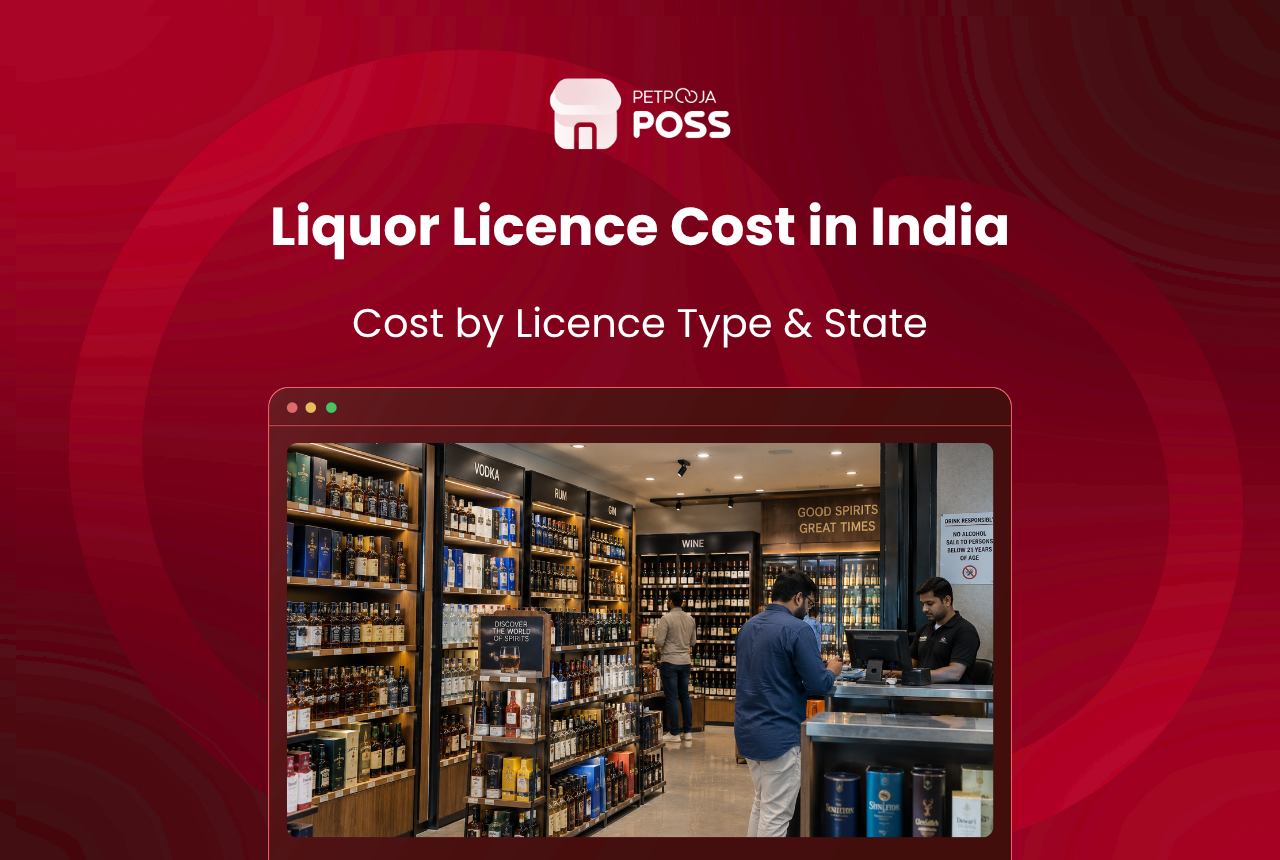
A liquor licence in India is priced by your state, not by the Centre. The spread is wide enough to decide whether a bar is worth opening at all.
Delhi is one of the few states that publishes a full schedule. For the 2025-2026 excise year it charges an independent restaurant between ₹7,84,610 and ₹72,18,385 a year. Category and seat count decide where in that range you land. A one-day event permit in the same city costs ₹5,000.
That gap is not an error in the schedule. Each category is priced on a different basis. Seat covers set the restaurant fee, room count the hotel fee, membership size the club fee, and an event permit is flat. Once you know which basis applies, the number stops being guesswork.
Key Takeaways
- A Delhi restaurant licence runs ₹7,84,610 to ₹72,18,385 a year
- Category sets the price, not size: seats, rooms, star rating or members
- A one-day event permit is a flat ₹5,000
- The fee repeats every year and usually rises, so budget the renewal
- Only Delhi and Telangana publish charts; elsewhere, ask your excise office
What Does a Liquor Licence Cost in India?
Between roughly ₹5,000 and ₹72 lakh a year, and where you land depends almost entirely on your licence category. Alcohol sits on the State List of the Constitution, so every state writes its own schedule on its own calendar, and no national average is worth quoting.
What holds across states is the shape of the cost. You pay to hold the licence, and that sits apart from the excise duty built into your stock price. Plan against the recurring charge, because it lands whether the bar had a good year or a quiet one.
Delhi publishes the clearest schedule in the country, so it is the best place to see how the pricing works.
Liquor Licence Fees by Category: What Delhi Publishes
Delhi runs a numbered L-series and prints an annual fee against most of it. Know what each licence allows first, because the category decides the price more than outlet size does.
| Liquor licence category | Delhi form | What sets the fee | Published annual fee |
|---|---|---|---|
| Independent restaurant | L-18 | Seat covers | ₹7,84,610 to ₹17,26,138 |
| Independent restaurant | L-17 | Seat covers | ₹14,90,756 to ₹36,09,196 |
| Independent restaurant | L-19 | Seat covers | ₹29,81,509 to ₹72,18,385 |
| Liquor served to hotel guests in their rooms | L-15 | Number of rooms | ₹2,35,387 to ₹18,83,060 |
| Bar or restaurant inside a hotel | L-16 | Star rating and covers | ₹12,55,372 to ₹37,66,116 |
| Club serving enrolled members | L-28 | Number of members | ₹2,35,386 to ₹6,27,686 |
| One function on one named day | P-10 or P-13 | Flat fee per event | ₹5,000 |
Figures cover Indian and foreign liquor together. The restaurant rows sit on the department’s L-17, L-18 and L-19 schedule, and the event permit fee on its licence category list. The hotel and club schedules are linked in the next section.
Every annual figure above is a 2025-2026 excise year rate, published with a stated 10% increase over 2024-2025. The department revises these yearly, so confirm current rates before budgeting.
Three of those rows describe the same kind of outlet. Delhi publishes separate schedules for L-17, L-18 and L-19, all granted to independent restaurants. The department confirms which one applies at the application stage, so it is not the applicant’s choice. Lowest schedule to highest is roughly nine times the money.
What Decides Your Liquor Licence Fee?
Five things move the number in Delhi, and the same bases turn up in other states under different names.
- Seat covers. A restaurant fee steps up in bands, so an outlet with 52 covers pays the same as one with 100. That makes the fee table a room design constraint: a 46-seat and a 60-seat room in Delhi (an example) can fall into different bands.
- Rooms and star rating. Hotels are priced on what the building is, not the size of the bar. Delhi’s L-15 and L-16 schedule charges L-15 by room count and L-16 by star classification, stepping once at 75 covers. A budget hotel bar and a five-star bar of equal size pay very different fees.
- Members on the roll. A club is priced by its register. Delhi’s L-28 schedule steps at 800 members and again at 1,500, so enrolment drives the fee more than footfall does.
- What you are allowed to pour. Narrower permissions carry lighter conditions and lower fees. Beer-only and wine-only forms exist in some states. A cafe adding a glass of wine at dinner is rarely in the same band as a cocktail room.
- Hours. Round-the-clock service is charged as a multiplier rather than a flat sum. Delhi’s 24×7 scheme adds 50% of the basic annual licence fee. It reaches four-star and five-star hotels, the categories above them, and deluxe motels.
Liquor Licence Fees in Telangana: Charged Up Front, Not Yearly
Telangana is the only other state that puts its numbers in public, and it charges on a completely different basis. There is no seat-linked annual fee. A bar pays most of its money up front, then a registration tax to stay open.
| Telangana charge | What it covers | Published amount |
|---|---|---|
| Prior clearance in Form 1(A) | New 2B bar | ₹1,00,000 |
| Application fee in Form 1(B) | New 2B bar | ₹2,00,000 |
| Prior clearance in Form 1(A) | New elite bar | ₹3,00,000 |
| Bar registration tax | 2B bar renewal | ₹1,00,000 |
| In-house consumption excise tax | Club, up to 500 sq m | ₹3,00,000 or ₹6,00,000 |
Amounts come from the Telangana Prohibition and Excise Department’s service and fee chart. A new 2B bar starts at ₹3,00,000 in application charges before it pours anything.
The club row carries a sixth pricing basis. Telangana sets that rate by whether the local population passes three lakh, which is a variable Delhi’s schedule does not use anywhere.
Why Do Most States Not Publish a Liquor Licence Fee Table?
Delhi and Telangana are the exception rather than the rule, and that is the honest answer to most fee searches.
Maharashtra publishes more than 40 licence forms with a description of what each covers. The money sits elsewhere, and the link its department labels “Current License Fees” opens a scanned document dated 2018-19. Our comparison of Delhi and Maharashtra licence rules sets out where else the two diverge.
That is the usual picture. Rates sit in excise policy notifications that change each policy year, so a figure from an older article is often out of date.
A few states do not sell the licence you are looking for at all. Gujarat runs prohibition, so the question there is one of permits rather than restaurant licences.
Either way the move is the same. Identify your category, ask your own excise office for the current notification, and treat any number found elsewhere as a guide to scale rather than a quote.
What Else Should You Budget Beyond the Liquor Licence Fee?
The licence fee is the headline, and it is not the whole outlay. Across the licensed bars we onboard, the deposit and the duty are the two lines owners most often leave out of the opening budget. Five other costs sit alongside the fee.
- Excise duty on stock. Duty is paid on the liquor itself and reaches you inside the purchase price. It is a running cost tied to volume, not a one-time charge.
- A security deposit. Most states hold a deposit against the licence. The amount sits in your state’s rules, so read the notification rather than assuming a figure.
- Renewal. The fee repeats annually and can move, as Delhi’s 10% step for 2025-2026 shows. This line item is not fixed.
- A separate licence for anything you make on site. Brewing your own beer puts you into microbrewery licensing. That is a manufacturing permission, priced apart from the bar licence.
- Changes made after the licence is granted. The Telangana fee chart cited earlier charges ₹25,000 to change a trade name and ₹1,00,000 to alter the premises. Rebranding or moving a wall is a licensing cost, not only a fit-out cost.
Selling sealed bottles for customers to carry out is a different permission again, closer to a wine shop licence than to anything on the restaurant schedule.
Put all of it into the opening budget rather than first-year running costs, since most of it falls due before you serve a drink.
What to Track Once the Liquor Licence Is Live
Once the fee is paid, the licence has to survive an inspection, and inspections turn on stock records rather than the certificate.
Two numbers do most of the work. The first is the gap between what was poured and what was billed, where margin and compliance answers both sit. The second is service hours, since a bill stamped after closing time is a problem on paper too.
Alcohol also stays outside GST, so the bill has to separate drinks from food rather than taxing the ticket at one rate. In the bars we set up, this is the setting most often left wrong in the opening week.
A bar and brewery POS records liquor stock bottle by bottle, tracks pour against sale, and raises separate food and drink bills on one table. That is what turns a paid licence into a defensible one.
Conclusion
A liquor licence has no national price. The useful question is not what it costs in India, but what your category costs in your state.
Delhi shows the pattern clearly. Restaurants pay by seats, hotels by rooms and classification, clubs by members, and a single function costs a flat ₹5,000. Telangana charges its bars up front instead. Other states follow one of these bases even where the schedule is harder to find.
So fix your category before you budget, then take it to your own excise department for the current notification. The online application route confirms the fee against your premises, not against a national average.
After that, the fee only pays for itself if the stock behind the bar reconciles. Petpooja’s bar POS keeps pours, bills and closing stock on one record so the licence holds up at the next inspection.
Frequently Asked Questions
It depends on your state and your licence category. Delhi charges independent restaurants between ₹7,84,610 and ₹72,18,385 a year for 2025-2026, and a one-day event permit there is ₹5,000. Telangana charges a new bar ₹3,00,000 in application charges instead. Most states price through excise policy notifications rather than a standing table.
It is annual for a standing licence. The fee repeats at renewal and is often revised upward, as Delhi’s stated 10% increase for 2025-2026 shows. Event permits are the exception, since they are charged per function rather than per year.
For a one-off function, the event permit, at a flat ₹5,000 in Delhi. For a permanent outlet, narrower permissions cost less, which is why beer-only and wine-only forms are the lower rung in states that publish them. A Delhi club licence is cheaper than a restaurant licence, but service stops at enrolled members.
No. They are separate charges. The licence fee buys the permission to sell, and excise duty is levied on the liquor itself and reaches you through the purchase price. Budget for both, along with the other clearances on a restaurant compliance checklist.
Work out your category first, then go to your state excise department’s site for the notification that prices it. Ask for the current excise year specifically. Most states reset rates annually, and older figures stay online long after they stop being accurate.








