
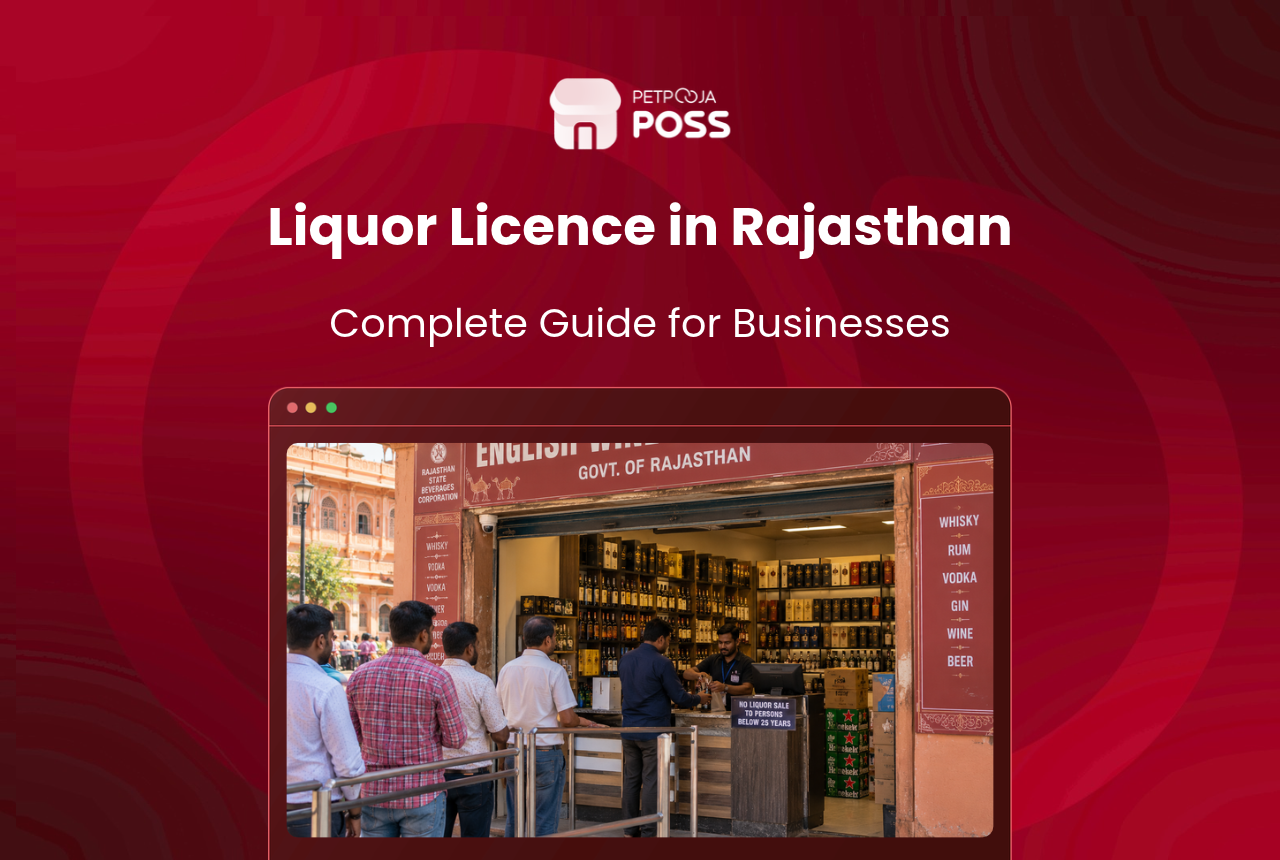
A liquor licence in Rajasthan is priced differently from most states. A retail shop does not pay a flat fee or a fee set by population. It pays 5% of its annual guarantee amount, a figure the excise department fixes against each shop.
That one rule shapes everything else. The guarantee is fixed per shop before you bid, so your fee is settled the moment you know which shop you are chasing.
A bar works the other way round. It pays a flat fee, from ₹8.5 lakh for a three-star hotel up to ₹16 lakh for a five-star.
This post covers the current fees for shops and for bars, the cap on how much one person may hold, how to apply, and the rules that follow.
Key Takeaways
- Your shop licence fee is 5% of a number the state sets, not one you choose.
- The guarantee is a floor. Sell less and you still owe the basic licence fee on the full quantity.
- You may hold two clusters in a district and five in the state.
- A bar is priced on the building, so the same bar costs more in Jaipur than in a small town.
What are the Liquor Licence Types in Rajasthan?
Rajasthan splits its licences by where the drinking happens and by what is sold. This section names each one, because the money works differently for a shop and for a bar.
- Composite shop. The ordinary retail liquor shop, licensed for sale off the premises. Its guarantee is set against country liquor and Rajasthan Made Liquor (RML).
- Model shop. A retail shop for premium liquor, heritage liquor, premium wine, premium beer and accessories. The Excise Commissioner grants it.
- Bar licence. For drinking on the premises, with separate rules and separate fees for a restaurant, a hotel and a members’ club.
Three smaller licences sit alongside them. A BIO brand shop sells Bottled in Origin (BIO) stock, which is liquor bottled in the country it was made in. Only the manufacturer or its authorised dealer may hold one.
A wine factory outlet lets a wine unit sell and offer tastings of its own duty-paid wine at the production site. An RSGSM heritage liquor brand shop sells only heritage liquor made by the state corporation.
Most people applying want a composite shop, and the wine shop licence process guide walks through that for India as a whole. If you are adding drinks to a restaurant instead, the types of bar licence guide explains what each one lets you serve.
How Much Does a Liquor Licence in Rajasthan Cost?
The cost splits in two: a retail shop pays 5% of its guarantee amount, while a bar pays a flat fee set by the building it sits in. This section gives both, plus the charges on top.
Retail shop licence fees
The retail shop fees came into force on 1 April 2025, replacing the flat city-wise fees that applied before.
| Retail licence type | Annual licence fee |
|---|---|
| Composite shop | 5% of the annual guarantee amount |
| Model shop | 5% of the annual guarantee amount |
| BIO brand shop | 5% of the annual guarantee amount |
| Wine factory outlet | ₹1,00,000 |
| RSGSM heritage liquor brand shop | ₹1,00,000 |
| Walk-in facility, other than a model shop | ₹10,00,000 |
| RTDC shop | 5% of the excise duty on what it lifts |
The guarantee amount is the number that matters. It is set for each shop before bidding opens, and it is not the same as your sales. You commit to it, and the licence fee is 5% of it.
Bar licence fees
A bar is priced on the building it sits in, not on the bar itself. Every rate below was last revised on 1 April 2022.
Hotel and club bars come under the Rajasthan Excise (Grant of Hotel Bar/Club Bar Licences) Rules, 1973. A restaurant bar has its own rules, made in 2004.
| Luxury hotel or train | Basic licence fee |
|---|---|
| Five-star hotel | ₹16,00,000 |
| Four-star hotel | ₹11,00,000 |
| Three-star hotel | ₹8,50,000 |
| Luxury trains | ₹8,50,000 |
Any other hotel pays by room count and by where it stands. Up to 50 rooms it is ₹8,00,000 inside the Jaipur, Jodhpur, Udaipur or Mount Abu limits, ₹5,00,000 in the second tier and ₹3,00,000 elsewhere.
Above 100 rooms the Jaipur figure rises to ₹15,00,000.
A heritage hotel is cheaper, and its top band covers a wider area. It adds Jaisalmer and the land within 10 km of Kumbhalgarh fort. There it is ₹2,00,000 for up to 10 rooms and ₹4,00,000 above 25 rooms, falling to ₹50,000 in smaller places.
A restaurant bar is licensed separately and priced by city rather than by size.
| Restaurant location | Basic licence fee |
|---|---|
| Jaipur headquarter | ₹8,00,000 |
| Jodhpur headquarter | ₹7,00,000 |
| Other divisional and district headquarters, Mount Abu, other municipalities, Bhiwadi UIT and within 10 km of Kumbhalgarh fort | ₹5,00,000 |
| Any other restaurant | ₹3,00,000 |
Clubs are cheaper, and the split is between a members’ civil club and a commercial one.
| Club type | Jaipur, Jodhpur, Udaipur | Elsewhere |
|---|---|---|
| Civil club bar | ₹2,00,000 | ₹1,50,000 |
| Commercial club bar | ₹6,00,000 | ₹4,00,000 |
A civil club run for government servants or news media people pays half the figure above.
What else you pay
Three charges sit outside the tables above. Every bar application must carry 10% of the initial licence fee when you file it, and a restaurant bar adds a process fee of ₹5,000.
The balance is due quickly. A restaurant bar licensee pays the rest of the initial fee within seven working days of the licence being issued.
A retail shop also pays a basic licence fee on volume. That is ₹46.00 per bulk litre of country liquor and ₹80.00 per bulk litre of Rajasthan Made Liquor.
The retail fees come from the Rajasthan Excise (Amendment) Rules, 2025, issued by the Finance (Excise) Department on 1 April 2025. The bar and volume figures come from the excise department’s own schedule of fees.
A note on the fee schedule, from me. The two documents disagree. The department’s schedule still lists flat model shop fees: ₹26 lakh for Jaipur, ₹20 lakh for Jodhpur and Udaipur, ₹15 lakh for other cities. The 2025 amendment replaced all of them with 5% of the guarantee amount. It is the later document and a rule change, so plan around the 5%.
Why the guarantee amount decides everything
Work it through on one shop and the structure becomes clear.
The number to chase before you bid is therefore the guarantee on the specific shop, not an average for the district.
Petpooja is India’s biggest and most price effective restaurant POS, behind the success of 1,00,000+ outlets. It has run restaurant billing for 14+ years and processes 60 lakh bills a day at 0% errors.
Who Is Eligible for a Liquor Licence in Rajasthan?
Rajasthan does not screen applicants on experience or capital. It limits how much of the market one person may hold, which is the rule most people miss until they have already won a shop.
No person may hold an interest in more than two clusters for retail off sale in the same district, and no more than five across Rajasthan.
That came in with the 2025 amendment to rule 74. It applies to an interest, not just a licence in your own name.
Neither the fee schedule nor the 2025 amendment defines what a cluster contains. Treat the cap as a limit on holdings, and check how clusters are drawn up when the excise department notifies the shops.
The rest of the eligibility sits in the Rajasthan Excise Act, 1950 and the Rajasthan Excise Rules, 1956. Applying for a bar is a separate route, covered below.
How to Apply for a Liquor Licence in Rajasthan
Retail shops and bars follow different routes. Shops go through a cluster allotment run by the excise department. A bar is applied for directly.
The retail shop route
- Wait for the year’s allotment notice. It carries the shops on offer and the process for that year, which the standing rules do not set out.
- Check the guarantee before anything else. It fixes your licence fee at 5%, and it fixes the basic licence fee you owe whether or not you sell.
- Apply through the excise portal. Rajasthan runs allotment online, and other states have moved the same way. The online liquor licence steps guide covers that route.
- Check the cluster cap before you bid. Two per district and five in the state, counting any interest you already hold.
The bar route
- Work out your band first. A bar in a three-star hotel and the same bar in a five-star are ₹7.5 lakh apart before anything else is counted.
- File under the right rules. Hotel and club bars go under the 1973 rules, a restaurant bar under the 2004 rules. The application must be properly signed.
- Attach 10% of the initial licence fee with the application, plus ₹5,000 process fee for a restaurant bar. This is a condition of filing, not something you settle later.
- Pay the balance on time. A restaurant bar has seven working days from issue to clear the rest of the initial fee.
Opening a bar is a bigger project than the licence alone, and the guide to opening a bar in India covers the rest of the setup.
What Rules Come With a Liquor Licence in Rajasthan?
The licence carries conditions from the day it starts, and the guarantee is the one that shapes the business. This section covers what it commits you to, and where the figure itself comes from.
The guarantee is a floor, not a target
If you sell less country liquor or Rajasthan Made Liquor than your guaranteed quantity, you still pay the basic licence fee on the guaranteed quantity. Slow months do not reduce the bill.
That is why the stock count matters more here than in a state with a flat fee. The gap between what you guaranteed and what you actually sold is money already committed.
Shop owners we work with tell us the closing count is where it gets uncomfortable, because the guarantee has already fixed what they owe. Matching every sale against what you bought is the job Petpooja does, and a bar and brewery POS handles the same problem on the pouring side.
Where the guarantee amount comes from
Neither the fee schedule nor the 2025 amendment says how the guarantee amount is arrived at. It is set outside the standing rules, shop by shop.
That is why the notification for the year matters more here than the rule book. It carries the one number your whole cost is built on.
What Happens If You Break the Rajasthan Liquor Licence Rules?
Offences and their punishments sit in the Rajasthan Excise Act, 1950, not in the fee schedule. The department does not publish a single compounding table the way some states do, so this section covers the consequences that are published.
The guarantee shortfall is the one that bites most often. It is not framed as a penalty at all. You simply owe the basic licence fee on the full guaranteed quantity, so a shortfall converts straight into a bill.
Holding more than the cap puts the licence at risk. The two-cluster and five-cluster limits are a condition of the licence. Breaching them is a matter for the licensing authority, not a fixed fine.
For anything beyond that, the figure depends on the offence and the section of the 1950 Act it falls under. We have not printed a rupee amount here because the department does not publish one, and inventing a range would be worse than saying so.
Conclusion
A liquor licence in Rajasthan turns on one number. Find the annual guarantee amount on the shop you want, take 5% of it, and you have your licence fee.
The first thing to do is get that guarantee figure when the shops are notified. It settles both your licence fee and the volume you are committing to.
Then check the cluster cap. Two in a district and five in the state is easy to breach if you already hold an interest through someone else.
Once the shop is trading, the guarantee has already fixed what you owe, so the money is made or lost on how closely stock matches sales. That daily match is the job a restaurant billing and inventory system does.
Frequently Asked Questions
No. The guarantee amount is set by the department against each shop before bidding. The bid decides who gets the cluster. The guarantee decides the licence fee and the volume you are committed to.
Yes, within the caps. The limit is two clusters in any one district and five across Rajasthan, and it counts any interest you hold rather than only licences in your own name.
Not the full year, but it is not counted from the day you apply either. The initial fee is split into four equal quarters. You pay for the whole quarter you apply in, plus every remaining quarter of that financial year.
Yes. The transfer fee is 50% of the annual licence fee, under rule 72-B of the Rajasthan Excise Rules, 1956. On a retail shop that works out at half of the 5% you already pay on the guarantee amount.
Every state sets its own fees and its own way of handing out shops. Telangana licence fees are set by population and run two years, while Madhya Pradesh licence fees are published flat by city. Haryana licence fees cover 21 months rather than a year. Our state-wise licence cost guide sets all the charges side by side.
No. Delhi and Maharashtra each run their own system. The Gujarat permit rules work on drinking permits rather than shop licences, because the state is dry.


