
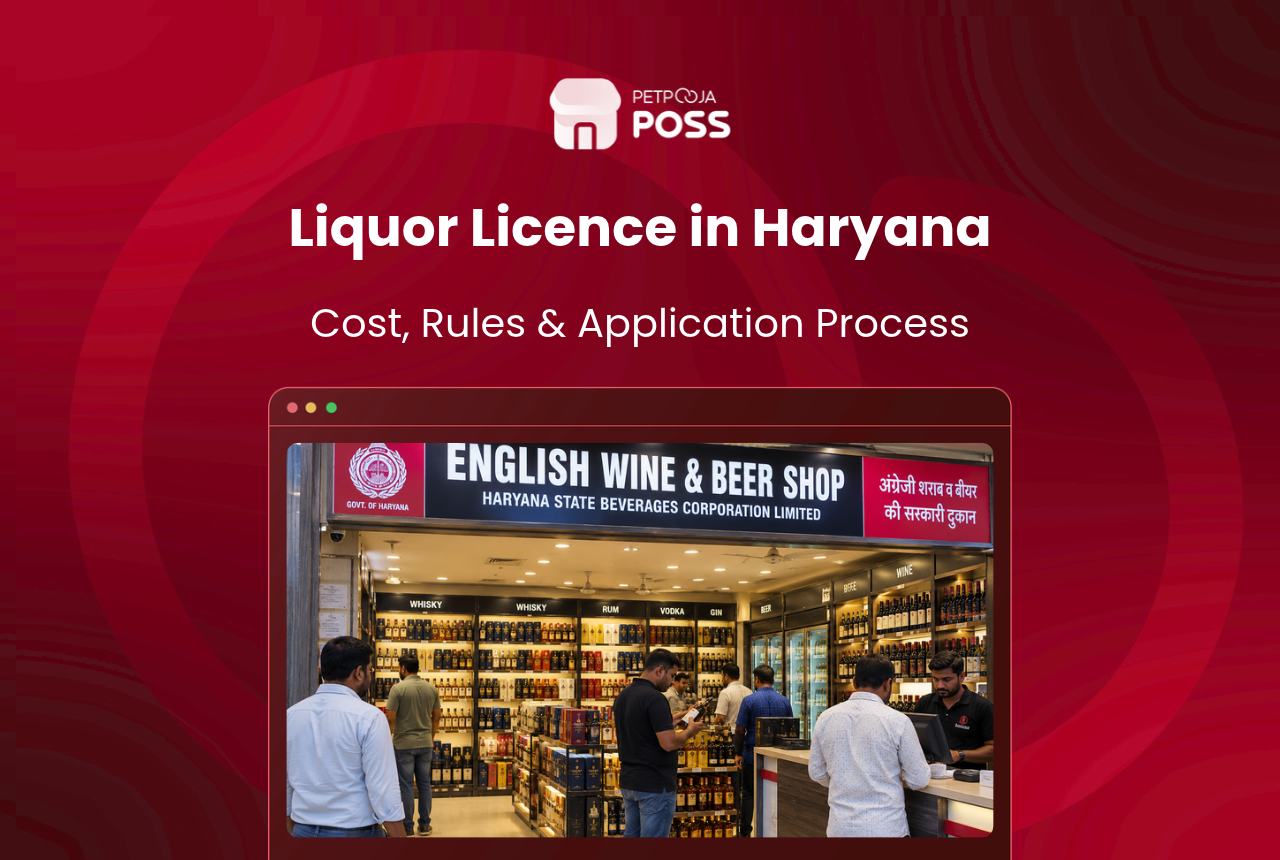
A liquor licence in Haryana costs a restaurant between ₹23 lakh and ₹45 lakh, and the figure depends on the district. Gurugram is the dearest. Most other districts are half the price.
The number that catches people out is not the fee. It is the period. This fee does not buy you a year. It buys you the whole 2025-27 policy period, which runs 21 months, and you pay it in seven quarterly instalments.
Retail shops work another way entirely. They are sold by zone through an e-tender, so there is no published price for them at all.
This post covers the bar fees by district and star rating, what a brewpub pays instead, and what late hours cost on top. It also covers who can apply, how both routes work, and what a missed instalment does to you.
Key Takeaways
- The headline fee covers 21 months, not 12. A Gurugram restaurant bar at ₹45 lakh is about ₹25 lakh a year, and that is the number to set against your takings.
- Staying open past midnight is bought separately, and in Gurugram it costs more than half the licence again.
- Most guides still quote fees replaced in June 2025.
What are the Liquor Licence Types in Haryana?
Six forms cover almost everything a food business needs. They are the bar licence, room service, a brewpub, a members’ club, a golf club and the two retail shop licences. Haryana names each by a form number rather than a description, so learn the codes before you reach a fee table.
- L-4 and L-5 are the bar licences. L-4 covers the bar in a hotel or restaurant and L-5 covers the attached service area. They are granted and priced together.
- L-3 is room service. It lets a hotel keep liquor in the room refrigerators.
- L-10C is the microbrewery licence, for a brewpub making its own beer on the premises.
- L-12C is the club bar, for a members’ club or a residential condominium.
- L-12G is the golf club bar, priced by the number of holes.
- L-2 and L-14A are the retail licences. L-2 sells Indian Made Foreign Liquor (IMFL) and L-14A sells country liquor. These are the shops, and they are won by tender.
If you are still weighing which one fits your premises, the types of bar licence guide explains what each category lets you serve. For the retail side, the wine shop licence process guide covers it across India.
How Much Does a Liquor Licence in Haryana Cost?
A restaurant bar runs from ₹23 lakh to ₹45 lakh. A hotel bar runs from ₹30 lakh to ₹85 lakh. Both figures cover the full policy period. Your district and your star rating set the figure. This section takes restaurants first, then hotels, brewpubs and clubs, and finally late hours.
Restaurant and standalone bar fees (L-4 and L-5)
Every bar that is not inside a rated hotel sits in this band. Only the district moves the number.
| Restaurant or bar location | Licence fee, 2025-27 |
|---|---|
| Gurugram | ₹45,00,000 |
| Faridabad, Panchkula and Sonepat | ₹35,00,000 |
| All other districts in the state | ₹23,00,000 |
An extra counter or bar point costs 20% of your licence fee, and you may hold at most three of them. On the Gurugram figure that is ₹9,00,000 for each one.
Hotel bar fees by star rating
A rated hotel pays more, but the fee buys extra bar points and room service without a separate charge.
| Hotel grading | Licence fee, 2025-27 | What it includes |
|---|---|---|
| 5 star and above | ₹85,00,000 | Main bar plus 3 points, room service, open round the clock |
| 4 star | ₹60,00,000 | Main bar plus 2 points, room service, open round the clock |
| 3 star, Gurugram | ₹53,00,000 | Main bar plus 1 point and room service |
| 3 star, Faridabad, Panchkula and Sonepat | ₹38,00,000 | Main bar plus 1 point and room service |
| 3 star, all other districts | ₹30,00,000 | Main bar plus 1 point and room service |
A hotel with no star rating pays a flat ₹2,00,000 for the L-3 room service licence on top of its bar fee. Rated hotels can also serve in up to three approved halls and ground floor lawns, for a one-off 50% of the licence fee.
Microbrewery fees (L-10C)
A brewpub that brews its own beer on the premises needs an L-10C. It is a bar licence in its own right, granted and paid the same way as the rest, and the fee is lower. L-10C is ₹30,00,000 in Gurugram, ₹20,00,000 in Faridabad, Panchkula and Sonepat, and ₹10,00,000 in every other district.
Excise duty on top is charged on your installed fermenting capacity at ₹40 per bulk litre a year, not on what you sell. The security is ₹2,00,000 rather than the ₹5,00,000 a bar pays.
Club and golf club bars
Clubs are priced on what kind of club they are, not on where the members live.
A club of repute pays ₹42,00,000 in districts with a metropolitan development authority and ₹21,00,000 elsewhere. A club inside a residential condominium pays ₹32,00,000 in Gurugram, ₹25,00,000 in Faridabad and ₹16,00,000 in other districts. A golf club bar is ₹60,00,000 for nine holes and ₹1 crore for eighteen.
What it costs to stay open past midnight
Every bar in Haryana closes at midnight. Four districts can buy their way past it, and nobody else can.
| Extension bought | Gurugram and Faridabad | Panchkula and Sonepat |
|---|---|---|
| Midnight to 2 AM | ₹25,00,000 | ₹9,00,000 |
| Each further hour | ₹10,00,000 (after 2 AM) | ₹6,00,000 (to 3 AM) |
Those are the rates for 1 April 2026 to 31 March 2027. They rose from ₹20,00,000 and ₹7,00,000 in the first part of the policy period. A four star hotel extending one of its extra points to 2 AM pays ₹45,00,000 for that alone.
Every figure above comes from the Haryana Excise and Taxation Department’s Excise Policy 2025-27.
Petpooja is India’s biggest and most price effective restaurant POS, behind the success of 1,00,000+ outlets. It has run restaurant billing for 14+ years and processes 60 lakh bills a day at 0% errors.
A note on the fee figures, from me. I read the three guides that rank for this search alongside the policy itself. All three still quote L-4 at ₹30 lakh and L-5 at ₹20 lakh a year. Those figures were replaced in June 2025. Budget from the policy, not from a guide.
Who Is Eligible for a Liquor Licence in Haryana?
Haryana sets no capital test and no experience test, but it is strict about what kind of place you are and where it stands. This section covers who qualifies, who decides, and what the premises have to look like.
Who can hold a bar licence
Not every restaurant in Haryana is allowed one. An L-4 or L-5 goes only to:
- A tourist complex run by Haryana Tourism, anywhere in the state.
- A hotel rated three star or above, anywhere in the state.
- A hotel or restaurant of repute inside municipal limits, or inside a metropolitan development authority area.
- A hotel or restaurant of repute in an industrial township built by the Haryana State Industrial and Infrastructure Development Corporation (HSIIDC), such as Manesar, Bawal or Rohtak.
A restaurant outside all four is normally shut out. There is one way round it, and it exists to promote tourism. The Government may still grant a licence to a reputed hotel, resort or restaurant with good facilities outside those limits. The Excise and Taxation Commissioner has to recommend the case first.
Who grants it, and what they inspect
Three offices touch a bar licence, and one of them visits you. The licence is granted by the Collector (Excise), with the approval of the Excise and Taxation Commissioner. Renewals are handled by your district Deputy Excise and Taxation Commissioner, or DETC.
Before either of those, a district committee inspects the premises and judges whether the facilities are good enough.
One useful rule sits alongside all that. If a department other than Fire does not decide your no objection certificate within a month, it counts as granted. Which certificates you need first is covered in our guide to the liquor and eating out licence.
What the premises must look like
The building has to pass its own tests, and they are stricter outdoors than in. A retail vend cannot sit within 150 metres of a school, college, main bus stand or place of worship.
An open air or terrace point has its own list:
- Four walls, with entry and exit that can be controlled.
- No direct opening on to the main road.
- A wall or fixed fence at least six feet high, if it is a rooftop or balcony.
- Nothing visible to people passing by, or to anyone looking down from nearby.
- No water more than two feet deep inside the same premises.
Nobody under 21 may be served in an open air point, and open air points are not allowed in residential areas at all.
What a retail bidder must put up
For a retail zone the test is financial rather than physical. You furnish earnest money with your bid. A successful bidder then puts down 2% of the bid amount on allotment day. On top of that comes a solvency certificate, or a bank guarantee worth 10% of the licence fee.
How to Apply for a Liquor Licence in Haryana
A bar is applied for and a shop is bid for, so the two routes share almost nothing. This section takes the bar route first because it is the one most restaurants need.
The restaurant or hotel bar route
- Find your district band. The same restaurant bar is ₹22 lakh cheaper outside Gurugram, Faridabad, Panchkula and Sonepat, and nothing about the premises changes that.
- Count your bar points before you apply. The main bar is included. Each extra point is 20% of the fee and you cannot hold more than three, so decide the layout first.
- Apply to the Collector (Excise) for the form that matches your premises, whether that is L-4, L-5, L-12C or L-12G.
- Budget for the instalments, not the headline. The fee is paid in seven quarterly parts, and the security of ₹5,00,000 sits on top of it.
Opening a bar is a bigger job than the licence alone. The guide to opening a bar in India covers the rest of the setup.
The retail vend route
- Register for the e-tender when the department publishes the zone notice for your district. Several states now run this online through the excise portal.
- Read the reserve price. Each zone has one fixed in advance, and it is the floor your bid has to clear.
- Lodge the earnest money with your bid. It must be a bank draft, and nothing else is accepted.
- Pay the first security on allotment day, which is 2% of your bid. The bank guarantee of 10% of the licence fee follows before you open.
What Rules Come With a Liquor Licence in Haryana?
Two conditions shape the money more than the rest. How long the licence actually lasts, and where you are allowed to buy your stock. This section covers both.
The period is 21 months, not a year
The policy runs from 12 June 2025 to 31 March 2027 and is divided into seven quarters. The fee you saw above covers all of it.
Each instalment falls due in the first week of its quarter. If you take the licence part way through, you pay nothing for the quarters already gone. You pay in full for the quarter you are granted in, and each one after. Surrender early with your DETC’s approval and the remaining instalments stop.
Where you must buy your stock
You cannot buy your IMFL wherever you like. Every bar has to take its supplies from the nearest two L-2 licensees, and it picks between those two.
Neither of them may charge you more than 10% above the minimum retail sale price, which the state sets by category in clause 7.1 of the same policy.
That cap is the whole point. Your buying price is fixed for you, while your selling price is yours to set. The margin is the one number in this business you actually control.
Restaurant owners we work with tell us the quarterly instalment is what focuses the mind. It arrives whether the quarter was busy or not. Matching what you poured against what you bought is the job Petpooja does. A bar and brewery POS handles the pouring side of it.
What Happens If You Break the Haryana Liquor Licence Rules?
Two things end a bar here, and neither of them is a fine. Miss an instalment, or sell spirits the wrong way, and the licence goes. This section covers both, then what a retail default costs.
Miss a quarterly instalment and the licence is cancelled and the security is forfeited. The policy states it plainly and there is no graduated penalty before it. Your ₹5,00,000 security goes with the licence.
Selling spirits by the bottle is the other way to lose the licence. Whisky, rum, brandy and vodka must be sold by the peg. Wine, beer and cider are exempt. Selling unaccounted liquor, or stock without holograms, counts the same way.
The licence is cancelled at once and the security forfeited. A second offence inside one year debars you for two years. It debars the premises as well, so a new tenant cannot simply take over the room.
On the retail side the money at risk sits earlier. A bidder who backs out after winning loses the earnest money lodged with the bid. The department also holds the 2% paid on allotment day and the 10% bank guarantee. A zone walked away from costs plenty before any fine.
The fee rises themselves have not gone unchallenged.
The Tribune reported the changes in May 2025. It quoted Rahul Singh, a trustee of the National Restaurant Association of India (NRAI). He said they “impose a heavy financial burden on thousands of establishments and could discourage regulated, responsible drinking.”
Excise officials defended the rise as a way to raise revenue and push out illegal operators.
Conclusion
A liquor licence in Haryana comes down to two questions. For a bar it is a published fee, set by your district. That runs from ₹23 lakh in most of the state to ₹45 lakh in Gurugram, and higher again with a star rating.
For a shop there is no published fee at all. You set it yourself when you bid for a zone, against a reserve price the department fixes first.
Whichever side you are on, read the period before the price. The fee covers 21 months and arrives in seven parts, so the quarterly number is the one your cash flow has to survive.
Once the licence is running, the fee is fixed and your buying price is capped. The margin is where the business is won. Keeping the pour in step with the purchase is what a restaurant billing and inventory system is for.
Frequently Asked Questions
Liquor sold through a bar licence carries VAT at 18%, with a surcharge of 5% on that VAT. It applies to imported foreign liquor as well, so price the drink with both on top of what you paid your L-2 supplier.
A five star hotel can, at a fixed ₹20,00,000 for each point it sub-leases. That is separate from the 20% charged for adding a point in the first place.
Haryana Tourism Corporation and the Haryana Shahari Vikas Pradhikaran (HSVP) pay a composite ₹2.70 crore each, covering all their outlets. They can instead choose to pay the ordinary district rate on each bar.
Yes, and the structure differs as much as the price. Rajasthan licence fees work off a guarantee the excise department fixes, while Delhi and Maharashtra each run their own system.
Our state-wise licence cost guide sets the charges side by side, and the Telangana licence fees page covers the other multi-year licence in the country. Madhya Pradesh licence fees show a state that publishes its bar rates flat by city and sells its shops by tender.








