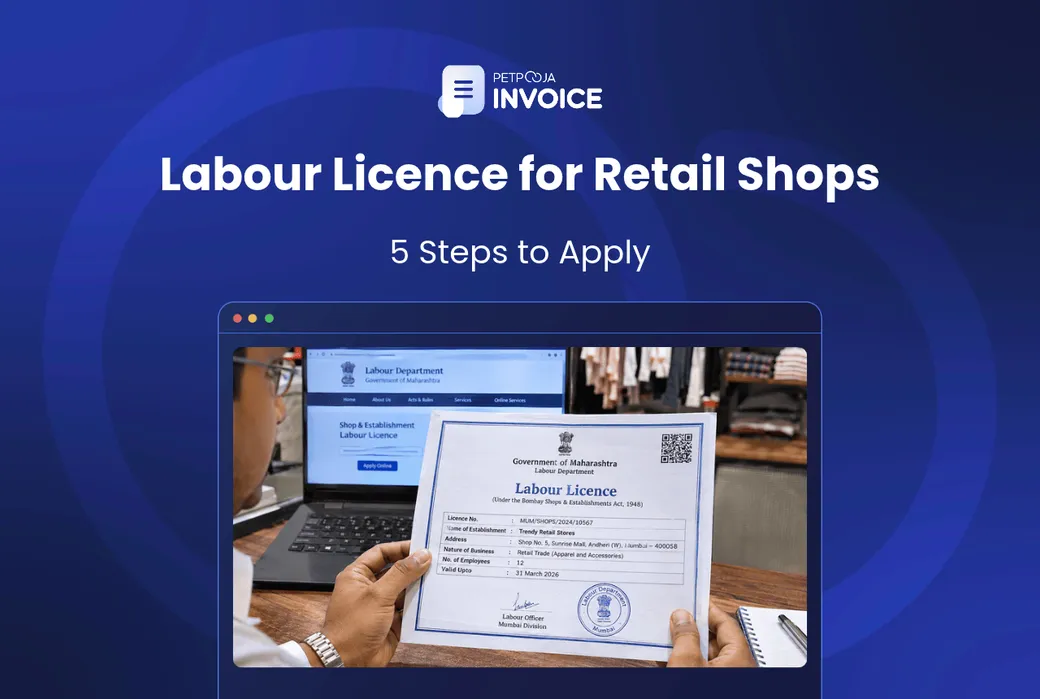



How do you get a labour licence for a retail shop? You get it in 5 steps. Check your state’s shops and establishments law, gather your documents and apply on the state labour department’s portal. Then pay any fee, display the certificate or receipt, and renew it or report changes when your state asks.
Two things decide how much of this you have to do: your state and the number of people you employ. Each state has its own law. In some states, a small shop only informs the labour department instead of taking a full registration.
“Labour licence” is the everyday name for this shop registration. People also call it a gumasta licence or a shop act licence. The same phrase is also used for a labour contractor’s licence. That is a different licence, which the section on the new labour codes touches on.
This guide walks small Indian business owners and shop owners through the 5 steps, the rules in five major states and the portal clicks for each of them. It also covers the penalties, and how to keep the certificate in line with the name and address on your GST bills.
Key Takeaways
- You get a labour licence from your state in 5 steps, mostly online. In Maharashtra and Gujarat, shops under 20 workers get a receipt, not a certificate.
- In those two states, recount staff before festive hiring, because 20 workers means full registration.
- Keep the shop name and address the same on your shop papers and GST bills, or a bank may query it.
How to Get a Labour Licence for Your Retail Shop
You get a labour licence for your retail shop in the same 5 steps in the five states below, mostly online. Some steps are lighter in some states. This section takes each step in order, from checking your state’s rule to keeping the certificate up to date.
The 5 steps:
- Check your state’s shops and establishments law.
- Gather the documents shop owners need.
- Apply on your state’s labour department portal.
- Pay the fee, then download and display the certificate.
- Renew the labour licence or report changes.
1. Check Your State’s Shops and Establishments Law
Every state and union territory has its own shops and establishments law, so the first job is to find yours. The law tells you two things: whether your shop must register, and how soon after you open.
Some states, like Maharashtra and Gujarat, set a worker line. Below it, you file an intimation, a short online notice that your shop has opened. You get a receipt for it, not a registration certificate. At or above the line, you take a full registration.
Maharashtra is a good example. An ordinance of 1 October 2025 raised its line from 10 to 20 workers. Bill LXXXIX of 2025 was then brought in to make that change an Act. The bill also shows the time limit: you apply or file the intimation within 60 days of starting the business.
Here is how the count works in practice (an example). A mobile phone shop in Pimpri has 12 counter staff and hires 4 more for the festive rush in October 2026. That is 12 + 4 = 16 workers, still under 20, so it files an intimation and gets a receipt.
A saree showroom in Thane with 23 staff (an example) is over the line, so it registers.
The card below shows the two routes.
Under 20 workers File an intimation Get a receipt, not a certificate Example: Pimpri shop, 16 workers 20 or more workers Take a full registration Get a registration certificate Example: Thane showroom, 23 staff The two routes in Maharashtra and Gujarat, using the examples above. Green: the intimation route for smaller shops. Amber: full registration once a shop reaches 20 workers.If your headcount sits close to 20, plan for the amber route before you hire.
Maharashtra’s 2025 amendment bill also shows the rule for a growing shop. Once your headcount reaches the line, you must take a full registration, so count again before every festive hiring season. If you use part-time or agency staff, ask the labour office how they count.
2. Gather the Documents Shop Owners Need
Keep your papers ready before you open the portal, because most forms ask you to upload them with the application. The list differs by state. Uttar Pradesh’s registration steps say no document is needed under its Act.
Maharashtra’s 2018 shops and establishments rules list these for a full registration:
- Aadhaar card of the employer, or of the person in charge if the business is a company.
- A photo of the shop that shows the inside and the Marathi name board.
- Any other licence the business must hold before it starts, like FSSAI for a food shop.
- Proof of the premises if you own it: a sale deed, property tax receipt, electricity bill or society maintenance receipt.
- For a rented shop: the lease or leave and licence agreement, plus one of those papers for the owner.
- A no-objection letter from a family member if the shop is in their premises. If it sits in a housing society, you need one from the society.
An intimation needs far less. The same rules list only two papers for it: the Aadhaar card and the shop photo with the Marathi name board.
Tamil Nadu’s registration form asks for similar details. It wants the shop’s name, nature of business, address, phone and email. It asks how the business is set up, such as a sole owner or a partnership. Then come the owner’s address proof, the number of employees, and a photo of the name board in Tamil.
So two habits help. In Maharashtra and Tamil Nadu, put up the name board in the state’s language before you photograph it. Then scan your rent agreement and electricity bill as clear PDF files.
3. Apply on Your State’s Labour Department Portal
Apply on your state labour department’s own portal, or the state single-window portal it points to. The form asks for the shop’s name, address, nature of business, owner details and headcount, then any document uploads your state needs.
In Uttar Pradesh, the labour department’s registration steps send you to the Nivesh Mitra portal, the state’s single window for permits. There you pick “Registration under UP Shops & Establishment Act, 1962”, the English name for the UP Dookan Aur Vanijya Adhishthan Adhiniyam, 1962. The state-by-state section below lists the steps for Uttar Pradesh and four other states.
Type the shop’s name exactly as it appears on your rent agreement and your GST registration. A small spelling change here follows you onto the certificate.
Use the same spelling you will set up in your billing software, so your GST bills match from the first day. Our shop and establishment licence guide covers the same process for cafés and restaurants.
4. Pay the Fee, Download the Certificate and Display It
Fees depend on the state. Some charge by the type of business and the number of staff. Some charge a flat fee, and some charge nothing for the registration itself. A few examples from official sources:
- Maharashtra: the 2018 rules say no fee is prescribed, but you pay the government’s e-service charges.
- Tamil Nadu: a July 2024 gazette notification sets a ₹100 fee and says the inspector issues the certificate online within 24 hours.
- Uttar Pradesh: the fee is set by the nature of the business and the number of workers.
What you get back depends on which route you took. In Maharashtra, an intimation gets an online receipt in Form G under rule 9 of the 2018 rules. The receipt itself says it is only an acknowledgement, not proof that the business exists. A full registration gets a digitally signed certificate in Form B.
That certificate then comes to you online. In Maharashtra, it carries eight details. These are the registration number, the name of the establishment, the name of the employer and the nature of business. Then come the address of the establishment, the date the business started, the number of workers and the period of registration.
Print the certificate or receipt and hang it where customers and inspectors can see it, usually behind the billing counter. Save the PDF in two places, because banks and suppliers may ask for a copy.
5. Renew the Labour Licence or Report Changes
Renewal depends on your state, so check what your own law says. Two examples from official sources:
- Telangana: the labour department’s FAQ page says every certificate must be renewed by 1 December each year. So a pharmacy in Madhapur, Hyderabad, would renew every year (an example).
- Maharashtra: the 2018 rules have an online renewal form, and the certificate says it must be renewed 30 days before it expires.
In Maharashtra, renewal is for the full certificate. The rules set no renewal for an intimation receipt. So the Pimpri phone shop in step 1 has nothing to renew while it stays under 20 workers. If it closes, the 2017 Act asks it to tell the Facilitator, the labour office that handles these filings, within 30 days.
Changes matter as much as renewal. In Maharashtra, the 2018 rules ask you to report any change in the certificate details online within 30 days. That covers a new address, a new shop name or a change in the business.
When you report a change, update your billing software on the same day. Your GST bills then carry the new details from the first bill.
Put the renewal date and the 30-day change window into one calendar. Our labour law compliance calendar gives you a ready format for it.
How to Apply for a Labour Licence Online, State by State
To apply for a labour licence online, you create an account on your state’s portal and pick the shops and establishments registration. Then you fill the form, pay and download the certificate or receipt. Below are the clicks for five states, taken from each department’s own guide or portal.
Apply for a Labour Licence in Maharashtra (LMS Portal)
Maharashtra takes shop filings on the labour department’s Labour Management System (LMS). These steps come from the department’s own user manuals for the portal:
- Go to the LMS portal and click Create Employer User Profile. This opens MAITRI, the state’s single window, where you register with your mobile number and email.
- Log in on MAITRI and fill the CAF (Common Application Form).
- Click Services Provided, then Labour Department, and click Apply next to the shops and establishments service. This takes you back to LMS.
- Click Shop and Establishment Application in the left menu, then Application Form.
- Pick intimation or registration, depending on your headcount, and click Confirm.
- Select your Division, District and Office Name, then fill the form.
- Click Upload Document against your application ID and upload the papers listed in step 2 of the 5 steps.
- Click Make Payment and pay the e-service charge online. On the intimation route, click Download Intimation Receipt to get your receipt straight away.
On the registration route, the digitally signed certificate comes online once the office approves it, as step 4 of the 5 steps explains.
The intimation manual still describes the old 0 to 9 worker line, so the option on screen may say the same. Count your staff against the 20-worker line, not the label.
Apply for a Labour Licence in Gujarat (eNagar)
Gujarat runs shop registration in its municipal cities through the eNagar portal. These are the menu names on the portal as of November 2026:
- Go to the eNagar portal and click Citizen Login. First-time users click Sign up and create an account.
- Log in with your username, password and the captcha.
- Click License, then Services, then Shops and Establishment.
- Click New Registration and fill in the shop’s details.
- Pay through Shops and Establishment Payment under Quick Pay. You can pay by debit card, credit card, net banking or UPI.
- Click Download Payment Receipt and keep it with your papers.
These steps are for a full registration. Shops under 20 workers give an intimation to the labour inspector instead. The same menu has Renew Registration, Modification and Cancellation for later. If your city is not listed on eNagar, check your municipal corporation’s website.
Apply for a Labour Licence in Uttar Pradesh (Nivesh Mitra)
Uttar Pradesh takes the registration through Nivesh Mitra, its single window for permits. These steps come from the labour department’s registration steps mentioned earlier:
- Go to the Nivesh Mitra portal and click Register here.
- Fill the sign-up form and verify your mobile number and email ID.
- Log in with the details sent to your email, then set a new password.
- Fill the common application form with your personal and business details.
- Click New Unit Details and add your shop.
- Click Apply for Permission/NOC/License and select your shop.
- Tick the box next to Department of Labour and select the registration under the UP Shops and Establishment Act, 1962.
- Click Fill/view form, fill it, then click calculate fee and submit.
- Click Pay consolidated fee on the left panel and pay. The certificate is generated once the payment goes through.
The department’s guide gives the old address, niveshmitra.up.nic.in. The portal now runs at the .gov.in address, so the button names may look slightly different.
Apply for a Labour Licence in Tamil Nadu
Tamil Nadu’s labour department publishes its own step-by-step procedure for the online application. In short:
- Go to labour.tn.gov.in and click New User.
- Enter your personal details and address, verify your mobile number and email, and upload your PAN card (or ration card, voter ID or driving licence) and Aadhaar card.
- Set a password, then log in on the user login page.
- On the dashboard, click The Tamil Nadu Shops And Establishments Act, 1947, then Registration.
- Fill in the shop, owner and worker details.
- Upload the GST proof or electricity bill, residential proof, PAN card and a photo of the name board. Each file must be a PDF under 1 MB.
- Tick the self-declaration and submit.
- Click Pay Online and pay the fee.
- Once the status shows Approved, click Download Certificate.
The procedure sets a timeline of 1 day for registration. If the status shows Returned, fix what the inspector flags and submit again.
Apply for a Labour Licence in Telangana
Telangana’s labour department home page links to both the application and the download. The screens in between are behind the login:
- Go to labour.telangana.gov.in and click Login for Online Registration / License and Renewals.
- Log in, or register if you are new, and follow the application steps on the portal.
- Once it is approved, click Application Status / Download Registration Certificate / Licence on the home page to get the certificate.
The labour department’s FAQ also mentions paying fees through MeeSeva centres, so check which payment route the portal offers when you apply.
Portal menus change often, so follow what the portal shows on the day.
What I could recommend from my end. Create the portal account with a mobile number and email the business will keep, not a staff member’s personal ones. Renewals, change reports and certificate downloads all go through that same login, often years later.
Labour Licence Rules for Retail Shops in 5 Major States
The labour licence rules for retail shops differ most on three points: the worker line, the portal and renewal. The table covers five major states, taken from each state’s official pages and laws.
| State | Shops Law | Who Must Register | Where to Apply | Renewal |
|---|---|---|---|---|
| Maharashtra | Maharashtra Shops and Establishments (Regulation of Employment and Conditions of Service) Act, 2017 | 20 or more workers; fewer than 20 file an intimation and get a receipt (since 1 October 2025) | LMS portal, through the MAITRI single window | Certificate: yes, 30 days before expiry. Intimation receipt: no renewal in the rules |
| Gujarat | Gujarat Shops and Establishments (Regulation of Employment and Conditions of Service) Act, 2019 | 20 or more workers since a 2025 ordinance; fewer give an intimation to the labour inspector and get a receipt | eNagar portal (municipal cities) | Renewal service listed on eNagar |
| Telangana | Telangana Shops and Establishments Act, 1988 | Every shop, within 30 days of opening | Labour department portal; its FAQ also mentions MeeSeva centres for fees | Yes, every year |
| Tamil Nadu | Tamil Nadu Shops and Establishments Act, 1947 | Not stated in the July 2024 notification; new shops apply in Form Y | Labour department web portal | Not stated in the 2024 rules |
| Uttar Pradesh | UP Dookan Aur Vanijya Adhishthan Adhiniyam, 1962 | Shops in notified municipal areas, within 6 months of opening | Nivesh Mitra single-window portal | Not stated in the registration steps |
We read each state’s official pages on 5 November 2026. States change these laws often, so check the current rule on your state’s website before you apply.
In Gujarat, the 2026 amendment bill was brought to replace the 2025 ordinance. It sets the registration line at 20 workers, up from 10.
Shops under 20 workers give an intimation to the labour inspector instead. They get a receipt. In the cities eNagar covers, registration goes through the portal, as the step-by-step section shows.
If your state is not in the table, search for your state’s labour department site. Look for the words “shops and establishments” in its online services list.
Match Your Labour Licence to Your Retail GST Bills
Your labour licence and your GST bills should carry the same shop name and address. This section explains why, and how to set it up once in your billing software.
Every GST tax invoice must show the supplier’s name, address and GST Identification Number (GSTIN). That comes from CGST Rule 46. So two of the fields on your shop certificate, the name and the address, also print on every bill.
If your shop is on the intimation route, use the same name and address on the intimation as on your bills. A bank may not accept an intimation receipt as business proof, so a small shop may need another document for its bank account.
Banks may compare your shop papers when you open a current account. These are the Know Your Customer (KYC) checks. The Reserve Bank of India’s KYC Directions, 2025 lists papers a bank can take as proof of a sole owner’s business. The shop registration certificate is one. A GST certificate is another. The bank asks for any two papers from that list.
If the names on those two papers differ, a bank may query the mismatch.
Registration number Name of the establishment Match GST bill Name of the employer Nature of business Address of the establishment Match GST bill Date business started Number of workers Period of registration The eight fields on a Maharashtra shop registration certificate, issued for a full registration. Green: the two fields, name and address, that also print on every GST bill, so they should match.Of the eight fields, the name and the address are the ones that should match your bills, so check those two letter by letter.
Here is the kind of gap to look for (an example). A hardware store in Warangal is registered as “Shree Balaji Hardware, Shop 4, Station Road”. Its bills print “Balaji Hardwares, Station Rd”. Both describe the same shop, but the names differ, and a bank may query the mismatch.
With Petpooja Invoice, you set your business name, address and GSTIN once in the business settings, and they print on your GST invoices. Multi-counter billing lets more than one counter bill on the same system. Your customer and vendor records and your reports sit in the same system.
If you are still choosing a billing tool, our list of GST billing software for small businesses compares five options.
Penalties for a Retail Shop Without a Labour Licence
A retail shop that runs without its labour licence can face penalties under its state’s shops law. The penalty for running without registration differs by state, and each state sets it in its own Act.
The five Acts in this post are from Maharashtra (2017), Gujarat (2019), Telangana (1988), Tamil Nadu (1947) and Uttar Pradesh (1962). Check the penalty section of your state’s Act, or ask the labour office.
Two examples from official sources show how fines and settlements work under the rules:
- Tamil Nadu: the July 2024 gazette notification mentioned earlier raised the fine for breaking the state’s shops rules (rule 18), from up to ₹50 to up to ₹2,000.
- Maharashtra: the 2018 rules mentioned earlier set up a Compounding Officer. An employer can settle a case by paying a fee. The officer sets the fee by how serious the breach is.
Beyond the fine, a missing certificate slows down everyday work. You lose one of the business proofs a bank accepts, as the GST bills section explains. An inspector who visits can also ask to see it.
If you have been trading without it, apply now rather than waiting for a notice. Our labour law compliance checklist helps you find any other gaps at the same time.
Do the New Labour Codes Change the Labour Licence?
For most shops, the new labour codes do not appear to replace the labour licence. The shops laws are state laws, and they were not merged into the four codes. A government backgrounder of 21 November 2025 explains how 29 labour laws were brought into four codes.
One of them, the Occupational Safety, Health and Working Conditions (OSH) Code, 2020, merged 13 central Acts. The backgrounder lists them, and no state shops law is on that list. So, as things stand, your shop still registers under your state’s law.
A larger establishment may also have separate duties under the OSH Code. If your business employs many people, check with your state labour office which code duties apply to you.
The codes did change the other “labour licence”, the one for contractors. The Contract Labour (Regulation and Abolition) Act, 1970 is one of the 13 Acts the OSH Code merged.
The same backgrounder says the contract labour rules now start at 50 contract workers instead of 20. It also mentions an all-India contractor licence valid for 5 years.
Conclusion
You get a labour licence for a retail shop in 5 steps, mostly online. Your state’s law and your headcount decide whether you register or only file an intimation.
Start by checking your state’s worker line and gathering the premises papers. Then apply on the labour department’s portal and hang the certificate or receipt behind the counter. If your state asks for renewal, put the date in your calendar.
For small Indian business owners and shop owners, the certificate and the bills should describe one business. Once you have the labour licence, copy the same name and address into Petpooja Invoice. Then every GST bill matches the certificate on your wall.
FAQs
How Do I Check My Labour Licence Status or Download It?
Most state portals let you track an application and download the certificate after you log in. Uttar Pradesh also has a public page to verify a registration number. Keep your application number handy, because most status pages ask for it.
Do Shop Owners Need a Separate Labour Licence for Each Branch?
Usually, yes. The forms are filed for each shop at its own address. So a second shop in another place is normally a second registration. Each branch’s certificate then carries its own address, which should match that branch’s bills.
Is a Labour Licence the Same as a Trade Licence?
No. The labour licence is issued under the state’s shops and establishments law and deals with the shop as a workplace. A trade licence comes from your local municipal body under its own rules. Treat it as a separate application.
Do I Still Need GST Registration If I Have a Labour Licence?
Yes, if your turnover or your type of sales calls for it. The shop registration and GST registration are separate, and one does not replace the other. Our GST registration checklist lists the papers you need for GST.
Can I Apply for a Labour Licence Before My Shop Opens?
The deadlines in this post count from the day you open, so there is no rule against applying early. In practice, many forms ask for a photo of the name board, so most shops apply once the shop is set up. You then have up to 60 days after opening in Maharashtra and 30 in Telangana.
Thanks. This helps us make the next article better.