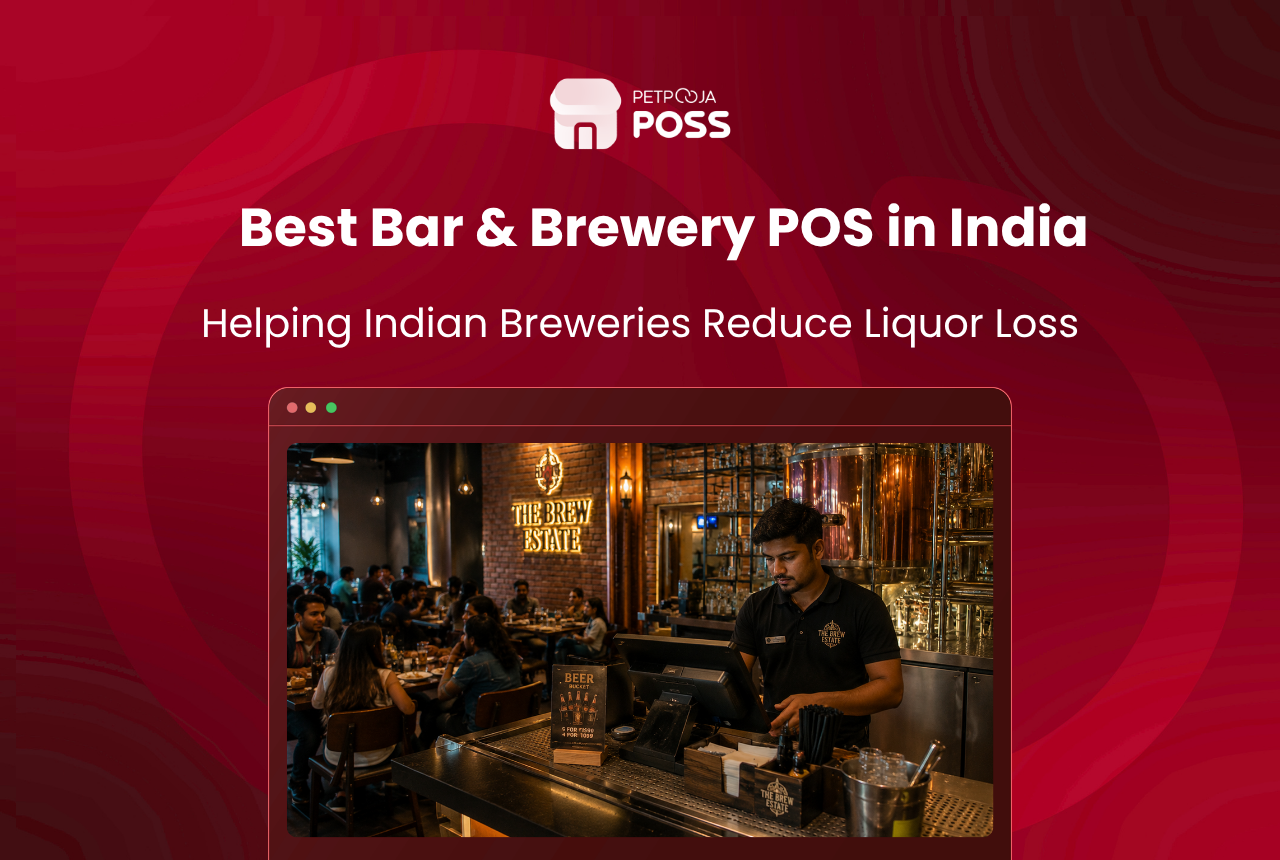
The best bar POS in India is the one that controls your two biggest risks: liquor inventory and pilferage. A bar loses money differently from a restaurant. The stock is high-value, easy to over-pour, and easy to walk out the back door. So a bar POS has to track liquor down to the measure and flag every suspicious void or free drink.
A regular restaurant POS bills food and sends tickets to the kitchen. A bar POS does that too, but it also watches the bottle. It deducts each peg from stock as you bill it, keeps bar orders separate from food orders, runs happy-hour prices, and holds an open tab for every guest at the counter.
Petpooja POSS is built for bars and breweries with exactly these controls: liquor inventory, consumption tracking, pilferage monitoring, multi-terminal billing for bar and kitchen, bill splitting, happy-hour sales, and individual tabs. It already works with bar brands like The Beer Cafe. The rest of this guide covers what to look for, and how each part works.
Key Takeaways
- A bar POS must track liquor stock as each drink is billed, not just at the end of the month
- Pilferage hides in cancelled bills, waived-off bills, reprints, and free drinks, so a good POS logs all of them
- Petpooja POSS handles liquor inventory, consumption tracking, and pilferage monitoring in one system
- Multi-terminal billing keeps bar tickets and kitchen tickets apart, with happy-hour pricing and per-guest tabs
- The right bar POS for you is the one that matches your licence type, floor layout, and stock
What Makes a Bar POS Different from a Regular Restaurant POS?
The difference sits in the stock. In a kitchen, a wrong portion costs a few rupees of dal or paneer. Behind the bar, a heavy hand on a premium pour, or a drink served and never billed, costs far more, and it happens shift after shift.
A bar also runs on a different rhythm. Guests sit for hours, order in rounds, and settle one tab at the end. Drinks need to reach the bartender while food reaches the kitchen. Prices change by the hour when happy hour starts. A POS built only for quick food billing struggles with all of this.
India’s food-services sector is large, valued at around ₹5.69 lakh crore by the National Restaurant Association of India, and bars sit at its high-margin, high-risk end. That mix of expensive stock and heavy footfall is why a bar earns or bleeds on stock control. It is also why the POS features a bar needs look different from a cafe’s.
What Should the Best Bar POS in India Do?
Before comparing brands, judge any bar POS against what the format actually needs. A tool that ticks these boxes will serve a pub, a fine-dine bar, or a microbrewery far better than a generic biller.
| Bar POS capability | Why it matters for a bar |
|---|---|
| Recipe-based liquor deduction | Sets the measure per drink and cuts stock as each is billed, so the bottle is tracked live |
| Consumption & variance tracking | Compares what should have been poured against what is missing, exposing over-pours and theft |
| Pilferage controls | Logs cancelled, waived, and reprinted bills and free drinks, the usual cover for a skimmed serve |
| User rights | Limits who can void a bill, give a discount, or open the cash drawer |
| Multi-terminal (bar vs food) | Drinks print at the bar, food prints in the kitchen, from one account |
| Happy-hour pricing | Switches to lower prices for set hours without manual edits |
| Individual tabs & split bills | Holds a running tab per guest and splits it cleanly at the end |
| State excise reports | Produces the format your excise department expects |
How Does Petpooja POSS Control Liquor Inventory?
This is where a bar POS earns its keep. In Petpooja POSS, you set each drink as a recipe with its measure, a 30 ml or 60 ml peg, for example. When a bartender bills that drink, the system removes that measure from the bottle’s stock on its own. Over a busy Saturday, the count keeps itself current instead of waiting for a month-end audit.
A daily stock closing check then does the real work. It shows closing-stock accuracy as a figure and marks any day you skipped. The gap between what the bills recorded and what is actually left in the bottle then shows up the next morning, not months later. That gap is your variance, and variance is where pilferage shows up.
In practice, tracking a bottle runs in four steps:
- Set each drink as a recipe with its measure, such as a 30 ml or 60 ml peg.
- Stock deducts that measure the moment the drink is billed.
- A daily stock closing check compares expected stock against what is actually left.
- Any variance points you to the bottle, the shift, or the user to look into.
Cleaner stock data also feeds better buying and pricing. Once you can see true consumption per label, it is easier to spot dead stock, reorder the fast movers, and read the bar inventory reports that keep liquor costs in check.
How Does a Bar POS Stop Pilferage?
Most bar theft is not a bottle going missing. It is a drink served, enjoyed, and never rung up, or one rung up and then cancelled after payment. Petpooja POSS carries a leakage view that watches for exactly these signals: KOTs that were cancelled, modified, or never turned into a bill, and bills that were modified, reprinted, or waived off.
The second layer is control over who can do what. User rights and permissions decide which staff can void an item, apply a discount, or reprint a bill. That way a large void is not one bartender’s private call. Discount caps limit how much can be knocked off at the counter, and the cash drawer stays shut on a complimentary order, which removes a common no-sale trick.
Here is an example, not a real bar. Picture a pub in Koramangala, Bengaluru, where the Friday variance report shows 14 pegs of a single malt missing against sales. The leakage view lists three cancelled bills on one terminal after 11 pm, all by the same login. That pattern, stock gap plus cancelled bills on one user, is what a manual register would never surface. For the wider playbook, our guide on stopping bar liquor theft goes deeper.
Running the Bar Floor: Tabs, Happy Hours, and Separate Tickets
Control is only half the job. The POS also has to keep a busy floor moving. Multi-terminal billing lets several counters run off one master account, so the bar station and the food counter bill at the same time without tripping over each other. Drinks route to the bar as their own KOT while food routes to the kitchen, which stops a cocktail order getting lost behind a food ticket.
For service, POSS holds an individual tab per guest, adds each round to it, and splits the bill cleanly when a group leaves. Happy-hour pricing switches to the lower rate for the hours you set, then switches back, with no manual price edits mid-shift. Captains can also take and settle orders tableside, which we cover in captain ordering.
How to Choose a Bar POS in India
Start with your licence and your layout, not the feature list. A bar runs under a state excise licence, issued by bodies such as the Delhi Excise Department. POSS can produce state excise reports where required, such as the West Bengal Excise report. Match the POS to how you actually operate before anything else.
A few practical checks before you sign:
- Liquor stock, not just food stock. Confirm the POS deducts by measure per drink and shows daily variance, as covered in optimising bar inventory.
- Pilferage reporting. Ask to see the leakage or void report, not just a promise of “security”.
- Offline billing. A dropped connection should not stop service; POSS keeps billing for up to five days offline and syncs later.
- Excise and GST. Check the POS handles the tax and excise formats your state expects.
- Your kind of bar. A taproom, a nightclub, and a fine-dine bar have different needs; the drink pricing setup should be easy to configure.
Several established POS players serve Indian restaurants, so compare a few on these points rather than on price alone. The best bar POS is the one that fits your outlet, backed by round-the-clock support for the nights things go wrong. You can see Petpooja POSS measured against this checklist on your own floor.
Conclusion
A bar does not fail on the menu. It fails on the pours nobody counted and the drinks nobody billed. That makes stock control and pilferage control the real test of a bar POS, well above how pretty the billing screen looks.
Petpooja POSS is built for that test, with liquor inventory, consumption and variance tracking, a leakage view, user rights, multi-terminal bar-and-kitchen billing, happy hours, and per-guest tabs in one system, behind 24×7 support. To see how it fits your bar or brewery, book a demo. If you are still at the setup stage, our guide on opening a bar in India walks through the licences and costs first.
Frequently Asked Questions
A bar POS is a billing and management system built for outlets that sell alcohol. On top of normal restaurant POS billing, it tracks liquor stock as each drink is billed, keeps bar orders separate from kitchen orders, runs happy-hour prices, holds open tabs per guest, and flags the voids and free drinks that hide pilferage.
Look for liquor inventory with recipe-based stock deduction, consumption and variance tracking, pilferage controls such as a leakage report and user rights, multi-terminal billing that keeps bar and kitchen tickets apart, happy-hour pricing, split bills, individual tabs, and state excise reports.
It deducts each measure from stock as a drink is billed, so the system knows what should be left. A daily stock check then shows any gap between expected and actual stock, backed by an inventory audit. Petpooja POSS also flags cancelled bills, waived-off bills, reprints, and modified KOTs, the usual cover for a skimmed drink.
Yes. Petpooja POSS runs happy-hour pricing for set hours and routes bar and food orders as separate KOTs, so drinks print at the bar station and food prints in the kitchen. It also keeps an individual tab per guest and splits bills at the end of the night. A quick check on your drink margins helps set those happy-hour prices.
Yes. POSS supports bars and breweries with liquor inventory, consumption tracking, and pilferage monitoring, and it already works with bar brands such as The Beer Cafe. A microbrewery running both a kitchen and a taproom gets separate bar and food tickets from the same billing account.