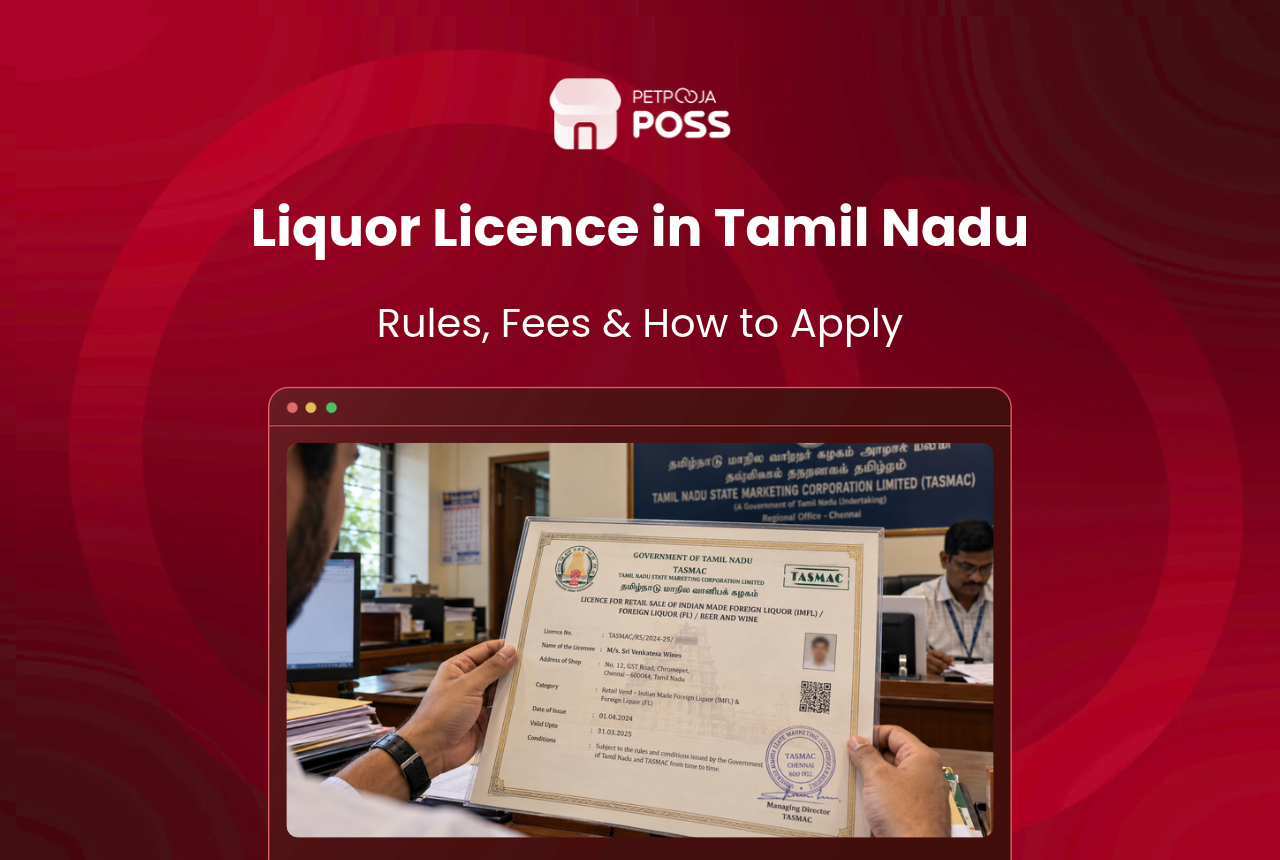
How do you get a liquor licence in Tamil Nadu? For a food business, you apply to the Commissioner of Prohibition and Excise in Chennai. The District Collector checks your premises and approves the file, and then the Commissioner grants the licence.
The catch is who can apply. Tamil Nadu has no standalone bar licence for a restaurant. The bar has to sit inside a hotel with rooms or a members’ club. A hotel needs an FL3 licence, and a club needs an FL2 licence.
The cost depends on that route. A hotel bar pays at least ₹5,32,500 a year, rising with the star rating. A club in Chennai now pays ₹30 lakh a year just for the right to sell liquor, after a June 2026 order raised club fees. That charge is called the privilege fee.
This post covers how to apply, the licence types, what the hotel and club licences cost, who is eligible, and what a breach costs.
Key Takeaways
- A restaurant alone cannot get a bar licence in Tamil Nadu. The bar must sit in a hotel with rooms or a members’ club.
- Apply to the excise Commissioner in Chennai. Your District Collector inspects the premises before any grant.
- Budget every year, not once. A hotel bar pays from ₹5,32,500 for each April-to-March licence year.
How to Apply for a Liquor Licence in Tamil Nadu
A bar licence in Tamil Nadu passes through two offices, the Commissioner’s office and your District Collector. This section takes the steps in order, from the first form to the licence.
- Pick the licence that fits your premises. A hotel applies for FL3, and a members’ club applies for FL2. The types are explained further down this post.
- Send the filled application to the Commissioner. The address is the Commissioner of Prohibition and Excise, Ezhilagam, Chepauk, Chennai 600 005. Attach the documents on the checklist for your licence type.
- Wait for the first check. The Commissioner’s office checks that the application is complete and correct.
- Pay at the Collectorate. Once the first check clears, you submit the same application again, this time to your District Collector. Attach the payment challan for the fees.
- Let the district team inspect. The Collector’s office verifies the documents and the premises. If the Collector approves, the file goes back to Chennai.
- Receive the licence. The Commissioner’s office does its final check and grants the licence for your category.
These steps come from the department’s FL2 and FL3 application checklist. The same checklist lists what the district team looks for. It wants a police No Objection Certificate (NOC) and fire safety kit in the bar and store room. It also wants a plan that marks the permit room, which is the room where liquor is served.
Renewing the licence every year
The licence year runs from 1 April to 31 March, so you renew every year. Renewal is online, on the department’s FL series renewal portal. You upload the papers again. They include your fire licence, your FSSAI licence and last year’s liquor purchases and sales.
Apply at least one month before the licence ends. If you miss that one-month mark, you can still apply before the licence ends, with a good reason. You then pay an extra 25% of the licence fee. The licence fee is ₹25,000 for a hotel bar and ₹30,000 for a club, so the extra is ₹6,250 or ₹7,500.
What I would do first. I would get the hotel’s boarding and lodging licence in hand before filling in anything. The FL3 checklist asks for it, and without it the application has nothing to stand on.
Several states now take these applications through an online portal. In Tamil Nadu, renewal is online. A new application still goes to the Commissioner’s office as a filled form.
What are the Liquor Licence Types in Tamil Nadu?
Tamil Nadu issues its bar licences under the Tamil Nadu Liquor (Licence and Permit) Rules, 1981. Each one is tied to a kind of premises, and none of them is for a restaurant on its own.
- FL3 is the licence for a hotel bar. It is graded by the hotel’s star rating. It covers drinks served in the licensed bar room, and sealed bottles guests take to their rooms.
- FL2 is the licence for a non-proprietary club, which serves its members.
- FL3A is for hotels run by the Tamil Nadu Tourism Development Corporation (TTDC).
- FL3AA is for TTDC hotels run by a franchisee.
The state’s Policy Note 2026-27 counts 869 FL2 licences and 812 FL3 licences in force.
Why a restaurant cannot open a bar on its own
Retail sale of Indian-made liquor in shops in Tamil Nadu belongs to one licensee, the Tamil Nadu State Marketing Corporation (TASMAC). Under the retail vending rules, its single licence covers its shops and the bars attached to them. A bar under those rules has to sit inside or next to a TASMAC shop.
So the public bars you see next to liquor shops run under TASMAC’s own licence. There is no separate excise licence a restaurant can apply for to join them. Hotels and clubs are different: they serve their own guests and members under FL3 and FL2. The 2026-27 Policy Note counts 4,048 TASMAC shops and 2,091 attached bars.
For how bar licences work in other states, the types of bar licence guide explains each category.
Liquor Licence Fees in Tamil Nadu for Hotel Bars
A hotel bar pays three fees every year, plus a draught beer charge if it serves draught beer. The biggest is the privilege fee, the yearly charge for the right to sell liquor. It is set by the hotel’s star rating, and the other two fees are flat. This section gives the official figures, then works through one hotel’s bill.
FL3 fees by star rating
| Hotel grade | Privilege fee a year | Licence fee | Application fee | Total a year |
|---|---|---|---|---|
| Five star, open 24 hours | ₹40,00,000 | ₹25,000 | ₹7,500 | ₹40,32,500 |
| Five star | ₹20,00,000 | ₹25,000 | ₹7,500 | ₹20,32,500 |
| Four star | ₹12,00,000 | ₹25,000 | ₹7,500 | ₹12,32,500 |
| Three star | ₹8,00,000 | ₹25,000 | ₹7,500 | ₹8,32,500 |
| Two star | ₹6,00,000 | ₹25,000 | ₹7,500 | ₹6,32,500 |
| One star and other hotels | ₹5,00,000 | ₹25,000 | ₹7,500 | ₹5,32,500 |
A hotel of three stars or above that serves draught beer pays an extra 10% of its privilege fee.
These are the figures in the department’s FL3 renewal procedure. The 2026-27 Policy Note revises the club fees but not these. Older pages on the same site still show lower FL3 fees, so go by the renewal procedure.
Before the licence is granted, the rules also ask for a security deposit and a signed counterpart agreement. The deposit can be forfeited if you break a licence condition.
What a three-star hotel bar pays
Here is what a three-star hotel in Madurai pays each year if it serves draught beer (an example).
So a three-star hotel bar with draught beer pays ₹9,12,500 every licence year, before the security deposit. The privilege fee is nearly nine tenths of it. That is why the star rating drives the bill. Our state-wise cost guide sets these against what bars pay in other states.
Club Liquor Licence Fees in Tamil Nadu
Club fees changed in June 2026, and they now depend on where the club is. This section gives the new figures.
Government Order (G.O.) (Ms) No. 38 of the Home, Prohibition and Excise Department, dated 25 June 2026, raised the FL2 fees. The new rates apply from 1 April 2026, as the 2026-27 Policy Note records.
| Where the club is | Application fee | Licence fee | Privilege fee a year |
|---|---|---|---|
| Chennai city | ₹10,000 | ₹30,000 | ₹30,00,000 |
| Other corporations, population above 10 lakh | ₹10,000 | ₹30,000 | ₹25,00,000 |
| Other corporations, population below 10 lakh | ₹10,000 | ₹30,000 | ₹20,00,000 |
| Municipalities | ₹10,000 | ₹30,000 | ₹15,00,000 |
| All other areas | ₹10,000 | ₹30,000 | ₹10,00,000 |
Older pages on the department’s site still show the lower club fees from before this order. Go by the 2026 figures above, and note that they apply to the whole licence year from April.
Who Is Eligible for a Liquor Licence in Tamil Nadu?
A hotel with rooms or a members’ club is eligible, and the person applying must have a clean record. This section covers hotels, then clubs, then the people behind them.
Hotels applying for FL3
The rules describe FL3 as a licence for star hotels. But the FL3 fee table above also has a row for “one star and other hotels”. So a hotel without a star rating is in the fee schedule too. Ask the Commissioner’s office which row your hotel falls in. The application checklist shows what the department expects from the hotel.
- A boarding and lodging licence for the current year.
- The restaurant’s sales for the last year.
- The number of guests staying in the last six months, and the average per day.
- Photos of the kitchen, two rooms with toilets, the restaurant and the reception. It also asks for the conference hall, car park and recreation room.
- A Tamil Nadu Public Building Licence.
The yearly renewal adds a restaurant licence and a structural stability certificate to that list.
The rules also count a beach resort as a star hotel if the state’s Director of Tourism certifies it. For that, the resort needs at least 20 lettable bedrooms or 40 beds with attached bathrooms. It also needs a separate dining room, conference and recreation facilities, and enough parking.
Clubs applying for FL2
A club must be non-proprietary, which means it belongs to its members rather than to an owner. It must have run for more than three years. At least 50 members must have said they want to obtain liquor from the club.
Who can hold the licence
You must not have a conviction under the Tamil Nadu Prohibition Act, 1937. A conviction for any other serious (cognisable or non-bailable) offence also rules you out. You sign a declaration saying so on the application form, which sits in the state’s liquor licence rules.
What If You Break the Tamil Nadu Liquor Licence Rules?
A breach can cost you the licence and the deposit. Separately, a place that allows drinking without any licence can be sealed for up to three months. This section covers what a bar owner and a restaurant owner should know.
Losing the licence and deposit
The Commissioner, who grants the licence, can cancel or suspend it if you break a condition. You get a written notice first, and up to 14 days to reply. The security deposit can also be forfeited in whole or in part.
The 2024 penalties
The Tamil Nadu Prohibition (Amendment) Act, 2024 raised the penalties sharply. The Assembly passed it on 29 June 2024, after the hooch deaths in Kallakurichi. The Governor gave assent on 11 July 2024. The penalties below are the ones the Bill as published in the gazette set out before the vote.
- Drinking in an unlicensed place. New section 5-A says the owner of a place must not allow liquor to be drunk there without a licence. An officer can seal the place for up to three months. It appears to cover a restaurant without a bar licence that lets guests drink their own bottles. The section names no exception for it.
- Allowing an offence on your premises. An owner or manager who lets a liquor offence happen there faces two to five years in prison. The fine is ₹1 lakh to ₹2 lakh.
Within 48 hours of a sealing, you get a written notice of the grounds, and you can reply to the officer. If the officer rules against you, you can appeal to the District Collector within 30 days.
Daily liquor accounts for an inspection
An FL3 hotel keeps a daily account of the liquor it issues. The rules say the daily total must tally with the main accounts register.
Bar owners we work with tell us the serving rules are easy to follow. The harder part is showing an inspector that the stock behind the bar matches what was sold. Matching what you sold against what you bought is the job Petpooja does. A bar and brewery POS tracks consumption against purchases.
Conclusion
To get a liquor licence in Tamil Nadu, you need a hotel or a club behind the bar. You apply to the excise Commissioner in Chennai. The District Collector checks the premises before the licence is granted.
Check the route first, then budget for the fee every year. A hotel bar pays from ₹5,32,500 a year, and club fees went up in June 2026.
Once the licence is live, bar owners tell us the harder part is showing that the stock behind the bar matches what was sold. Your restaurant billing and inventory system helps you match every bottle sold to a bill.
Frequently Asked Questions
No. The FL3 licence form bars any sale on Gandhi Jayanthi, 2 October. That is the one date written into the licence itself, so check with your district excise office for any other dry days ordered during the year.
Yes. The rules let the Commissioner license an additional permit room in the same hotel. It needs its own application and its own set of fees.
Each state prices its licences in its own way. Telangana licence fees are set by population. Rajasthan licence fees for a shop are a share of its yearly guarantee. Madhya Pradesh licence fees are published flat by city. Haryana licence fees cover 21 months rather than a year.