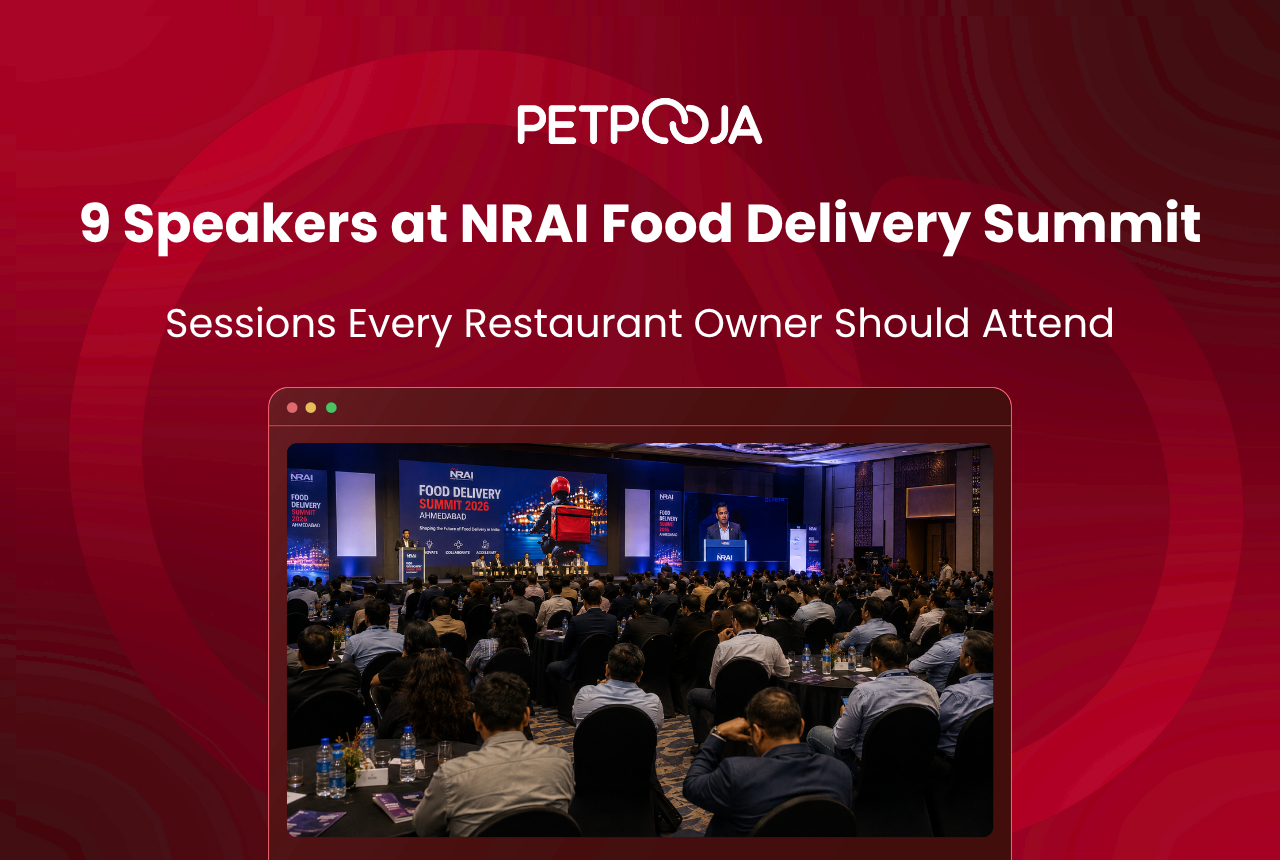
More than 70 speakers are expected at the NRAI Food Delivery Summit 2026 in Ahmedabad on 20 August. These are the top 9 for a restaurant owner: founders who built their businesses up from a single outlet.
For each one you get what they actually built and the question they are best placed to answer. Not what they will say, because no session summaries have been released yet.
Key Takeaways
- The top 9 founder-speakers fall into four groups, from chai chains to cloud kitchens.
- Judge a founder by the problem they solved, not the size of the business.
- Two of the nine built their businesses out of Gujarat.
- Bring your own numbers so their answers become comparisons rather than anecdotes.
How to Read This List
Every founder below gets the same two things: what they built, and the one question they can answer better than anyone else in the hall.
The summit puts its founders into four groups. Use the table to find the group closest to your own business, then read that section first.
| Founder Group | Who Is in It | Read This Group If |
|---|---|---|
| Chai and coffee chains | Chaayos, Chai Point, Tea Post | You sell a low-priced item and need volume to make the money work |
| Multi-outlet systems | Rolls King, 22nd Parallel, Boba Bhai | You are opening your second, third or tenth outlet |
| Kitchen-only brands | Dil Foods, BOX8 | You run delivery only, with no dining room |
| The early builders | Honest | You want to hear what worked before apps and funding existed |
For dates, venue and how to register, see our guide to the NRAI Food Delivery Summit 2026.
Founders Who Turned Chai and Coffee Into Chains
Three of the nine built national or regional chains on a product most people bought from a roadside stall. Low ticket size, high frequency, tiny footprint.
Nitin Saluja, Chaayos. Co-founded a chai chain that took a daily habit and put a brand on it. Best placed to answer how a low-ticket item survives chain-level rent and staffing.
Amuleek Singh, Chai Point. Founded the business in 2010 and built a corporate channel alongside the stores, using IoT chai dispensers placed in offices. Worth hearing on selling one product through several channels at once.
Darshan Dashani, Tea Post. Grew a chai chain out of Gujarat, which makes him the closest reference point for anyone building from a smaller city rather than a metro.
This group is worth sitting in on because the format is genuinely hard. A low bill value means you need volume, and volume in a small space means throughput must be near-perfect.
If a beverage-led format is what you are weighing, our menu pricing calculator is the fastest way to test whether the maths works at your rent.
Founders Who Built Systems to Open Many Outlets
The second group is about the unglamorous part. One outlet is a business; ten is a system.
Arjun Toor, Rolls King. Co-founded a rolls-led QSR chain that grew from a food truck into a franchise network. Its kitchens are built as assembly lines needing little culinary skill, which is the opposite of hiring better cooks. Ask him what you must standardise before handing a kitchen to a franchisee.
Deepti Sarma, 22nd Parallel. Co-founder of a South Indian kitchens business. Useful on holding recipe consistency across sites when the food is the whole proposition.
Dhruv Kohli, Boba Bhai. Founded a Korean street food and bubble tea format in 2023 that reached 60+ outlets in under two years. Worth hearing on building a young brand fast without the operations breaking first.
All three faced the same fork: own the outlets or franchise them. Owned sites give control and tie up capital. Franchised sites grow faster but hand your standards to someone else.
The operational half of this is central kitchen management; the software half is multi-outlet menu management.
Founders Who Proved a Kitchen Is Enough
Two of the nine built businesses with no dining room at all.
Arpita Aditi, Dil Foods. Founder and CEO of a cloud kitchen business. Best placed on how a kitchen-only operation finds demand without a storefront to walk past.
Anshul Gupta, BOX8. Co-founded a delivery-first business running multiple brands. The person to ask about running several menus from one kitchen without the prep collapsing.
A cloud kitchen is a delivery-only kitchen with no dining area and no shopfront, so it has no walk-in traffic at all. Every order has to be bought or earned through an app. That single fact changes the whole economics, and it is what both founders had to solve first.
Both operate in the format where margin is thinnest. Our guide to cloud kitchen cost leaks covers what usually goes wrong, and a KDS in a cloud kitchen covers throughput.
The Founder Who Built Before There Was an Industry
Vijay Gupta, Honest. Started with a street food cart in Ahmedabad in the 1970s and grew it into a chain that now franchises internationally, including in the United States. He built all of it in a period when none of the current playbook existed. No aggregators, no delivery apps, no venture funding.
He is the one founder here who built F&B in this country before anyone called it an industry. That perspective is the hardest to get anywhere else, because it predates every tool the rest of the room takes for granted.
It is also the most useful counterweight in the building. When every other session assumes an app, a dashboard and a funding round, someone who grew without any of them is a reminder that the fundamentals were always the fundamentals.
If franchising is your direction, our restaurant expansion checklist is a useful primer, and the franchise cost calculator sizes the number before you commit.
What These Nine Founders Have in Common
Look past the categories and the same pattern shows up.
- None started with the format they are known for now. Every one of these businesses changed shape between outlet one and outlet ten.
- All of them chose a narrow product. Chai, rolls, momos, boba, South Indian. Focus came before scale, not after it.
- All of them hit the systems wall. The point where doing it personally stops working is where each of these stories turns.
- Two built from Gujarat, which matters if you assume national brands only start in the big four metros.
The systems point is worth dwelling on, because it is where most owners are stuck. There is a moment when you can no longer personally check every bill, every stock count and every menu change.
Past that point the business needs a system rather than your attention. That is what Petpooja POSS is built for, and it is the transition every founder on this list describes in some form.
How to Actually Use Their Sessions
Write down your problem statements before you travel. Two or three, in plain words, with your numbers attached.
“Delivery orders are up 30% but my take-home has not moved” is a problem statement. “How do I grow?” is not. The first one gets you a real answer. The second gets you a polite one.
Your problem statements decide what you ask. Here is the difference on the floor:
| Instead of Asking | Ask This |
|---|---|
| How did you scale so fast? | What broke first when you went from 2 outlets to 10? |
| Any tips for cloud kitchens? | My kitchen runs 3 brands and prep slows after 8 PM. How did you sequence yours? |
| How do you handle commissions? | At what point did you stop discounting, and what happened to your order volume? |
| How do you keep quality up? | What did you standardise before letting a franchisee run a kitchen? |
Two more things worth doing on the day:
- Ask about the part nobody puts on a slide. Every business here went through a stretch that did not go to plan, and that is the part that transfers to your outlet.
- Translate the answer to your own scale. What worked at 40 outlets rarely works unchanged at 2, so ask what they would do differently at your size.
Founders answer differently in a corridor than on a stage, because a panel answer has to work for the whole room. If you get two minutes near the coffee, that is where the narrow version of your question pays off.
Recommended Reads Before the Summit
These three cover the rest of the day, and they are worth reading before you book your travel.
- What to expect at the summit explains how panels, workshops and the exhibition floor each work, so you know which format suits your questions.
- The full speaker planner groups the wider line-up by business problem, which is how you find the other 60-odd speakers worth your time.
- What NRAI actually does covers the association behind the summit, including the advocacy and research work that runs all year.
Conclusion
Nine founders, four groups, one day. The list above is a subset of a much larger line-up.
More than 70 speakers are expected. Among the other founders worth knowing about: A.D. Singh, who founded Olive Bar & Kitchen and helped establish Indian fine dining as a category. Ankit Chona, who founded Hocco Ice Cream in Ahmedabad. Abhijeet Anand, who founded the compact-format coffee chain ab.coffee.
Deepti Sarma and Arpita Aditi are also two of the few women founders on a list this size, which is worth noting in itself.
The value is not in hearing a big name. It is in finding the one founder who solved the problem you have now, and asking them the specific version of your question.
If what you take away is operational, it usually lands back in your own systems. Petpooja POSS covers billing, online orders, inventory and reporting for over 1,00,000 restaurants.
Frequently Asked Questions
The founder line-up includes Nitin Saluja of Chaayos, Amuleek Singh of Chai Point and Darshan Dashani of Tea Post. It also includes Arjun Toor of Rolls King, Deepti Sarma of 22nd Parallel, Dhruv Kohli of Boba Bhai, Arpita Aditi of Dil Foods, Anshul Gupta of BOX8 and Vijay Gupta of Honest.
Match the founder to the problem you have, not the brand you admire. A single-outlet owner planning a second site gets more from the franchise-side founders than from a cloud kitchen platform.
The programme lists 5+ panel discussions and 6+ workshops within 15+ sessions, so most founders appear on panels alongside others rather than in solo talks.
Yes. Darshan Dashani built Tea Post out of Gujarat and Vijay Gupta founded Honest, also a Gujarat business. Ankit Chona of Hocco Ice Cream is another Ahmedabad founder on the wider list.
Bring your own numbers. Food cost percentage, net payout after commission and repeat order rate turn a founder’s story into a comparison against your own outlet rather than an anecdote.