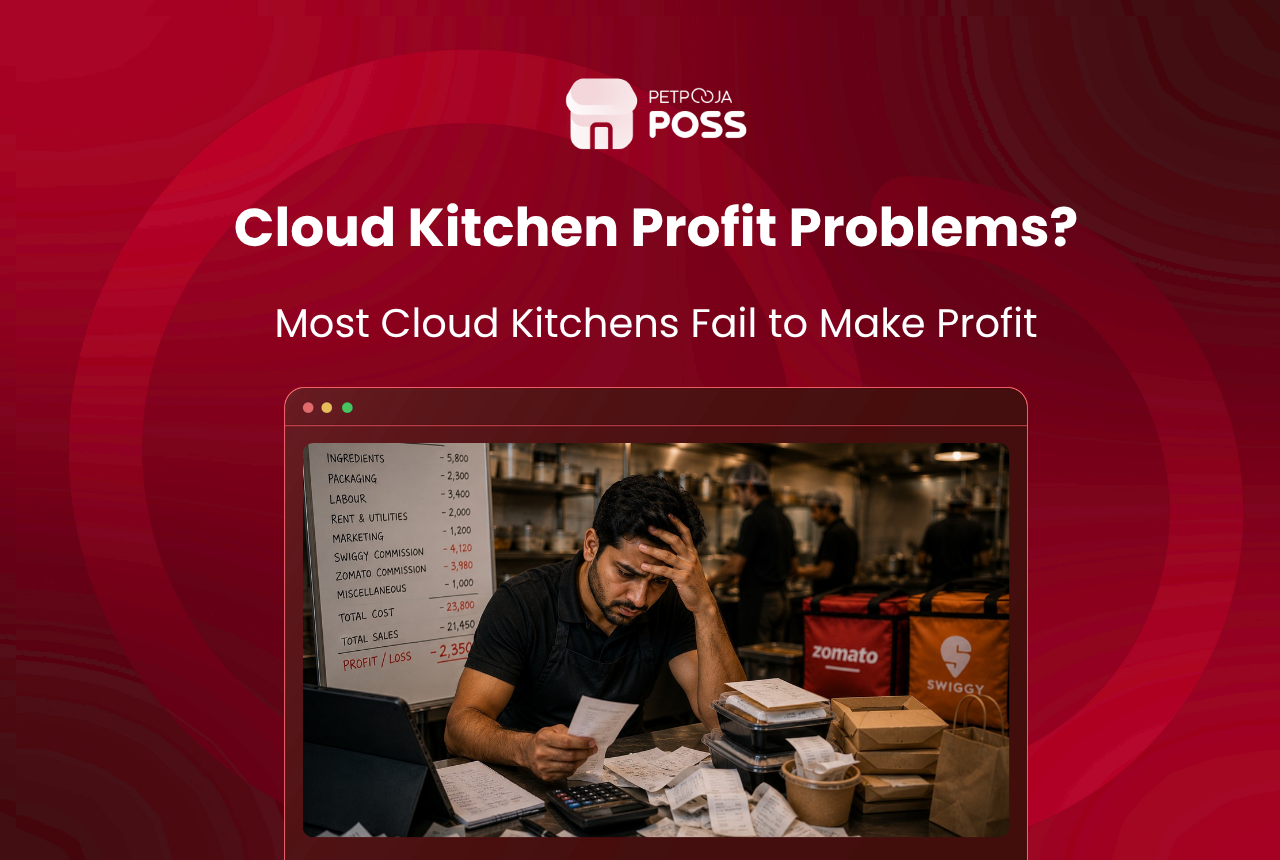
The mistake is not tracking food cost until the month-end P&L shows up. By then, the damage is already Rs 15,000-25,000. Every other cloud kitchen problem people talk about, whether it’s aggregator commission, high rent, or weak branding, sits downstream of this one blind spot.
About 25-30% of cloud kitchens in India shut down within their first year of operation (BBFT, 2024). Nearly 50% of delivery kitchens in cities like Delhi, Mumbai, and Bangalore are unprofitable, according to an NRAI survey cited in the same report. The market itself is healthy, valued at USD 1.24 billion in 2025 and growing at 12.28% CAGR (IMARC Group). Demand isn’t the issue. The kitchens that close are the ones that don’t know their numbers until it’s too late.
Key Takeaways
- The #1 cloud kitchen mistake is not tracking food cost weekly, which lets Rs 15,000-25,000 in waste pile up unnoticed
- 25-30% of Indian cloud kitchens fold within year one, and nearly half in metro cities run at a loss
- Ingredient spend should stay between 28-32% of revenue; anything above 35% makes profitability nearly impossible after commission and rent
- Weekly inventory checks catch price spikes and waste at Rs 5,000-8,000 instead of Rs 18,000-25,000
What Is the Biggest Mistake Cloud Kitchens Make?
Most operators blame Swiggy and Zomato commissions for thin margins. Commission is a real cost, 20-30% per order, but it’s a known cost. The number is printed on every settlement report. No surprises there. Understanding the pros and cons of the cloud kitchen model helps, but it won’t fix a margin problem the owner can’t see in real time.
The actual profit killer is ingredient spend that creeps up without anyone noticing. A delivery kitchen owner in Vastrapur, Ahmedabad, might set a menu assuming 30% food cost. Then tomato prices climb Rs 15/kg over two weeks. Chicken rates shift by Rs 20/kg after a supply disruption. Cooking oil inches up quietly. None of these changes appear in any report until the owner sits down with the Tally sheet at month end.
By then, raw material cost has drifted from 30% to 36-37%. On Rs 5 lakh revenue, that 6-7 percentage point gap translates to Rs 30,000-35,000 gone. Not stolen. Not wasted in one visible incident. Just leaked, Rs 800-1,200 per day across small ingredient overruns and untracked spoilage.
This is the mistake that kills most cloud kitchens. Not a dramatic collapse but a slow, invisible leak that compounds week after week until the P&L arrives.
Why Does Food Cost Spiral So Fast in Cloud Kitchens?
Delivery-only kitchens are more vulnerable to ingredient cost leaks than dine-in restaurants. Three structural reasons explain why.
Limited storage means frequent purchasing. A typical delivery kitchen in a city like Pune or Hyderabad stores two to three days’ worth of ingredients. That means purchasing happens 10-15 times a month. Each purchase is a chance for price fluctuation to go unnoticed. A dine-in restaurant buying weekly has four such chances. A delivery-only kitchen has fifteen.
No walk-in customer feedback loop. In a dine-in restaurant, portion sizes get informal checks. A waiter notices if plates come back full. The owner sees leftovers. In a cloud kitchen, food goes into a brown box and disappears into a delivery bag. Nobody sees whether the portion was 20% heavier than it should have been. India’s food services sector is growing at 9-10% CAGR according to the India Brand Equity Foundation, but that growth rewards operators who track waste, not those who assume portions are consistent.
Multi-brand menus inflate ingredient lists. Many operators run two or three virtual brands from the same kitchen. A biryani brand, a Chinese brand, and a burger brand, for example. That’s three sets of ingredients, three sets of recipes, and three waste streams. Knowing your food cost across all three without a system is close to impossible.
How Much Money Do Cloud Kitchens Actually Lose to Poor Tracking?
The gap between a kitchen that tracks weekly and one that doesn’t is roughly Rs 25,000 per month, or Rs 3 lakh a year. Here’s a side-by-side comparison of two kitchens in Tier-1 Indian cities, both doing Rs 5 lakh per month in revenue.
| Parameter | Kitchen A (no weekly tracking) | Kitchen B (weekly tracking) |
|---|---|---|
| Revenue | Rs 5,00,000 | Rs 5,00,000 |
| Target food cost | 30% | 30% |
| Actual food cost | 36% | 31% |
| Food cost overshoot | Rs 30,000/month | Rs 5,000/month |
| Aggregator commission (22%) | Rs 1,10,000 | Rs 1,10,000 |
| Rent | Rs 35,000 | Rs 35,000 |
| Staff | Rs 60,000 | Rs 60,000 |
| Other costs | Rs 40,000 | Rs 40,000 |
| Net profit | Rs 25,000 (5%) | Rs 50,000 (10%) |
Kitchen B isn’t doing anything clever with marketing or pricing. The only difference is that someone checks ingredient spend every Friday and adjusts purchasing before the damage compounds. That one habit is worth Rs 25,000 per month.
A cloud kitchen without weekly food cost tracking loses roughly Rs 25,000 more per month than an identical kitchen that checks every Friday. On Rs 5 lakh monthly revenue, that’s the difference between a 5% net margin and a 10% net margin, or Rs 3 lakh in annual profit. In this example, it’s the difference between a kitchen that barely survives and one that can reinvest in growth.
What Are the Other Common Cloud Kitchen Mistakes?
Ingredient cost blindness is the worst offender because it’s invisible. But it isn’t the only one. Restaurant Times lists several operational failures that compound the problem.
Overspending on setup before proving demand. A delivery kitchen doesn’t need Rs 15-20 lakh in build-out. Many operators who failed spent heavily on interiors and equipment for a space nobody visits. A functional setup with the right cooking stations and a fire NOC costs a fraction of that amount.
Running too many menu items. This ties directly back to ingredient spend. Consider a kitchen running 45 items across three brands. If 30 of those items get fewer than two orders a day, the ingredients for those dishes sit in the fridge expiring. The NRAI Food Services Report shows that operators who trim menus to high-selling items see a 5-9 percentage point drop in raw material cost.
Ignoring direct orders entirely. A kitchen running 100% on Swiggy and Zomato hands over 20-30% of every rupee earned. Moving even 20-25% of orders to WhatsApp or a direct link keeps Rs 15,000-25,000 per month in the owner’s pocket. This shift doesn’t happen by accident. It requires collecting customer phone numbers from day one and building a broadcast list over months.
No channel-wise profitability tracking. Knowing total revenue isn’t enough. The kitchen needs to know whether Swiggy orders are profitable at 22% commission, whether Zomato orders at 25% are breaking even, and what margin looks like on direct orders. Without this split, the operator can’t decide where to push marketing spend.
How Can a Cloud Kitchen Fix This Before It’s Too Late?
The fix isn’t complicated. It’s just not glamorous, and most operators skip it because it feels like admin work rather than business building. Weekly food cost checks catch ingredient overruns at the Rs 5,000-8,000 stage instead of the Rs 18,000-25,000 month-end shock. Four steps make the difference.
- Check ingredient spend every Friday. Pull the week’s purchase invoices. Compare them to the week’s revenue. If food cost sits above 32%, something moved, whether it’s an ingredient price, a portion size, or waste from a slow-selling item. Across 1,00,000+ businesses on Petpooja POSS, we’ve watched this pattern repeat: monthly tracking catches problems at Rs 18,000-25,000. Weekly tracking catches the same problems at Rs 5,000-8,000.
- Photograph every purchase invoice. This sounds basic, but it eliminates the “I’ll enter it later” problem. A photographed invoice gets digitised and tracked. A mental note gets forgotten by the evening rush. A POS with invoice scanning turns a photo into a logged entry with line-item detail, which makes the Friday cost check a two-minute task instead of an hour-long Tally exercise.
- Track channel-wise margins in the POS. Petpooja’s cloud kitchen POS splits revenue into Swiggy, Zomato, direct, and walk-in. When the weekly report shows that Zomato orders carry a 6% margin while direct orders carry 22%, the operator knows where to focus. Brands like Hocco, Burgitos, and Banoffee run their operations through this system and can see exactly which channel pulls its weight.
- Trim the menu ruthlessly. Pull a sales report. Sort by order count. If the bottom third of the menu contributes less than 10% of revenue, remove it. The ingredients for those items are dead money sitting in the fridge. Fewer items means tighter purchasing, less waste, and a lower food cost ratio.
What Does a Healthy Cloud Kitchen P&L Look Like?
Operators often ask what “good” looks like. Here’s a rough benchmark for a delivery kitchen doing Rs 5-8 lakh in monthly revenue, based on patterns we see across Petpooja’s restaurant base.
| Cost head | Healthy range | Danger zone |
|---|---|---|
| Raw material / food cost | 28-32% | Above 35% |
| Aggregator commission | 18-25% | Above 28% (no direct orders) |
| Rent | 5-10% | Above 12% |
| Staff wages | 10-15% | Above 18% |
| Packaging | 3-5% | Above 7% |
| Utilities and misc | 3-5% | Above 7% |
| Net profit | 10-20% | Below 5% |
A healthy cloud kitchen targets 28-32% food cost, 18-25% aggregator commission, 5-10% rent, and 10-15% staff wages, leaving a net profit of 10-20%. Once food cost crosses 35% or two cost heads enter the danger zone at the same time, the kitchen needs corrective action within the week, not at month end. Weekly kitchen inventory cost tracking is what keeps each line in check.
Conclusion
The cloud kitchen market in India is growing. The demand is real. But demand alone doesn’t pay rent on the 5th of every month.
The kitchens that survive past year one aren’t the ones with the best branding or the cleverest Instagram campaigns. They’re the ones where someone sits down every Friday, pulls up the food cost number, and makes a decision before the damage compounds into a month-end shock.
That weekly habit, paired with proper inventory tracking and a POS that breaks revenue by channel, is the difference between a kitchen that bleeds quietly and one that compounds steadily. It isn’t a secret. It’s just maths that most operators discover three months too late.
Frequently Asked Questions
Not tracking food cost on a weekly basis. Most owners only discover ingredient cost overruns at month end, by which point the damage is typically Rs 15,000-25,000. Weekly checks catch the same problems early, at the Rs 5,000-8,000 stage.
Roughly 25-30% shut down within year one, as noted in the BBFT report cited above. In metros like Delhi, Mumbai, and Bangalore, close to 50% of delivery kitchens are running at a loss, with poor unit economics and heavy aggregator dependency cited as the top reasons.
Keep it between 28-32% of revenue. Once ingredient spend crosses 35%, there’s almost nothing left after aggregator commission (20-30%), rent, staff wages, packaging, and utilities. The Friday tracking habit is the only reliable way to catch a drift before it reaches that danger zone.
Start with a weekly purchase-vs-revenue check every Friday. Trim menu items that get fewer than two orders a day since the ingredients for those dishes are dead stock. Photograph every purchase invoice for accurate tracking, and use a POS with invoice scanning that turns photos into logged line items within seconds.
Yes, but margins are tight and unforgiving. A well-run delivery kitchen can net 15-20% profit on Rs 5-8 lakh monthly revenue, provided raw material cost stays under 32% and at least 20-25% of orders come through direct channels rather than aggregators.