
The Short Answer
The best table reservation software depends on what problem you are solving. If you need diners to find your restaurant and book a table, you need a booking platform like Swiggy Dineout or EazyDiner. If you need one screen where every booking, phone call, and walk-in lands in the same list with live floor status, you need a reservation management system.
Most restaurants in India need both. The platform brings the guest. The management system makes sure two guests do not end up at the same table at 8 PM on a Saturday.
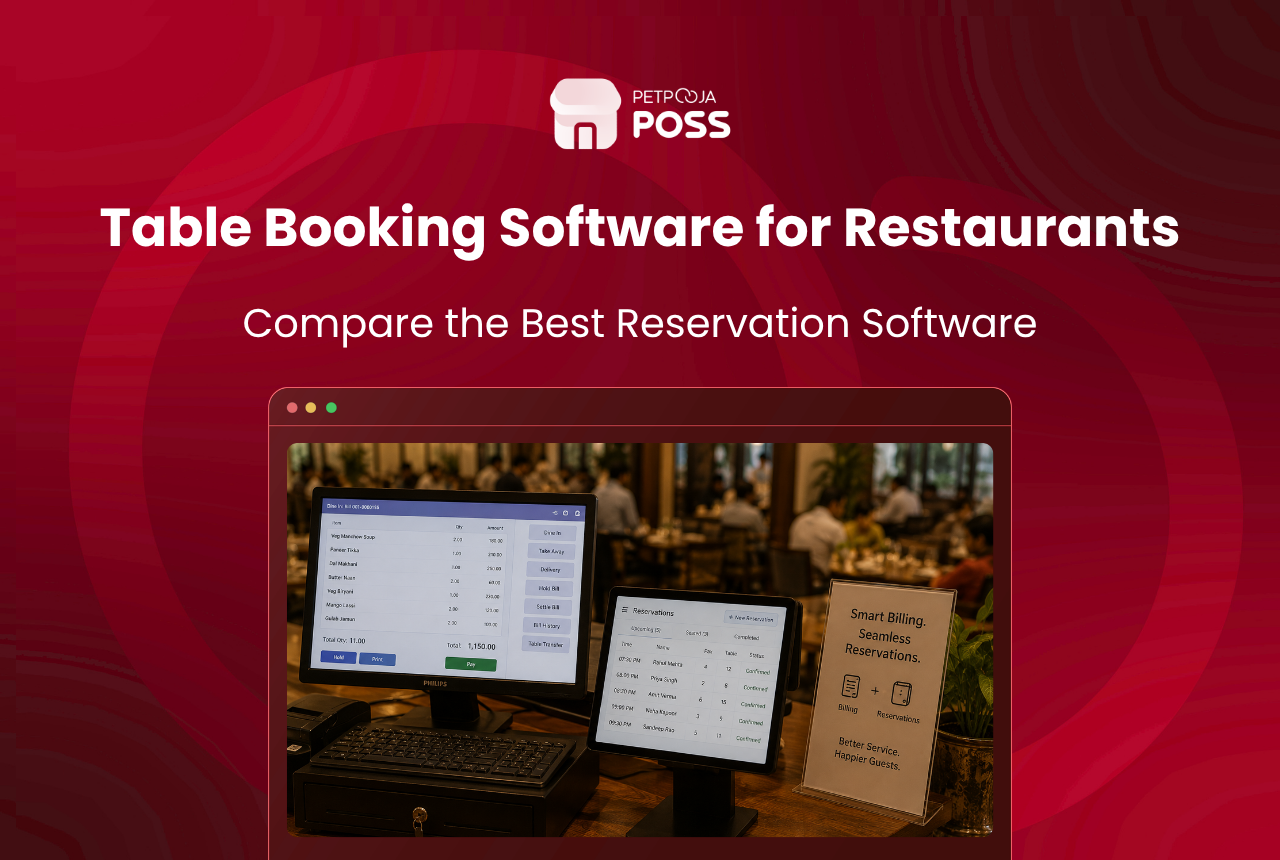
For restaurants already running a POS, a POS-integrated reservation manager avoids the double-entry trap. Petpooja’s Table Reservation Manager runs as a POSS add-on across 500+ restaurants in 80+ Indian cities, pulling 10,000+ daily bookings from Zomato Dining, EazyDiner, District, phone calls, walk-ins, and the restaurant’s own booking link into a single inbox. The floor view updates the moment a bill settles on the POS.
For restaurants that want reservation management without switching their billing system, standalone SaaS tools like Eat App connect via API.
Key Takeaways
- “Reservation software” covers two different products: booking platforms (diner-facing) and management systems (restaurant-facing)
- Booking platforms bring guests but do not manage your floor, walk-ins, or guest history across channels
- Management systems pull all channels into one screen, sync with POS billing, and build guest CRM over time
- POS-integrated options spare the host from updating two systems; standalone SaaS works without a POS switch
- Before picking, check for multi-channel inbox, POS sync, walk-in queue, deposit links, and offline mode
What Are the Two Types of Reservation Software?
A restaurant owner in Vastrapur, Ahmedabad, once told us he already had “reservation software” and pointed at the Zomato Dining tab on his phone. Bookings were coming in, sure. What he did not have was a way to see those bookings next to the six phone calls his manager had taken and the four walk-ins clustering near the entrance. That gap is what most “best reservation software” lists ignore entirely.
Booking platforms face the diner. Swiggy Dineout, EazyDiner, Zomato Dining, and District help guests discover restaurants, browse available slots, and reserve a table. The restaurant gets listed, the diner books, a notification arrives. These tools create demand. They do not manage it.
Reservation management systems face the host stand. They merge every booking from every platform, every phone call, every walk-in, and the restaurant’s own booking link into one list. Capacity planning per slot, walk-in queue with wait times, POS-synced floor view, and auto-built guest CRM all live here.
Mixing up these two categories is why restaurants install a booking platform and still end up with double bookings on Saturday night.
Which Booking Platforms Work for Indian Restaurants?
Swiggy Dineout
Best for: Maximum diner reach across India.
The largest booking platform in India by restaurant count: over 40,000 restaurants across 50+ cities, per a Swiggy Dineout press release. Runs inside the Swiggy app, which means your restaurant shows up alongside delivery listings. Dineout’s GIRF festival drives heavy booking volume during promotional windows. The trade-off: bookings land as notifications, not inside a management system. No floor sync, no walk-in queue, no cross-channel view.
EazyDiner
Best for: Premium and fine-dine discovery.
Covers 15,000+ restaurants in 300+ cities and positions itself as a premium dining discovery app. The EazyDiner Prime membership drives repeat bookings from high-spend diners. Stronger in the fine-dine and mid-casual segment than in QSR. Same limitation as Dineout: bookings from EazyDiner sit in their own silo, separate from phone calls, walk-ins, and other platform bookings.
Zomato Dining and District
Best for: Diners already inside the Zomato or District ecosystem.
Zomato runs its dining reservation flow inside the main Zomato app. District targets a younger, nightlife-oriented crowd in select metros. Both bring bookings from their own user base but do not aggregate reservations from other channels.
The shared limitation: none of these platforms merge phone calls, walk-ins, or bookings from rival platforms into a single view. Our blog on revenue leaks from poor table management covers what that fragmentation costs in actual covers lost per week.
Which Reservation Management Systems Are Available in India?
This is the category where a proper comparison matters. These tools face the host stand, not the diner. Three types exist in India right now.
Petpooja Table Reservation Manager (POS-Integrated)
Best for: Restaurants already on POSS that want one screen for every booking source.
Runs as a POSS add-on across 500+ restaurants in 80+ Indian cities. Six-channel inbox pulls bookings from Zomato Dining, EazyDiner, District, phone calls, walk-ins, and the restaurant’s own branded booking link into a single list. Walk-in queue with estimated wait times, and orders from queue so guests can order before being seated and the kitchen gets a head start.
When a bill closes on the POS, the floor map flips that table to “free” without the host checking with the cashier. Guest CRM builds itself across all channels over time. Offline mode keeps the host running even when the Wi-Fi drops mid-service. Runs on Windows and Android. Flat pricing as a POSS add-on, no per-cover charges.
Limitation: Requires Petpooja POSS. Not available as a standalone product.
Eat App (Standalone SaaS)
Best for: Restaurants that want reservation management without switching their billing system.
Eat App raised $10 million in an expanded Series B round and acquired India-based ReserveGo in late 2025, per TechCrunch, bringing its India base to over 2,000 restaurants via a Swiggy partnership. Plugs into your existing POS through API or operates independently. Covers multi-channel reservations, guest CRM, and table management through a cloud dashboard.
The trade-off: floor sync depends on API uptime, not a native POS connection. Cloud-dependent with no offline fallback if internet drops during service.
Restroworks (POS with Built-In Module)
Best for: Chains and franchises already on the Restroworks platform.
Formerly Posist, Restroworks includes table visibility and reservation handling as part of its cloud POS for chains and franchises across India and the Middle East. The reservation piece is one module inside a larger restaurant management suite, not a standalone product built around host-stand workflows. Native POS sync since it is the POS.
How Do These Reservation Tools Compare?
| Criteria | Booking Platform (Swiggy Dineout, EazyDiner) | POS-Integrated (Petpooja TRM) | Standalone SaaS (Eat App) | POS with Module (Restroworks) |
|---|---|---|---|---|
| Brings new diners | Yes | No (manages what arrives) | No | No |
| Multi-channel inbox | No (own platform only) | Yes (6 channels) | Yes (varies by plan) | Partial |
| POS floor sync | No | Native, real-time | API-based | Native |
| Walk-in queue | No | Yes, with wait estimates | Yes | Varies |
| Deposit on booking link | No | Yes, refundable per cover | Yes | Varies |
| Guest CRM auto-build | Partial (own platform data) | Yes (all channels) | Yes | Partial |
| Offline mode | N/A | Yes, with sync | No (cloud-dependent) | Varies |
| Works without POS switch | Yes | Requires POSS | Yes | Requires their POS |
| Pricing model | Commission or listing fee | Flat add-on fee, no per-cover charge | Monthly per-outlet subscription | Bundled with POS subscription |
| Best for | Getting discovered by diners | Managing all bookings, one screen | Adding reservation layer, no POS change | Chains already on Restroworks |
This table is a directional guide. Standalone and POS-module features vary by plan, pricing tier, and version. Confirm with each provider before deciding.
What Should You Check Before Picking Reservation Software?
An NRAI restaurant survey found that 67% of restaurant owners say technology directly impacts revenue. But not every feature carries the same weight. The priority depends on format and scale.
For example, a 20-cover fine dine in Banjara Hills, Hyderabad, where three no-shows on a Saturday cost ₹15,000 or more, needs deposit links and confirmation workflows above anything else. A 60-cover casual dine in Electronic City, Bangalore, for example, drawing 40% of covers from walk-ins, cares more about a proper walk-in queue than deposit logic. Run your numbers through our free table turnover rate calculator before ranking features.
Regardless of format, four things are non-negotiable:
Multi-channel inbox. If the tool cannot pull Zomato Dining, EazyDiner, phone calls, and walk-ins into one list, the host will juggle three apps and a diary. That is the exact problem you are trying to fix.
POS sync for live floor status. Without it, the host walks to the cashier after every bill to check if a table is free. That lag eats 5 to 8 minutes per table turn on a busy night. Our guide on turning tables faster without rushing guests breaks down what that delay costs in covers per service.
Walk-in queue with estimated wait times. “Position 4, about 15 minutes” holds a family at the door. “Maybe 10 minutes, who knows” does not. Our blog on reducing customer wait time covers what different wait messaging does to walkout rates.
Offline capability. The Wi-Fi at most Indian restaurants drops at least once during a busy weekend service. A system that blanks out when the router restarts fails the host at the worst possible moment.
If you are evaluating a full restaurant management platform alongside the reservation piece, our guide on picking the right restaurant management system covers the broader checklist.
Conclusion
The best table reservation software is not one product. It is a booking platform that brings diners in, paired with a management system that handles what arrives. Swiggy Dineout (40,000+ restaurants) and EazyDiner (15,000+ restaurants) cover the discovery side. The missing piece for most Indian restaurants is the second layer: one screen where every booking, call, and walk-in lands in a single list with live floor status.
For restaurants on Petpooja POSS, the Table Reservation Manager fills that gap as a POS-integrated add-on with six-channel inbox, walk-in queue, and offline mode. For restaurants on other POS systems, standalone SaaS tools like Eat App (2,000+ India restaurants) fill the same role through an API layer. Check for multi-channel inbox, POS sync, walk-in queue, and offline capability before deciding.
FAQs
Yes. Swiggy Dineout shows bookings from its own platform. It does not merge phone reservations, EazyDiner bookings, or walk-ins into the same view. A management system pulls all channels into one list so the host catches overlapping bookings before guests arrive.
One faces the diner, the other faces the host. Platforms help guests discover and book restaurants. Management systems pull every booking into one list, sync the floor with POS billing, queue walk-ins, and log guest history. One creates demand; the other manages it.
No. It runs as a POSS add-on and relies on the POS for live floor sync and billing data. Restaurants on other billing systems can explore standalone SaaS tools that connect via API. Our Table Reservation Manager walkthrough covers the full feature set for restaurants already on POSS.
Depends on volume. A shared Google Sheet works fine at 10 bookings per night. Past 15 to 20 bookings from multiple channels, the sheet cannot cross-check availability or sync with billing. The paid system typically pays for itself by recovering one or two no-show covers per week.
Varies by type. Booking platforms charge restaurants a commission or listing fee. Standalone SaaS tools charge monthly per-outlet. Petpooja’s TRM uses flat pricing as a POSS add-on, no per-cover charges. Check current pricing on each provider’s page since rates shift often.
Fine dine and mid-scale casual dine running 20+ covers with 90-minute table times. Three no-shows on a peak night cost ₹10,000 to ₹20,000 in lost revenue at those price points. QSRs with 15-minute turns and counter billing rarely need one. Once installed, add a reservation review step to your opening and closing checklist so the host checks the evening’s list before every service.








