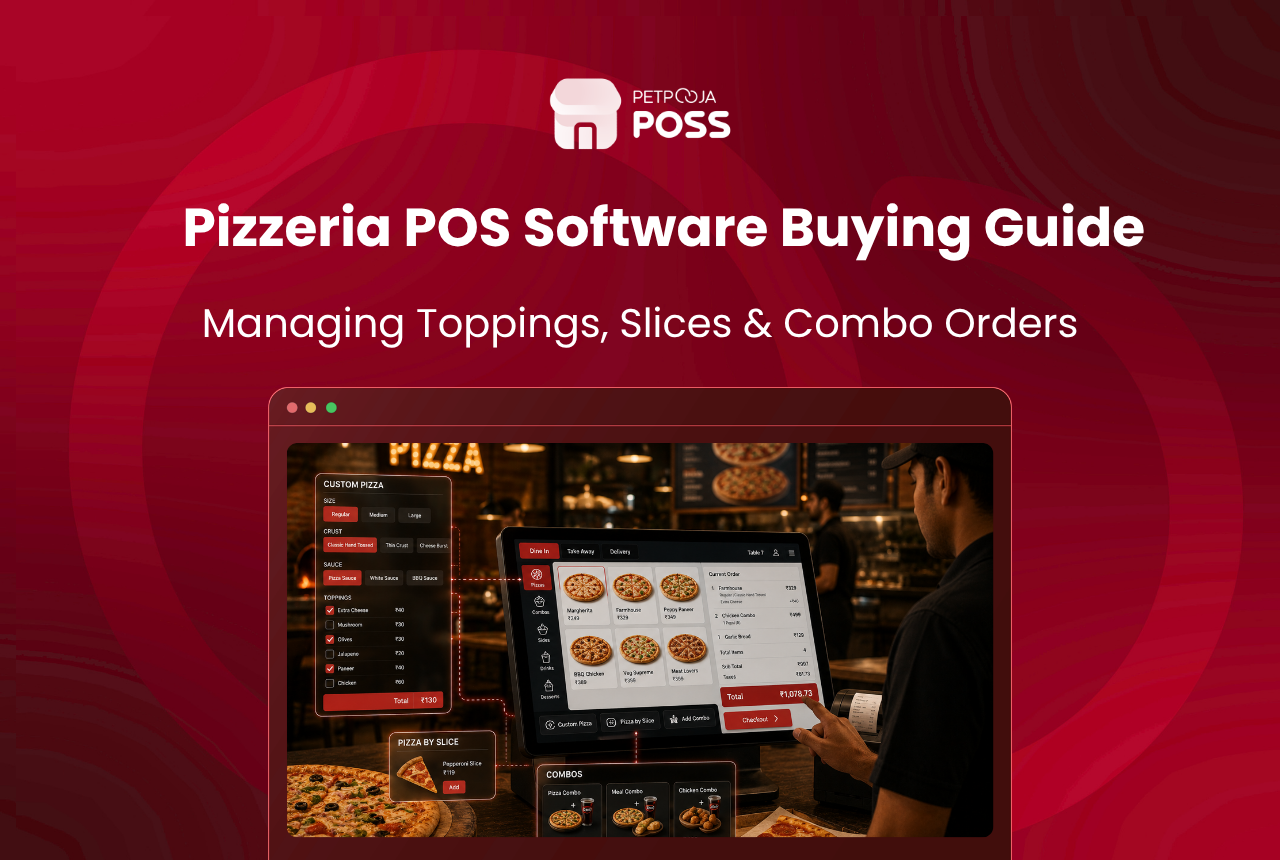
A pizzeria POS has to do one thing a normal restaurant POS struggles with: price and track a pizza that can be built a hundred different ways. The best pizzeria POS handles topping combinations, sell-by-the-slice, and combos, and it deducts the raw material behind each topping as the pizza is billed.
A plain biller treats a Margherita and a loaded four-topping pizza the same way. That breaks down fast in a pizza shop, where every order is a fresh mix of base, size, crust, and toppings. If the POS cannot price each add-on and remove its stock, your food cost quietly drifts and the kitchen gets the wrong ticket.
Petpooja POSS is built for pizzerias with item combos and variations, sell-by-the-slice, 100+ topping permutations, raw-material tracking, and multi-outlet inventory. This guide covers how each part works, and what to look for when you pick a POS for your pizza shop.
Key Takeaways
- A pizzeria POS must price a pizza built from a base, size, crust, and toppings, not treat every pizza the same
- Variations handle size and crust; add-ons handle toppings, each with its own price
- Sell-by-the-slice lets a slice and a whole pizza both bill and both draw down stock
- Raw-material tracking removes the cheese, sauce, and toppings used on every order, keeping food cost visible
- Petpooja POSS runs this across multiple outlets and already works with pizza brands like La Pino’z
What Must a Pizzeria POS Handle?
Before comparing brands, judge any pizza POS against what the format actually needs. A tool that ticks these boxes will serve a slice counter, a dine-in pizzeria, or a delivery-first pizza chain far better than a generic biller.
| Pizzeria POS capability | Why it matters for a pizza shop |
|---|---|
| Variations (size, crust, base) | One pizza item covers small to large and thin to pan, without a separate item per size |
| Add-on toppings with own prices | Each extra topping is priced and added on its own, so no combination is mispriced |
| Sell-by-the-slice | A single slice and a whole pizza are both billable and both cut stock correctly |
| Combos and meal deals | Pizza plus a side and a drink bills as one deal at the right price |
| Raw-material tracking | Cheese, sauce, and toppings come off stock per order, keeping food cost honest |
| Category-wise KOTs | The right ticket reaches the oven and the sides station separately |
| Multi-outlet inventory | Stock and sales read per branch from one account |
How Does a Pizzeria POS Manage 100+ Topping Combos?
This is where a pizza POS earns its place. In Petpooja POSS, a pizza is not one fixed item. You set the pizza as an item with variations for size and crust, then add toppings as add-ons, each carrying its own price. When a biller builds an order, the system adds every choice to the total on its own.
That structure is what lets one pizza item cover 100+ topping permutations. You are not creating a separate menu line for every possible mix. You set the parts once, and the POS assembles and prices the order at the counter. Each add-on can carry separate per-customisation pricing, so a premium topping costs more than a basic one.
The same setup feeds cleaner reporting. Because size sits under variations and toppings under add-ons, POSS can show a variation report of which sizes sell and an add-on report of which toppings ride along. Over a month, that tells you whether the large pan base or the extra chicken drives your Friday revenue. You can then build the next offer around what already sells.
At the counter, a single pizza order builds in four steps:
- Pick the base and size as the pizza’s variation.
- Add each topping as an add-on, with its own price.
- POSS totals the bill from the parts chosen.
- Raw material for each topping comes off stock as the order is billed.
Sell-by-the-Slice: Billing Part-Pizzas Cleanly
Not every pizza sells whole. Slice counters, food courts, and cafes move single slices all day, and a POS that only knows whole pizzas forces staff to fudge the bill. Petpooja POSS supports sell-by-the-slice, so a slice and a full pizza are both proper items.
That matters for two reasons. The bill stays accurate, because a slice is priced as a slice rather than a fraction keyed in by hand. Stock stays accurate too, because the slice draws down its share of the base and toppings, so a tray sold slice by slice reconciles against what left the kitchen.
For counters that lean on slices and quick pickups, the same speed helps at the till. A tidy menu of sizes, slices, and combos keeps the queue moving, which is part of running a pizza outlet that can grow without the billing turning into a bottleneck.
Combos, Raw-Material Tracking, and Food Cost
Pizza margins live and die on cheese. A pizzeria POS should link every pizza and topping to a recipe, so billing an order removes the exact cheese, sauce, and toppings it used from stock. In Petpooja POSS, that raw-material tracking runs on each sale, so consumption is measured rather than guessed at month-end.
Combos work the same way underneath. A pizza-plus-side-plus-drink deal bills as one combo at the set price, while the stock behind each part still comes off inventory. That keeps the offer attractive to customers without hiding what it actually costs you to serve.
Here is an example, not a real outlet. Say a pizzeria in Viman Nagar, Pune runs a Friday-night rush of 120 pizzas, half of them ordered with extra cheese. With raw-material tracking switched on, each extra-cheese add-on pulls its share of mozzarella from stock as the bill closes. By midnight the owner can read the cheese used against the pizzas sold. There is no weighing blocks by hand the next morning and guessing where the gap came from.
Clean consumption data is what makes food cost real. Once you can see how much cheese a branch burns through per hundred pizzas, you can read your menu mix properly. From there it is easier to spot the toppings that lose money and price the next deal right. A quick check on your pizza margins turns that data into a decision.
How Do You Handle Online Pizza Orders Without Mistakes?
Most pizzerias now take a large share of orders from Swiggy and Zomato, where a wrong topping means a refund and a bad review. A pizzeria POS should pull those orders onto one screen so staff are not copying tickets between tablets, a problem we cover in managing restaurant orders without chaos.
Petpooja POSS carries an Order Accuracy Checklist for online orders. When staff mark an order ready, the POS prompts an item-wise check, with every topping, add-on, and combo shown as its own line to be ticked off. That single step cuts the missing-item and wrong-topping complaints that eat a pizzeria’s ratings.
Stock control ties in here too. When a topping runs out, the item can be switched off so it stops showing across your online ordering channels, which prevents a customer ordering something the kitchen cannot make.
How Do You Choose a Pizzeria POS in India?
Start with how your pizzas are actually built and sold, not the feature list. A slice-led counter, a dine-in pizzeria, and a delivery-first brand each stress a POS in different places. Match the tool to your format first.
A few practical checks before you sign:
- Variations and add-ons. Confirm one pizza item can carry sizes, crusts, and priced toppings, rather than needing a separate item per combination.
- Sell-by-the-slice. If you sell slices, check the POS bills a slice as its own item and cuts stock for it.
- Raw-material tracking. Ask to see stock come off per order, not just a monthly count, so food cost is live.
- Online order accuracy. Look for an item-wise ready check that lists each topping, as covered above.
- Offline billing. A dropped connection during a delivery rush should not stop the counter, so check the POS keeps billing offline and syncs later.
- Multi-outlet control. For more than one branch, confirm you can push one menu and read stock per outlet.
Several established POS players serve Indian restaurants, so compare a few on these points rather than on price alone. India’s food-services sector is valued at around ₹5.69 lakh crore by the National Restaurant Association of India. A busy pizza shop pushes a high order count through dine-in and delivery at once, so the billing engine you pick has to keep up on a Friday night.
Conclusion
A pizza is a simple food with a complicated bill. Base, size, crust, and a shifting set of toppings mean no two orders cost the same, and a POS that cannot price and stock each part will quietly leak your margin.
Petpooja POSS is built for that reality, with variations and priced add-ons, sell-by-the-slice, combos, raw-material tracking, and multi-outlet inventory in one system, behind 24×7 support. To see how it fits your pizza shop, ask the Petpooja team for a demo. If you are still at the setup stage, our guide on opening a pizza outlet walks through the kit and layout first.
Frequently Asked Questions
A pizzeria POS is a billing and management system built for pizza shops. On top of normal restaurant billing, it prices a pizza built from a base, size, crust, and toppings, sells a whole pizza or a single slice, runs combos, and deducts the raw material behind each topping as the order is billed.
It uses variations for size and crust and add-ons for toppings, each with its own price. When a biller builds a pizza, the POS adds every choice to the price on its own. In Petpooja POSS this covers 100+ topping permutations without a separate item for each mix.
Yes. Petpooja POSS supports sell-by-the-slice, so a single slice and a whole pizza are both billable items that draw down the right amount of stock. This suits counters and food courts that sell slices through the day alongside full pizzas.
By linking each pizza and topping to a recipe. When an order is billed, the POS removes the cheese, sauce, and toppings used from stock, so your consumption is tracked live rather than guessed. Pairing that with a food cost calculator shows which topping is eating your margin. The raw-material tracking then keeps your inventory and food cost honest across branches.
Yes. Petpooja POSS runs multi-outlet inventory and central menu control, and it already works with pizza brands such as La Pino’z. A chain can push one menu across branches and read stock and sales for each outlet from the same account.