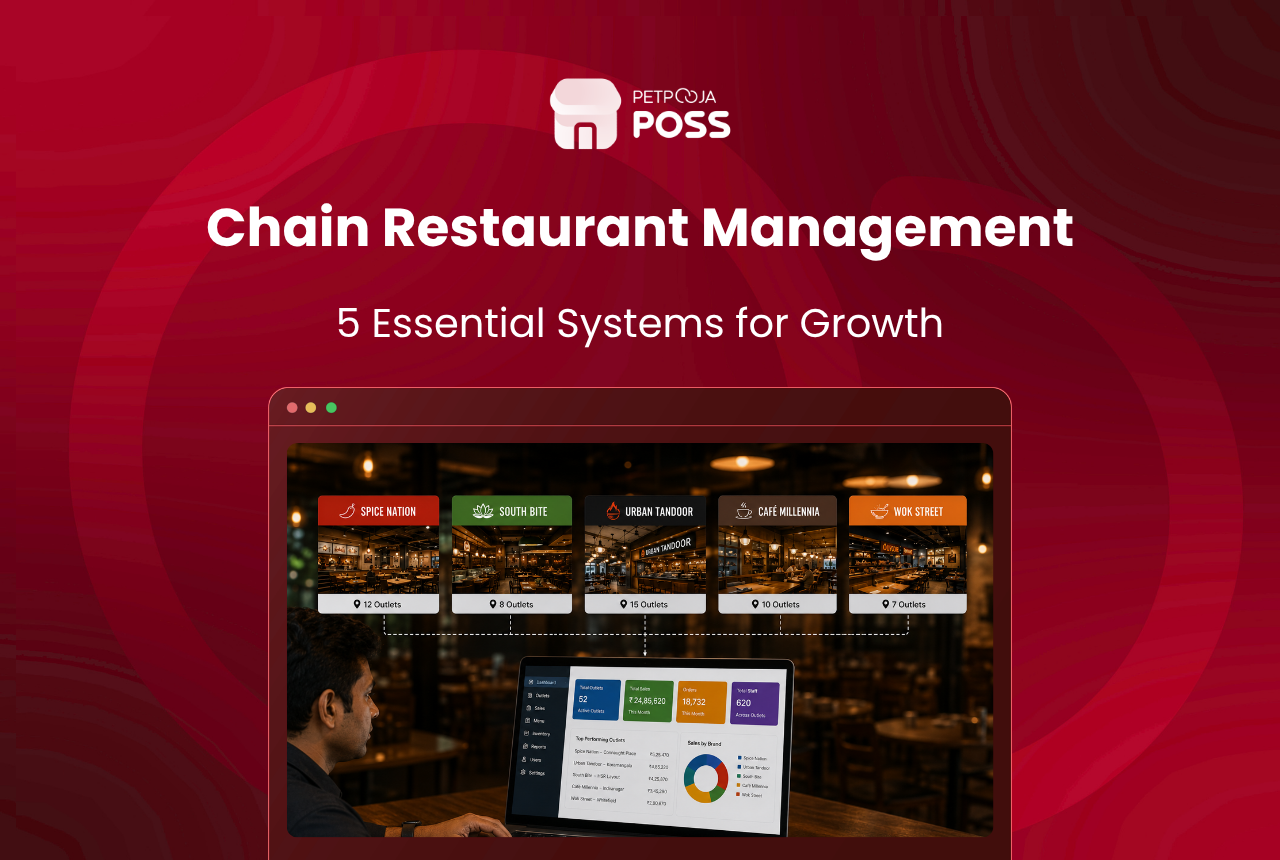
Running one restaurant is a job you can hold in your head. Running five is not. The moment you open a second outlet, the things that used to be obvious stop fitting in one person’s memory. Today’s stock, this outlet’s sales, whether the biryani tastes the same everywhere: none of it stays in your head any more. To manage chain restaurants well, you replace that memory with systems.
The short answer is this: keep the outlets consistent, and keep them visible.
Consistency means the same menu, prices, recipes and standards everywhere. Visibility means you can see every outlet’s numbers from one screen, without waiting on a manager’s phone call. Get those two right and the chain runs; miss them and each new outlet adds chaos instead of profit.
This guide covers the five systems that make it work. Across the restaurant chains on Petpooja, the ones that scale smoothly are rarely the ones with the best marketing. They are the ones with the tightest systems underneath.
Key Takeaways
- A chain runs on two things: consistency across outlets and visibility into each one.
- A central kitchen keeps taste and cost steady once you cross three or four outlets.
- Manage the menu, prices and stock centrally so a change made once reaches every outlet.
- A head-office view of all outlets’ sales lets you spot the weak one early.
Why Running Chain Restaurants Is Different
A single restaurant forgives small slips. A chain multiplies them. A pricing mistake, a stock leak or a dip in service does not stay at one outlet. It repeats across every branch and shows up in the brand’s reputation.
That is why chains are worth getting right. India’s organised food services segment is where most chains sit, and it is projected to grow at a 13.2% CAGR through FY28, per the NRAI India Food Services Report 2024. The owners who capture that growth are the ones whose systems can carry ten outlets as easily as two.
The table below shows what actually changes as you move from one outlet to many.
| What you manage | One outlet | A chain |
|---|---|---|
| Menu and prices | Change on the spot | Push one change to every outlet at once |
| Stock | Count it yourself | Track each outlet against par levels |
| Sales | Read one bill roll | Compare every outlet on one screen |
| Consistency | You are there | Written SOPs run in your place |
5 Systems to Run Chain Restaurants Successfully
With that shift in mind, here are the five systems that keep every outlet consistent and under control.
1. Run a Central Kitchen for Consistency
The first system is a central kitchen, also called a base kitchen. It semi-prepares your core items in one place, then sends them out to each outlet, so the gravy in Andheri tastes exactly like the gravy in Powai.
It saves money as much as it saves taste. Buying raw materials in bulk for one kitchen is cheaper than every outlet ordering on its own. One skilled team prepping the base also cuts the skill you need at each branch. Our guide to central kitchen management covers how the indents and dispatch work.
You do not need one on day one. Below three or four outlets, tight recipes and a shared vendor list can hold consistency. Past that, a central kitchen becomes the cheapest way to keep every plate the same.
It also fixes the vendor mess that grows with each outlet. Instead of every branch chasing its own suppliers for daily perishables, the central kitchen buys once and dispatches. Nobody at an outlet is left negotiating rates on a busy morning.
2. Keep One Menu and One Price List Everywhere
Nothing looks more broken than selling a dish at ₹280 in one outlet and ₹310 in another. Keeping an item live at one branch after another has dropped it is just as bad. On a chain, the menu has to be managed from one place.
Change the price or the item once, and it should reach every outlet at the same time. Doing this outlet by outlet is where errors creep in, which is why multi-outlet menu management from a single screen matters as you grow.
There is room for local variation on top of the shared base. A festival item in Ahmedabad or a spicier version in Hyderabad can be added per outlet, as long as the core menu and prices stay under central control.
The same discipline keeps your delivery menus straight. When Swiggy, Zomato and your own channel all pull from one master menu, an item you switch off does not stay on sale somewhere you forgot to check.
3. Control Stock and Catch Leakage at Every Outlet
Stock is where a chain quietly bleeds. Collecting daily consumption from each outlet by hand is slow, and the gaps it leaves are exactly where leakage hides. Indian households alone throw away about 55 kg of food per person a year, per the UN Food Waste Index Report 2024. A chain adds its own share of that at every branch.
Smart inventory management tracks each outlet’s stock use and flags when a level drops below par. You reorder on time, and you spot the outlet whose consumption does not match its sales. That mismatch is often the first sign of staff theft.
Recipe-linked stock is what makes this exact. When the system knows what each dish should consume, you can compare it to what actually went out. A food cost calculator then helps you size the gap per item.
4. See Every Outlet’s Sales From One Screen
You cannot fix what you cannot see. Waiting for each manager to send figures is slow and easy to fudge. So the fourth system is a single view that pulls every outlet’s billing into one place.
With all outlets on one screen, you compare them directly and catch the weak one early, not at the end of a bad quarter. The P&L view from your POS shows where each outlet’s money actually goes. Grouping outlets into zones by city or brand then lets you read the numbers the way you run the business.
Those same reports guide the menu too. Seeing which items sell where, through your POS sales report, tells you what to push at one outlet and drop at another.
5. Standardise Operations With SOPs
Consistency does not happen by hoping. It happens because the same standard operating procedures run at every outlet, from opening checks to how a complaint is handled. Write them down, and a new outlet inherits the whole playbook on day one.
Document the lot: recipes, portion sizes, cleaning schedules, hiring steps and service standards. A shared kitchen SOP checklist is a simple way to keep every branch to the same routine without you standing in each one.
SOPs also protect the outlets you already have. It is easy to pour attention into the new branch and let the flagship slide. Give each outlet the same checks, and do not strip your best staff from the original to prop up the latest.
See How a Good POS Helps With That
Each system above needs a shared source of truth, and that is what a multi-outlet POS provides. With Petpooja POSS, the Head Office Dashboard shows every outlet on one screen, and you can group them into zones by region, state, city, brand or channel.
The stock side runs from the same place. You manage inventory at the central kitchen and each outlet, and get alerts when levels fall below par. A consolidated route plan then tells dispatch which raw materials go to which outlet. For the books, Tally integration rolls the accounts up without double entry.
Take a 12-outlet biryani brand spread across Hyderabad and Bangalore (an example). One dashboard shows the day’s sales per outlet, flags the branch running low on stock, and pushes a menu change to all twelve at once. That is work which would otherwise take a full team on separate spreadsheets.
Conclusion
Managing chain restaurants is not about working harder at each outlet. It is about building systems that hold the outlets to one standard and show you all of them at once. A central kitchen, a shared menu, tight stock control, one sales view, and written SOPs are the five that matter most.
If you are building from scratch, a sensible order is:
- Get the menu on one screen. Central control stops price and item drift across outlets.
- Pull every outlet’s sales into one view. You cannot fix what you cannot see.
- Tighten stock with par-level alerts. This is where a chain quietly leaks.
- Add a central kitchen. Past three or four outlets, it is the cheapest way to hold taste.
Put the one or two that hurt most today on a single platform before you open the next outlet. A chain built on shared systems can add its tenth branch as calmly as its second. A chain built on memory and spreadsheets rarely gets that far.
Frequently Asked Questions
Keeping every outlet consistent while still seeing what each one is doing. A dish, a price or a service standard that drifts at one outlet quietly damages the whole brand. The fix is shared systems for the menu, stock and reports, so the same rules run everywhere and you can spot the outlet that is slipping.
Not from day one, but it pays off fast once you cross a few outlets. A central kitchen semi-prepares food in one place and sends it out, so taste stays the same everywhere and buying is cheaper in bulk. Below three or four outlets, tight recipes and shared vendors can hold consistency instead.
Manage the menu centrally so a change made once pushes to every outlet at the same time. This stops the common problem of one outlet selling an old price or a dish another has dropped. A POS with multi-outlet management does this from a single screen rather than outlet by outlet.
Use a head-office view that pulls every outlet’s billing into one dashboard, rather than waiting for managers to send reports. You can then compare outlets, spot the weak one early, and group outlets into zones by city or brand to read the numbers the way you actually run the business.
When collecting reports and syncing menus by hand starts eating your week, usually around the second or third outlet. A multi-outlet POS keeps the menu, stock and sales of every outlet in one place, so the admin work does not grow with each new outlet you open.