
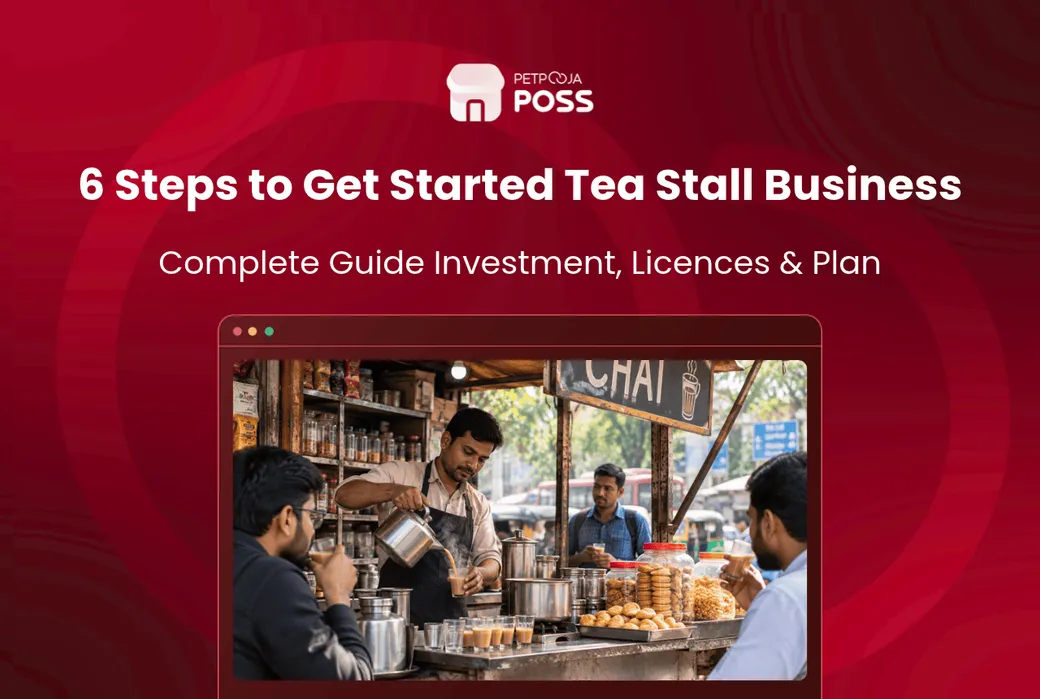



How do you create a tea stall business plan? You build it in 6 steps, from choosing your stall and spot to working out how many cups you must sell to cover your costs. For a small stall, the plan does not need to be long.
What decides whether the plan works is the cost of one cup against its price. Milk is usually the biggest part of that cost, so a small change in the milk rate shows up in every cup you sell.
This guide explains what a tea stall business plan is, then walks through the 6 steps. It also covers what to prepare first, the licences you need, how to get funding and the free templates you can use along the way.
Key Takeaways
- A tea stall business plan takes 6 steps, and the gap between price and cost per cup decides whether it works.
- A street cart needs a certificate of vending as well as FSSAI registration, so sort out both first.
- Every rupee you cut from the price is a rupee less profit on each cup, so undercutting is costly.
What Is a Tea Stall Business Plan?
A tea stall business plan is a short written plan for your stall. It says what you will run and where, what you will sell, what it will cost and how many cups you need to sell. This section covers what it is for.
You use it for three jobs:
- To decide. Pricing one cup and your monthly costs shows you whether the spot can earn before you spend on a cart.
- To get funding. A bank, a government scheme or a family member lending you money will want to see the numbers.
- To run the stall. After opening, you compare each month’s sales against it.
How to Create a Tea Stall Business Plan in 6 Easy Steps
You create a tea stall business plan by working through 6 steps in order: three about the stall and three about the money. This section takes each step in turn.
The stall 1 Choose your stall type and spot 2 Set your menu and price per cup 3 List the licences you need The money 4 Work out the setup cost 5 Work out the cost per cup 6 Find your break-even point The 6 steps to create a tea stall business plan, in two groups: the stall and the money.Work through them in this order. The money steps depend on the spot, the menu and the licences you settle first.
Step 1: Choose Your Stall Type and Spot
Decide what you will run: a cart, a fixed kiosk or a small shop. Then name the exact spot. College gates, bus stands, hospitals, office markets and industrial areas usually bring a steady flow of people.
Stand at the spot at the times you expect to be busiest, and count who walks past. Write that count in the plan, because your sales forecast starts from it. A cart on the street can only stand where your city allows street vending, which the licences section below explains.
If you are planning a seated cafe instead, our cafe business plan covers that format.
Step 2: Set Your Menu and Price per Cup
Keep the menu short. Plain chai, ginger or masala chai and lemon tea cover most orders. Biscuits, rusk or a bun from a local bakery add to each bill without much work.
Note what stalls near your spot charge for a cup. Then set your own price for every item, because your cost per cup in step 5 is measured against it.
Step 3: List the Licences You Need
List each licence, who issues it and what it costs. For most stalls that means FSSAI registration, then either a certificate of vending for a street cart or Shop and Establishment registration for a shop. The licences section below explains each one, and what happens if you skip it.
Step 4: Work Out the Setup Cost
Setup cost is everything you pay before the first cup. That means the cart or counter, a gas stove and cylinder, vessels and opening stock. It also covers a signboard, a phone for billing and the paperwork.
Use real quotes from sellers near you, and we suggest adding about 10% of the total as a contingency for things that go wrong. Our free restaurant startup cost estimator (Excel) has the cost lines ready to fill in.
Step 5: Work Out the Cost per Cup and Monthly Costs
Work out what goes into one cup: milk, tea leaves, sugar, ginger or masala, gas and the cup itself. Price each from what you will actually buy, then add them up. Our food cost calculator does the sum for any recipe.
Then list the costs that stay the same every month, however many cups you sell. For a stall, these are the rent or vending fee for the spot, a helper’s wage, phone and power, and repairs. Our tips to reduce food cost help protect what each cup earns over its cost.
Step 6: Find Your Break-Even Point and Funding Need
Break-even is the number of cups you must sell to cover your monthly costs. Use this formula:
Break-even cups a month = monthly fixed costs ÷ (price per cup − cost per cup)
Divide the answer by 30, and round up, to get cups a day. The break-even calculator does this for you. Then add one month of fixed costs to your setup cost, because a new stall can take weeks to build regulars. That total is the money you need to start.
What Do You Need Before Creating a Tea Stall Business Plan?
You need a few facts in hand before you create a tea stall business plan, because most steps use them. Each item feeds one of the steps above, so gather them before you start.
- Two or three possible spots, with a count of people passing each at its busiest time
- Prices from the stalls nearby for a cup of chai and the snacks they sell
- Quotes from local sellers for the cart, the stove and the vessels
- The rates you will pay for milk, tea leaves and sugar from your suppliers
- The money you can put in yourself, and how much you need to borrow
- Your documents: Aadhaar, a bank account and a mobile number linked to it
If you are new to food businesses, our free restaurant startup guide (PDF) covers the basics of starting out in India.
Which Licences Does a Tea Stall Business Need?
A tea stall business needs FSSAI registration, a vending certificate or shop registration depending on where it runs, and GST once sales pass the GST limit. Your city may also ask for a trade licence. This section covers each one, then what happens if you skip them.
Every tea stall FSSAI registration GST only past ₹20 lakh a year (most states) Cart or kiosk Certificate of vending Small shop Shop and Establishment registration Also ask your city about a trade licence The licences a tea stall needs, by where it runs. The sections below explain each one.The top box applies to every stall, with GST only once sales pass the limit. The two boxes below it depend on where the stall stands.
FSSAI Registration for a Tea Stall
Every tea stall needs FSSAI registration before it sells a cup. An FSSAI order of 13 March 2026 sets basic registration for food businesses with turnover up to ₹1.5 crore, from 1 April 2026.
A tea stall sits well inside that limit. Our FSSAI fee calculator shows the fee for your turnover.
Certificate of Vending for a Cart or Kiosk
A cart or kiosk on the street needs a certificate of vending. Under Section 4 of the Street Vendors Act, 2014, the Town Vending Committee of your city issues it. The Act sets the minimum age at 14, or a different age if your state sets one.
Shop and Establishment Registration for a Small Shop
A stall run from a small shop registers under your state’s Shop and Establishment law instead. The form and fee differ by state. Many cities also ask food sellers for a trade or health licence from the municipal office, so ask yours before you open.
GST Registration for a Tea Stall
A tea stall needs GST registration only once its sales pass the limit. Under the Central Goods and Services Tax (CGST) Act, Section 22, that is ₹20 lakh of turnover a year in most states, and lower in four north-eastern states.
Check your own yearly sales against it. ₹20 lakh a year works out to about ₹5,500 a day. Our guide to restaurant licences in India explains the common licences in more detail.
What Happens If a Tea Stall Skips a Licence?
Skipping a licence can cost a tea stall a fine, and a vendor who ignores an eviction notice can lose its stock. Here is what the law says.
- Vending without a certificate. Section 28 of the Street Vendors Act says a vendor who sells without a certificate, or breaks its terms, can be fined up to ₹2,000 for each offence. The local authority decides the amount.
- Refusing to move. Under Section 19, if a vendor does not leave a spot after an eviction notice, the local authority can also seize the goods.
- Selling food without FSSAI registration. A small stall must register under Section 31(2) of the Food Safety and Standards Act, 2006. Its penalties were changed by the Jan Vishwas Act, 2023, notified on 7 November 2023, so check the current amount on India Code.
Each of these is quicker to sort out before your first day than after an inspection.
How to Get Funding for a Tea Stall Business
You get funding for a tea stall business by showing a plan whose numbers hold up. The money can come from a government scheme, a small bank loan, or your own and your family’s savings. This section covers where the money can come from.
Can You Get a Government Loan to Start a Tea Stall?
Yes, if you sell on the street and qualify. The PM SVANidhi scheme lends to street vendors. A Press Information Bureau release of 27 August 2025 sets the first loan at up to ₹15,000 and the second at up to ₹25,000.
The third loan is up to ₹50,000, and lending stays open until 31 March 2030. Each loan builds on repaying the one before.
What Other Ways Can You Fund a Tea Stall?
The usual routes are a small bank loan, your own savings, or money from family. Registering on Udyam can help when you apply for a loan, as our Udyam registration guide explains. Our guide to restaurant loans covers the bank routes for bigger amounts.
Tips to Make Your Tea Stall Business Plan Work
A tea stall business plan works when it is honest about the cost of each cup and easy to check. These five tips help you get there.
- Price every cup from its recipe. Milk is usually the biggest cost in a cup, so recheck its price whenever your supplier changes the rate.
- Think twice before cutting your price. Every rupee off the price is a rupee less profit on each cup, so you must sell more cups to make the same money.
- Put your own pay into the plan as a fixed cost if the stall has to pay your household bills.
- Track sales every day. Our free restaurant daily revenue tracker gives you a sheet for each day’s takings.
- Keep a monthly profit and loss sheet. Our restaurant P&L statement template lets you set your plan beside what really happens.
What Tools Do You Need Before Running a Tea Stall?
Before you open a tea stall, you need a way to take payments, bill each cup and see what sells. This section covers each tool. Together they turn your plan into a daily target.
- UPI and a payment app, so customers can pay from their phones. You only need a bank account for this, not a GST number.
- A billing app or POS, so every cup and snack is recorded as its own item.
- Sales reports, so you can see cups a day and which items sell best.
Petpooja has a light version, Petpooja Lite, that runs on any Android device. It is built for street-side outlets, kiosks and small takeaway counters, and it covers billing with basic reports. Lite needs the internet and has no stock module, so it cannot track your milk stock.
If your spot has a weak signal, Petpooja’s Android POS is the other option. It bills offline for up to 5 days and keeps a live count of the items you sell, such as biscuits. It does not track milk by the cup. To see milk and tea leaves drop cup by cup, you need restaurant inventory software with a recipe for each drink.
Petpooja’s restaurant reports show item-wise sales, so you can see which teas and snacks sell best.
What I could recommend from my end. Add every tea and snack to your billing app as its own item, at the price on your board, before day one. Then at the end of each month, put the month’s sales next to the cups-a-day target in your plan.
If sales stay below the target for two months running, go back to step 5 or step 6 and redo that step with the real figures.
Conclusion
A tea stall business plan takes 6 steps, but one number matters most: the gap between your price and your cost per cup. The people passing your spot then decide how many cups you sell.
Start by pricing one cup and counting the people passing your spot. Then sort out FSSAI registration, and a certificate of vending if you sell from a cart or kiosk, before you buy any equipment.
Once you open, the plan becomes your daily target. A restaurant POS that records every cup you sell shows whether the stall is keeping to that plan.
Frequently Asked Questions
Do I Need a GST Number to Accept UPI Payments?
No. GST registration depends on your yearly turnover, not on how customers pay. You can take UPI from your first cup with just a bank account and a payment app.
Can I Run a Tea Stall Alone, Without a Helper?
You can, and it lowers your fixed costs, so you need to sell fewer cups to break even. The trade-off is that you cannot leave the stall during busy hours.
How Long Does It Take to Create a Tea Stall Business Plan?
Most of the time goes into choosing the spot and getting quotes, not putting the plan together. Once you have those, the plan itself can take a day or two.
Is There a Free Tea Stall Business Plan Template?
There is no template made only for tea stalls on our site. The free restaurant startup cost estimator in step 4 works for a stall too: delete the lines you do not need, and keep the cart, stove, vessels and opening stock.
Can I Use the Same Plan for a Tea Franchise?
Partly. The 6 steps stay the same, but you add the franchise fee and the brand’s rules on setup to your costs. Confirm each fee with the franchisor before you put it in the plan.
Thanks. This helps us make the next article better.

Nisarg Kansara is Senior Marketing Manager at Petpooja. What he brings to table is the tactical layer, meaning the features most users never find, the automations that remove a daily chore, and the exact fix for a workflow that keeps breaking. He spends his weeks with Indian business owners working out where billing, purchase entries and task follow-ups fall apart in practice, and that input shapes how the products change. India has over 1.5 crore active GST registrations, and most of those businesses still handle compliance by hand. Nisarg writes for the owners trying to change that, with a focus on where AI removes manual work rather than adding another button.


Comments
Loading comments…