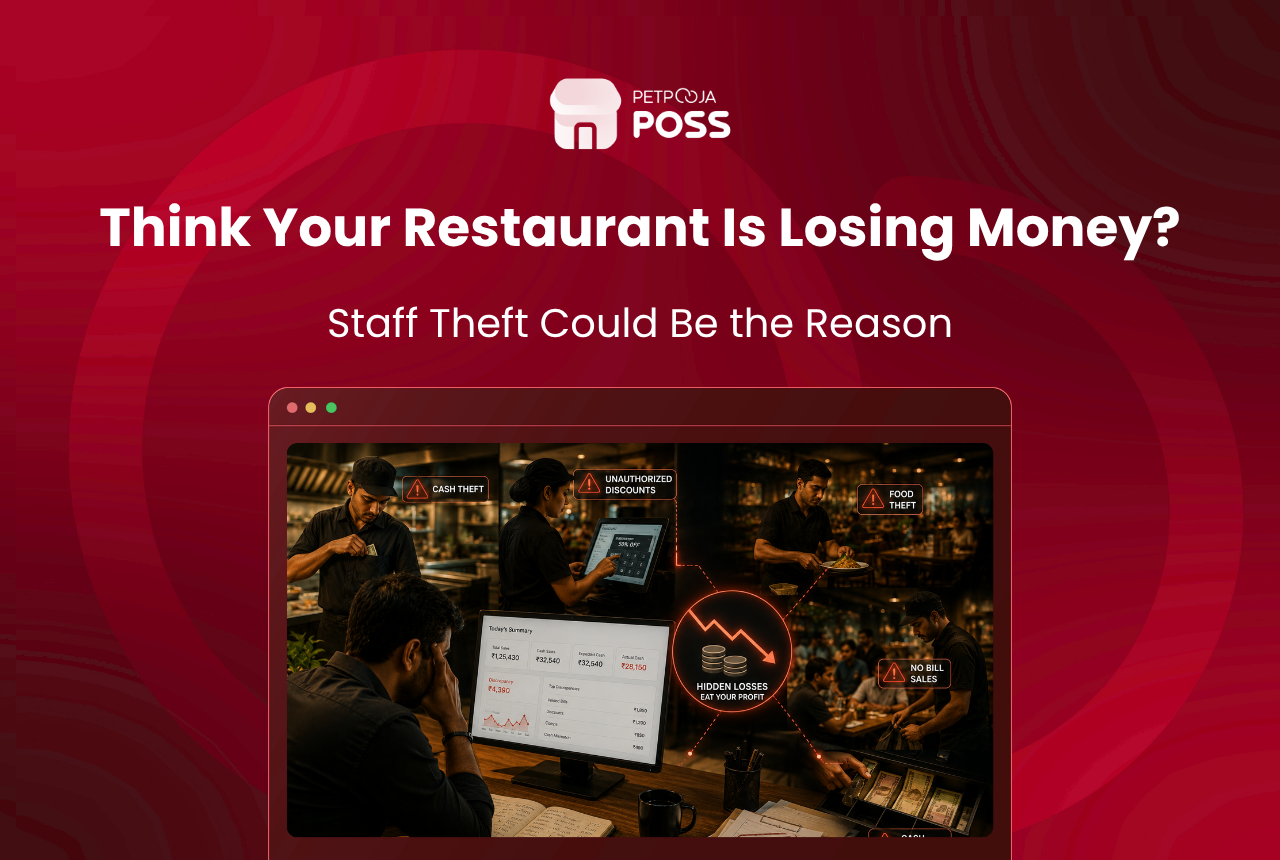
Restaurants lose money to staff theft in small, quiet amounts, not one dramatic robbery. A cancelled bill here, a comped drink there, a reprinted receipt near closing time, and the cash never reaches the till. Over a month these add up to real money on a business that already runs on a thin margin.
The way to stop it is not suspicion, it is a record. When your POS logs every cancelled KOT, waived bill, discount, and reprint against the name of the person who did it, theft has nowhere to hide. Add tight user rights so a junior biller cannot delete or edit a settled bill, and most leakage stops on its own.
This guide shows where the money actually goes, why it is so hard to spot by eye, and the exact controls that shut each gap. Petpooja POSS has a dedicated Leakage panel, per-user rights, and a full audit trail built for this. Here is how each part works.
Key Takeaways
- Staff theft rarely shows as one big missing sum; it leaks out through minor cancels, comps, and reprints
- A POS stops it by logging every risky action against a named user, not by watching people
- The Leakage panel in Petpooja POSS puts cancelled KOTs, waived bills, and reprints in one view
- User rights keep sensitive actions, like cancelling a settled bill, with a supervisor
- A five-minute weekly check of the Leakage panel catches most problems while the amounts are still tiny
Where Does the Money Actually Leak Out?
Staff theft is rarely a hand in the cash drawer. It hides inside normal-looking actions on the billing screen and in the kitchen. Each one is a tiny gap, and a busy floor has plenty of them.
Here are the points where money most often slips away in a restaurant.
| Where it leaks | What it looks like on the floor |
|---|---|
| Cancelled bills | An order is served, the guest pays cash, then the bill is cancelled and the cash kept |
| Comped or waived items | Free drinks or dishes marked complimentary for friends or walk-in favours |
| Reprints | A bill is printed twice, one copy handed over, the cash from the other pocketed |
| Voided KOTs | Food leaves the kitchen, but the item is quietly removed from the final bill |
| Unasked discounts | A discount the guest never requested is applied, and the difference is skimmed |
| Stock and pilferage | Short pours at the bar, or ingredients walking out the back door |
The bar is a special case because liquor is high value and easy to under-pour. A dedicated bar and brewery POS ties each peg back to stock, so a bottle that should yield 30 measures cannot quietly become 26.
Why Is Staff Theft So Hard to Catch?
Each act is tiny and looks normal in the moment. One cancelled order inside a day of 300 bills does not stand out, and a single comped coffee reads like good hospitality. By the time the month closes, the trail has gone cold and the numbers have blended in.
The scale of the problem is easy to underrate. The Association of Certified Fraud Examiners, a global body that studies workplace fraud, estimates that a typical organisation loses around 5% of its yearly revenue to internal fraud, and that these schemes usually run for months before anyone notices. On a restaurant working at a single-digit net margin, losing even part of that turns a good month into a flat one. It is worth checking how thin your own margin really is with a profit margin calculator before you decide the leak is too minor to chase.
How Does a POS Stop Staff Theft?
The fix is not more watching. It is a system where every risky action carries a name, a time, and a reason, and where junior staff cannot do the most sensitive things. When staff know each cancel and reprint is stamped and stored, the easy theft dries up. Here is how Petpooja POSS handles each layer.
The diagram below maps the common leak points to the control that closes each one.
The Leakage Panel
Petpooja POSS has a Leakage panel that pulls the risky actions into one screen. It tracks KOTs that were cancelled, modified, never turned into a bill, or shifted between tables, and bills that were modified, reprinted, or waived off. Instead of hunting through raw sales, an owner scans a single view and asks why a table saw four reprints on a quiet Tuesday.
Because the panel sits on top of live billing, a spike is visible the same day, not at month end. A pattern caught on the 3rd is a conversation. The same pattern found on the 30th is already a month of lost cash.
User Rights: Who Can Do What
The strongest control is deciding who is allowed to do the risky things at all. Petpooja POSS lets you set per-user rights, so a biller can take orders and settle bills but cannot cancel a settled one, edit an order after settlement, or issue a refund unless you grant that exact right.
The logic is strict on purpose. If a bill is already settled and the user lacks “After Settlement Modification” rights, the system blocks the cancellation and stops any change to total-affecting fields. Sensitive actions stay with a manager, and anything that does happen carries the name of the person who was allowed to do it. You can see the current Petpooja POSS rights layout inside User Management.
The Audit Trail Behind Every Change
Under all of this sits an audit trail that records who did what and when. For expense, withdrawal, and cash top-up logs, each change captures the timestamp, the user, a note of exactly what changed, and the source it came from, whether a phone, the web dashboard, or a specific POS terminal.
Even bulk actions are covered. When an admin removes a batch of orders from the dashboard, the system sends a one-time password to the registered email and phone, then logs the IP address, the browser, and the exact invoices removed. There is no silent delete.
The Reports That Flag Theft
A few standard reports do the detective work for you. The After Print Modification report tracks bills changed after they were printed, the Cancel Order report shows the quantity and cost of cancelled orders, and the Discount report lists every discount applied across the outlet.
On the stock side, a consumption report compares what your recipes say should have been used against what actually left the store. A gap between the two is where short pours and back-door pilferage show up as numbers, not hunches, and each gap quietly pushes up your food cost.
A Simple Weekly Routine to Catch Leakage
You do not need to watch the floor all day. A short, fixed routine catches most problems while they are still cheap to fix, and it works best as a habit, not a witch hunt.
- Open the Leakage panel once a week and look for any table or biller with an odd count of cancels, waivers, or reprints.
- Cross-check the top three cancels against the reason logged. A cancel with no clear reason, or the same reason on repeat, is worth a quiet word.
- Read the discount report and confirm the big discounts match an approved offer, not a favour.
- Match one busy day’s stock consumption to sales, especially at the bar, where the money per unit is highest.
- Tie the check to closing. Fold it into your opening and closing checklist so it happens on a set day and never slips.
Businesses lose the most when no one is looking at the numbers at all. The same silent drain hits shops too, as this piece on how retail stores lose profit without knowing shows. A weekly glance is the cheapest insurance you can run.
Here is an illustration, not a real client. Picture a two-outlet QSR in Sarkhej, Ahmedabad, where a biller cancels one ₹340 order most evenings after a cash sale. On its own it is invisible. Across a month that is roughly ₹9,000 gone from a single till, and the owner only spots it because the Leakage panel shows the same terminal cancelling near the 11pm close. The fix was not a camera. It was removing that biller’s cancel right and moving it to the shift supervisor.
Conclusion
Staff theft in restaurants is mostly minor and hidden inside normal actions, which is exactly why it survives on a busy floor. You do not beat it with suspicion or by hovering over the till. You beat it with a record: every cancel, comp, discount, and reprint stamped with a name and a time, and the risky actions locked behind user rights.
Petpooja POSS gives you that record out of the box, with the Leakage panel, per-user rights, and a full audit trail working together across 1,00,000+ restaurants. Set the rights once, glance at the Leakage panel each week, and the easy theft simply stops paying off. To see how the controls fit your outlet, book a demo.
Frequently Asked Questions
The common methods are minor and easy to miss. A bill is cancelled after the guest pays cash, a receipt is reprinted and the second lot of cash kept, items are comped to friends, or pegs are poured short at the bar. None looks dramatic alone, which is why they add up unnoticed. The types of employee theft guide covers the full list.
A POS cannot force honesty, but it removes the cover theft needs. When every cancel, discount, void, and reprint is logged against a named user, and junior staff cannot change a settled bill, most casual theft stops because there is now a clear record to answer to.
It is a single view of the actions most tied to revenue loss: KOTs that were cancelled, modified, moved, or never billed, and bills that were reprinted, modified, or waived. The Leakage panel in Petpooja POSS puts these in one place, backed by a full audit trail of who changed what and when.
User rights decide who can do the risky actions. You can stop a biller from cancelling a settled bill, applying a discount, or editing an order after settlement unless they hold that specific right. This keeps sensitive actions with a supervisor and leaves a name against anything that does happen.
Petty leakage is common wherever cash, discounts, and stock pass through many hands, and restaurants have all three. Most of it is small and opportunistic, not organised. The aim is not to assume the worst of staff, but to run a system where both the temptation and the cover are removed.