
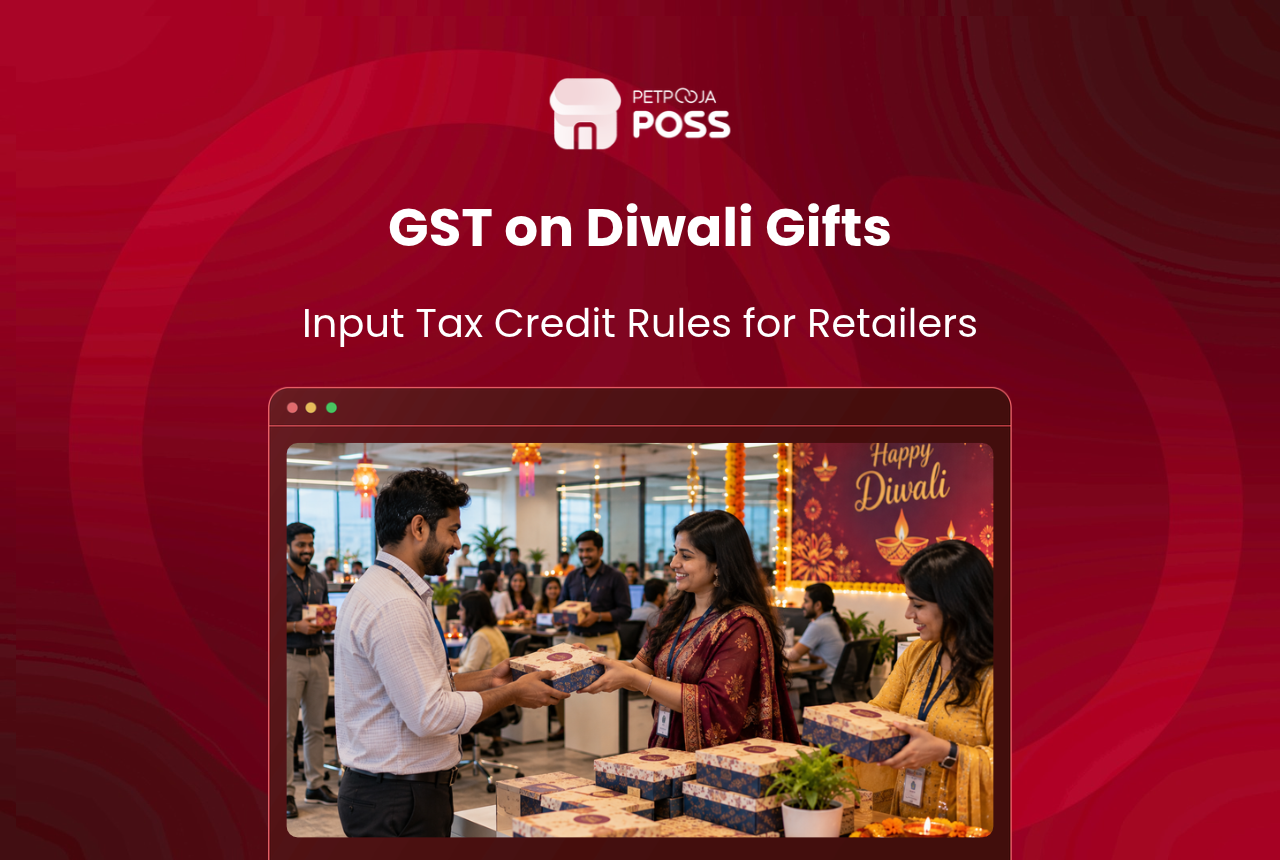
What is the GST on Diwali gifts for small Indian business owners? Usually there is no GST on the gift itself when you hand it over. The catch is on the buying side: you usually cannot claim back the GST you paid on the gift.
For an Indian retailer, three things decide your case: who gets the gift, how much that person gets from you in a year, and what the gift is. A sweet box for a regular customer and a phone for your store manager can fall under different rules.
This post sets out six rules for shop owners giving Diwali gifts to staff and customers. Each rule comes from the GST law or a document of the Central Board of Indirect Taxes and Customs (CBIC). The post also covers what the GST Council said in October 2026.
Key Takeaways
- Whether you run one shop or five, a Diwali gift is rarely taxed when given. The cost is the GST on your purchase bill, which you usually cannot claim back.
- Staff gifts stay outside GST only up to ₹50,000 per employee a year, and the year’s gifts add up.
- The GST Council’s October 2026 meeting has not yet changed the credit rule.
The 6 GST Rules on Diwali Gifts for Shop Owners
GST on Diwali gifts follows six rules, and they apply to a small shop just as they apply to a large company. Each rule depends on who gets the gift, what they get from you in a year, and what the gift is. This table gives the result for each kind of gift.
| Type of Diwali Gift | GST on the Gift Itself | Input Tax Credit on Your Purchase |
|---|---|---|
| Staff gift, up to ₹50,000 in the year | None | Not allowed |
| Staff gift, above ₹50,000 in the year | Charged | Allowed |
| Gift to a client or customer | None | Not allowed |
| Cash | None | Nothing to claim |
| Gift voucher | None on the voucher | Nothing to claim on the voucher |
| Hamper you sell to a buyer | Usually charged at the highest rate among its items | Allowed |
The six rules below explain the table, with the source behind each one.
1. Gifts to your staff up to ₹50,000 a year carry no GST
A gift to an employee is outside GST as long as that employee’s gifts stay within ₹50,000 for the financial year. The GST law says so in its Schedule I, the list of free supplies that are still taxed.
CBIC repeated it in a press release on staff gifts in July 2017. Gifts up to ₹50,000 a year by an employer to an employee are outside GST.
The limit is per employee and per financial year, not per gift. A wedding gift in May 2026 and a Diwali gift in November 2026 add up.
The 2017 press release also explains what a gift is. It is given freely, now and then, and the employee cannot demand it as a right.
2. Staff gifts above ₹50,000 a year are taxed
Once an employee’s gifts cross ₹50,000 in the financial year, GST applies. CBIC’s July 2017 press release on staff gifts says gifts above that value are subject to GST when they are made in the course of business.
The reason is that the GST law treats an employer and an employee as related persons. Goods given free between related persons can still be taxed. The employer pays that GST, as the one giving the gift.
Take a furniture showroom in R S Puram, Coimbatore (an example). It gave its store manager a ₹18,000 hamper in April 2026 and plans a ₹41,500 phone for Diwali. The two add up to ₹59,500, which is over the limit.
The press release does not say whether GST is then charged on the whole value or only on the part above ₹50,000. Ask your accountant before you bill it.
A sweet box or a small hamper on its own is far below that line. Phones, gold coins and other large rewards are what can cross it.
3. Gifts to your customers and clients carry no GST
A gift to a regular customer, a dealer or a client is not taxed when you give it. CBIC’s Circular 92/11/2019 says goods given free, with nothing paid, are not a supply under GST. A supply is anything you sell or provide in the course of business.
The circular keeps one exception: the cases the GST law lists in Schedule I, its list of free supplies that are still taxed.
Related persons are on that list, and the GST law counts an employer and an employee as related. That is why staff gifts get their own limit. An ordinary customer or client is not a related person, so the ₹50,000 staff limit does not apply to them.
Take a mobile phone shop in Kharadi, Pune, sending dry-fruit boxes to its 120 most regular customers in October 2026 (an example). None of those gifts carries GST when given.
4. Shop owners usually cannot claim input tax credit on gifts
This is the rule that costs money. Input tax credit is the GST on your purchases that you set off against the GST on your sales. The GST law blocks it on goods given away as gifts or free samples, and Circular 92/11/2019 repeats that. This is one kind of blocked credit.
Here is how that works on one purchase (an example). A hardware store on Dhebar Road, Rajkot, buys 38 sweet boxes for its staff at ₹640 each.
Sweets are taxed at 5% under Notification 9/2025-Integrated Tax (Rate), and our GST on sweets list covers the rest.
- Price of 38 boxes: 38 × ₹640 = ₹24,320
- GST at 5%: ₹24,320 × 0.05 = ₹1,216
- Total paid: ₹25,536
Budget for the gift with its GST included. The exception that matters for Diwali gifts is a staff gift that crosses the ₹50,000 limit. Because that gift is taxed, the circular lets the giver claim the credit on it.
5. Cash, vouchers and contract perks have their own rules
A cash gift has no GST. GST is a tax on goods and services, and the GST law’s definitions of goods and of services both leave money out. CBIC’s Circular 243/37/2024 on vouchers sets out those two definitions.
Gift vouchers follow the same circular. It says buying or selling a voucher is neither a supply of goods nor a supply of services. The goods or services bought with the voucher may be taxable.
So a voucher changes hands with no GST on it. The tax falls on what the holder buys later. If your shop sells ₹500 gift vouchers at the counter, there is no GST on the voucher. You charge GST on the shirt the customer buys with it (an example).
One more thing is often mistaken for a gift: a perk written into the employment contract. CBIC’s July 2017 press release says what an employer gives an employee under that contract is not subject to GST.
None of these documents says whether cash or vouchers count towards the ₹50,000 staff limit. Ask your accountant if a large cash gift and a gift in kind fall in the same year.
6. A hamper sold in your shop usually takes its highest GST rate
A hamper you sell at one price is usually taxed as one bundle, not item by item. Separate items packed together and sold for one price are a mixed supply. CBIC’s mixed supply guide says a mixed supply takes the rate of its highest-taxed item.
If the items naturally go together around one main item, the same guide treats it as a composite supply, taxed at the main item’s rate.
This matters on both sides of the counter. If you sell hampers, one high-rate item lifts the GST on the whole box. As the seller, you keep the input tax credit on what goes into the hamper, as on any other sale.
If you buy hampers to gift, that higher GST is part of your cost under rule 4.
What I would set up first. I would add each hamper to the billing software as its own item, with its own GST rate, before the first bulk order comes in. Then every hamper bill prints the right tax, and nobody works it out at the counter.
What Changed in GST on Diwali Gifts for Retailers in 2026?
Nothing has changed in law for GST on Diwali gifts after the October 2026 meeting, for retailers or anyone else. The GST Council met on 8 October 2026 and made recommendations, including on input tax credit, but none of them is law yet.
The Council’s press release recommends changing the blocked credit section of the GST law. It would lift the block on a list of items that includes outdoor catering, health and life insurance, and free samples.
The release names free samples. It does not name gifts.
It also says its recommendations take effect only through circulars, notifications or changes to the law. Gifts are not on the list, so the credit on your Diwali gifts stays blocked, including the sweet boxes for your counter staff. Even the items on the list stay blocked until the change is notified.
What Happens If Shop Owners Get GST on Diwali Gifts Wrong?
A mistake on GST on Diwali gifts is corrected by paying the tax back with interest, and a penalty can follow. Two mistakes are the ones to watch.
- Claiming credit on gifts. If the Rajkot hardware store in rule 4 claimed the ₹1,216 on its sweet boxes, it would have to reverse that credit and may owe interest on it.
- Missing the ₹50,000 limit. If an employee’s gifts cross the limit and you charge no GST, the tax is still due, with interest.
The GST Council’s October 2026 press release recommends removing the minimum penalty of ₹10,000 in cases with no fraud. Until that becomes law, the minimum stays.
The interest rate is set by government notification, so ask your accountant for the rate that applies to you.
What GST Records Should Retailers Keep for Diwali Gifts?
For Indian retailers, good records for GST on Diwali gifts come down to three lists. This section covers what goes in each one.
While talking to shop owners using Petpooja Invoice, one question comes up every October. They ask whether the GST on staff sweet boxes can be claimed. This is not survey data. It is what owners tell us in the weeks before Diwali.
Under rule 4 above, the answer is no. The three lists below keep your gift records in order.
- A gift total for each employee. Add each gift in the financial year, so you can see who is close to ₹50,000. A garment store in Vijay Nagar, Indore, with 26 staff needs only one sheet with a row per person (an example).
- Gift purchase bills, kept apart. Mark them so the GST on them is not claimed with your other purchases. Our credit matching template has a column for credit you cannot claim.
- Hamper sales, if you sell them. Give every hamper a single line on the bill, at a single GST rate.
If you sell festive goods too, our guide to festive retail sales covers the selling side.
Conclusion
For small Indian business owners, GST on Diwali gifts is less about tax on the gift and more about the GST you cannot claim back.
A gift to a customer or client carries no GST, and neither does a staff gift within ₹50,000 in a financial year. In both cases the GST you paid to buy the gift stays with you as a cost. Cross the staff limit and the gift is taxed.
Start with the per-employee total, because that total decides whether a staff gift is taxed. Then keep your gift bills apart from the rest.
If you also sell Diwali hampers, Petpooja Invoice bills each hamper as one item with its own GST rate.
Frequently Asked Questions
No. Income tax on a gift is paid by the employee under a separate law, with its own limits. GST is the employer’s side. Our post on the new income tax rules covers the payroll changes for 2026.
It is not. Circular 92/11/2019 treats “buy one get one” as two items sold for one price. The GST is in that price, and the seller keeps the input tax credit on both items.
Usually not. Companies under common control can be related persons, and a free supply between related persons can be taxed. Check the relationship with your accountant before you treat it as an ordinary client gift.








