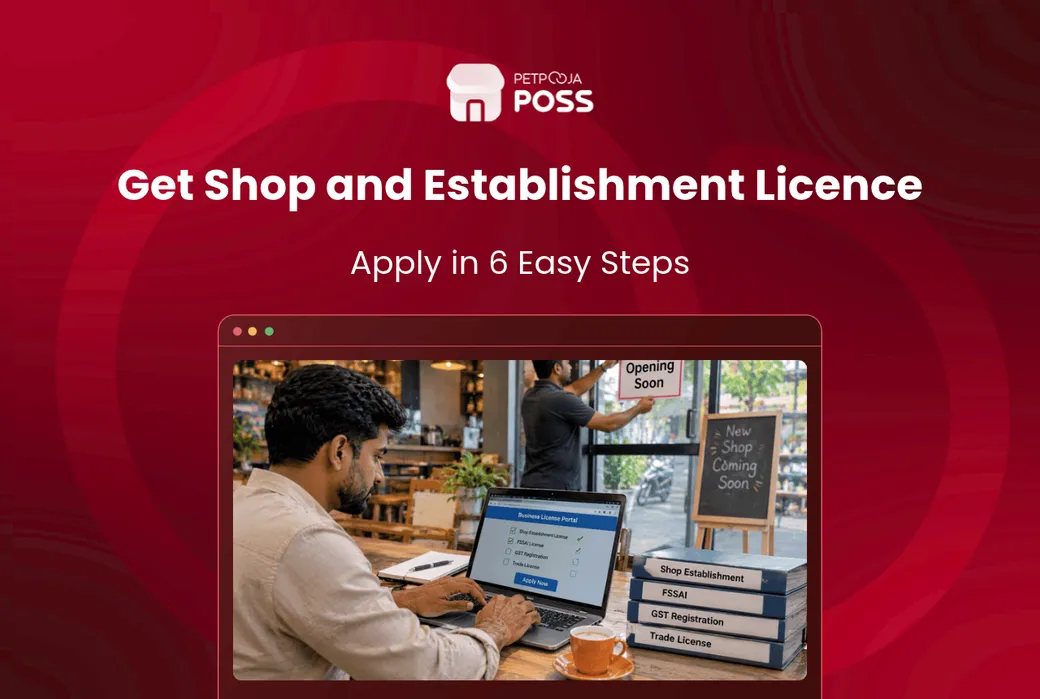



How do you get a shop and establishment licence for your restaurant? You usually apply online on your state’s portal. You fill in a form, upload the documents your state asks for and pay any fee. All 6 steps can be done yourself, without an agent.
In most states the labour department runs the portal. In Gujarat your city or town runs it, and in Mumbai the municipal corporation does.
The licence is your registration under your state’s Shops and Establishments Act. In Maharashtra, people often call it a Gumasta licence. Each state has its own Act, so the rules for a café or restaurant differ by state.
Several states changed their rules in 2025 and 2026. In some states, a small outlet does not register. It only sends an intimation, a short online form that tells the labour department your outlet exists. In others, a small outlet needs neither. This guide covers the 6 steps, why the licence matters, the rules in 11 states and what applies after you register.
Key Takeaways
- Step 1: Check if your state needs registration, an intimation or neither.
- Step 2: Create an account on your state’s or city’s portal.
- Step 3: Keep your ID, premises proof and name board photo ready.
- Step 4: Fill in the form online and pay any fee.
- Step 5: Download the certificate, or acknowledgement, and keep it at the outlet.
- Step 6: Renew or update it when details change.
How to Get a Shop and Establishment Licence in 6 Steps
Getting a shop and establishment licence for a restaurant takes 6 steps, usually on your state’s portal. Some portals issue the certificate within a day once the form is complete.
Step 1: Check If You Need Registration, an Intimation or Neither
Find out what your state asks of an outlet your size. Count everyone you employ. In Tamil Nadu, contract workers count too.
- Every outlet registers: Karnataka, West Bengal, Kerala and Delhi. Since September 2026, Karnataka exempts outlets already registered under the OSH Code. That Code covers outlets with 10 or more workers.
- Every outlet with at least one worker registers: Telangana, where a 2009 order exempts outlets with no staff.
- Under 20 workers, intimation only: Gujarat, Haryana and Maharashtra (Maharashtra raised its limit from 10 to 20 in October 2025).
- Only outlets at or above a worker limit register: Tamil Nadu (10 or more workers), Rajasthan (11 or more, under a 2025 notification) and Uttar Pradesh (20 or more, under a 2025 amendment). Smaller outlets there do not register.
An intimation does not get you a certificate. You get an acknowledgement in Maharashtra and Gujarat, and a Basic Information Performa (BIP) ID in Haryana. You still follow Steps 2 to 6, but Step 3 needs fewer documents. For an intimation, Maharashtra and Gujarat ask mainly for an ID and a photo of the name board.
Check the deadline too. It usually runs from the day you start business, and it differs by state.
Karnataka 30 days Telangana 30 days West Bengal 30 days Rajasthan 30 days Haryana 1 month Maharashtra 60 days Gujarat 60 days Kerala 60 days Delhi 90 days Tamil Nadu 6 months Uttar Pradesh 6 months Time you have to apply after you start business, by state, for outlets that must register. In Maharashtra, Gujarat and Haryana, the same deadline applies to the intimation. Source: each state’s Shops and Establishments Act or labour portal, checked October 2026.Most states give you one or two months, so apply in your first weeks of business.
If you employ 10 or more workers, the Occupational Safety, Health and Working Conditions Code (OSH Code) also covers your outlet, so ask your labour department about it. It is one of the four new labour codes, in force since 21 November 2025. Gujarat’s labour portal, for example, asks outlets with 10 or more workers to register under it. In Karnataka, outlets registered under it no longer need a separate shop and establishment registration.
Step 2: Find Your State or City Portal and Create an Account
Your state’s portal is listed in the state table further down. In Gujarat, your city or town runs the Act. In a big city, use the city’s portal, such as Surat’s at suratmunicipal.gov.in. In a smaller town, apply to the town council or panchayat. In Mumbai, use the Municipal Corporation of Greater Mumbai (MCGM) portal at portal.mcgm.gov.in.
Most portals ask you to sign up with a mobile number and email. Then pick the shop and establishment service, not a trade licence, which is a separate permission. In Haryana you start with a Basic Information Performa, both to register and to send an intimation. In Uttar Pradesh you apply on Nivesh Mitra, the state’s single-window portal, under the labour department’s services.
If your state is not in the table, search your state labour department’s website for shops and establishments registration.
Step 3: Keep the Required Documents Ready
Most portals ask for the same few documents, so scan them before you start.
- Owner’s ID proof, such as Aadhaar
- Premises proof: if you rent, the rent or leave-and-licence agreement; if you own, a sale deed, property tax receipt or electricity bill
- A photo of the outlet’s name board
- Staff details: the number of workers, and in some states a list of employees
- A partnership deed or company certificate, if you are not the sole owner
Delhi is the exception: its labour department says no document is needed at all.
Some states want the name board in the local language. Maharashtra wants Marathi, Tamil Nadu wants Tamil and Telangana wants Telugu.
To register in Maharashtra, also upload any other licence you hold, such as your FSSAI licence. FSSAI is the Food Safety and Standards Authority of India. If the outlet is inside a housing society, add the society’s no-objection letter.
Step 4: Fill in the Form and Pay the Fee
Fill in the outlet’s name, address, type of business, owner details and number of workers. Upload the documents, then pay online. In many states you do not need to visit an office: Telangana and Delhi, for example, issue the certificate online.
Fees are small or nil in most states that publish one. Delhi’s labour department charges nothing, West Bengal charges ₹30 for 1-5 workers and Tamil Nadu’s Shops Rules set ₹100. Gujarat’s Shops Rules set ₹1,000 for a restaurant. Rajasthan’s labour department lists the highest fee in our table: a one-time ₹20,000 for an outlet with 11 to 50 workers.
Track the application on the portal after you pay, and answer any query the department raises there.
Step 5: Download the Certificate and Keep It at the Outlet
Download the certificate from the portal once it is approved. Telangana’s labour department says its portal gives it at once. Gujarat’s Shops Rules give the local body one day to issue it, and the labour departments of Karnataka and Rajasthan set the same limit.
Under the Acts we checked, each outlet that must register needs its own registration, so a second branch is a second application. The Acts of Delhi, Karnataka, Kerala, Rajasthan, Tamil Nadu and West Bengal ask you to display the certificate at the outlet. In Maharashtra and Gujarat, you must show it when an inspector asks. If you sent an intimation, keep the acknowledgement or BIP ID instead.
Step 6: Renew or Update It When Something Changes
Check whether your state needs a renewal. Some no longer do. Tamil Nadu dropped renewal in 2021. Rajasthan’s labour department gives a certificate for life. Under Haryana’s 2026 amendment, the certificate stays valid until it is cancelled. Since September 2026, Karnataka’s certificate lasts until the business closes, under its amended Act. Telangana has no renewal but charges a fee every year.
In Gujarat, the certificate lasts until the ownership or nature of the business changes, and then you need a fresh one.
Others still renew: West Bengal every 3 years and Kerala every year. Maharashtra’s lasts for the period you choose, up to 10 years. If you sent an intimation, register once your staff reaches 20.
Report any change, such as a new address or staff count, on the portal. You get 7 days in West Bengal, Haryana, Rajasthan and Kerala, and 30 days in Delhi and Tamil Nadu.
Why Do Restaurants Need a Shop and Establishment Licence?
Most café and restaurant owners need a shop and establishment licence, or at least an intimation. That is because most state Acts we checked name restaurants, eating houses or cafés as covered establishments. Some states cover every outlet, and others cover outlets once they reach a set number of workers. Running without one can lead to a fine.
The fines are real. In Gujarat, an outlet that must register but does not faces a ₹10,000 penalty, which includes the registration fee. In Maharashtra, a missed intimation costs ₹1,000, and other breaches of the Act can cost up to ₹1 lakh.
The licence also helps with your bank. Banks can accept it as proof of your business when a sole owner opens a current account. This is set out in the Reserve Bank of India’s know your customer rules. It is one of a list of documents, and the bank usually asks for two.
Your state’s Act also sets staff rules: hours, the weekly off and night work. Those matter more in a restaurant than in most shops, because service runs late, and they are covered below.
The licence is not needed for everything. In April 2025, the goods and services tax (GST) department told its officers to stop asking for it during GST registration. The order is CBIC Instruction 03/2025-GST, from the Central Board of Indirect Taxes and Customs.
FSSAI’s document list for a basic registration asks for a photo, ID and address proof, not this licence.
What are the Shop and Establishment Licence Rules by State?
The rules differ by state in who registers, the fee and how long the certificate lasts. This table covers 11 states, from each state’s Act, rules or labour department portal.
| State | Who must register | Portal | Fee | Valid for | Fine |
|---|---|---|---|---|---|
| Maharashtra | 20 or more workers; fewer give an intimation | lms.mahaonline.gov.in (Mumbai: portal.mcgm.gov.in) | Check the portal | Up to 10 years | ₹1,000 for a missed intimation; up to ₹1 lakh for other breaches |
| Gujarat | 20 or more workers; fewer give an intimation | Your city, town council or panchayat | ₹1,000 for a restaurant | Until the ownership or nature of the business changes | ₹10,000, including the registration fee |
| Karnataka | Every outlet, even with no staff (exempt if registered under the OSH Code) | www.ekarmika.karnataka.gov.in | ₹810 for 1-9 workers | Until the business closes (since September 2026) | Up to ₹3,000 (₹5,000 for a repeat) |
| Delhi | Every outlet, for now | labourcis.nic.in | Free | Not stated by the department | ₹25 to ₹250 |
| Tamil Nadu | 10 or more workers | labour.tn.gov.in | ₹100 | No renewal | Check with the department |
| Telangana | Every employer | labour.telangana.gov.in | ₹500 a year for 1-5 workers | No renewal; the fee is paid yearly | Up to ₹100 for a first offence |
| West Bengal | Every outlet | silpasathi.wb.gov.in | ₹30 for 1-5 workers | 3 years | Check with the department |
| Kerala | Every outlet | lcas.lc.kerala.gov.in | Check the portal | 1 year | Check with the department |
| Haryana | 20 or more workers; fewer give an intimation | hrylabour.gov.in | Check the portal | Until cancelled | ₹3,000 to ₹10,000 |
| Rajasthan | 11 or more workers (2025 notification) | sso.rajasthan.gov.in | ₹20,000 one-time for 11-50 workers | Lifetime | Up to ₹250, plus a late fee equal to the registration fee (₹20,000 for 11-50 workers) |
| Uttar Pradesh | 20 or more workers (2025 amendment) | niveshmitra.up.nic.in | Check the portal | Check the portal | Up to ₹2,000 |
Laws or fees changed in many of these states in 2025 and 2026, so check the portal before you apply. Delhi has amended its Act to cover only outlets with 20 or more workers. The change starts only from a date the government has yet to notify, so every Delhi outlet still registers.
In Tamil Nadu, a restaurant may also need to register under a second law, the Tamil Nadu Catering Establishments Act.
What Must You Do After Shop and Establishment Registration?
After you register, your state’s Act sets the working hours, the weekly off, the night-shift rules and the records you keep. These are the parts that most affect a restaurant. Renewal and updates are covered in Step 6.
- Opening hours: Gujarat’s Act lets outlets open 24 hours in its big cities and on national highways; elsewhere, closing hours apply. West Bengal’s labour department says restaurants and cafés close by 11 pm.
- Weekly off: in Maharashtra and Gujarat, the law lets you open all 7 days. Every worker still gets 24 hours in a row off each week.
- Women on night shifts: many states in our table allow it by law or order, including Maharashtra, Gujarat, Karnataka, Kerala, Delhi and Tamil Nadu. They require the woman’s consent, a safe ride home and some other conditions. In Haryana, the orders that allow women on night shifts do not cover standalone restaurants, so check before you roster women late.
- Records: keep an attendance and wages register; Gujarat’s Shops Rules call it Form P. Give each worker an appointment letter if your state asks for one. Haryana, Karnataka and Uttar Pradesh do. File any yearly return on time. Tamil Nadu’s is due by 31 January.
- Name board: Maharashtra’s Act wants Marathi in Devanagari script first, in a font no smaller than any other language. Tamil Nadu’s Shops Rules want Tamil first.
Attendance and wage records are easier to keep up to date with staff attendance and payroll software than on paper. Our list of licence violations shows what else inspectors check.
Conclusion
You can get a shop and establishment licence yourself in 6 steps, usually online. First check whether your state wants registration, an intimation or neither. Then keep the documents ready, apply, and download the certificate or acknowledgement.
Skipping it can cost more than the fee. Gujarat charges an outlet that should have registered a ₹10,000 penalty, which includes the registration fee, and Maharashtra fines ₹1,000 for a missed intimation. For the other permits you need, see our guide to the licences a restaurant needs.
Frequently Asked Questions
Does a cloud kitchen need a shop and establishment licence?
Yes, or an intimation, if your state’s rules cover an outlet of its size (see Step 1). The Acts we checked register the premises, not the brand, so one kitchen running several delivery brands usually needs one registration. Our guide to cloud kitchen licences lists the other permits.
Do I need one if I run the outlet alone, with no staff?
It depends on the state. Karnataka and West Bengal register every outlet, even one with no staff, and so do Kerala and Delhi. The no-staff fee is ₹405 in Karnataka and ₹25 in West Bengal. Telangana exempts outlets with no staff. In Gujarat, Haryana and Maharashtra, a one-person outlet sends an intimation. In Tamil Nadu, Rajasthan and Uttar Pradesh, an outlet below the worker limit does not register.
Is a shop and establishment licence the same as a trade licence?
No. The shop and establishment licence is your registration under your state’s Shops and Establishments Act. The labour department runs it, or in Gujarat and Mumbai the local body. It registers the outlet and sets staff rules. A trade licence is a separate municipal permit to run the business at that address, and many restaurants need both.
Can I register an outlet inside a residential building?
Yes, if local rules allow a food business there. In Maharashtra, an outlet that registers also uploads the housing society’s no-objection letter, as Step 3 notes.
Thanks. This helps us make the next article better.

Fatema Rasiwala is a growth marketer & content writer at Petpooja. She likes to define herself as a wordsmith of the digital page, keeping up with restaurant industry trends, and crafting tales of mirth with a sharp wit. Reach her at fatema.rasiwala@petpooja.com