
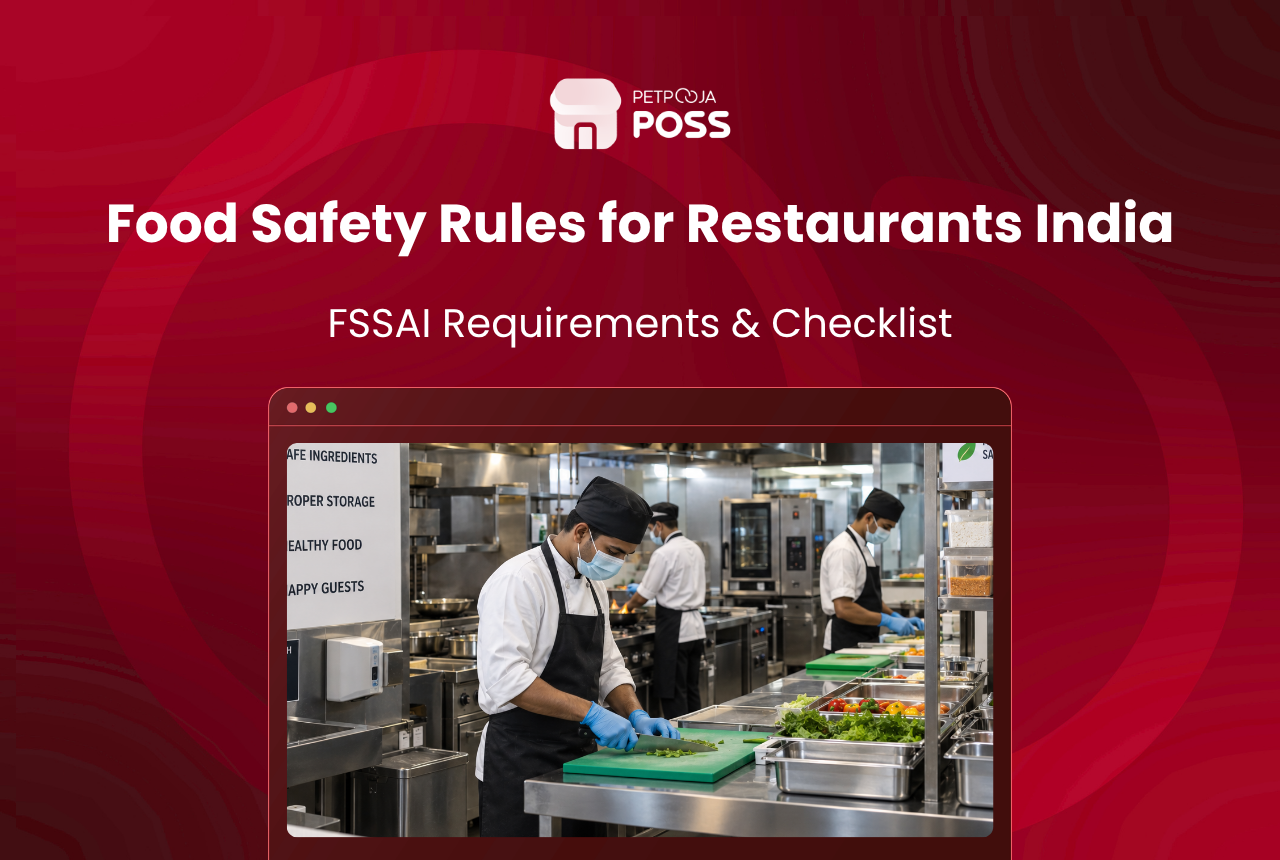
Food safety rules for an Indian restaurant come from one Act and one schedule. The Food Safety and Standards Act, 2006 sets the law. Schedule 4 of the licensing regulations sets what your kitchen must do.
Between them they cover six areas. Your licence, your premises, how you store food, how you cook and move it, your staff, and the records you keep.
This post takes each area in turn. It says what the rule asks for, then points to the detail where you need it. Treat it as the map, not the manual.
Key Takeaways
- Food safety rules sit in the FSS Act, 2006 and Schedule 4 of the licensing regulations
- A restaurant follows Schedule 4 Part II and Part V together
- Six areas: licence, premises, storage, cooking, staff, records
- Records are kept for a year, or the food’s shelf life if longer, and they are where kitchens fall short
- The licence track opens with a notice giving at least 14 days; fines run separately
What are the Food Safety Rules for Restaurants in India?
The food safety rules for an Indian restaurant are the hygiene and safety conditions tied to your food licence. The Act adds offences that apply whether or not you hold one. Two documents matter, and this section covers how they fit together.
Which Law Sets the Food Safety Rules?
The FSS Act, 2006 is the law. It creates the licence, the inspections and the penalties. It does not describe your kitchen.
Schedule 4 of the 2011 licensing regulations does. It sets the hygiene practices a licensed food business must follow, split by the kind of business you run.
Which Parts of Schedule 4 Apply to a Restaurant?
A restaurant follows two parts of Schedule 4. Part II is the general set for every licensed business, and Part V adds the catering detail on top. Part II runs to 12 numbered areas, from where the premises sit to how staff are trained.
Everything below comes from those two parts. Where a rule has its own guide on this blog, the section points to it.
Do You Need a Food Licence or a Registration?
Every food business needs either a registration or a licence. Which one you hold decides which rules apply. Bigger businesses take a licence, and the smallest ones register.
Which Form Decides Which Rules Apply?
You apply for a licence on Form B and a registration on Form A. The form you filed is what decides your rulebook. A registration-only business follows Part I, the lighter set, and everything in this post from here on assumes you hold a licence.
Thresholds and fees change, so check the current position rather than a number you remember. Our FSSAI licence fees guide sets out the categories. The FoSCoS portal walkthrough covers applying.
Where the Licence Must Be Displayed
Once the licence is granted, display a true copy in a prominent place. That is the first of the licence conditions listed in the regulations, not a courtesy.
Where the licence number itself has to appear is a separate set of rules. Our guide to FSSAI logo rules covers packs and menus.
What Do the Food Safety Rules Say About Your Premises?
The building itself has to keep food safe. Part II sets this out across its layout, equipment, facilities and sanitation clauses. Most of it is fabric and fittings rather than cleaning.
Building, Floors and Insect Screens
The structure has to keep pests and dirt out before anyone cleans anything. Clause 2.3 wants floors that drain properly, sloped away from where food is prepped. Clause 2.5 asks for wire mesh or an insect screen on openings to the outside, as applicable, with closing springs on the doors.
Clause 3 wants surfaces that touch food to be rust free and easy to clean, so chipped enamel is out. It also asks that containers for waste are marked and kept apart from anything used for food.
Potable Water and Waste Disposal
Clause 4.1.1 says only potable water goes into food. Clause 4.1.3 asks you to clean the tanks at set times, and to write each cleaning in a register.
Clause 4.5.1 wants a covered bin, ideally one that opens without being touched. Empty and wash it every day with a disinfectant. Clause 4.5.4 says no waste is left open inside.
Pest Control and Proofing
Pest control is a clause of its own, and it turns on sealing the building rather than spraying it. Clause 9.2 asks that holes and drains are sealed or meshed. Food sits in pest-proof containers above the ground and away from walls, and animals, birds and pets stay out.
Our guide to pest control requirements covers the clause in full, including what a treatment record must show.
What are the Food Safety Rules for Storing Food?
Storage rules turn on two things: temperature and separation. Get those right and most of the rest follows.
Temperatures for Food on Arrival
Storage starts at the receiving door. Part II clauses 5.1.7 and 5.1.8 put high risk food at 5°C or below on arrival, and frozen food at -18°C or below. Food that arrives warm has already spent time between 5°C and 60°C, the band where bacteria grow fastest.
Keeping Raw and Cooked Food Apart
Inside, Part V section V keeps raw meat apart from other foods. It puts vegetarian food above non-vegetarian on separate fridge racks, and dry goods off the floor in sealable containers.
Stock Rotation and FIFO
Rotation is a safety measure as much as a cost one. Part V section V names FIFO as the stock rotation rule. Our guide to organising cold storage covers the layout side.
What are the Food Safety Rules for Cooking, Cooling and Transport?
Part V sets the temperatures for cooking and cooling in section II.3, and for carrying food out in section IV. They are the numbers worth pinning up in the kitchen.
Cooking and Reheating Temperatures
Clause (d) says cooking and reheating must get food hot all the way through. Clause (g) puts reheated food at 74°C in the middle. Clause (i) rules out reheating on a steam table, in a bain-marie, in a bun drawer or under a heat lamp.
Cooling Food You Will Serve Later
Clause (f) covers food you mean to serve later. Hot held food is cooled to 21°C within two hours, or to 5°C within four, then refrigerated.
Carrying Food Out at a Safe Temperature
Carrying food out is Part V section IV. Hot food travels at 60°C or above and cold food below 5°C, with the journey kept as short as it can be.
What are the Food Safety Rules for Restaurant Staff?
Staff rules cover three things: how people work, whether they are well enough to be there, and whether they have been trained.
Hygiene and Protective Clothing
Hygiene on the floor is Part V section III. Handwashing, clean protective clothing, head covering, and no street shoes in the preparation area. Our guide to kitchen hygiene rules covers it.
Medical Checks and Vaccination
Staff health is a licence condition. Clause 10.1.2 has every food handler examined once a year by a registered medical practitioner. Clause 10.1.3 adds vaccination against the enteric group of diseases. Both records are kept for inspection.
Under clause 10.1.1, anyone carrying an illness that can pass through food stays out of food areas. The same clause asks you to run a system where staff report symptoms to management straight away.
Food Handler Training
Training is the third piece. Part II clause 12 asks that food handlers are trained in hygiene, with periodic checks on how they are doing.
Which Food Safety Records Must You Keep?
Six records carry the most weight on an inspection, and this section names each one with where it sits in Schedule 4. They are the usual gap, because the work on the floor is often fine and the paperwork is not.
- Cleaning. Under clause 9.1.1, a written schedule naming what is cleaned, how often and with what, plus the record showing it happened.
- Pest control. Under clause 9.2.3, the pesticides and insecticides used, with dates and frequency.
- Medical checks. The signed yearly examination for each handler, from the staff rules above.
- Vaccination. The enteric group record that sits with it.
- Water tanks. Under clause 4.1.3, each cleaning entered in a register.
- Raw materials. A register of what you bought and who from, under clause 5.1.3. Your supplier bills are what it ties back to. On larger loads the E-way bill helps too, though that is a GST paper, not a food safety one.
Clause 8.2 sets how long you keep records, and its own list is wider than these six. It names prep, cooking, storage, delivery, service, food quality, lab results, cleaning, pest control and recall.
Everything on that list is kept for a year, or for the shelf life of the food if that runs longer.
Keep the six above for that same year, and keep anything else on the 8.2 list that your kitchen produces. Our FSSAI compliance checklist is built around this list. The restaurant kitchen SOP checklist covers the written procedure Part II wants.
Where Food Safety Paperwork Falls Down
Three gaps come up more than the rest, and none of them is a dirty kitchen. All three are about paperwork and timing rather than hygiene.
Restaurant owners using Petpooja raise these more than any others. None of this is survey data. It is what people say when the talk turns to an inspection that went badly.
Everything lives in someone’s head. The kitchen may run well on habit, but Part II asks for a written procedure you can be audited against. A café in Vastrapur served safely for four years and still had nothing to hand an officer (an example).
The records exist but cannot be found. Six registers kept in six places count for nothing when an officer is standing there. A bar in Aundh had finished its March 2026 round in full and still could not put the papers on the table (an example).
Nobody owns the calendar. Medical checks, tank cleaning and pest visits all run on their own cycles, and they drift as staff change. A cloud kitchen in Kharadi doubled its team in January 2026 and checked none of the new starters (an example).
What Happens If You Break the Food Safety Rules?
Three things can follow, and they run separately: your licence can be suspended, you can be fined, and in the worst cases there is a prison sentence. This section covers all three. The action comes from the Act, not from Schedule 4.
The Improvement Notice and Licence Suspension
Under Section 32, a Designated Officer who thinks you have fallen short sends you a notice. It gives the grounds, the steps to take, and at least fourteen days.
Miss that and the same section lets your licence be suspended. Fail again and it can be cancelled, once you have had a chance to explain. You can appeal to the Commissioner of Food Safety within fifteen days.
Our guide to the violations behind a licence suspension covers what actually triggers one.
Fines Under the FSS Act
Fines run alongside the licence track. Unhygienic or unsanitary conditions cost up to ₹1 lakh under Section 56, and ignoring what a Food Safety Officer tells you costs up to ₹2 lakh under Section 55.
Prison Sentences for Unsafe Food
Section 59 goes further than a fine. It covers unsafe food whether or not anyone is injured, and the sentence rises with the harm done.
About Petpooja
Petpooja is the restaurant POS behind more than 1,00,000 outlets in India, and it does more than print a bill. Sales, purchases and stock sit in one system, so the numbers you run the place on are in one place rather than three books.
Its AI Inventory Agent keeps stock levels updated on its own, so you can see what is actually sitting in your stockroom without counting it first.
Conclusion
Food safety rules look large until you split them into six areas. The licence sets who you are. The premises and storage rules set what the kitchen must be, the cooking and staff rules set how it runs, and the records prove it happened.
Start with the written procedure and the record folder. Those two close most of the gap in most kitchens, and they are the cheapest things on the whole checklist.
Then walk your own kitchen before someone else does. Our pre-inspection checklist covers the ground an officer covers. The raw materials register is the one that needs least extra work, because a restaurant POS that records goods inward already holds most of what it asks for.
Frequently Asked Questions
They come from the FSS Act, 2006 and Schedule 4 of the licensing rules. They fall into six areas: your licence, your premises, storage, cooking and transport, staff, and records. A restaurant follows Schedule 4 Part II and Part V together.
Yes. It sits inside the licensing rules rather than beside them, so meeting it is a condition of your licence. Licence holders follow Part II and Part V. A business with only a registration follows Part I, which is lighter.
High risk food is received at 5°C or below and frozen food at -18°C or below. Reheated food reaches 74°C in the middle. Hot held food is cooled to 21°C within two hours or 5°C within four before it goes in the fridge.
One year, or the shelf life of the food if that is longer, under clause 8.2. It covers cleaning, pest control, food quality, lab results, storage, service and recall.
The licence track starts with a notice giving at least fourteen days. After that a licence can be suspended, then cancelled. Fines run on their own track. They reach ₹1 lakh for unhygienic conditions under Section 56, and ₹2 lakh for ignoring what a Food Safety Officer tells you under Section 55.
Yes. Every food handler is checked once a year, and a registered medical practitioner signs the record. Staff must also be vaccinated against the enteric group. Keep both records for inspection.








