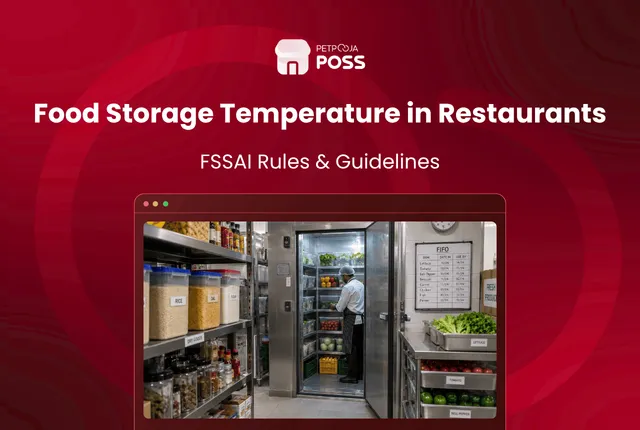



FIFO means first in, first out. The stock that arrived earliest gets used earliest, so nothing sits at the back of a shelf until it is no longer safe to serve.
One rule makes it work: older stock goes at the front, new stock goes behind it. One rule overrides it: anything past its use-by date comes off the shelf, whatever the rotation says.
The rest of this guide is about keeping the first rule alive in a busy kitchen. It is easy on a quiet morning. It is hard at seven on a Saturday, when the only empty space is the one the cook can reach.
Below is the six-step setup, what belongs on the label, and the three places FIFO quietly fails in an Indian kitchen.
Key Takeaways
- Start by labelling every delivery at the door with the date it arrived and its use-by.
- Then store older stock in front and new stock behind, unless the new item expires first.
- Next, give every item one marked home on the shelf.
- After that, have the line take from the front, and check the front of every shelf before service.
- And train everyone who signs for a delivery, because FIFO is set at the door.
How Do You Set Up Inventory in a Restaurant Using FIFO?
Six steps, and the order matters: steps 1 and 2 are what the other four depend on.
This is not only good practice. FSSAI’s catering guidance states that storage of raw materials, ingredients and finished products “shall be subjected to FIFO (First in First out), FEFO (First expire First out)”, and that food in storage should carry proper date and time tagging (FSSAI Guidance Document for the Catering Sector). The regulation names both methods, which is why the expiry rule above is not optional.
- Label at the receiving door. Write the date the moment the delivery is checked in, before anything goes on a shelf. Labelling later means someone is estimating. An estimated date is worse than no date, because it looks reliable.
- Store old in front, new behind, but check the use-by first. Physically move the existing stock forward and put the new delivery at the back. There is one exception. If something arriving today expires before the stock already on the shelf, it goes in front of that stock. Position by whichever date comes first, not by which box arrived first. This is the step people skip under pressure, and skipping it undoes the rest.
- Give every item one home. A shelf position per item, marked. If rice can live in three places, nobody knows which sack is oldest.
- Set a pull rule for the line. Kitchen staff take from the front. If step 2 was done properly, the front item is the right one, so nobody has to work the dates out mid-service. They do still check that what is in their hand is in date. A shelf is only as good as the last person who restocked it.
- Run a daily front-of-shelf check. One person, one pass through the store before service. They are looking for anything at the front that should have gone already. Anything in date goes on today’s prep list; anything past it goes in the bin, not back on the shelf.
- Train it as a receiving habit, not a storage habit. FIFO lives or dies at the delivery door. Everyone who signs for a delivery needs to know the rule, including whoever covers on an off day.
Step 1 is the one that decides whether the rest holds. A kitchen that labels at the door has something to rotate by; a kitchen that labels “later” is running on memory.
One shelf, seen from the side Oldest front Older New delivery, back The cook reaches here and takes the front item. If the shelf is right, the front one is right. Audit from the far end, not this one. This arrangement is the method. The steps around it exist to keep the shelf looking like this when nobody has time to think about it.The arrangement is the easy part. Holding it through a week of deliveries is the whole job, and that is what the six steps are for.
Where each step happens At the door 1. Label on arrival 2. Old in front, use-by checked In the store 3. One home per item On the line 4. Take from the front Before service 5. Front-of-shelf check 6. Everyone who signs for a delivery is trained on step 1. The two shaded steps are the ones that decide the rest. Both happen at the receiving door, before anything reaches a shelf.Four of the six are one-off decisions. Only steps 4 and 5 repeat every day.
What Is the FIFO Food Storage Method?
FIFO is a stock rotation method. Items are used in the order they arrived, so the oldest usable stock always leaves the shelf first.
It applies across the back of house: dry store, chiller, freezer and prep fridges. The same logic covers a sack of rice and a tray of marinated chicken, though as the label section below shows, the two carry different dates.
The reason it matters commercially is scale. Food services account for 28% of global food waste, according to the UNEP Food Waste Index Report 2024, which puts total waste at 1.05 billion tonnes a year. A portion of that is stock that was bought, stored, and never used in time.
What Goes on a FIFO Label?
Four fields, of which every item needs three: two dates and a name. Which two dates depends on where the item came from.
| Field | Why it is there |
|---|---|
| Date received | Establishes the rotation order for supplier-packed stock |
| Use-by or best-before | Ordering is useless if the item has expired anyway |
| Item name | Decanted stock loses its packaging and its identity |
| Opened or prepped date | Replaces the received date once an item leaves its packaging or is made in house |
A supplier-packed sack carries the date received and the use-by. A prepped tray carries the date it was made and the date it has to go. One date on its own answers half the question: which came first, or whether it should still be there at all.
That is why prepped items get their own date rather than inheriting one. A marinade made on Tuesday is not the same age as the raw chicken that arrived on Tuesday, and only the prep date says so.
Where FIFO Breaks Down in an Indian Kitchen
FIFO is simple in theory and it fails in three predictable places.
Bulk staples. A new sack of atta gets emptied into the bin the old one is still sitting in. Once two batches are mixed there is no order left to rotate, and no way to tell which flour is which age. Finish the old bin before you open the new sack, as long as it is still in date. Keep two bins going rather than topping one up.
Prepped and marinated items. These have no supplier label, so they only carry a date if someone writes one. A prep fridge is a common place to find the first spoilage of the week, more so than the dry store.
Local produce with no packaging. Vegetables from the mandi arrive with no date on them. A Thursday delivery to a kitchen in Vastrapur (an example) and a Saturday one look identical by Sunday. They still need a date written by whoever receives them, or the freshest bunch of coriander gets used first because it looks better.
The pattern in all three is the same: no supplier label means no date unless a person creates one. That is the gap to close, and it sits at the receiving door. Dating and holding are two of the items on our food safety rules checklist, which covers what else a daily check should cover.
Where the dates go missing Bulk staples batches mixed Prepped items no supplier label Local produce no date at all Same cause: no label means no date unless a person writes one All three are fixed in the same place, which is the receiving door, not the shelf where you notice the problem. Three different symptoms, one cause. Closing it is a receiving job, not a storage job.Fix it at the door and all three stop happening at once.
How Do You Check FIFO Is Actually Working?
Do not audit from the front. The front of the shelf tends to look right, because that is where anyone tidying puts the neatest item.
Pull from the back, once a week. Take one item from the back of three different shelves and compare each against whatever is sitting in front of it. If the sack at the back is dated August 2026 and the one in front says September, rotation has stopped happening on that shelf.
One other signal is worth watching over a longer run. The stock and wastage numbers tell you whether the problem is improving month to month, and a widening gap between what was bought and what was sold tends to show up before anyone finds spoilage on a shelf.
A kitchen standard operating procedure, or kitchen SOP, is where the rule belongs in writing, so a new joiner is not learning it by watching.
What FIFO Actually Saves You
Three things, roughly in the order you notice them.
Less spoilage. Stock leaves the shelf before it expires, which is the direct saving and the easiest to see in a wastage log.
Fewer safety risks. Stock is used while it is still in date, or discarded on schedule, rather than discovered past its date in the middle of a rush.
A truer stock count. Rotation and counting are the same discipline. A store that rotates properly is a store you can actually count, and a count you trust is what makes your food cost ratio mean something. A food cost ratio (FCR) built on a guessed closing stock is a guessed FCR.
That last one is why FIFO belongs beside your inventory rather than beside your cleaning schedule. A restaurant POS with inventory tracking gives you the consumption side of the picture, and FIFO keeps the physical shelf matching what the system thinks is there.
Conclusion
Older stock in front, new stock behind, dated at the door, and nothing kept past its use-by. That is the whole FIFO food storage method, and the other four steps exist only to keep the habit alive on a busy Saturday.
Three failure points are worth checking this week: bulk staples going into a shared bin, prep items carrying no date, and unlabelled produce from the market.
Then audit it from the back of the shelf, because the front is where the tidy items end up.
Frequently Asked Questions
What does FIFO stand for in food storage?
First in, first out. Stock is used in the order it arrived, so the oldest usable item always leaves the shelf first. It applies to dry store, chillers, freezers and prep fridges alike.
What is the difference between FIFO and FEFO?
FIFO orders stock by the date it arrived. FEFO, first expired first out, orders it by the expiry date instead. They usually agree, but not always, and where they disagree the expiry date wins. A short-dated delivery that arrived today goes in front of older stock with months left on it. That is the exception built into step 2 above, and it is why the use-by date belongs on the label.
What should be written on a FIFO label?
For supplier-packed stock, the date received and the use-by. For anything prepped in house, the date it was made and the date it has to go, because a prep tray has no supplier label to fall back on. Plus the item name on anything decanted out of its packaging. Two dates either way, because one answers only half the question.
Who is responsible for FIFO in a restaurant?
Whoever receives the delivery, because that is where labelling happens. Storekeepers and chefs maintain it, but the habit is set at the door. Anyone who covers receiving on an off day needs the same training.
How often should FIFO be checked?
A front-of-shelf pass every day before service, and a proper audit weekly where you pull from the back of the shelf rather than the front. Daily catches what is about to expire; the weekly pull catches whether rotation is happening at all.
Thanks. This helps us make the next article better.

Hi there! I’m Simran Jain, and I am so happy that you are here. My favorite thing in life is time spent in the kitchen. And all the better with being able to share my experience with y'all. I love everything related to food and I am always writing or cooking.