
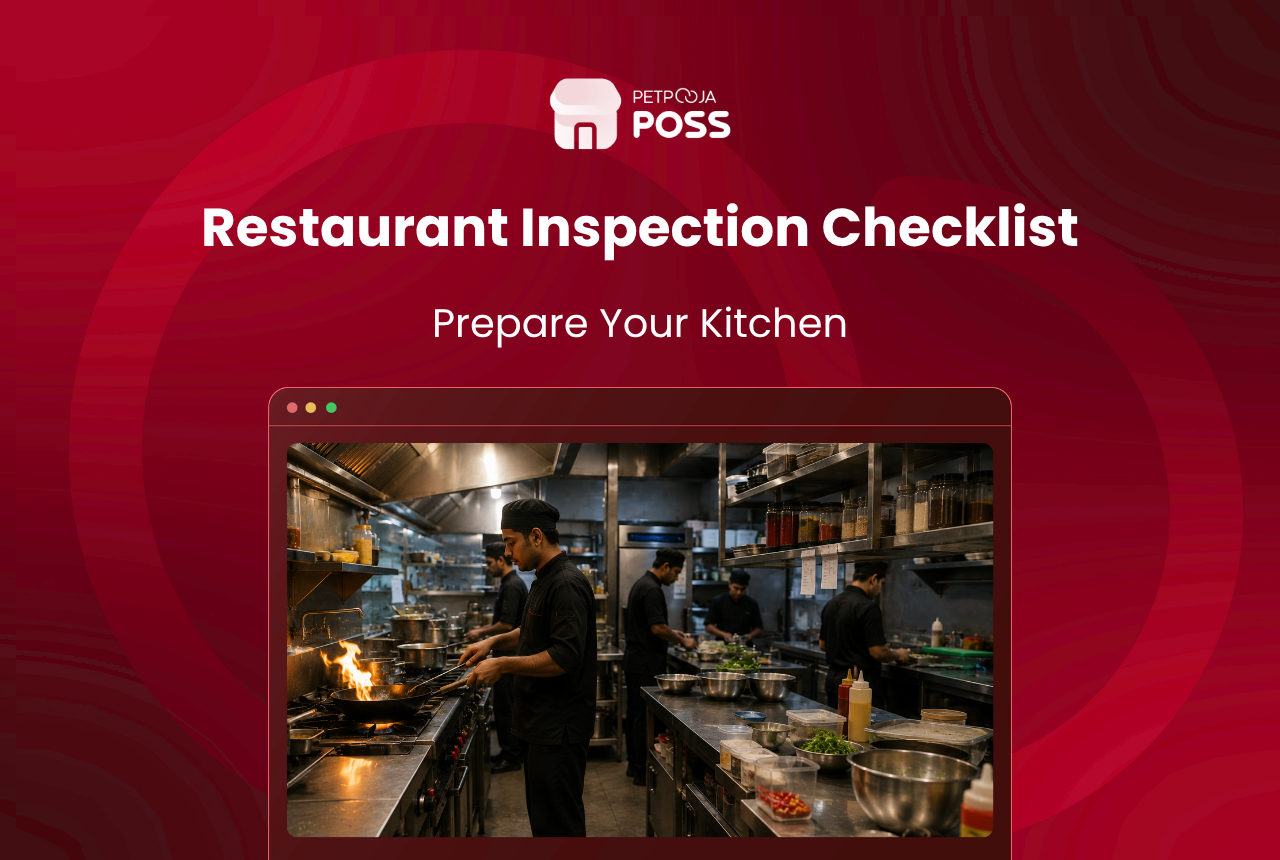
Food safety officers do not wander. They move through a kitchen in a fairly predictable order, starting at the door and finishing at the bin area, and the findings cluster at the same nine stops almost every time.
So walk it yourself in that order. You will see what they would see, a week or a month earlier, while it is still cheap to fix.
This is not a compliance list to file. It is a route through your own premises, with the specific thing that gets flagged at each stop.
Most restaurant owners we work with can tell you last night’s covers to the rupee and have no idea what their walk-in was holding at 3pm. That gap is the whole reason inspections go badly.
Key Takeaways
- Inspections follow a route. Walking the same route finds the same faults.
- Four of the nine stops need nothing but your eyes and ten minutes.
- Temperature and pest records are the two that decide arguments.
- The person who set the kitchen up is the worst person to inspect it.
- Monthly for the full walk, daily for the two-minute version.
Why Walk Your Kitchen in Inspection Order?
Because the findings cluster. Across the state enforcement drives of 2026, the reasons given for suspensions were strikingly repetitive: temperature control failure, pest activity, expired stock, and deficient handwashing or ventilation.
Almost none of it was clever. It was equipment left unrepaired and shelves nobody had looked at.
Walking your own kitchen in the same sequence surfaces the same things, with one advantage. You are allowed to fix what you find.
What are the Nine Stops?
The order matters, because it is roughly the order an officer uses.
| # | Stop | What gets flagged |
|---|---|---|
| 1 | Entrance and display | Licence not displayed, or expired on its face |
| 2 | Service and front of house | Water station, cutlery storage, visible cleanliness |
| 3 | Dry store | Expired stock, open sacks, items on the floor |
| 4 | Cold storage | Temperature, overloading, raw above ready-to-eat |
| 5 | Prep area | Board separation, thawing practice, cloths |
| 6 | Cooking line | Oil condition, hot holding, surfaces |
| 7 | Handwash and wash-up | Soap, running water, access blocked |
| 8 | Waste and back door | Bin lids, pest evidence, drainage |
| 9 | Records | Logs, reports, certificates, invoices |
Inspection Stops 1 to 3: Front of House and Dry Store
1. Entrance and Display
Stand where an officer would stand. Your FSSAI licence should be visible without asking, along with the Food Safety Display Board where you are required to show one.
Look at the licence itself rather than the frame. Check the name matches the entity trading today, and the address matches the premises you are standing in. Outlets that changed hands or expanded often display a certificate that no longer describes them.
2. Service and Front of House
Less scrutinised than the kitchen, and not ignored. The drinking water station, how cutlery and crockery are stored, whether cloths look clean.
If you run a self-serve counter, look at the sneeze guard and the serving spoons. Shared spoons between two containers is a routine finding.
3. Dry Store
This is where the first real problems usually appear. Three things get flagged:
- Expired stock, most often in slow-moving items. Spices, colours, speciality sauces bought for a menu you dropped.
- Sacks and boxes on the floor, which blocks cleaning and invites pests.
- Open containers with no lid, no label and no date.
Pull items from the back of the shelf, not the front. The kitchen inventory habit that keeps food cost down is the same one that keeps this shelf clean, which is why outlets with tight stock control tend to pass this stop without trying.
Waste from expired dry goods is quietly expensive. Our food waste calculator puts a yearly number on it.
Inspection Stops 4 to 6: Cold Storage, Prep and Line
4. Cold Storage
The stop that closes kitchens. Open every chiller and freezer and take an actual reading with a probe, not the display on the door.
Then look at three things:
- Loading. A packed chiller does not circulate air, so the middle sits warmer than the reading suggests.
- Order. Raw meat and fish on the bottom shelf, ready-to-eat above. Never the reverse.
- Covering and dating. Open trays with no film and no date are a finding on their own.
A door gasket that has perished is the most common physical cause, and the cheapest to fix once somebody notices it. Run a finger along the seal. If it is cracked or no longer springs back, the unit is working harder than it should and losing the argument on a hot afternoon.
Take the reading at the busiest part of the day rather than first thing. A chiller that holds overnight can drift badly once the door has been opened forty times during service, and that is the condition an officer arriving at 1pm will find.
5. Prep Area
Colour-coded boards are worth having, but the finding is usually simpler than that: one board doing everything, or a board so scored it cannot be cleaned.
Check how frozen items are being thawed. On a counter at room temperature is a finding. In the chiller overnight, or under running cold water, is not.
Then look at the cloths. A single wiping cloth used across raw and ready-to-eat surfaces undoes everything else in this section.
One more thing gets missed here: where prepped items go once they are made. A tray of cut vegetables with no cover, no label and no time on it is a finding even if it was cut twenty minutes ago, because nothing on the tray proves that.
6. Cooking Line
Oil is the visible one. Dark, viscous frying oil that has not been changed reads badly and can be tested.
Beyond that, look at hot holding. Food held warm rather than hot sits in exactly the range that causes problems, and a bain-marie that has not been switched on early enough is a common cause.
The back of house areas nobody shows visitors are where this stop lives, which is why they drift.
Inspection Stops 7 to 9: Wash-Up, Waste and Records
7. Handwash and Wash-Up
A dedicated handwash basin, with soap and running water, not blocked by crates. That last part is what fails, because storage creeps toward whatever wall has space.
Check that the basin is for hands rather than doubling as a pot sink. And look at the dishwash temperature or the sanitiser concentration, whichever your setup uses.
8. Waste and the Back Door
Bins with lids that close. Waste held away from prep areas. Drainage that runs rather than pools.
The back door is where pest evidence shows first: gaps under the door, propped-open doors, food debris outside. Look at the floor along the wall, which is where droppings collect and where nobody sweeps.
9. Records
The stop everyone leaves until last, and the one that decides arguments.
| Record | Kept where it should be? |
|---|---|
| FSSAI licence | On display, not in a drawer |
| Pest control reports | On site, with dates, not with the contractor |
| Temperature logs | Started at least a fortnight ago |
| Water test report | Six-monthly, unless you are on municipal supply and keep the bills |
| Staff medical certificates | Matching the people actually on shift |
| Supplier invoices | Retrievable in minutes, not in a shoebox |
A fortnight of temperature readings is worth more than any explanation you can offer about a warm chiller. That is why the logs need starting before there is a problem, not after.
The pest control row catches people out for a different reason. The reports usually exist, but they sit with the contractor rather than in the kitchen. Ask for the last three by email and keep them on site, because an officer will not wait while somebody phones the pest company.
Supplier invoices matter most when a sample fails. If the analysis says your paneer was not paneer, the invoice and the supplier’s licence number are what move the question upstream to whoever sold it to you. Without them, the finding stops with you.
Where purchase records sit inside your billing system rather than a folder, that last row stops being a hunt. A restaurant POS that keeps invoices against each item turns a supplier question into a search.
How Do You Make the Kitchen Walk Stick?
A checklist nobody runs is worse than no checklist, because it creates the belief that somebody is checking.
Three things make the difference.
Rotate who walks it. The person who designed the kitchen stops seeing it. A manager from another outlet, or simply somebody who was not there when the crate got put in front of the basin, finds more in ten minutes than the head chef finds in an hour.
Split it by frequency. The full nine stops monthly, and a much shorter version every day.
The daily one is four things, and it genuinely takes two minutes:
- Chiller and freezer readings, written down with the time
- Handwash point, soap present and nothing stacked in front of it
- Raw meat below ready-to-eat, in the chiller as well as the store
- Bin lids closed and the back door shut
Those four are where the drift starts. Everything else on the nine-stop walk moves slowly enough to catch monthly. Fold the daily four into your opening and closing checklist rather than running them as a separate ritual, because a routine attached to an existing habit survives and a standalone one does not.
Write down what you found, including nothing. A log that says “checked, all clear” on the 3rd is evidence. A blank page is not.
Example (illustrative). Say a 40-cover restaurant runs the full walk on the first Monday of each month and the two-minute version daily. In month one it finds a perished gasket, a shelf of expired colour and a blocked handwash basin. In month four it finds nothing, because the same three things stopped happening. This is an example of how the pattern usually goes, not a measured result.
For the daily kitchen habits underneath all of this, our kitchen hygiene rules cover the ground floor, and the kitchen SOP checklist turns them into a routine.
What If the Kitchen Walk Finds Something Serious?
Fix it before the next service where you can, and write down what you did.
Where it needs a supplier or an engineer, the record of having identified and reported it matters. An outlet that spotted a failing chiller on the 3rd, logged it, and has an engineer booked for the 5th is in a very different position from one that never noticed.
Two findings are worth acting on the same day rather than scheduling. Live pest activity, because it multiplies, and a chiller holding warm with stock inside it, because everything in there becomes questionable the longer it sits.
The rest can go on a list with dates against them. What an officer reads badly is not an imperfect kitchen. It is a kitchen where nobody appears to be looking.
If the walk turns up licence or paperwork gaps rather than physical ones, our FSSAI compliance checklist covers that side in full.
Conclusion
An inspection is not a test of how good your food is. It is a test of whether the boring things were done on an ordinary Tuesday when nobody was watching.
Walking your own kitchen in the officer’s order is the cheapest version of that test, and you get to fail it privately.
Start the temperature log this week even if you do nothing else. It is the single record that turns a bad finding into a manageable conversation.
Where the purchase and stock side already sits in your POS, stop 9 stops being a hunt through folders and becomes a search.
Frequently Asked Questions
Once a month for the full nine stops, plus a two-minute daily check on fridge temperatures and the handwash point. Monthly is often enough to catch drift and rare enough that it actually gets done. Weekly full walks tend to stop after a month.
Usually not. Routine and drive-based visits are unannounced, which is rather the point. Notice is more common for a scheduled follow-up after an improvement notice, where the officer is checking specific items rather than looking around.
Licence on display, pest control reports with dates, temperature logs, staff medical certificates and recent supplier invoices. Water deserves a note of its own. Water used in food or touching food surfaces must be potable, and testing is required roughly every six months. There is a carve-out worth knowing. On Municipal Corporation supply the testing is not mandatory, provided you keep the water bills as your record. Borewell and tanker water get no such exemption. Verifying a supplier’s own licence is worth doing too, and our licence check guide covers how.
Somebody who did not set it up. Familiarity is the enemy here. If you run more than one outlet, swapping managers for the walk works better than either of them checking their own kitchen.
Not reliably. Sampling follows risk and complaints rather than size, so a single kitchen with a complaint against it can see an officer before a large chain does. If your licence application is still pending, the FoSCoS process comes first.








