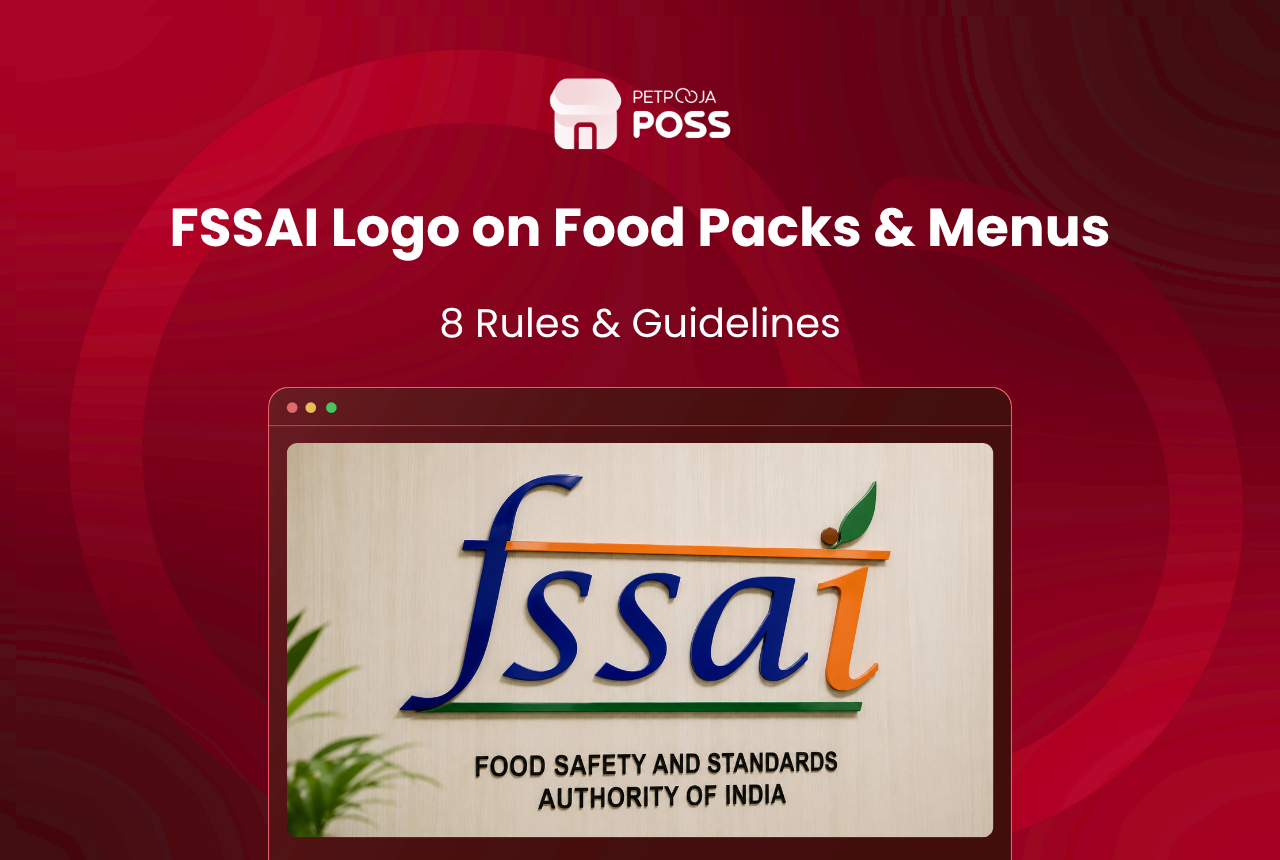
The FSSAI logo never travels alone. Wherever it appears, the 14-digit licence number sits with it, and on a pack it brings a further set of declarations that are not optional.
The rules come from the Food Safety and Standards (Labelling and Display) Regulations, 2020, with a separate order covering your bills. The eight items below are what a food business in India has to get onto a package, a menu card and a customer receipt.
In the outlets we work with, the item that gets missed most is the plainest one: the licence number on the bill.
Key Takeaways
- The logo and the 14-digit number always appear together, in a contrasting colour
- The number belongs on every bill and invoice, not just on packs
- The non-veg mark is a brown triangle now, not a circle
- Anything containing egg counts as non-vegetarian
- Menu labelling duties differ from packaging duties
Where the FSSAI Logo and Number Have to Appear
Three surfaces, and they are governed by different rules.
On a pre-packaged food label, the Labelling and Display Regulations require the FSSAI logo and licence number to be displayed in a colour that contrasts with the background. A grey number on a grey wrapper does not satisfy it.
On a bill or invoice, an FSSAI order made the 14-digit number mandatory from 1 October 2021. No new document was required, so the number simply goes on the receipt you already issue.
On the premises, a true copy of the licence itself must stay on display, which the licensing regulations set out separately from anything you print.
The 8 Declarations at a Glance
Use this as the pre-print check. The last row is the one that applies to a restaurant with no packaged product at all.
| # | What Must Be Printed | Where It Applies |
|---|---|---|
| 1 | FSSAI logo with the 14-digit licence number | Pack label |
| 2 | Licence number on the bill | Every receipt and invoice |
| 3 | Veg or non-veg symbol | Pack and menu |
| 4 | Name of the food and ingredient list | Pack label |
| 5 | Net quantity, batch or lot number | Pack label |
| 6 | Date of manufacture and best before | Pack label |
| 7 | Name, address and consumer care details | Pack label |
| 8 | Nutritional information | Pack label |
These are the eight that decide most labels. A pre-packaged product may also need country of origin if imported, instructions for use, and a separate food additives declaration, so check the regulation for anything you sell sealed.
1. The Logo With the Licence Number
The mark is not decorative. It signals that the business behind the food is licensed, and it is only meaningful when the number sits beside it.
Print both in a contrasting colour on the label. A customer who wants to check the number can run it through the public FBO search. Our FSSAI licence check guide covers how that works from their side.
2. The Number on Every Bill
This is the one restaurants miss, because it feels like a packaging rule.
Since 1 October 2021 the 14-digit licence or registration number has to appear on cash receipts, invoices and bills. FSSAI’s stated reason was to give a customer something to quote when they complain. System-generated government documents such as GST e-way bills are outside it.
Set it once in your billing software rather than asking a cashier to remember. Our restaurant bill format template shows where the number sits alongside the GST fields.
Take a sweet shop in Kharadi selling boxed mithai and loose items over the counter (an example). Its boxes carry the logo and number correctly, because the printer was briefed. Its counter bills carry neither, because nobody told the billing software. Same requirement, only one half of it actioned.
3. The Veg and Non-Veg Symbol
The non-veg mark changed, and plenty of packaging still carries the old one.
Vegetarian food takes a green filled circle inside a green square outline. Non-vegetarian food takes a brown filled triangle inside a brown square outline. The triangle replaced a brown circle so that a colour-blind customer can tell the two apart by shape rather than colour alone.
Size scales with the pack. For a principal display panel up to 100 cm², the circle runs at least 3 mm across, and the square around it is twice that. Anything containing egg is non-vegetarian for this purpose, which catches more bakery items than owners expect.
4. Name of the Food and Ingredient List
The name has to describe the food honestly, not just brand it.
Ingredients follow in descending order of composition by weight at the time of manufacture. Compound ingredients get broken out, and food additives are declared by class name with the number or name of the additive.
5. Net Quantity, Batch or Lot Number
Net quantity is the contents excluding the wrapper, so a 200 g pack means 200 g of food.
The batch, lot or code number is what makes a recall possible. It is the field that lets you pull one day’s production off a shelf instead of the whole line. Generate it properly rather than reusing one number across several weeks.
6. Date of Manufacture and Best Before
Two dates, and they answer different questions.
The date of manufacture or packing says when the food was made. The best before or use by date says how long it stays fit. For food you make and pack in your own kitchen for sale, both belong on the sticker, not just one.
7. Name, Address and Consumer Care Details
The complete address of the manufacturer or packer goes on the label, along with consumer care contact details.
A postbox is not an address. The point is reachability. A customer with a complaint, or an inspector tracing a batch, should reach the business that made the food without going through a distributor.
8. Nutritional Information
Nutritional information is declared per 100 g or 100 ml and per serving, covering energy, protein, carbohydrate, sugars, fat and salt or sodium.
Added sugar, trans fat and sodium carry their own declarations. FSSAI has also approved showing added sugar, salt and saturated fat in bold and a larger font. The Health Ministry announced that in June 2024. Check the current label format before committing to a print run.
What Belongs on the Menu Rather Than the Pack
A restaurant that packs nothing still has menu duties, and they are a different list.
The veg and non-veg symbols carry across to menu cards and display boards. Allergen information belongs there too. Calorific value in kcal per serving is required from food service establishments holding a central licence, or running outlets at ten or more locations.
Read that as two tests rather than one. A ten-branch chai chain is caught by the outlet count, and a single large restaurant on a central licence is caught by the licence alone.
Menus that carry calories also carry a reference line: “An average active adult requires 2,000 kcal of energy per day; however, calorie needs may vary.”
Our post on FSSAI food labelling regulations covers the menu side in detail, including the exemption for caterers operating fewer than sixty days a year. Design matters as much as compliance here, and the menu card design rules show how to fit the marks in without wrecking the layout.
Where Food Businesses Get This Wrong
The same handful of misses come up again and again:
- The licence number is on the pack but missing from the bill
- The old brown circle is still on the non-veg mark
- An egg-containing cake or mayonnaise is marked vegetarian
- The number printed is the application number, not the granted 14-digit licence number
- A lapsed licence keeps getting printed because nobody diarised it
That last one costs more than a reprint. A number that no longer verifies is worse than no number, so our FSSAI renewal guide is worth a read alongside this.
Take a bakery chain in Baner printing 4,200 pastry boxes a month (an example). It reprinted the whole stock after an inspection, because the boxes carried a green circle on an egg sponge. The mark was the only thing wrong with the box.
Setting It Up Once Instead of Every Print Run
Most of this is a setup job done once, not a daily discipline.
The veg or non-veg flag belongs on the item record itself. It then follows the dish onto the menu card, the aggregator listing and the printed bill, with nobody re-tagging it. That is what a product master is for.
A restaurant POS holds the FSSAI number in outlet setup and prints it on every bill and digital receipt, which closes the gap that catches most outlets. The same item record drives what the POS billing screen shows, so the mark on the bill matches the mark on the menu.
Conclusion
Eight declarations, three surfaces. The logo and the 14-digit number on the pack, the number again on every bill, and the veg or non-veg mark on both the pack and the menu.
The rest of the pack list is detail a printer will get right if you brief it. That means name and ingredients, net quantity and batch, both dates, the full address, and the nutrition panel.
Check two things before your next print run. That the non-veg mark is a triangle, and that your licence has not quietly lapsed. Getting the number onto every bill is a one-time job inside Petpooja POSS.
Frequently Asked Questions
The logo with the licence number is required on pre-packaged food labels, printed in a colour that contrasts with the background. A restaurant serving food on a plate is not packaging it. The requirement bites when you sell something sealed, such as a bottled sauce or a boxed sweet.
It scales with the principal display panel. For a panel up to 100 cm², the inner circle or triangle runs at least 3 mm across and the square around it is twice that diameter. Larger panels take proportionally larger marks.
Yes, and on the bill. A cloud kitchen sells food in sealed containers through an aggregator, so the number should appear on the container label and on the order invoice. Our FoSCoS application guide covers getting the licence in the first place.
No. The 14-digit number that goes on labels and bills is the one on the granted licence or registration. An application reference is not the same thing and will not verify on the public search.
No, the lists differ. Menus carry the veg and non-veg marks, allergen information, and calorie values where the business runs ten or more outlets. The full ingredient list, net quantity, batch number and dates belong to packaged products. A GST invoice template covers what the bill itself needs.