


- Shift rostering with unlimited A/B/C configurations and weekly rotation is non-negotiable for factories
- Overtime must calculate at double the ordinary rate under Section 59 of the Factories Act
- A face scanner at the factory gate eliminates proxy attendance across shift changes
- Flat-fee pricing absorbs seasonal contract labour without inflating your payroll bill
- PF/ESIC auto-filing matters because 80-90% of factory workers fall under statutory wage ceilings
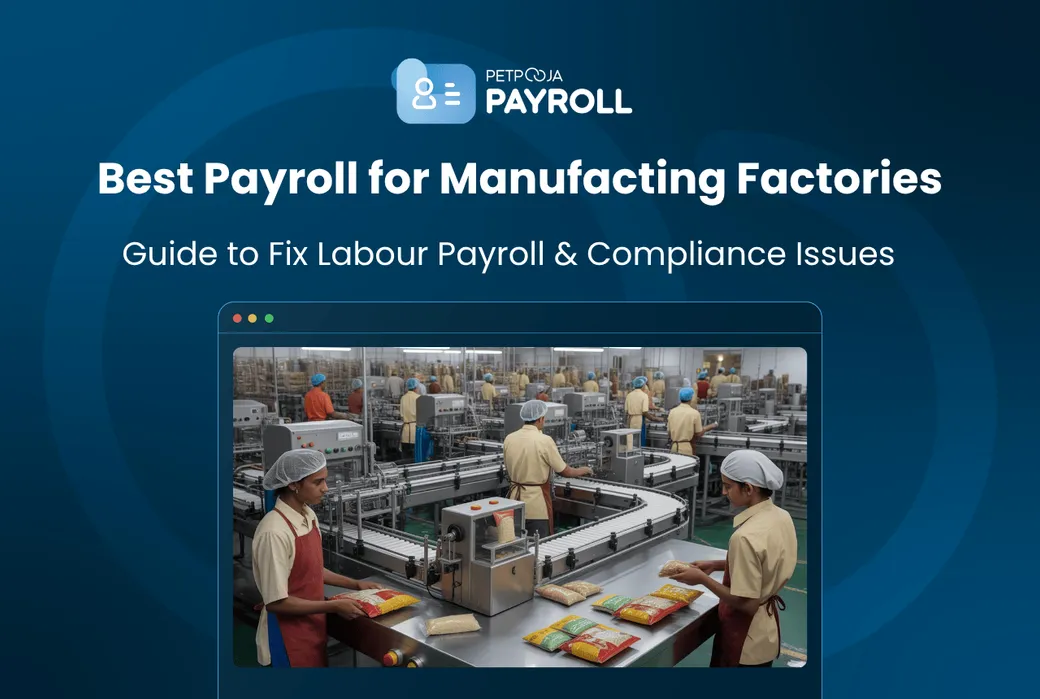
Factory payroll in India is not a simplified version of office payroll. It runs on the Factories Act, 1948, which caps weekly hours at 48, mandates overtime at twice the ordinary wage, and requires documented attendance and wage registers that Factory Inspectors can demand during surprise visits. A standard HR tool built for 9-to-5 office teams cannot handle three-shift rotations, piece-rate wages, or a workforce split between permanent rolls and contract labour.
This guide covers the six features every factory owner should look for, and what to check before you pick any tool for your production floor.
Why Does Factory Payroll Software Need to Be Different?
Here is what standard payroll tools were not designed for:
- Rotating shifts that change weekly. Most office payroll tools assume one fixed shift per employee. Factories rotate workers across morning, afternoon, and night shifts on a weekly or fortnightly cycle. Each shift has a different allowance component
- Overtime at double rate, not time-and-a-half. Under Section 59 of the Factories Act, every hour beyond 48 per week must be paid at twice the ordinary wage. Many generic tools default to 1.5x overtime, which underpays workers and creates compliance risk during inspections
- Piece-rate alongside time-based pay. Garment stitchers in Tirupur earn per piece. Packaging workers in Baddi earn per carton. Meanwhile, the machine operator on the same floor earns a fixed monthly salary. One payroll cycle, three wage structures
- Contract labour on the same register. The Contract Labour Act, 1970 requires factories to maintain separate records for contract workers, but attendance and wage processing often happen on the same system
- Inspector-ready registers. Factory Inspectors check Form B (overtime register), Form D (wages register), and muster rolls during surprise visits. If your software cannot generate these, you spend days recreating records from raw data
At Petpooja, we see manufacturing clients in Surat and Ludhiana maintaining parallel paper registers for years because their payroll software could not produce inspector-ready reports.
How Should Factory Payroll Software Handle Shift Rostering?
Indian manufacturing plants typically run 2-3 rotating shifts (morning, afternoon, night) on weekly or fortnightly cycles. Payroll software for factories must support unlimited shift configurations with automatic rotation, recalculating attendance, night-shift allowances, and overtime based on each worker’s assigned shift that week.
Attendo (formerly Petpooja Payroll)’s flexible shift module does this out of the box. You define A, B, and C shifts with start times, end times, break durations, and night-shift allowance rules. Rotations happen on a schedule you set, and the system recalculates allowances based on whichever shift a worker is on that week.
For a ceramic tile factory in Morbi running 3 shifts across 150 workers, the admin sets the rotation pattern once. Every Monday, shifts rotate and the system picks up new assignments without anyone touching a spreadsheet. If you run multiple plants, the same shift template replicates across locations from a single dashboard.
How Is Overtime Calculated at Double Rate Under the Factories Act?
The Factories Act, 1948 (Section 59) mandates overtime at double the ordinary wage rate for every hour beyond 48 per week. Many generic HR tools default to 1.5x, which underpays workers and creates a compliance gap that Factory Inspectors flag during surprise visits.
Attendo applies the 2x multiplier by default. The system tracks daily and weekly hours, flags anyone approaching the 48-hour threshold, and applies the correct rate during salary processing. For a chemical plant in Valsad where 20 workers regularly log 52-55 hours during peak production weeks, the extra hours are calculated and added to the salary sheet without manual input from the admin.
Why Do Factories Need Biometric Attendance on the Production Floor?
Proxy attendance during shift changeovers costs Indian factories lakhs annually in ghost wages. Face recognition scanners work where fingerprint devices fail because factory workers handle machine oil, chemicals, and metal dust throughout their shift. A biometric device at the gate timestamps every shift-change transition and feeds data directly into payroll.
When the night shift ends at 6 AM and the morning batch starts at the same time, a card swipe or buddy punch slips through unnoticed. Attendo’s face recognition scanner (lifetime warranty) catches this because it verifies each individual regardless of hand condition.
An auto-parts manufacturer in Chakan, Pune with 90 employees across 3 shifts uses the face scanner at the gate to capture every transition with a timestamp. The admin gets WhatsApp attendance reports daily without chasing supervisors.
Why Does Flat-Fee Pricing Matter for Seasonal Factories?
Indian manufacturing units often scale headcount by 30-50% during peak seasons. On per-employee payroll platforms, adding 35 temporary workers at Rs 50-100 per head per month inflates costs unpredictably. Flat-fee payroll pricing absorbs seasonal contract labour without increasing the software bill.
A food processing unit in Mandideep, for example, goes from 60 employees in April to 95 during the festive production rush. Those 35 extra heads on a per-employee platform add Rs 1,750-3,500 per month for a few months of use. By contrast, Attendo charges a flat annual fee regardless of headcount. Add 10 contract labourers in September, release them in December. The bill stays the same.
How Does Payroll Software Handle PF/ESIC for the Entire Factory Floor?
India’s manufacturing sector employs over 27 million workers in registered factories alone, and 80-90% of them earn below the Rs 21,000/month ESIC ceiling. Filing contributions for 80-150 people manually is a full-day job each month. On top of that, a missed deadline triggers penalties under Section 7Q of the EPF Act at 12% annual interest. Attendo auto-generates PF ECR files, ESIC contribution sheets, and PT challans based on each person’s salary bracket. For a textile mill in Bhilwara where the owner handles compliance without a CA, this saves 2-3 days each month.
How Do Custom Salary Heads Work for Piece-Rate Wages?
In Indian factories, piece-rate workers (garment stitchers in Tirupur, packaging workers in Baddi) earn per unit produced, while machine operators on the same floor earn fixed monthly salaries. Payroll software must support custom salary heads where per-unit rates sit alongside fixed pay, night-shift allowance, overtime, and statutory deductions in the same cycle.
A stitcher earning Rs 8 per piece who produces 180 pieces in a day takes home Rs 1,440 for that shift. Attendo lets you define per-unit or per-carton rates as separate salary components. For an electronics assembly unit in Noida with 3 production lines at different output rates, each line’s piece rate is configured separately. Overtime on piece-rate workers is calculated on average daily earnings, as prescribed under the Factories Act.
What Should You Check Before Picking Factory Payroll Software?
Before you sign up for any payroll software, run it against this checklist:
| Requirement | Why It Matters |
|---|---|
| Unlimited shift configurations | Factories rotate workers across 2-4 shifts; a tool capped at 2 shifts will break |
| Overtime at 2x (not 1.5x) | Factories Act, Section 59 mandates double rate; non-compliance flags during inspections |
| Biometric hardware included or supported | Proxy attendance costs factories lakhs in ghost wages annually |
| Flat-fee or per-employee pricing | Seasonal hiring makes per-head pricing unpredictable |
| PF ECR + ESIC auto-generation | Manual filing for 80+ workers is impractical; late filing triggers 12% interest |
| Piece-rate wage support | If any part of your floor earns per unit, the tool must handle output-based pay |
| Inspector-ready reports | Form B, Form D, muster rolls in prescribed formats save days during surprise visits |
How Do 3 Payroll Software Options Compare for Factories?
Beyond Attendo, two other tools are commonly considered by Indian factory owners: Keka (strong shift rostering and production-linked pay for 50-500 worker plants) and greytHR (best-in-class statutory compliance auto-filing for owners without an HR team).
| Feature | Attendo | Keka | greytHR |
|---|---|---|---|
| Pricing | Flat annual fee | Per employee/month | Per employee/month |
| Biometric device | Included (face scanner) | Not included | Not included |
| Shift rostering | Unlimited configs | Advanced rotation engine | Basic shifts |
| Overtime at 2x | Yes | Yes (auto from shift rules) | Configurable |
| Piece-rate pay | Custom salary heads | Production-linked module | Manual workaround |
| PF/ESIC auto-filing | Yes | Yes | Yes (strongest) |
| Seasonal hiring cost | No extra charge | Extra per head | Extra per head |
Attendo fits plants under 200 employees needing flat pricing and bundled hardware. Keka suits larger operations (50-500) with dedicated HR managing rosters and output bonuses. greytHR works where compliance filing is the priority and the owner handles HR alone.
Conclusion
Manufacturing payroll needs shift rostering, Factories Act overtime at double rate, biometric attendance, and PF/ESIC automation. If you are still on Excel, here is why you should switch to salary management software. Attendo covers all six features above with flat pricing and bundled hardware. For complex rosters, Keka adds production-linked bonuses. For compliance-only needs, greytHR auto-files without an HR team.
Frequently Asked Questions
Does payroll software calculate overtime at double rate as required by the Factories Act?
Attendo enforces overtime at twice the ordinary wage rate under Section 59 of the Factories Act, 1948. The system tracks hours beyond the 48-hour weekly cap and applies the double-rate multiplier in the same payroll run without manual calculation.
Can I manage both permanent and contract workers on the same software?
Yes. Attendo lets you define separate pay structures for permanent staff (monthly salary with PF) and contract labourers (daily wage or piece rate). Both groups process in the same cycle with different compliance rules applied to each.
Is a biometric device necessary for factory attendance?
For plants with 30+ workers across shifts, a face scanner at the gate prevents proxy punching during shift changes. Attendo includes one with lifetime warranty. The device handles oily or chemical-stained hands that cause fingerprint scanners to fail on the factory floor.
How does piece-rate payroll work?
You define a per-unit or per-carton rate as a custom salary component. The system multiplies each worker’s daily output by the rate and adds it to their base wage. Overtime on piece-rate workers is calculated on the average daily earnings, as prescribed under the Factories Act.
What records should a factory maintain for Inspector visits?
Factories must maintain Form B (overtime register), Form D (wages register), muster rolls, PF/ESIC contribution records, and leave-with-wages registers. Payroll software that generates these reports in the prescribed format saves hours during surprise inspections. Attendo produces downloadable reports matching these formats.
Thanks. This helps us make the next article better.

Avani Joshi is a Content Writer at Petpooja, where she writes about payroll, billing, and the everyday software that keeps Indian SMEs running. She has a knack for taking complicated topics and explaining them in plain language for business owners who don't have time to decode jargon.