
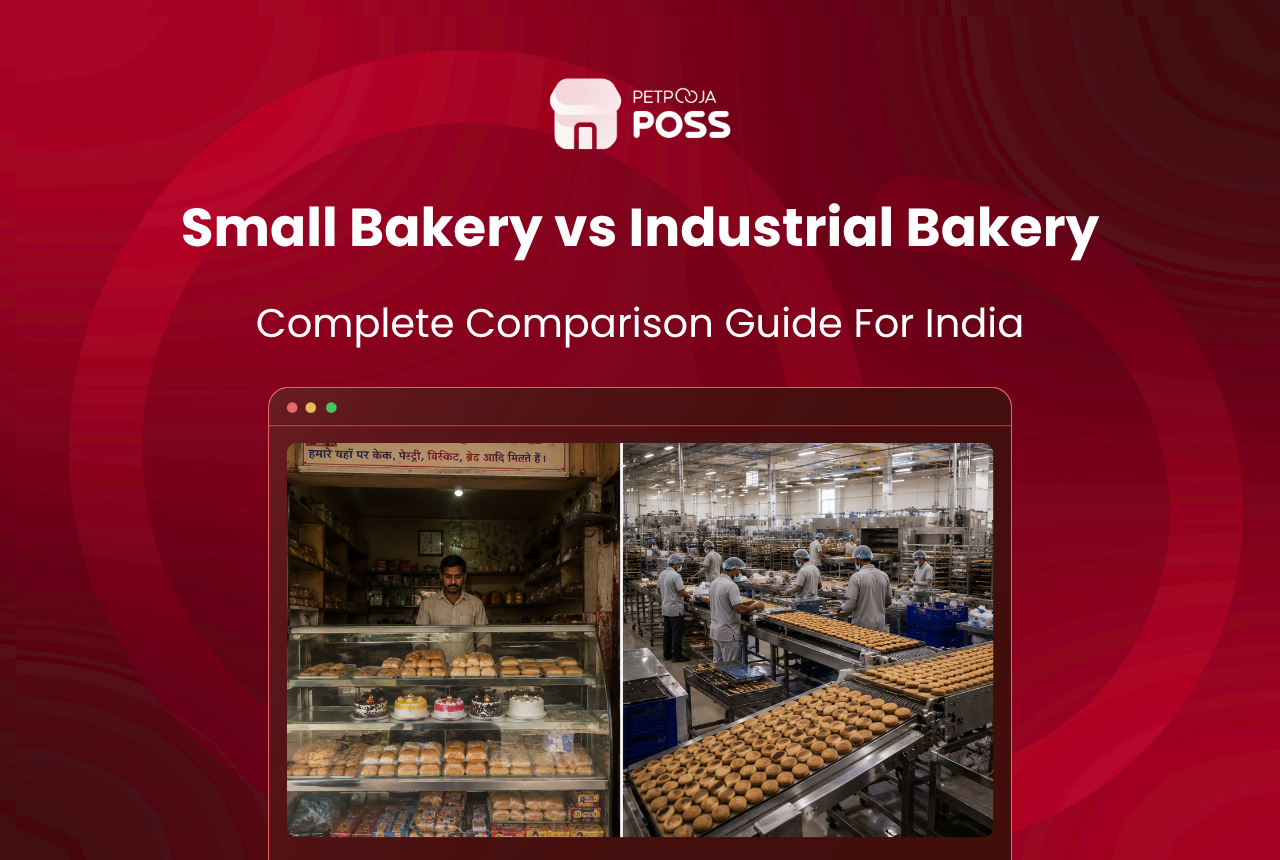
Small bakeries keep more of every rupee they earn. A home baker in Bopal, Ahmedabad, clearing 12 cake orders a week can pocket 40-60% of revenue as net profit, per Truffle Nation’s margin data. An industrial unit running a tunnel oven in Bhiwandi keeps 10-20% on each unit, but ships 3,000 of them a day to supermarket shelves, hotel kitchens, and franchise counters.
So the answer is not “which is better.” It is: do you want to sell 30 cakes a week at Rs 1,400 each to people who found you on Instagram, or do you want to sell 3,000 pav buns a day at Rs 8 each to a distributor who does not know your name?
That single question decides your capital, your licence tier, your equipment, your staff, and frankly, what your mornings look like for the next five years.
Key Takeaways
- Home bakeries net 40-60% margins. Industrial units net 10-20%, but on volumes that dwarf a retail counter.
- A small setup runs on Rs 50,000 to Rs 15 lakh. Industrial production starts at Rs 25 lakh and can cross Rs 1.5 crore.
- FSSAI basic registration (Rs 100/year) is enough for a home or small retail bakery. Industrial operations need a state or central licence.
- Small bakeries sell to end consumers. Industrial ones supply hotels, chains, and distributors.
What Is the Difference Between a Small and Industrial Bakery?
A small bakery is any setup where the person who owns it is also the person pulling trays out of the oven. Could be a home kitchen in Maninagar, Ahmedabad. Or a 300 sq ft counter in Aundh, Pune, with two helpers. Or a cloud kitchen listing on Swiggy with no walk-in traffic at all. Either way, production is batch-based, mostly made to order, and the owner touches every stage.
Industrial is a different animal altogether. The oven is a tunnel oven or a rotary rack, not an OTG. The mixer handles 50-100 kg of dough in one go. There is a packaging line, a cold storage room, and a loading dock. Britannia operates at this scale. Monginis runs 1,000+ outlets fed by centralised production.
Theobroma is a good reference point. It started as a single counter in Colaba, Mumbai, in 2004, was valued at Rs 2,410 crore by mid-2025, and had expanded to 225 outlets in 30+ cities. That trajectory took two decades and multiple rounds of funding.
But many guides treat these as two steps on the same ladder. They are not. The customer base, the pricing logic, the compliance burden, and the daily rhythm are entirely separate. India’s food processing sector itself is projected to reach Rs 47,13,350 crore by FY26-end according to IBEF, and within that, the organised baking segment and the cottage-industry segment operate on completely different tracks.
Small Bakery vs Industrial Bakery: The Numbers
| Parameter | Small Bakery | Industrial Bakery |
|---|---|---|
| Setup cost | Rs 50,000 to Rs 15 lakh | Rs 25 lakh to Rs 1.5 crore |
| Monthly running cost | Rs 30,000 to Rs 2 lakh | Rs 5 lakh to Rs 25 lakh |
| Output per day | 20 to 200 units | 1,500 to 5,000+ units |
| Net margin | 40-60% (home), 15-28% (retail) | 10-20% |
| People on payroll | 1 to 5 | 10 to 50+ |
| Floor space | 100 to 500 sq ft | 1,500 to 5,000+ sq ft |
| Sells to | End consumers | Distributors, hotels, retail chains |
| Break-even | 8-14 months (home), 18-30 months (retail) | 24-48 months |
Now look at the home row. A first-time operator clearing Rs 75,000 a month in revenue keeps Rs 38,000-45,000 of it. Meanwhile, a retail counter doing Rs 1.5 lakh a month keeps only Rs 19,000-22,000 because rent and staff eat into the rest. The factory-scale operator doing Rs 10 lakh a month keeps Rs 1-2 lakh, but that Rs 10 lakh figure is a Tuesday, not a milestone.
What Licences Does a Bakery Need in India?
For a home operation selling brownies through Instagram, FSSAI basic registration at Rs 100 a year is the only food-safety requirement. Apply on the FoSCoS portal, wait 7-30 days for approval. That covers annual turnover up to Rs 12 lakh. Cross that threshold, and you graduate to a state licence at Rs 2,000-5,000 per year.
On the industrial side, the paperwork is heavier. FSSAI state licence is the floor. Above Rs 20 crore turnover or multi-state supply, a central licence at Rs 7,500/year kicks in. Then there is the Factory Licence under the state Factories Act, Pollution Control Board consent (the NOC nobody budgets time for), and fire clearance because commercial gas lines and tunnel ovens do not get waved through without an inspection.
Apart from FSSAI, GST registration applies to both formats once turnover crosses Rs 20 lakh. Small operators under Rs 1.5 crore can file under the GST Composition Scheme at 1%. Industrial units cannot use this scheme, though, because their B2B buyers need input tax credit on every invoice, and composition invoices do not allow that.
The full document checklist for both tiers is in our FSSAI compliance checklist.
What Equipment Does Each Bakery Format Need?
For a small operation, the entire equipment list fits inside two Amazon orders.
- OTG oven, 60L: Rs 8,000-15,000. Morphy Richards and Bajaj are what most first-timers in Ahmedabad and Pune land on
- Stand mixer, 5-7L bowl: Rs 15,000-45,000
- Refrigerator, 300L: Rs 20,000-35,000
- Tins, moulds, sheets: Rs 10,000-20,000
- Packaging (kraft boxes, ribbons, cake boards): Rs 5,000-10,000
All in: Rs 58,000 to Rs 1.25 lakh for a home kitchen. Our bakery equipment checklist has the expanded list with brand recommendations per category.
By contrast, the industrial floor looks nothing like this. A tunnel oven alone costs Rs 8-25 lakh, and a 50 kg spiral mixer runs at Rs 2-6 lakh per Godrej Capital’s bakery plan breakdown. Add a dough divider and moulder (Rs 3-8 lakh), packaging line (Rs 5-15 lakh), and walk-in cold storage (Rs 3-8 lakh). Total equipment bill before rent, wiring, or the first kg of flour: Rs 21 lakh to Rs 62 lakh.
Which One Fits Your Situation?
Forget “which is better” for a moment. Think about three things: capital in hand, who the buyer is, and how long you can wait before the venture pays for itself.
Under Rs 15 lakh in capital? A small setup is the only realistic option. The economics do not support a factory at that budget, and borrowing to fill the gap is how ventures end up shutting by month eighteen with a loan EMI still running.
On the other hand, if you already have supply contracts with hotels, a caterer chain, or a D-Mart listing, the industrial route makes sense because distribution is locked before the oven is even installed. The operators we have seen struggle the most at Petpooja are the ones who built a production floor first and then went looking for buyers. The floor sat idle for months. Rent did not.
And if you are somewhere in between? Start from your flat. Prove demand with 50-80 orders a month. The capital for a bigger setup tends to show up once the product has a reputation attached to it. Theobroma did exactly this. Thousands of home bakers across India are doing it right now, graduating from OTG to deck oven once the weekly order count outgrows the kitchen.
When Does a Bakery Need Billing Software?
Ten cake orders a day? A ruled notebook and a UPI screenshot folder will do. Forty walk-in bills plus six Swiggy orders plus three WhatsApp prepaids hitting between 4 PM and 8 PM? Something gets missed. A black forest cake marked as “chocolate cake” on the bill. Butter consumption off by 2 kg because a custom order was never entered.
Across our platform, we have seen this exact pattern repeat with bakery counters that crossed 30-40 daily transactions. Petpooja POSS handles billing, KOT, inventory deduction, and Swiggy/Zomato order syncing on one screen for over 1,00,000 food outlets. Not a Day 1 purchase if the operation runs on 10 orders. But once the daily count crosses 30-40, the notebook starts lying about stock.
For industrial operators, the need is different altogether: ERP-grade software for batch production planning, raw material scheduling, and B2B invoicing. Different tool, different budget.
Conclusion
In short: the smaller format keeps more of each sale. The industrial format moves more volume. Neither model is wrong. The wrong move is picking the factory route without distribution contracts already signed, or staying with a home setup when daily orders have been hitting 80 for three straight months and the OTG runs six hours without a break.
So pick based on what the bank balance says today and what the order diary says this month. The format can always change later. Most of the names people recognise in this industry started exactly where a first-timer would: a single counter, a single oven, a single neighbourhood.
Frequently Asked Questions
On margins, absolutely. Home bakers keep 40-60% of revenue. Industrial units keep 10-20%, per Truffle Nation’s 2026 analysis. But a factory pushing 3,000 pav buns a day at thin margins earns more in absolute rupees than a home baker filling 15 cake orders a week.
Rs 25 lakh at the bare minimum. Comfortable range is Rs 50 lakh to Rs 1.5 crore. Equipment eats Rs 21-62 lakh of that. The rest goes to space, wiring, compliance, and enough working capital to survive the 24-48 month break-even wait.
Yes. Theobroma started from a single Colaba counter in 2004. The typical trigger is when daily orders consistently exceed OTG capacity and the owner is turning away work. At that point, the FSSAI licence tier changes, the production space changes, and semi-automated equipment replaces the stand mixer.
Rs 100/year basic registration up to Rs 12 lakh turnover, rs 2,000-5,000/year state licence between Rs 12 lakh and Rs 20 crore. Rs 7,500/year central licence above Rs 20 crore or for multi-state supply. Use our food cost calculator to estimate where your turnover will land.
Home bakeries: 8-14 months. Overheads are negligible. Retail counters: 18-30 months because rent and staff salaries run whether or not the display case is empty. Industrial: 24-48 months, and that assumes the distribution pipeline is active from month one. If it is not, add another 6-12 months.








