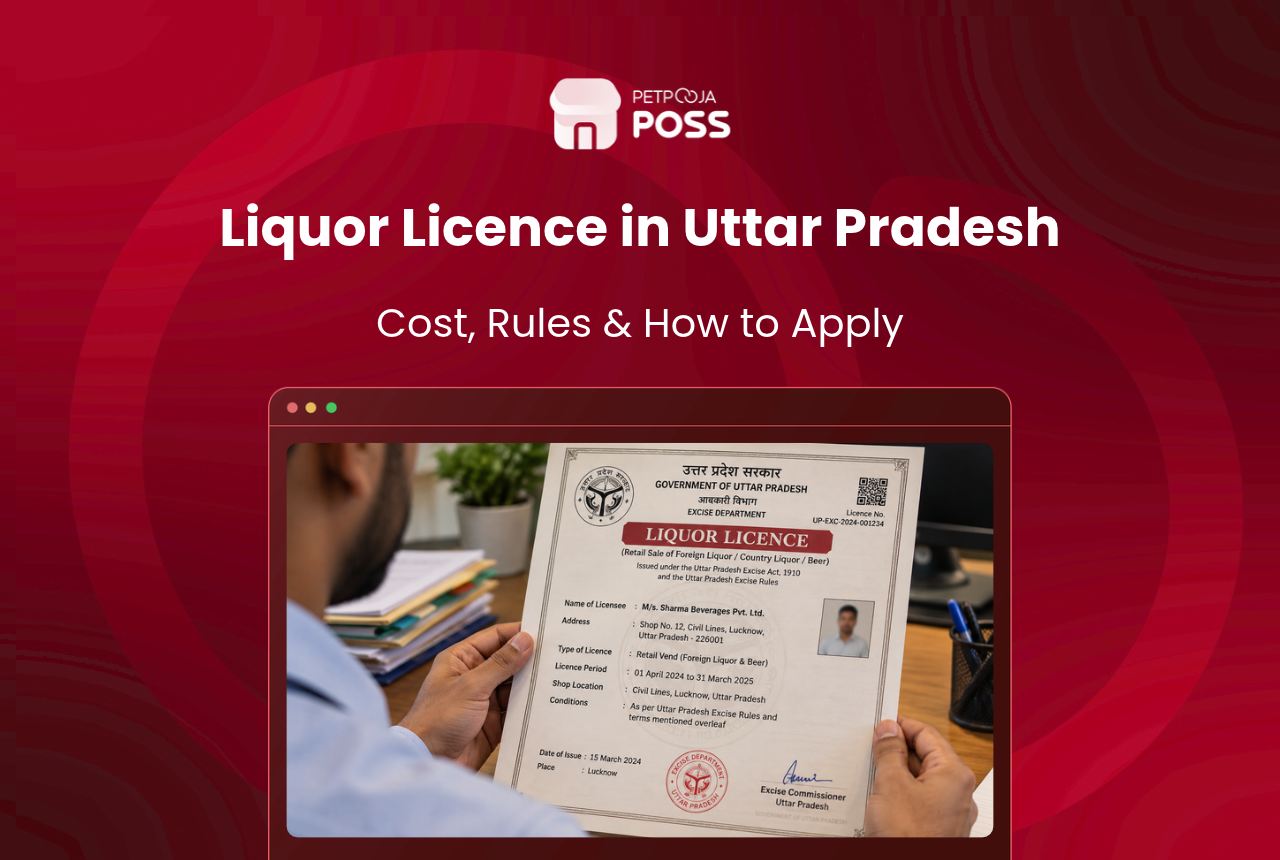
How do you get a liquor licence in Uttar Pradesh? For a restaurant bar, you apply through your district excise office, and a District Bar Committee has 20 working days to decide. The yearly fee is ₹5 lakh to ₹15 lakh.
Where your premises sits decides that fee. Lucknow city, Noida and Ghaziabad pay the most, and most of the state pays the floor.
A retail shop works differently. You cannot apply for a particular shop. You enter an e-lottery, and each shop’s fee is worked out on its own.
This post covers how to apply, the licence types, what each one costs, who is eligible, the rules once you open, and what a breach costs.
Key Takeaways
- You apply for a bar licence through your district excise office, and a District Bar Committee must decide within 20 working days.
- A restaurant bar pays ₹5 lakh to ₹15 lakh a year. Your district band sets the figure, so check it before you sign a lease.
- A retail shop is not granted on application. You enter a lottery, and only your excise office can tell you that shop’s fee.
How to Apply for a Liquor Licence in Uttar Pradesh
There are two routes, and they share almost nothing. A bar licence is applied for, while a retail shop is drawn by lottery. This section takes the bar route first.
The restaurant or hotel bar route
- Find your district band before anything else. The state is split into five bands for licence fees, from Special at the top down to Category 4. The same restaurant bar costs ₹10 lakh less in Category 3 than in the Special band. The band table is in the fees section below.
- Get the fire no objection certificate early if you are in a multi-storey building. Without it, the premises does not qualify.
- Apply through the district excise office. Use the code for your kind of premises, such as FL-6 for a hotel. The next section lists the main codes. Keep your FSSAI licence and local body licence ready, because the policy refers to both, and ask the office for the current application form.
- Wait for the District Bar Committee. It has 20 working days to decide on your application.
- Budget the extras with the fee. Processing is 10% on top, and you can renew up to six months late, with interest charged on the delay.
What I would do first. I would check the band before choosing the site, not after. The top band, Special, stops 5 km past the Lucknow municipal corporation limit. A restaurant bar just beyond that ring falls one band lower and pays ₹10 lakh a year, not ₹15 lakh.
Opening a bar is a bigger job than the licence alone. The guide to opening a bar in India covers the rest of the setup.
The retail shop route
- Wait for the year’s e-lottery notice for your district. Several states now run this online through the excise portal.
- Ask the district excise office what that shop’s licence fee is. It is worked out shop by shop, so this is the only way to know what winning will cost you.
- Pay the application fee named in the notice. The notice sets it for that shop type and that district.
- Enter the draw, and pay the licence fee if you are drawn. Allotment is by lottery, so the application fee buys a chance rather than a shop.
What are the Liquor Licence Types in Uttar Pradesh?
Uttar Pradesh names each licence by an FL code. Five of them cover almost every food business, and this section takes those.
- FL-7 is the restaurant bar licence. This is the one most restaurants want.
- FL-6 is the hotel bar licence, priced by star rating and room count.
- FL-7A is the club bar licence, priced by how many members the club has.
- FL-11 is the event bar licence, taken per function rather than per year.
- FL-AL-1 is the airport bar licence, split between domestic and international terminals.
Retail is separate. Country liquor shops, composite shops and model shops are allotted by lottery. Composite and model shop fees are covered further down.
If you are still weighing which one fits, the types of bar licence guide explains what each category lets you serve.
Liquor Licence Fees in Uttar Pradesh by District Band
A restaurant bar pays ₹5 lakh to ₹15 lakh a year, and the district band alone decides where in that range you land. This section gives the five bands, then the restaurant bar fee in each, then the charges on top.
The five district bands
Every fee on this page depends on this table, so find your district here first.
| Band | Where it covers |
|---|---|
| Special | Gautam Buddh Nagar authority area, plus Lucknow and Ghaziabad municipal corporation areas and 5 km around them |
| Category 1 | The rest of Gautam Buddh Nagar, Ghaziabad and Lucknow districts, plus the city areas of Kanpur Nagar, Agra, Prayagraj and Varanasi and 5 km around them |
| Category 2 | Bareilly, Aligarh, Gorakhpur, Jhansi, Mathura, Meerut, Moradabad, Saharanpur, Ayodhya and Firozabad |
| Category 3 | Every other district headquarters, and municipal council areas elsewhere in the state |
| Category 4 | Everywhere else |
Most of Uttar Pradesh sits in the bottom two bands, which is why a single statewide figure misleads.
FL-7 restaurant bar licence fee by band
One schedule covers every restaurant bar in the state. The size or standard of the place does not change it.
| District band | FL-7 annual licence fee |
|---|---|
| Special | ₹15,00,000 |
| Category 1 | ₹10,00,000 |
| Category 2 | ₹7,50,000 |
| Category 3 | ₹5,00,000 |
| Category 4 | ₹5,00,000 |
So the top band pays three times the bottom two, for exactly the same licence.
Processing and renewal charges
The licence fee is not the whole bill. Processing costs a further 10% of the licence fee, so a restaurant in Lucknow city pays ₹1,50,000 on top.
Renewal the next year swaps that 10% for a 1% renewal charge. On that same bar it is ₹15,000 instead of ₹1,50,000. You still pay the annual fee itself.
Every fee on this page, from the bands above to the shop and late-hours charges below, comes from the Uttar Pradesh Excise Policy 2026-27. It is the government order dated 12 February 2026, and it runs the excise year 2026-2027.
Hotel, Club and Event Liquor Licence Fees in Uttar Pradesh
Hotels, clubs, airports and events are priced on more than the district band. This section covers each one.
FL-6 hotel bar fees
A hotel pays on its star rating. An unrated hotel pays on its room count instead.
| Hotel star rating or room count | Special | Cat 1 | Cat 2 | Cat 3 | Cat 4 |
|---|---|---|---|---|---|
| 5 star and above | ₹27.5 lakh | ₹25 lakh | ₹20 lakh | ₹15 lakh | ₹12.5 lakh |
| 4 star | ₹25 lakh | ₹22.5 lakh | ₹17.5 lakh | ₹12.5 lakh | ₹10 lakh |
| 3 star | ₹20 lakh | ₹17.5 lakh | ₹15 lakh | ₹10 lakh | ₹9 lakh |
| Up to 50 rooms, unrated | ₹15 lakh | ₹10 lakh | ₹7.5 lakh | ₹5 lakh | ₹5 lakh |
| 51 to 100 rooms, unrated | ₹17.5 lakh | ₹12.5 lakh | ₹10 lakh | ₹7.5 lakh | ₹5 lakh |
| 101 rooms or more, unrated | ₹20 lakh | ₹15 lakh | ₹12.5 lakh | ₹10 lakh | ₹7.5 lakh |
UP Tourism grades hotels separately, from Bronze up to Diamond, and the policy pairs each grade with a star rating. A hotel that UP Tourism has not graded pays 10% more than the row that fits its star rating or room count. Conceal your star rating and the department recovers the difference with penal interest.
Club, airport and event bars
The smaller codes are priced on members, terminals or hours rather than on district alone.
A club bar (FL-7A) splits at the 100 member mark, and the band decides the rest.
| Club size | Special | Cat 1 | Cat 2 | Cat 3 | Cat 4 |
|---|---|---|---|---|---|
| Up to 100 members | ₹5 lakh | ₹4 lakh | ₹3 lakh | ₹1.5 lakh | ₹1.5 lakh |
| Over 100 members | ₹8 lakh | ₹6 lakh | ₹4 lakh | ₹2 lakh | ₹2 lakh |
An airport bar is simpler. It is ₹5 lakh at a domestic terminal and ₹6 lakh at an international one, anywhere in the state.
Event bars are charged per 12 hours. For a private function there are three rates:
- ₹500 at your own home, for a function with no commercial purpose.
- ₹1,000 inside a gated society, with the residents’ association’s no objection.
- ₹11,000 for each counter at a hotel, restaurant, banquet hall, resort, farm house, barat ghar or community centre.
A ticketed show or a sporting event is priced on how many people attend. For these events, every counter after the first is charged at half rate.
Liquor Shop Licence Fees in Uttar Pradesh
A retail shop has no published fee, and this is the part to watch. The policy publishes a formula instead, and the answer comes out different for every shop.
A composite shop sells foreign liquor, beer and wine over the counter.
The policy sets two separate figures for each composite shop, and both start from last year.
- Its sales target. This is the minimum guaranteed revenue (MGR), the sales the shop must deliver. For 2026-27 it is last year’s MGR plus 7.5%, rounded up to the next ₹5,000. It is set once for foreign liquor and once for beer.
- Its licence fee. This is worked out at the licence fee rates used in 2025-26, again once for foreign liquor and once for beer. Each part is rounded up to the next ₹5,000, and the two parts added together are the shop’s fee for the year.
The District Collector approves both figures. The policy does not print the fee rates themselves.
A model shop is a composite shop that also lets customers drink on the premises. It is priced against its neighbours rather than against its own past.
Convert a composite shop into one and its fee cannot fall below 80% of what a model shop within 200 metres already pays. Where there is no model shop that close, the floor becomes 90% of the dearest composite shop in the same 200 metres.
So the only honest answer on a shop comes from your district excise office. The wine shop licence process guide covers the retail side across India.
Who Is Eligible for a Liquor Licence in Uttar Pradesh?
Uttar Pradesh puts most of the test on the premises rather than on you. It asks what the building is, and who signs off on it. This section covers who decides and what they look at.
Who grants it
A bar licence is granted by the District Bar Committee. The District Collector chairs it, with a senior police officer and the divisional Deputy Excise Commissioner as members.
The other two members have 15 working days to send their reports. A report that misses that deadline counts as a no objection, so a member’s late report does not hold up the committee.
What the premises must satisfy
The building carries most of the conditions, not the applicant.
- A multi-storey building needs a valid fire no objection certificate, either for your premises or for the whole building.
- No new FL-7 may open within 300 metres of a model shop, measured gate to gate. That covers municipal corporation areas and 5 km around them. Gautam Buddh Nagar is exempt and existing licences are unaffected.
- A restaurant with a valid local body licence and an FSSAI licence need not be in a commercial zone.
- An extra counter elsewhere in the building costs 25% of your licence fee, or ₹2,50,000 if that is higher.
All of it runs under the UP bar licence rules, which the annual policy amends rather than replaces.
Uttar Pradesh Liquor Licence Rules: Hours and Display
Two conditions follow you after you open. This section covers how late you may serve, which costs money, and what the premises must display, which does not.
How late you can serve
Bars close at midnight across the state, and going later is a separate purchase you renew each year. The rates below are set by the same Excise Policy 2026-27.
| Where the bar is | How late you may serve | Price a year |
|---|---|---|
| Municipal corporation areas and Gautam Buddh Nagar | Until 2 AM | ₹2,50,000 |
| Municipal council areas | Until 1 AM | ₹1,00,000 |
A star rated hotel can go further, up to 4 AM, by buying extra two-hour blocks at ₹2,50,000 each. The midnight limit binds hotel bars with no star rating, but serving their own in-house guests is exempt from it.
An event bar sets its own hours online, up to 12 hours. It may never run past 2 AM, whatever the function.
So the ₹15,00,000 licence fee becomes a ₹19,00,000 bill in the first year, if you also buy the late licence.
What the premises must display
Every bar must fix a steel plated warning board in a visible place. It warns against narcotic drugs and psychotropic substances. The requirement comes from an excise circular of 6 January 2022 and applies to every licensed premises.
Restaurant owners we work with tell us the display rule is the one that gets missed. It is cheap to satisfy and easy to forget until an inspection.
The stock behind the bar is the other thing an inspection asks about, and it is harder to answer from memory. Matching what you sold against what you bought is the job Petpooja does. A bar and brewery POS tracks consumption against purchases.
What If You Break the Uttar Pradesh Liquor Licence Rules?
The penalties sit in the Excise Act, not the annual policy. For serious offences they reach prison. This section covers what a licensee faces.
Section 64 of the United Provinces Excise Act 1910 covers acts by a licensee or their staff. Selling to anyone under 21 is a separate offence, under section 61. So is employing them to serve.
The everyday breach is a fine, not a sentence. Failing to produce your licence on demand carries a fine of up to ₹2,000 under section 64. So does wilfully breaking a licence condition. There is no imprisonment attached to it.
Adulteration is the one that carries prison. Section 64-A covers mixing a noxious drug or any foreign ingredient into what you sell.
That offence carries imprisonment of not less than six months and up to three years, plus a fine between ₹1,000 and ₹2,000. The six month floor matters, because a court cannot go below it.
A second conviction draws an enhanced sentence. The Act also lets a senior excise officer settle a case for a payment instead of taking it to court. So a breach can end in a payment rather than a hearing.
The chapter setting all of this out is Chapter X, Excise Act, published by the department in English.
Conclusion
A liquor licence in Uttar Pradesh starts with your district excise office for a bar, and with a lottery for a shop. The District Bar Committee has 20 working days to decide on a bar.
The fee comes down to your district band. A restaurant bar pays ₹15 lakh in Lucknow city, ₹10 lakh in Kanpur or Agra, and ₹5 lakh across most of the state.
So check your band first, then add the 10% processing fee. Then decide whether late hours are worth ₹2,50,000 a year.
Once the licence is live, owners tell us the harder part is showing that the stock behind the bar matches the sales. Keeping every bottle tied to a bill is the job of your restaurant billing and inventory system.
Frequently Asked Questions
Yes. An FL-7 may be granted for floating platforms and vessels in a water body. A river or lake venue is licensed under the same restaurant bar code.
The Special band reaches 5 km beyond the Lucknow and Ghaziabad municipal corporation limits. It counts that ring whether the land is urban or rural. A rural plot inside the ring pays the Special band fee.
Yes, and the structure differs as much as the price. Haryana licence fees cover 21 months rather than a year, while Madhya Pradesh licence fees are published flat by city.
Our state-wise licence cost guide sets the charges side by side. The Telangana licence fees page covers a state that prices by population instead.