
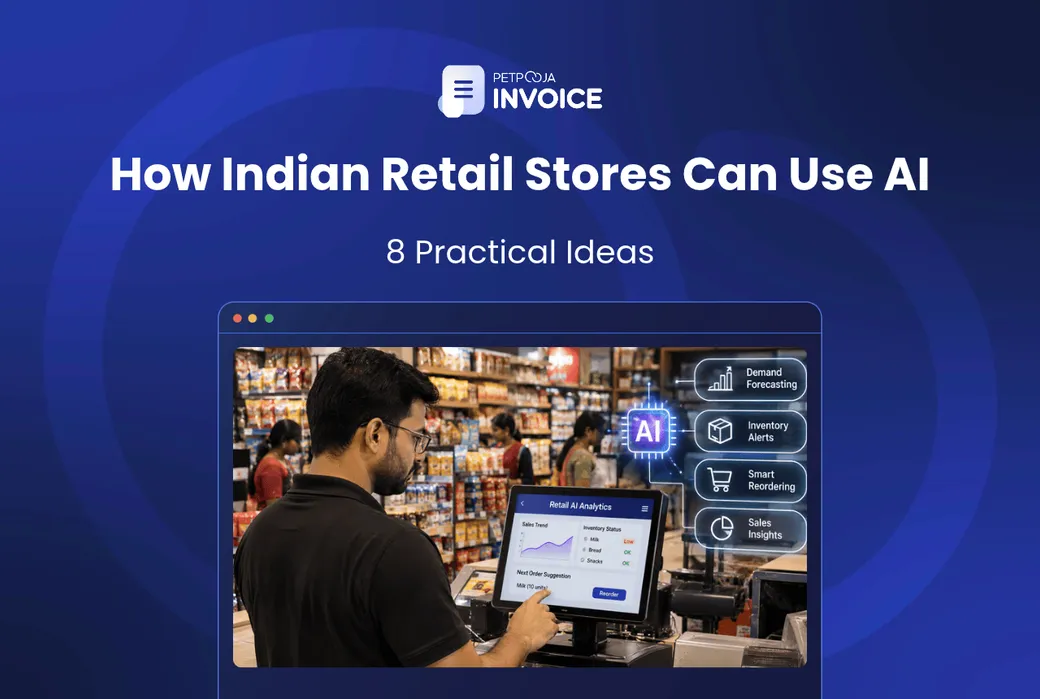



What does artificial intelligence (AI) in retail mean for a small Indian store? It means software that does a few routine shop jobs for you. This post gives you 8 practical uses, from keeping stock counts updated to reading supplier bills and writing offer messages.
None of them needs a data team or a big budget. How well each one works depends on the data your shop already has. That means a clean item list, a bill for every sale, and a record of what you bought.
Shop owners often hear about AI through stories of very large chains. Those stories do not help a saree shop in Surat or a mobile accessories shop in Indore. The uses here are ones that small Indian business owners can try, and most of them can start this month.
For each use, you get what it is, the AI tool to try, a short example and one caution. First, a look at how AI in retail is growing in India. After the 8 uses come the benefits, the basics to set up and the disadvantages to plan for.
Key Takeaways
- Of the 8 uses, four can come built into retail billing software and four lean on general AI tools fed with your own shop facts. Start where your software already helps.
- Stock counts and stock gaps come from your bills, so every unbilled sale makes them wrong.
- AI saves typing and counting, but a person still checks its output before it reaches a customer.
How AI in Retail Is Growing and What It Does for Stores
AI in retail is growing in India, with large retailers leading the spending. This section shows how far it has spread and the two forms it takes in a small store.
Large Indian retailers are already spending on it. In a May 2025 Honeywell survey of large retailers in seven countries, 96% of the Indian ones were investing in AI, the highest of any market. The same survey found 64% of Indian retailers use optical character recognition (OCR), the technology that reads text from a photo, against 42% globally.
For a small shop, AI arrives in two forms. The first is built into billing software and works on your own records. Some of these tools use machine learning. That is software that learns from past data, for example to see what sells.
The second form is an AI chat tool, such as ChatGPT or Google Gemini, that writes text from what you type. It knows nothing about your shop unless you tell it. So the first form needs clean bills and barcodes, and the second needs correct facts from you.
What are the 8 Practical Uses of AI in Retail Stores?
The 8 practical uses of AI in retail stores run from stock counts to regional-language signboards, and each one comes with an AI tool to try. In the tool lines below, Petpooja Invoice is named first wherever it has an AI feature for the job. For use 7, its sales reports feed a general AI tool. The other uses name a general AI tool you can start with today.
The 8 uses:
- AI keeps stock counts updated for reorders
- AI virtual try-on in clothing stores
- AI helps spot theft and billing loss
- AI turns supplier bills into purchase entries
- AI writes product descriptions and offer messages
- AI drafts replies to customer questions
- AI spots slow movers for offers
- AI translates signboards into regional languages
The table shows the AI tool to try for each use, what the shop needs first and one caution.
| AI Use in a Retail Store | AI Tool to Try | What the Shop Needs First | One Caution |
|---|---|---|---|
| Stock counts for reorders | Petpooja Invoice AI Inventory Agent | Every sale billed against the right item | A wrong opening stock stays wrong |
| Virtual try-on | Petpooja Invoice Garment AI Try-On | A clothing range customers often try on | A screen never replaces the trial room |
| Theft and billing loss | Petpooja Invoice AI Theft Detection | Every sale billed, every purchase entered | A gap is a question, not proof |
| Supplier bills to purchase entries | Petpooja Invoice Purchase AI | A bill kept for every purchase | Check GST rate and quantity on every entry |
| Product descriptions and offers | ChatGPT, Google Gemini or Canva Magic Write | The real facts about each item | Never let it invent a feature |
| Customer replies | WhatsApp Business quick replies, drafted with ChatGPT | Your actual timings and exchange rules | Keep customer details out of it |
| Slow movers and offers | Petpooja Invoice sales reports, read with ChatGPT or Microsoft Copilot in Excel | A few months of item-wise sales | Check the GST on the offer price |
| Regional language text | BHASHINI or Google Translate | A native speaker to check it | A wrong word on a signboard stays up |
Read across a row to see whether a use suits your shop today. The sections below take each one in turn.
1. AI Keeps Retail Stock Counts Updated for Reorders
This use keeps your stock figure current after every sale and purchase, so you know what to reorder. It is a good first use for most shops.
AI tool to try: Petpooja Invoice. In billing software, each scan at the counter takes one unit off the stock count. Petpooja Invoice comes with an AI Inventory Agent. Its product page says that with it, “inventory levels are automatically updated without the need for manual entry”. You then work out the reorder point yourself from that count.
(An example) A stationery shop in Nashik sells about 3 boxes of A4 paper a day. Its supplier takes 4 days to deliver, and the owner wants 2 days of spare stock. So it reorders when stock falls to 3 × (4 + 2) = 18 boxes.
One caution: the AI starts from the stock you entered on day one. If that opening count was wrong, every later figure is wrong too. The stock inventory management template helps you set a correct starting count. Our post on retail inventory mistakes covers the errors that creep in after that.
2. AI Virtual Try-On Shows Clothes Before the Trial Room
A virtual try-on tool shows a customer how a garment might look on them, on a screen, before they walk into the trial room. It suits garment shops, saree showrooms and ethnic wear stores.
Tools of this kind usually take a photo of the customer and place the chosen garment over it. The customer can flip through several pieces in a few minutes. It works best when the trial room has a queue, such as on a Sunday evening before Diwali.
Try-on Kurti choices 1 Customer picks a kurti on the screen 2 Sees how it looks before the trial room A generic try-on screen. The cream fill marks the chosen kurti, shown on the customer’s photo and outlined thick in the row of choices. The pale green fill is simply a second kurti in the row.(An example) A kurti shop in Surat’s Ring Road textile market has one trial room. A customer shortlists 2 of 9 kurtis on the screen and takes only those 2 inside. The queue moves faster, and fewer pieces come back crumpled.
AI tool to try: Petpooja Invoice lists Garment AI Try-On among its features, so ask in a demo how its version works.
The catch: a try-on screen shows the look, not the fit. Tell the customer to check the size in the trial room, so the piece does not come back to you as a return.
3. AI Helps Spot Theft, Stock Gaps and Billing Loss
Shrinkage is the gap between what the shop bought, what it billed and what is on the shelf. It covers theft, damage and items handed over without a bill, and AI can flag it early.
Tools of this kind usually look for patterns a person misses in a busy week. That could be one item that keeps going short, or a counter where bills are cancelled more often.
AI tool to try: Petpooja Invoice lists AI Theft Detection among its features, so ask in a demo what its version checks.
(An example) A mobile accessories shop in Indore started with no stock of a new charger model, bought 40 in October 2026 and billed 31. The shelf should hold 9, but the count finds 7. Two chargers at ₹649 each make a ₹1,298 gap to look into.
One caution: a gap is a question, not proof. The item may sit in the back room or may have been billed under the wrong code. A cycle count checks a few items each day without closing the shop.
4. AI Turns Supplier Bills Into Purchase Entries
Supplier-bill reading tools read a photo of a supplier bill and turn it into a purchase entry, so nobody types each line by hand. When the entry is saved, the stock goes up by what came in.
This matters most for shops that buy from many suppliers every week, like a kirana or a hardware store.
AI tool to try: Petpooja Invoice lists Purchase AI on its product page, so ask in a demo what it covers for your purchases. If you only need the text off one bill photo, Google Lens can copy it on a phone, but you still make the purchase entry yourself.
1 2 3 Supplier bill Item Qty Groundnut oil 1 litre 12 Purchase entry Groundnut oil 1 litre 12 Check GST rate and quantity Then save Stock card Groundnut oil 1 litre Old stock 24 + received 12 = 36 in stock (an example) A generic flow from supplier bill to stock card, as in the Coimbatore example below. The cream fill is the paper bill, and the pale green fill is the stock figure after the purchase entry is saved.(An example) A kirana store in Coimbatore’s Gandhipuram area receives a bill that includes 12 bottles of groundnut oil. A bill-reading tool turns the photo into a purchase entry. Once it is saved, the stock card moves from 24 bottles to 36.
Before you rely on it: check the GST rate, the quantity and the supplier’s GST Identification Number (GSTIN) before you save. A misread digit becomes a wrong input tax credit (ITC) claim later.
The other four uses lean on general AI tools. You feed them your own shop facts, and for use 7, your Petpooja Invoice sales reports.
5. AI Writes Product Descriptions and Offer Messages
Product descriptions, WhatsApp offer messages and short captions take a general AI chat tool a few seconds to draft. This helps a shop that lists items online or messages regular customers.
AI tools to try: ChatGPT or Google Gemini for the words, and Canva Magic Write if the message goes on a poster or an Instagram post.
The trick is to give it the facts. Type the fabric, sizes, colours and price, then ask for three short versions. Pick one and edit it in your own voice.
(An example) A hosiery shop in Ludhiana wants a WhatsApp message for regular customers before the first cold week of December 2026. The owner types: “Cotton thermal set, sizes M to XXL, 3 colours, ₹549. Write a 30-word message.” The owner gets a draft in seconds and changes two words.
One caution: an AI tool will happily invent a feature, like “100% wool” or “shrink-proof”. Read every claim against the item before you send it.
6. AI Drafts Replies to Customer Questions
Most shops answer the same few questions every day: shop timings, home delivery, exchange rules and stock checks. An AI chat tool can help you write quick, polite replies to them.
AI tools to try: ChatGPT or Google Gemini to draft the replies, saved as quick replies in WhatsApp Business so staff can send one in two taps.
Write your real answers once, then ask the tool to turn them into short replies you can save. Your staff then pick the right one instead of typing from scratch.
(An example) A gift shop in Jaipur’s Bapu Bazaar got the same four questions every day in October 2026. The owner saved four ready replies, in Hindi and English, on the shop’s phone.
Watch for: customer names, phone numbers and addresses. Keep them out of public AI tools. India’s data protection law, the Digital Personal Data Protection Act, 2023, covers how businesses handle digital personal data, so share only what the reply needs.
7. AI Spots Slow-Moving Stock So You Can Plan Offers
Slow movers are items that sit unsold. AI can read your sales data to find them, so you can plan an offer before the season ends. Slow stock ties up cash that could buy items that sell.
AI tools to try: start with the sales reports in Petpooja Invoice, which show what sold by product and by category. Then paste the item-wise figures into ChatGPT, or into Excel with Microsoft Copilot, and ask it to suggest bundles. For a method to sort items by how fast they sell, see inventory control methods.
(An example) In September 2026, a footwear shop in Lucknow’s Aminabad found 14 pairs of one sandal unsold for 90 days. At a cost of ₹412 a pair, that is ₹5,768 sitting on the shelf. The owner bundled it with a fast-selling chappal for the wedding season.
One caution: an offer changes the bill, so the GST must be worked out on the right price. Our guide to GST on discount explains how to bill each offer type.
8. AI Translates Shop Signboards Into Regional Languages
AI can translate a price card, a signboard or an offer message into Tamil, Marathi, Bengali or another language your customers read. This helps a shop whose buyers do not all read English or Hindi.
AI tools to try: BHASHINI, the Government of India’s language translation app, or Google Translate.
Give it short, plain text. “Buy 2, get 1 free on all school bags” translates well; a long sentence with a joke does not.
Check first: always have a native speaker check the text before printing. A wrong word on a signboard stays up for months, and every customer reads it.
(An example) A school bag shop in Madurai wants a Tamil price card before the June 2027 school reopening. The tool gives a draft, and the owner’s nephew, a native Tamil speaker, fixes one word before it goes to print.
With the 8 uses covered, the next question is what they add up to for a small shop.
Benefits of AI in Retail for Small Shops
The main benefit of AI in retail for a small shop is time. It takes over typing, counting and first drafts, so the owner spends less of the week on paperwork.
- Fewer typing errors. Bills and supplier entries can come from scans and photos instead of hand entry.
- Stock counts that keep up. The count moves with every bill, so reorders start from current figures, as long as the opening stock was right.
- Faster replies and offers. Drafts take seconds, so messages go out on the day they matter.
- Gaps found sooner. A short item can show up in days, not at the year-end count.
The benefits only hold when the records underneath are clean, which is what the next section covers.
What Indian Retailers Need Before Using AI in Retail
Indian retailers need three basics in place before using AI: a clean item list, a bill for every sale, and customer consent in plain words. This section explains each one and why it comes first.
- A clean item list. Each item gets one name, one barcode and the right GST rate. If the same oil appears under three names, no tool can count it. A standard operating procedure (SOP) sets the rules for your counter staff, and our billing SOP checklist gives you one to start from.
- Every sale billed. An unbilled sale looks like missing stock to an AI tool. Barcode scanning helps here, because a scan picks the exact item and adds it to the GST bill.
- Customer data consent in plain words. If you collect phone numbers for offers, tell customers why, in simple words, and let them say no. Keep it in line with India’s data protection law.
Billing software does much of this setup work for you. The Petpooja Invoice product page lists barcode scanning “to reduce manual data entry”, alongside the AI Inventory Agent mentioned in use 1.
(An example) A cosmetics shop in Vadodara opens the day with 20 tubes of one face wash. The counter scans and bills 6 by evening. The stock reads 14 without anyone touching a register, and that clean figure is what any AI tool reads next.
If you are still choosing a system, our list of retail POS software compares the options for Indian shops.
Disadvantages of AI in Retail Shops
AI in a retail shop has four clear disadvantages. It only knows your data, it can be confidently wrong, it cannot judge your customers, and cloud tools need internet. These are the ones to plan for.
- It is only as good as your records. Missing bills and wrong opening stock give wrong answers.
- It can sound sure and still be wrong. Chat tools make up facts, so check every claim before it reaches a customer.
- It does not know your street. A tool cannot tell that your buyers shop after the 1st, when salaries come in. You know that.
- Cloud-based tools need internet. Plan for what your counter does when the network drops.
Use AI for the repeat work and keep the judgement calls with you and your staff.
What I could recommend from my end. Because AI is only as good as your records, fix the item master before you switch on any AI feature. Give every item a single name, its own barcode and its GST rate.
Then run a week of normal billing and check the stock report against a shelf count of 10 items. If they match, your stock data is ready to build on.
Conclusion
AI in retail is not one big system. For a small Indian shop, it is 8 practical jobs, and the first four can come built into retail billing software.
Start with clean data. Give every item one name and one barcode, bill every sale, and check stock with a quick count. Then pick the one use that saves you the most time each week.
Shop owners who already bill every sale and track stock in one place are ready to use AI today. Petpooja Invoice puts Garment AI Try-On, AI Theft Detection, an AI Inventory Agent and Purchase AI in the same system as your GST bills. Book a demo to see them in action.
Frequently Asked Questions
Which AI Is Best for a Retail Business?
For stock, theft gaps and supplier bills, start with AI built into your billing software. That is why this post names Petpooja Invoice first wherever it has an AI feature for the job. For writing and translation, a general tool such as ChatGPT, Google Gemini or BHASHINI fills the gap. Whichever you pick, check its output against your own records for the first few weeks.
How Much Does AI for a Retail Shop Cost?
It depends on the route. General AI chat tools often have a free version that covers drafting and translation. AI features inside billing software usually come with the software plan, so compare plans, not tools. Petpooja Invoice lists its plans on the pricing page.
Can I Use AI if I Run My Shop From a Phone?
Yes, for many tasks. Chat tools work on a phone, and some billing software has a mobile app. Petpooja Invoice lists a Mobile Billing App and an Owner Mobile App on its product page.
Will AI Replace My Shop Staff?
Not in a small shop. AI takes over typing, counting and drafting, but it cannot greet a customer, fold a saree or settle a complaint at the counter. It frees your staff for the work customers notice.
Can AI Help With GST Returns?
It can prepare the data, not file for you. AI tools that read supplier bills can cut the typing behind your input tax credit (ITC) claims. A person still checks the figures and files on the GST portal. The inventory audit checklist helps you match stock before your year-end accounts.
Thanks. This helps us make the next article better.

Avani Joshi is a Content Writer at Petpooja, where she writes about payroll, billing, and the everyday software that keeps Indian SMEs running. She has a knack for taking complicated topics and explaining them in plain language for business owners who don't have time to decode jargon.
Comments
Loading comments…