
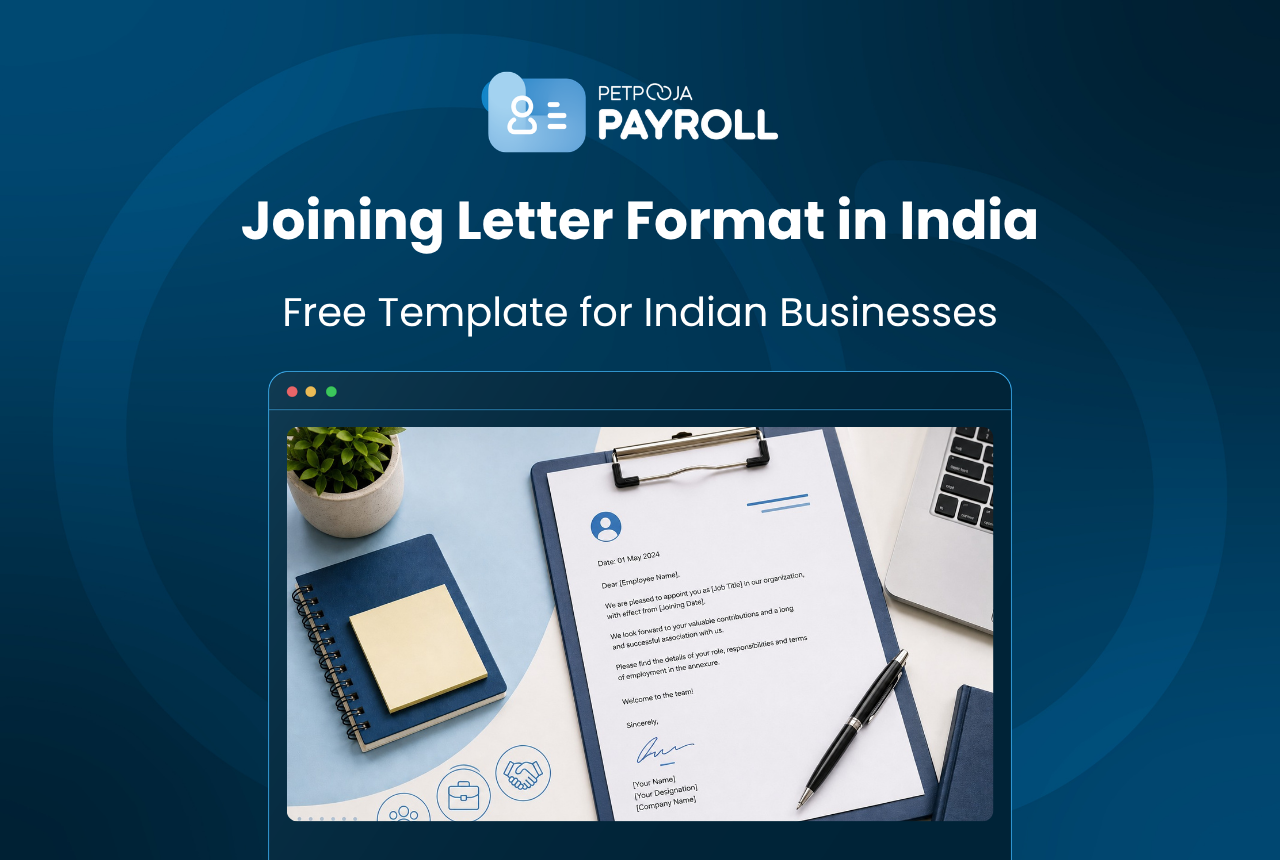
A joining letter is a one-page document that a new employee hands to their employer on day one, confirming “I have reported for duty on this date, for this role, and I accept the terms from my appointment letter.” The employer files it, and that date becomes the official start of employment for PF, ESI, and salary records.
That is the whole point of the document. One page, one date, one signature. The template is further down this page if you want to grab it right away.
But most Indian SMEs skip this letter entirely, and the trouble shows up six or eight months later when a PF inspector asks for joining dates and nobody can pin them down.
A garment unit in Tirupur with 45 operators, for example, had to reconstruct joining dates from old WhatsApp messages during an EPFO inspection in January 2026. The admin spent two full days matching names to dates. A signed joining letter on file would have taken that to zero.
In Brief: A joining letter is a one-page document submitted by an employee on day one, confirming their reporting date and acceptance of appointment terms. No Indian law mandates it by name, but the OSH Code 2020 requires appointment letters in a prescribed format. The joining date recorded in this letter feeds into PF, ESI, and gratuity calculations.
How Does a Joining Letter Fit Into the Hiring Paper Trail?
Three documents move between employer and employee during onboarding. They look similar, which is why they get confused, but each one does something different.
| Offer Letter | Appointment Letter | Joining Letter | |
|---|---|---|---|
| Who writes it | Employer | Employer | Employee |
| Handed over | After selection, before day one | On the first day or just before | On the first day |
| Legally binding? | No. Can be withdrawn before acceptance | Yes. Becomes a contract under the Indian Contract Act, 1872 | Not a contract, but serves as dated proof of reporting |
| What it says | CTC, designation, expected joining date | Full terms: salary breakup, notice period, leave policy, PF/ESI details | “I joined on this date, for this role, and I accept the appointment letter terms” |
Three documents complete the Indian hiring paper trail: the offer letter (employer’s intent to hire, not legally binding), the appointment letter (binding employment contract covering salary, notice period, and PF/ESI details under the Indian Contract Act, 1872), and the joining letter (employee’s written confirmation of reporting for duty on the agreed date).
Consider a diagnostic lab in Pune hiring a new phlebotomist, for example. The offer letter goes out in March, saying “we’d like you to join at Rs 22,000 CTC.” The appointment letter is printed on the lab’s letterhead and handed over during induction on 1st April, with PF details, probation clauses, and the reporting manager’s name. On the same morning, the phlebotomist writes back a joining letter: “I confirm I have joined on 1st April as per appointment letter ref. PPL/2026/0041.” Three separate pieces of paper, three jobs done.
Does Indian Law Require a Joining Letter?
Short answer: no law in India mentions the phrase “joining letter” as a mandatory document.
But the appointment letter is now mandatory. Section 6 of the OSH Code, 2020 says every employer covered under the Code must issue an appointment letter to every employee in a prescribed format that spells out designation, category, wages, and social security details. First-offence penalty: up to Rs 50,000.
The Industrial Employment (Standing Orders) Act, 1946 adds another layer for establishments with 50+ workers, requiring formal documentation of employment conditions.
Where does the joining letter sit in all of this? It is the employee’s written reply to the appointment letter. Not legally mandated, but practically indispensable. When a labour inspector in Ahmedabad asks “when did this employee start?”, the joining letter is the first document the HR team reaches for. Without it, the next best evidence is usually an attendance register entry or a biometric log, and neither carries a signature.
What Should a Joining Letter Include?
Most HR teams overthink this. The document is not a contract. It is a confirmation note. One page.
From the employee’s side:
- Date
- Addressed to the HR manager (name and company)
- Subject line: “Joining Letter” or “Joining Confirmation”
- Reference to the appointment letter number and date
- Designation and department
- Date of joining and reporting location
- One line saying “I accept the terms and conditions”
- Signature
Salary figures do not belong here. Those sit in the appointment letter and the salary structure breakup.
From the employer’s side (if they issue a joining confirmation):
Company letterhead, employee name and ID, designation, joining date, reporting manager, probation period if applicable, and an authorised signatory. Some companies issue this as a welcome letter with the same information baked in.
Joining Letter Format (Ready-to-Use Template)
This is a sample joining letter that an employee submits to their employer. This is an illustrative template. Change the bracketed fields to match your company’s details.
Hand this to new employees during induction. Collect the signed copy before lunch. File it with the appointment letter.
Why Does the Joining Date Matter for PF, ESI, and Gratuity?
Nobody uploads a joining letter to the EPFO portal or the ESIC system. The document itself stays in the employee’s physical or digital file. But the date written on it ripples through every compliance calculation the business runs.
PF contributions start from the date of joining. If the joining letter says 1st April but the EPFO portal was updated with 8th April because the admin got around to it a week late, the employer owes seven days of backdated PF. During audits, that gap shows up as a notice. Use our free PF calculator to check the exact contribution amount.
ESI eligibility depends on a 9-month contribution qualifying period counted from the joining date. A wrong date can push an employee’s medical claim eligibility into the next cycle. We have watched this happen at a mid-sized electronics retailer in Hyderabad where three warehouse staff had their ESI benefits delayed by an entire quarter because the joining dates on file did not match the ESIC portal.
Gratuity kicks in after 5 continuous years under the Payment of Gratuity Act, 1972. The starting point for that count? The joining date. A dispute over whether someone joined on 28th March or 3rd April can decide whether they qualify for gratuity at exit. You can run the numbers with our free gratuity calculator.
Probation timelines, increment cycles, and annual leave credit also trace back to the same date. One number, printed on one letter, feeding into half a dozen calculations.
What Mistakes Do Employers Make With Joining Letters?
Not all of these are obvious. The first two are common knowledge; the rest tend to surface only during audits or employee exits.
Skipping the letter entirely. A logistics firm in Bhiwandi running 60+ delivery riders might not bother with joining letters because “they’re daily-wage staff.” The Shops and Establishments Act still expects records of employment. When an ex-rider files a PF complaint eight months later claiming they joined earlier than the records show, there is no signed document to settle the dispute.
Collecting it three weeks after the person starts. By then the employee fills in the date they remember, which may not match the attendance register. Backdating a joining letter in May for someone who joined in April raises questions if the document is ever scrutinised.
Dates that disagree with each other. The joining letter says 1st April, the PF portal says 5th April, and the first biometric punch is on 3rd April. Three different dates, one employee. During a PF or ESI audit, the inspector picks the earliest date and asks why contributions were not paid from that day.
No appointment letter reference. The joining letter should cite the appointment letter number. Without that link, the two documents sit in the file as unconnected papers. If there is ever a disagreement about what terms the employee accepted, the chain breaks.
Forgetting the employee’s copy. The employee needs a signed copy for their own records. Bank loan applications, rental agreements, visa paperwork, and full and final settlement at exit all reference the joining date. If the employee has no proof of it, they come back to HR asking for a duplicate, which wastes everyone’s time.
How Does Payroll Software Help With Joining Date Records?
When a company uses payroll software instead of paper files, the joining date entered on day one feeds into attendance, PF, ESI, and salary calculations without anyone copying it between systems. The date lives in one place. Every report pulls from the same source.
Attendo (formerly Petpooja Payroll) works this way across 30,000+ businesses. The moment the admin adds a new employee and enters the joining date, probation reminders, PF contribution start dates, and ESI eligibility timelines all pick up from that single entry. No spreadsheet, no manual cross-checking between the joining letter and the PF portal.
Conclusion
The joining letter is not glamorous paperwork. It is a single page that records one date and one acceptance. But that date shows up in PF contributions, ESI qualifying periods, gratuity calculations, and probation timelines. Skipping it feels like saving time until an audit or an employee dispute proves otherwise. Print the template above, collect it on day one, match the date across every system, and keep a signed copy on both sides.
Frequently Asked Questions
Yes, and plenty of companies in India do this now, especially for remote hires. A signed PDF attached to a formal email works. The key is that the date, designation, and appointment letter reference number are clearly mentioned, and the HR team saves a copy in the employee’s digital file.
No law penalises the employee for not submitting one. But most HR teams hold back ID card issuance, system access, or even the first salary credit until the signed letter is in. It is treated as part of the day-one onboarding checklist, not a legal formality.
Opposite ends of the timeline. The joining letter is signed on day one. The experience letter is issued by the employer on the last day, confirming tenure and designation. They never overlap.
Not directly. Section 6 covers factories, mines, plantations, and contract labour establishments. Small retail shops and offices fall under their respective state Shops and Establishments Acts, which have separate record-keeping rules. The appointment letter mandate under the OSH Code carries a penalty of up to Rs 50,000 for the first offence, but that applies only to covered establishments. Our PF ESI compliance checklist covers the full documentation requirements.
No. The joining letter is a confirmation note, not a terms document. Salary breakup, CTC, and deductions belong in the appointment letter. Putting salary in both documents doubles the chance of a mismatch showing up during audits.








