
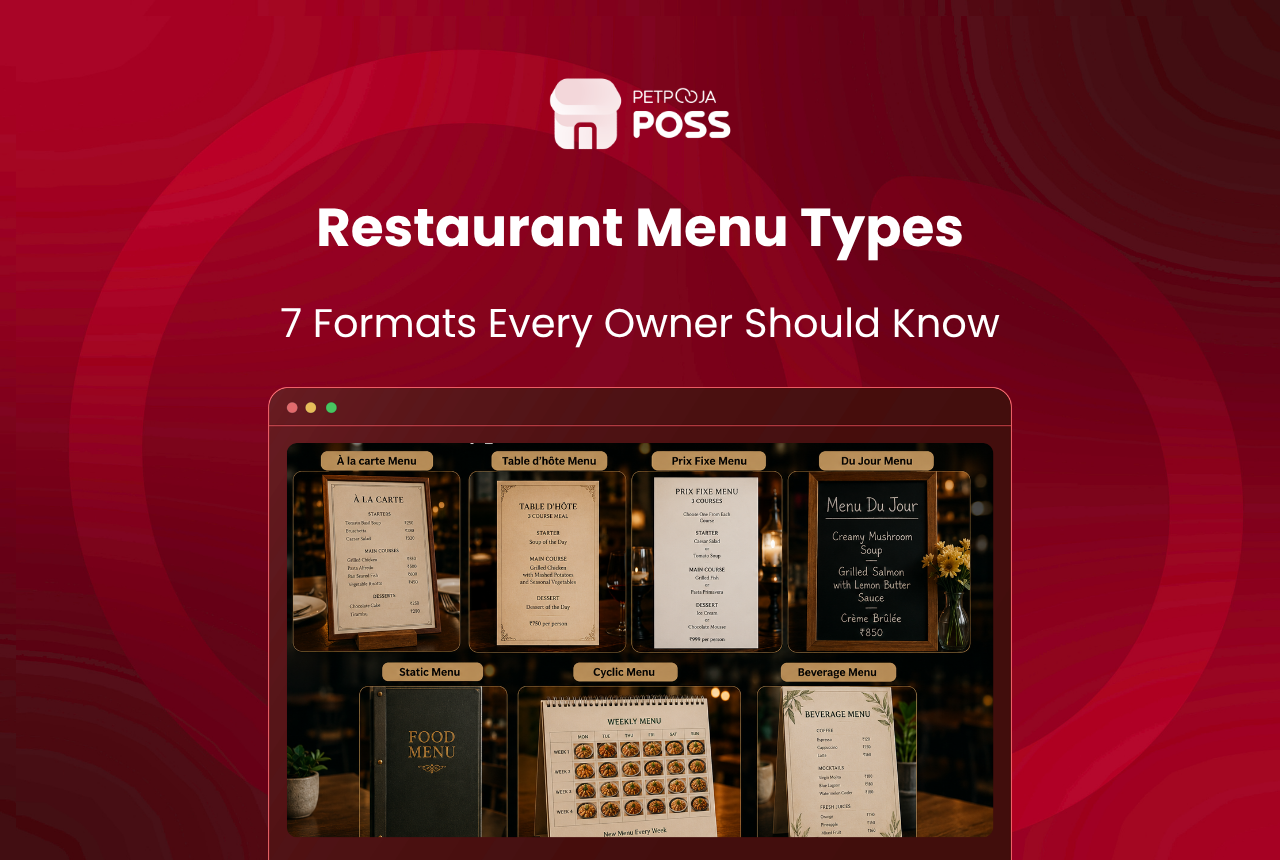
There are seven menu formats used across restaurants today: à la carte, table d’hôte, prix fixe, du jour, static, cyclic and beverage. They differ on one thing above all, which is how the price is attached. Either the guest pays per dish, or they pay one price for a whole meal.
Everything else follows from that. À la carte, static and beverage menus price each item on its own. Table d’hôte and prix fixe price the meal as a set. Du jour and cyclic menus are defined by how often the list changes rather than by how it is billed.
In the kitchens we work with, most outlets run two of these at once. A static à la carte card is the base, and a du jour board or a festival prix fixe sits on top during the season.
Key Takeaways
- The seven types split into per-dish pricing, per-meal pricing, and rotation-based formats.
- À la carte and static menus suit outlets where guests build their own order.
- Table d’hôte and prix fixe steady the average bill, since the courses are fixed before the guest sits down.
- Du jour and cyclic formats fit kitchens that buy fresh daily or cook in bulk for the same diners.
- Any Indian outlet with a central licence or ten-plus locations must show calorie values on the menu.
The 7 Menu Types at a Glance
Here is how the seven compare on the two things that shape your operations most: pricing, and how often the list changes.
| Type of Restaurant Menu | How It Is Priced | How Often It Changes | Typical Indian Outlet |
|---|---|---|---|
| À la carte | Per dish | Rarely | Casual dining, cafés |
| Table d’hôte | One price, limited choices per course | Seasonally | Banquets, wedding catering |
| Prix fixe | One price, full course sequence | For occasions | Fine dine, festival menus |
| Du jour | Per dish, priced daily | Every day | Chef-led kitchens, bistros |
| Static | Per dish | Once or twice a year | QSR, chains, cloud kitchens |
| Cyclic | Usually a set rate per head | On a fixed loop | Canteens, hostels, hospitals |
| Beverage | Per glass, bottle or pitcher | Every few months | Bars, pubs, breweries |
The same seven types sort into three families, which is the quickest way to hold them in your head.
7 Types of Restaurant Menus Explained
Each format below is defined by how it charges the guest and how often the list changes. Most outlets end up running two of them together rather than picking just one.
1. À La Carte Menu
À la carte is French for “by the card”. Each dish carries its own price and is ordered on its own. Sides, breads and drinks are billed separately, so two guests at the same table can spend very differently.
Most Indian casual dining rooms run this format. It gives the kitchen the clearest read on what sells, because every item has its own sales line instead of being buried inside a combo.
Pricing those items is a job of its own, and the free menu pricing calculator does the arithmetic once you know your food cost ratio.
The trade-off is forecasting. Guests order in any combination, so a slow-moving item can sit in the walk-in for days before anyone notices.

2. Table d’Hôte Menu
Table d’hôte means “table of the host”, a phrase that goes back to French inns where every guest ate the same meal at a common host’s table. The modern version keeps the fixed price and adds a little choice, usually two or three options per course.
Indian banqueting runs almost entirely on this logic. As an example, a wedding caterer in Vastrapur quoting a per-plate rate is offering table d’hôte, even if nobody at the venue uses the phrase.

3. Prix Fixe Menu
Prix fixe simply means fixed price. Every guest gets the same number of courses and pays the same amount no matter what they choose inside each course.
The difference from table d’hôte is one of degree. Prix fixe runs a longer, fixed course sequence, and most kitchens use the two terms interchangeably.
Example: a fine dine restaurant in Lower Parel offers a five-course Diwali menu at ₹2,450 per head. Whether the guest picks the paneer or the fish for the main, the bill is ₹2,450. That is a prix fixe menu.
4. Du Jour Menu
Du jour translates to “of the day”. This is the board or insert that changes daily, often written in chalk or shown on a screen near the entrance.
It solves a supply problem. When the morning mandi run decides what the kitchen can cook well that day, a du jour list sells it at a fair price without reprinting anything.
Once you have more than one outlet, screens cost less to run than chalk, which is the argument in our breakdown of digital vs printed menus.
5. Static Menu
A static menu is the wide, category-wise card that stays the same for months. Whatever a guest saw in March is still there in August. Nearly every QSR and chain in India runs one, because consistency is the point.
Someone ordering at a La Pino’z outlet in Aundh expects broadly what they saw at the Madhapur one, and that predictability is what the format buys you.
Static does not mean untouched, though. Most chains rework their item categories, prices and layout once or twice a year, and our menu card design rules cover what to change at that reprint.
6. Cyclic Menu
Cyclic menus repeat on a fixed loop. As an example, a hostel canteen might run a 14-day cycle and a corporate cafeteria a 7-day one, after which the whole rotation starts again.
They suit places that feed the same people every day: hospital canteens, factory messes, school kitchens, hostels. The operator charges a monthly or per-head rate rather than pricing dish by dish. Because the cycle repeats, a weak day repeats too, so the rotation is worth reviewing every quarter.
7. Beverage Menu
Beverage menus sit apart because they are priced and regulated differently. Drinks sell by glass, bottle, pitcher or peg, and alcohol carries excise rules that vary state by state.
That reaches down to the licence a bar has to hold. Maharashtra’s state excise department sets its own licence types and fees, and every other state does the same on its own terms.
Bars keep a standing list of house pours and rotate a smaller seasonal section every few months. The food card and the drinks card move at different speeds, so most outlets print them separately.
Which Menu Type Should You Choose?
With the seven formats laid out, three questions settle it for almost every outlet.
- Who decides what the guest eats? If the guest builds their own order, you need à la carte or static. If you decide the meal and they pick within it, use table d’hôte or prix fixe.
- How predictable is your supply? A kitchen buying fresh at the mandi each morning cannot print a fixed card and stand behind it, so it needs a du jour layer. A kitchen cooking to a standard recipe sheet has no such problem and is better off static.
- Are you feeding the same people daily? Hostels, factory messes and hospital canteens should run a cyclic loop of 7 or 14 days, because repetition is the complaint they get. Anywhere guests turn up once a month, the cycle is wasted effort.
Once the base format is picked, let sales data adjust it rather than instinct. Pull the menu mix percentage for every item over a full quarter, and the bottom of that list tells you what to cut at the next reprint. Our guide to using a POS sales report walks through that exercise.
What Does Indian Law Require on Your Menu?
Format is your choice. What appears on the card is not entirely up to you.
Under the Food Safety and Standards (Labelling and Display) Regulations, 2020, food service establishments holding a central licence, or running ten or more locations, must show the calorific value in kcal per serving against each item. The card must also carry the line about an average active adult needing 2,000 kcal a day.
That obligation has applied since 1 July 2022, after FSSAI pushed back the original January date. It sits in Chapter 3 of the FSSAI labelling and display compendium.
Two more rules apply to menus of every size. The vegetarian or non-vegetarian mark must appear against each item, and the eight declared allergen groups must be flagged, which symbols are allowed to do. Those eight run from gluten cereals and crustaceans through to soy and sulphites.
Only a few narrow cases sit outside this, such as caterers running fewer than 60 days a year. If your licence is still pending, the FoSCoS licence steps cover registration.
Keeping the Menu Accurate Everywhere It Appears
Picking a format is the easy half. The hard half starts when the same menu has to live on a printed card, a QR link, Swiggy, Zomato and your billing screen at once.
Across the restaurants billing on our POS, the pattern we see most often is a price changed on the dine-in card in the morning and missed on the aggregator listing until a guest queries it at the counter. That item runs at a negative margin in the meantime.
A restaurant POS holds one item master that every channel reads from. Change a rate once and the KOT screen, the QR menu and the aggregator listing all move together.
Switching an item off when the prep runs out works the same way, which stops a sold-out biryani taking orders at 9pm. Our menu management software guide covers that workflow.
Conclusion
The seven menu types are less competing options than different tools. À la carte and static hand control to the guest, table d’hôte and prix fixe steady your bill value, du jour and cyclic formats solve supply and repetition problems.
Most outlets settle on a static à la carte base with one layer on top. Pick that base by asking who decides the meal, how your supply behaves, and how often the same guests return. Then let a quarter of sales data tell you what to change.
Once the format is set, keep every version of the menu in sync from one place. Petpooja’s restaurant POS handles menu, pricing and channel updates from a single screen, so the card, the QR link and the aggregator listings never drift apart.
Frequently Asked Questions
À la carte, table d’hôte, prix fixe, du jour, static, cyclic and beverage. Some lists collapse table d’hôte and prix fixe into one, which is why you will also see the count given as five or six.
À la carte prices every dish separately, so the guest pays only for what they order. Table d’hôte charges one price for a multi-course meal with a short list of choices per course. One gives the guest more freedom, the other gives you a more predictable bill value.
A static à la carte card is the safest base. It needs no daily reprinting, and clean per-item sales data lets you price each dish against its own food cost. Add a du jour board only if your kitchen buys fresh each morning. Use a cyclic menu only if you feed the same guests daily, such as a hostel or factory mess.
Only those with a central licence or ten or more outlets, and the rule has applied to them since 1 July 2022. Single-outlet restaurants sit outside the calorie rule, but every menu must still carry the veg or non-veg mark and flag the eight declared allergens.
Static cards are reviewed once or twice a year, and du jour lists change daily by design. Whichever format you run, check item-level sales every quarter so slow movers get cut before they tie up stock. AI-led menu engineering shortens that review.


