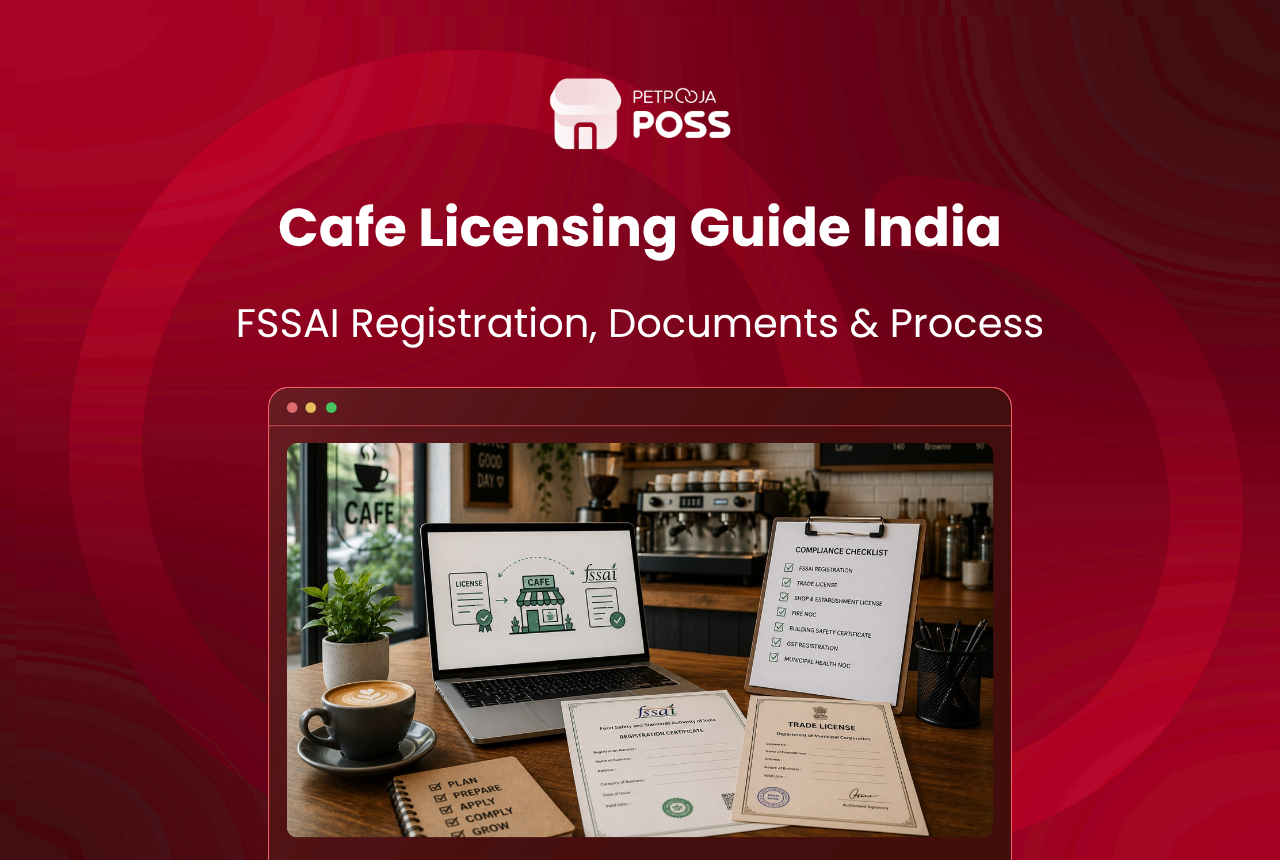
Before a cafe in India can serve its first paying customer, four registrations need to be in place: FSSAI food safety registration (Rs 100 a year for most cafes after the April 2026 threshold revision), a Shop and Establishment licence, GST registration once projected turnover crosses Rs 20 lakh, and a fire NOC where local rules apply. Every cafe licence in India across these four heads costs between Rs 35,000 and Rs 1.5 lakh and clears within 30 to 60 days if all four applications go out in the same week.
The timing is the part most owners get wrong. A cafe owner we worked with in Paldi, Ahmedabad, signed his lease in December 2025 and only filed FSSAI on 21 February after interiors were done. By late March, three months of rent had been paid on a cafe that could not serve anybody.
Key Takeaways
- FSSAI basic registration: Rs 100/year, covers turnover up to Rs 1.5 crore (revised April 2026)
- Four registrations total: FSSAI, Shop Act, GST, fire NOC
- FSSAI takes the longest (7 to 45 days by licence type), file it first
- Total licence cost: Rs 35,000 to Rs 1.5 lakh
- Start 45 to 60 days before target opening, during the fit-out
What Changed in the FSSAI Threshold in April 2026?
From 1 April 2026, the FSSAI basic registration ceiling jumped from Rs 12 lakh to Rs 1.5 crore in annual turnover. FSSAI issued the order on 13 March 2026 (File No. RCD-01002/1/2021-Regulatory-FSSAI), signed by the Director of Regulatory Compliance.
The old Rs 12 lakh number had been frozen since 2011 and had not been revised for 15 years while the food economy doubled in size.
| Licence Type | Annual Turnover | Fee/Year | Validity if issued from 1 April 2026 |
|---|---|---|---|
| Basic Registration (Form A) | Up to Rs 1.5 crore | Rs 100 | Perpetual |
| State Licence (Form B) | Rs 1.5 crore to Rs 50 crore | Rs 2,000 to Rs 5,000 | Perpetual |
| Central Licence (Form B) | Above Rs 50 crore | Rs 7,500 | Perpetual |
A 40-seat cafe in Vastrapur, Ahmedabad, pulling in around Rs 65 lakh a year would have needed a state licence under the old rules. After April 2026, Rs 100 covers it. Nearly every independent cafe and small chain in India sits comfortably below Rs 1.5 crore, so the state licence tier is now mostly relevant for large restaurant groups and institutional caterers.
How Do You Apply for FSSAI on FoSCoS?
Since 2020, FoSCoS is the only portal that processes FSSAI applications. The old FLRS system is gone.
For basic registration, the paperwork is thin. Sign up using the owner’s Aadhaar-linked mobile, verify via OTP, and select “Apply for Registration” (not “Licence,” that is the Form B path). Pick “Eating House / Restaurant / Snack Bar” from the food business dropdown.
Form A fits on a single screen. Business name, address, food categories, owner details. Three documents to upload:
- Passport-sized photo of the owner
- Identity proof (Aadhaar, voter ID, or passport)
- Premises proof (rental agreement or electricity bill)
No kitchen layout drawing. No water test. No equipment list. Those belong to Form B.
Pay Rs 100, submit, wait. Officially 7 working days for processing. In practice, a cafe in Navrangpura cleared it in 3 days. Another in Salt Lake, Kolkata, waited 11 because the electricity bill was in the landlord’s name and the food safety officer asked for a resubmission. Small things like that eat up the buffer.
Certificate arrives by email. Print it, laminate it, mount it near the entrance. FSSAI rules say it must be visible at the premises, and the Swiggy verification executive will photograph it during onboarding.
Turnover crossing Rs 1.5 crore? Form B instead. Additional paperwork: a scaled kitchen layout, a NABL-accredited water analysis report (Rs 1,500 to Rs 3,000), an equipment inventory, and a food safety management plan. Processing: 30 to 45 days, sometimes with a site inspection.
Shop and Establishment Licence (Gumasta)
Nothing to do with food. This one is about your staff.
The Shops and Establishments Act registration governs working hours, weekly offs, overtime, and leave entitlements. Every commercial establishment must file it within 30 days of starting operations. In Maharashtra they call it Gumasta; in Gujarat it goes through the state labour portal. The hiring process glossary is worth reading if you are onboarding staff around the same time.
Maharashtra’s online system spits out the certificate in under 48 hours. Delhi takes one to three working days. Gujarat: seven to ten. Fees sit between Rs 500 and Rs 3,000 depending on state and headcount.
Labour inspectors do visit cafes. Not having this certificate on the wall turns a routine visit into a memo, regardless of how spotless the kitchen is. The legal compliance checklist covers what an inspector might ask for.
GST Registration
Free. Zero fee on the GST portal. Clears in three to seven working days.
Mandatory once annual turnover crosses Rs 20 lakh (Rs 10 lakh in north-eastern states). One thing most first-time cafe owners miss (GST credit notes are worth reading up on separately): registering voluntarily before the cafe opens lets you claim input tax credit on every fit-out invoice. Espresso machine, furniture, ACs, signage.
A cafe owner in Bopal, Ahmedabad, for example, filed for GST before the contractor started. By the end of her first quarter, the input credit recovered came to Rs 68,000. The registration itself took 40 minutes on the portal and cost nothing. Once registered, GST returns must be filed monthly or quarterly depending on the scheme. Missing a return attracts a late fee of Rs 50 per day (Rs 20 for nil returns), so set a reminder on the 11th of each month. Our free GST calculator helps estimate the tax component on menu pricing before you finalise rates.
Does Your Cafe Need a Fire NOC?
No national rule governs this. Whether a cafe needs a fire NOC depends on what the local fire department considers the threshold, which varies by seating, floor area, building height, and building type.
A ground-floor chai cafe with 18 seats in Udaipur probably will not need one. A 50-seat place on the second floor of a commercial complex in Kothrud, Pune, certainly will. One phone call to the district fire office confirms it.
The inspection happens during the fit-out, which is when you want it. If the fire officer decides the emergency exit should be 150 cm instead of 120 cm, the mason can fix it that afternoon. We have seen the same fix cost Rs 3,000 during fit-out and Rs 45,000 after handover at a cafe in Aundh.
Fee: Rs 1,000 to Rs 5,000. Processing: 15 to 30 days.
Cafe Licence Filing: The 60-Day Calendar
Rent starts the day the lease is signed. The sequence below runs all four applications during the interior fit-out, so everything arrives before the contractor leaves.
- Day 60 – FSSAI on FoSCoS. Basic registration clears in a week, but keep the buffer for document resubmissions.
- Day 45 – Fire NOC. The officer visits while wiring is being run and tiles are going down. If something fails inspection, the contractor is still on site.
- Day 30 – GST registration. Three to seven working days. Early filing means input credit on every fit-out bill.
- Day 15 – Shop Act. Most states wrap it up within ten working days. Fastest of the four.
What Happens Without FSSAI on Swiggy and Zomato?
Swiggy and Zomato both ask for a 14-digit FSSAI number at onboarding. No number, no listing.
For most new cafes, delivery orders are what keep the kitchen staff busy while walk-in traffic builds. A cafe in Maninagar, Ahmedabad, filed FSSAI after the interiors were done. Certificate plus Swiggy’s verification queue took 52 days of zero delivery revenue while rent, salaries, and the milk vendor’s bill kept arriving.
Across hundreds of cafe onboardings at Petpooja, the pattern has been consistent: owners who file within a week of signing the lease open on time. The cafe business plan guide covers how to build these timelines into the launch calendar.
Do Cafe Licences Still Need Renewal?
This is the part that changed most, and it depends on when your licence was issued.
An FSSAI licence or registration issued from 1 April 2026 carries perpetual validity. There is no expiry date and no renewal cycle to diarise.
If your cafe was licensed before that, your existing certificate runs to the expiry date printed on it. Open your certificate on FoSCoS and check that date rather than assuming either way. Where a renewal is still due, file it at least 30 days ahead, because late submissions attract Rs 100 per day and owners usually discover the lapse when an aggregator re-verification flags the expired certificate mid-season.
Perpetual validity is not the same as having nothing to file. The annual return obligation and the annual fee continue, and a licence can still be suspended or cancelled.
GST registration does not expire, but the fire NOC does. Most fire departments issue it for one to three years, so track that date alongside FSSAI.
Shop Act renewal rules change by state. Maharashtra asks for it every year. Gujarat issues the licence for the lifetime of the business. Our FSSAI compliance checklist lays out the renewal calendar by licence type.
Conclusion
Rs 35,000 to Rs 1.5 lakh, 30 to 60 days if filed in parallel. The April 2026 FSSAI revision moved the ceiling to Rs 1.5 crore, so almost every standalone cafe pays Rs 100 a year. File FSSAI while the contractor is dismantling packing material, fire NOC while tiles go down, GST during the second coat of paint, Shop Act whenever there is a spare hour. Our cost of opening a cafe in India breakdown covers every other expense head, and Petpooja POSS handles billing once the cafe is running.
Frequently Asked Questions
Rs 100 a year (Rs 500 for five years). Covers any cafe with turnover below Rs 1.5 crore under the April 2026 revision. Above that, state licence fees run Rs 2,000 to Rs 5,000 per year. The restaurant startup guide breaks down all setup costs including licences.
If turnover stays under Rs 1.5 crore, Form A. Three documents: photo, ID proof, premises proof. That is the entire upload. Form B is for turnover above Rs 1.5 crore, and it adds a kitchen layout drawn to scale, a NABL-accredited water test report, an equipment list, and a food safety management plan. Nearly every standalone cafe in India will use Form A.
Depends on the premises. A small ground-floor setup with 15 seats might be exempt under local rules. Anything above the ground floor or inside a commercial complex almost always needs it. Ring the district fire office; they confirm in two minutes.
Parallel filing: 30 to 60 days. FSSAI basic takes about a week, fire NOC 15 to 30 days, GST 3 to 7 days, Shop Act 1 to 15 days by state. Sequentially it can cross 90 days, which is three months of rent on a cafe that cannot serve anyone.
Yes, and the onboarding executive photographs the printed certificate at the premises during verification. Our types of cafes in India guide covers which formats do well on delivery. The top cafe franchises piece covers the franchise route.