The bars we help set up rarely get the bar equipment list wrong. They get the order wrong, and buy the showpiece shaker before the ice machine.
A working bar needs equipment in seven groups. Bartending tools, glassware, ice and cold storage, prep, surfaces and storage, cleaning, and billing.
Miss a group and service breaks at the busiest hour. A bar with beautiful tools and no ice machine sends a runner out for bags of ice every evening.
One rule sits outside all seven, and most owners find out about it during an inspection. The measure you pour with is a legal instrument.
Key Takeaways
- A bar needs seven groups of equipment: tools, glassware, ice and cold storage, prep, surfaces, cleaning and billing.
- Ten hand tools cover service. The shaker, jigger and strainer take the most use.
- Glassware follows your menu. Six shapes cover most bars.
- Ice needs its own machine. A bottle cooler does not make ice.
- Your jigger needs a legal metrology stamp before you serve by measure.
The Bar Equipment List at a Glance
Here is the full list, grouped by where each item sits during service.
| Group | What it covers | Why the bar stops without it |
|---|---|---|
| Bartending tools | Shaker, jigger, bar spoon, strainer, muddler, speed pourers, tongs, rimmer, opener, corkscrew | No drink gets made |
| Glassware | Highball, rocks, wine, beer, cocktail and shot glasses | Nothing can be served |
| Cold and ice | Ice machine, ice bucket and scoop, bottle cooler, under-counter chiller | Drinks go out warm |
| Prep | Chopping board, bar knife, juicer or reamer, garnish caddy, blender | No garnish, no fresh juice |
| Surfaces and storage | Bar mats, service mats, speed rail, back bar shelving, dump sink | The station turns chaotic |
| Cleaning | Glass washer or three-sink setup, bar brushes, cloths, sanitiser | Glasses recycle dirty |
| Billing | POS terminal, bill printer, KOT printer | Nothing gets recorded |
Bartending Tools Behind Every Bar
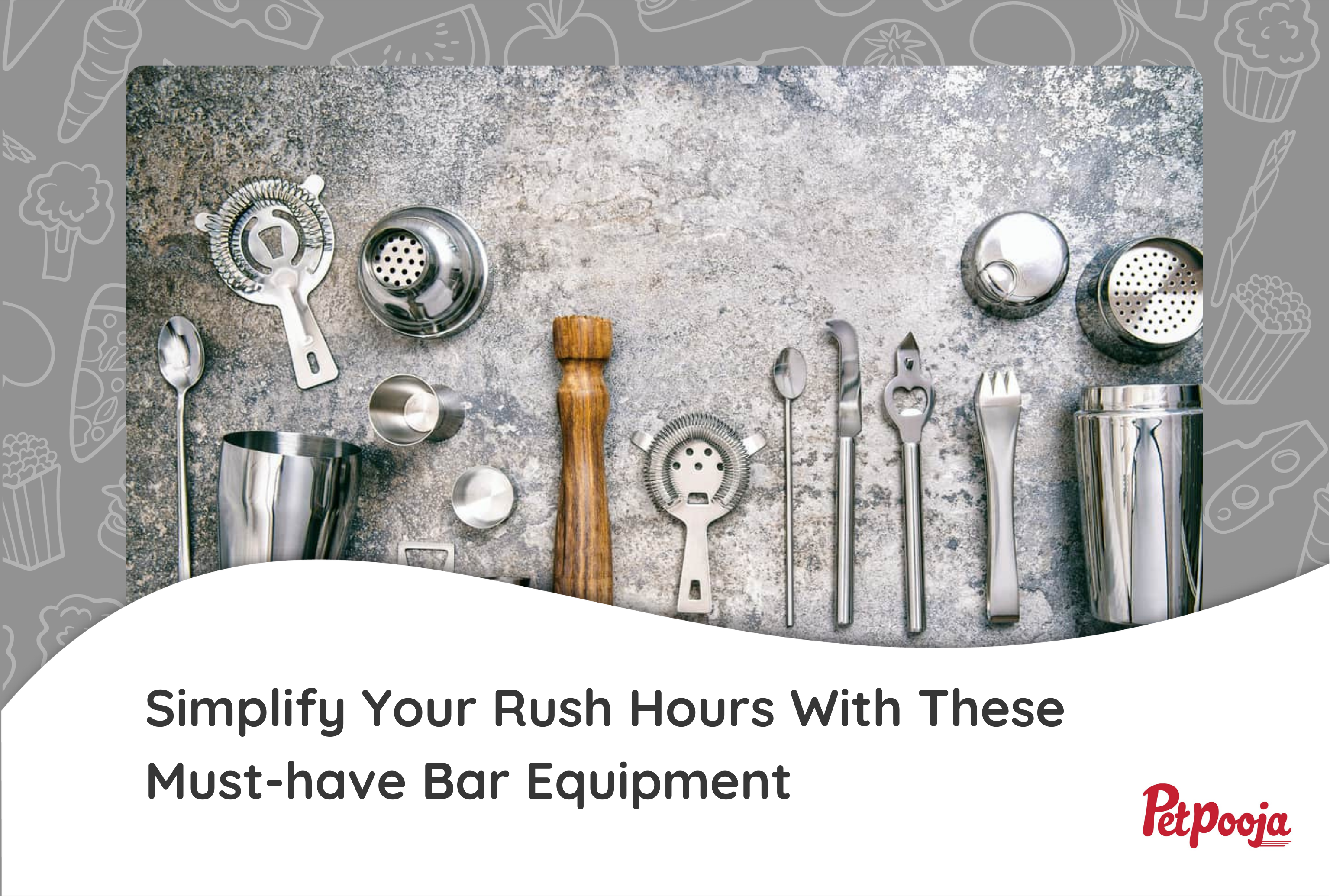
These are the items a bartender touches on every order. Buy them in stainless steel and buy doubles of the small ones. If the bar itself is still being planned, our guide on how to open a bar sets out the order these purchases sit in.
| Tool | What it does |
|---|---|
| Cocktail shaker | Chills and mixes the drink by shaking it with ice |
| Jigger or peg measure | Measures the pour so every drink tastes the same |
| Bar spoon | Stirs and layers without breaking the ice |
| Hawthorne strainer | Holds back ice and pulp as you pour |
| Fine mesh strainer | Catches seeds and small pulp for a clear drink |
| Muddler | Crushes fruit, sugar and mint for a mojito or old fashioned |
| Speed pourers | Control the flow from the bottle and speed up pouring |
| Ice tongs | Move ice without hands touching it |
| Rimmer | Coats the glass rim with salt or sugar |
| Bottle opener and corkscrew | Open caps and corks |

Two of these go missing more than the rest. Speed pourers get pulled off bottles at closing and vanish. Bar spoons bend. Order spares with the first batch, and put a tool count on your closing checklist so you find out the same night.
What to Check Before You Buy Bar Tools
The same tool sells at four different prices, and the gap is usually build quality rather than brand.
- Food-grade stainless steel, not plated finishes. Plating chips into drinks and the tool then has to be binned.
- Commercial weight. A light shaker dents on the first drop. Anything that feels flimsy in the shop will not last a season behind a busy counter.
- No visible seams on anything holding liquid. Seams trap residue and fail a hygiene check.
- Dishwasher safe, if you run a glass washer. Hand-wash-only tools slow the close down every night.
Buy the shaker, jigger and strainer at the best quality you can afford. All three are handled hundreds of times a shift and fail first. The bar POS comparison applies the same test to the billing side.
Glassware Your Bar Menu Decides
Glassware is the one group you cannot copy from another bar’s list. Your menu decides it. A place pouring mostly beer and highballs needs nothing like the range a cocktail bar carries.
Start with six shapes and add only what a menu item actually requires:
- Highball or Collins for long mixed drinks
- Rocks or old fashioned for spirits on ice
- Wine glasses, red and white if the wine list justifies both
- Beer glasses in the style your draught brand expects
- Cocktail or coupe for anything served without ice
- Shot glasses for straight pours
Treat glass as a consumable, not a fixed asset. Breakage during a busy Saturday is normal.
Work out the quantity from where glasses actually sit. At any moment during service a glass is on a table, in the wash, or on the shelf.
Buying one set per seat means the shelf is empty while the first round is still being drunk. Stock several sets of the shapes your menu leans on.
How a Bar Station Is Laid Out
Most bar equipment lists ignore geography. Geography is what makes a bar fast. The same tools in the wrong place add a step to every single order.
A working station splits into three zones:
- Front bar. The counter the guest sees. Bar mats, the garnish caddy and the tools in current use sit here, inside one arm’s reach.
- Under bar. Everything below the counter. The speed rail, ice well, dump sink and glass storage live here, so a bartender can pour without turning around.
- Back bar. The shelving behind. Premium bottles, backup stock and the bottle cooler sit here, along with the till.
Order matters more than volume in the under bar. A speed rail holding your eight fastest pours in a fixed sequence lets a bartender build a drink without looking down for the bottle.
Leave the terminal and printer a fixed home on the back bar too, clear of the wet zone. Our POS hardware guide covers what that setup needs.

Fix that sequence once and train to it. Bartenders who move between outlets in the same group can then work any bar in the chain from their first shift.
Bar Machines, Ice and Cold Storage
This is the group new owners underbuy, and it costs them every single evening.
- Ice machine. Ice is an ingredient, and you use far more of it than you expect. Buying bagged ice daily works for a month, then turns into a running cost nobody budgeted for and a hygiene question nobody can answer.
- Bottle cooler. This holds the bottles you are actively selling at serving temperature, under or behind the counter.
- Under-counter chiller. Backup stock, juices and garnishes live here, so the bartender is not walking to the kitchen mid-order.
- Blender. Only if the menu has frozen or blended drinks. Skip it otherwise and buy it when the menu changes.
- Juicer or reamer. Fresh citrus is what separates a decent drink from a mixer-heavy one, and a hand reamer is enough at low volume.
A bar in Aundh that opens with a cooler but no ice machine spends its first monsoon sending a runner out twice a night. That is the sort of gap this list is meant to catch.
Cleaning Equipment That Keeps Glasses Usable
Wash capacity decides how many guests you can serve, and it is the group owners cut first when the budget tightens.
The regulations set a floor here. Part V of Schedule 4 requires sinks with a draining board, detergent and hot water for cleaning utensils, crockery and cutlery, plus separate sinks where equipment is washed. A single sink behind the bar does not meet that.
Part V also requires a written cleaning schedule, which is where a kitchen SOP checklist earns its place behind the bar as much as in the kitchen.
Above that floor you have two options. An under-counter glass washer runs a cycle in a few minutes and returns glasses clear and dry, which matters because a cloudy glass reads as dirty. The alternative is a multi-sink setup: wash, rinse, sanitise, with a drying rack.
Size whichever you pick against your busiest hour, not your average one. Keep bar brushes for the inside of glasses, separate cloths for counter and glassware, and a sanitiser rated for food contact surfaces.
What Indian Law Says About Bar Equipment
Here is the part no international bar equipment list will tell you. Two Indian rules apply to the kit behind your counter, and both are cheap to sort before opening.
Your serving measures are instruments of trade, so they need verification under the Legal Metrology Act, 2009. Your premises fall under Part V of Schedule 4 of the food safety regulations, which names snack bars directly. Neither rule appears on an imported checklist, and both are checked on inspection.
Your Serving Measures Need Stamping
A jigger or peg measure is not just a tool. It decides the amount you sell, which makes it a measure used in trade. India serves spirits by the peg, a small peg being 30 ml and a large peg 60 ml.
Section 24 of the Legal Metrology Act, 2009 requires every person holding a weight or measure to have it verified before putting it into use. Verification and stamping is done by the state legal metrology department, and inspectors check that only stamped measures are in use.
Section 33 sets the price of getting this wrong. Using an unverified measure carries a fine of ₹2,000 to ₹10,000 for a first offence, and a repeat offence can bring imprisonment of up to a year.
A jigger ordered online does not arrive stamped. Nor does a set that came bundled with your bar counter. Ask your supplier whether the measures are verifiable, then get them stamped before you open.
State excise rules sit on top of this, so check your licence conditions too. Our guide on applying for a liquor licence covers that side.
Hygiene Rules for Bar Equipment
Food safety law reaches behind the counter too, and most owners assume it stops at the kitchen door.
Part V of Schedule 4 covers catering and food service establishments, and it names snack bars alongside restaurants and hotels. It applies on top of Part II, not instead of it.
In practice that means your wash setup, your storage and your staff hygiene are all inspectable, on the same terms as the kitchen’s.
Which Bar Equipment to Buy First
Group the spend into what stops service and what improves it. Everything in the first list has to be there on opening night.
Example (illustrative). Say a 40-seat cocktail bar is opening in Lower Parel. A sensible first order is two shaker sets, four jiggers, three bar spoons, two strainers, roughly 100 glasses across four shapes, an ice machine, a bottle cooler, bar and service mats, a wash setup, and the billing hardware. The rimmer, powered juicer and display shelving follow after the first menu review. This is an example, not a template.
The opening sequence around the equipment is covered in the guide linked earlier, and the bar setup cost breakdown covers the money side.
The Equipment That Tracks All the Rest
Every item above pours, chills or washes. One piece of equipment counts.
A bar loses stock in ways a kitchen does not. An over-pour of 10 ml on every peg disappears silently, and by the monthly count the bottle figure and the sales figure no longer agree. That gap is why bars run an inventory audit far more often than restaurants do.
A bar and brewery POS closes the loop. It records each peg against a recipe and tracks the bottle to the millilitre, so you see the variance between what was poured and what was sold.
Our guide on bar liquor theft covers the patterns worth watching.
Pair it with our inventory audit checklist for the physical count, so the screen figure and the bottles on the shelf get compared properly.
Conclusion
A bar equipment list is only useful if it is grouped. Tools, glassware, cold storage and cleaning have to arrive together, because a gap in any one stops service at the busiest hour of the week.
Two things separate an Indian list from an imported one. Your measures need legal metrology verification, and your bar is a food service establishment under Part V. Both are cheap to sort before opening and expensive to fix during an inspection.
Get the equipment in and the drinks flow. Knowing what was poured against what was sold is what protects the margin, and that is the job Petpooja’s bar POS does.
Frequently Asked Questions
If the measure decides the quantity you sell, yes. Section 24 of the Legal Metrology Act, 2009 requires a measure to be verified before it is used, and Section 33 sets a fine of ₹2,000 to ₹10,000 for a first offence. A jigger bought online does not arrive stamped.
More than one set. A glass is always in one of three places during service: on a table, in the wash, or on the shelf. One set per seat empties the shelf while the first round is still going.
No, and treating them as one purchase is a common mistake. An ice machine makes ice, a bottle cooler holds working stock at serving temperature, and a chiller stores backup. Buy only a cooler and you will be carrying bagged ice in every day.
Speed pourers, bar spoons and glassware. Pourers get pulled off bottles at close, spoons bend, and glasses break during service. Spares cost little and stop a mid-shift scramble.
Your bar is a food service establishment, so Part V of Schedule 4 applies on top of the general requirements in Part II. If you run a microbrewery the equipment list grows again, and so does the licensing.