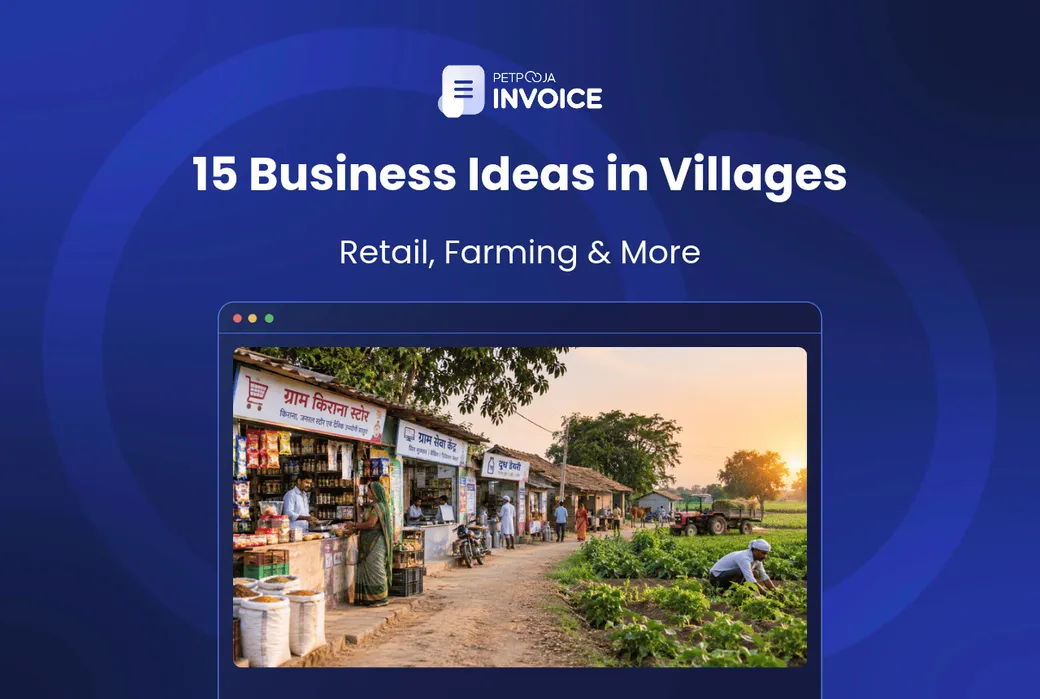



What business ideas work in a village? This list gives you 15 of them, and village retail shops lead the list. The rest are farm and animal businesses and services. The ones that work best meet a need villagers already have. Think of a kirana, an agri input shop, a dairy or a flour mill.
Four checks decide which one suits you. Who will buy it, and how often will they pay? Will your own cash last until the harvest? Can it also sell in the nearest town? And do you have the power and internet it needs?
This post gives each idea’s budget, buyers, licence and one tip. Then it covers the licences and the government schemes that help small Indian business owners start in a village.
Key Takeaways
- Pick an idea villagers already need, like a retail seed shop before sowing or a flour mill, because steady local demand beats a clever idea.
- Farm money comes after the harvest, so plan your cash for the months in between.
- Seeds, fertiliser and pesticides each need their own licence, and most food needs FSSAI. Sort out the paperwork before you buy stock, not after.
15 Business Ideas in Villages at a Glance
The table below lists all 15 business ideas in villages, with a rough budget for each. Its last column shows any licence needed on top of the basics explained below the table. The budgets are our estimates for a small start. They leave out land, and they are not quotes.
This post is about businesses that suit a village. For shops that suit a town street, our small business ideas post covers 22 retail ideas.
Suggested 3 categories: Village retail shops (kirana, agri inputs, cattle feed, building material), Farm and animal businesses (dairy, poultry, goats, vermicompost, bees, mushrooms), Service businesses (digital service centre, flour mill, oil mill, tractor hire, tent house).
| Business Idea in a Village | Starting Budget (Our Estimate) | Main Buyers | Licence Beyond the Basics |
|---|---|---|---|
| 1. Village kirana store | ₹2 lakh to ₹10 lakh | Every household | FSSAI registration |
| 2. Agri input shop | ₹2 lakh to ₹10 lakh | Farmers | Seed, fertiliser and pesticide licences |
| 3. Cattle feed and fodder shop | ₹2 lakh to ₹10 lakh | Dairy farmers | Check your state’s rules |
| 4. Building material shop | Above ₹10 lakh | Families building homes, masons | None |
| 5. Dairy and milk collection | ₹2 lakh to ₹10 lakh | Dairy cooperatives, tea stalls, homes | FSSAI registration if you sell milk or milk products yourself |
| 6. Poultry farm | ₹2 lakh to ₹10 lakh | Traders, meat shops, egg sellers | Check with the animal husbandry office |
| 7. Goat farming | ₹2 lakh to ₹10 lakh | Traders, meat shops | Check with the animal husbandry office |
| 8. Vermicompost unit | Under ₹2 lakh | Farmers, nurseries | Check your state’s fertiliser rules |
| 9. Beekeeping | Under ₹2 lakh | Honey buyers, shops | FSSAI registration to sell packed honey |
| 10. Mushroom farming | Under ₹2 lakh | Vegetable sellers, hotels | FSSAI registration to sell mushrooms |
| 11. Digital service centre | Under ₹2 lakh | Every household | CSC registration, if you join the CSC network |
| 12. Flour mill (atta chakki) | Under ₹2 lakh | Every household | FSSAI registration if you sell packed atta |
| 13. Oil mill | ₹2 lakh to ₹10 lakh | Homes, shops | FSSAI registration if you sell oil you press |
| 14. Tractor and farm machine hire | Above ₹10 lakh | Small farmers | None |
| 15. Tent house and wedding supplies | ₹2 lakh to ₹10 lakh | Families, event organisers | None |
“The basics” means Udyam, a free registration for small businesses. It also means GST once you cross the turnover limit or sell goods to another state. It also means a shop or trade licence, where your state or gram panchayat asks for one. The licence section further down explains each one.
Retail Shop Business Ideas in Villages
These four retail shop business ideas in villages sell what villagers need every day or every season, so fewer trips to town are needed. Most need a room on a main lane or near the bus stop, and stock from a town wholesaler.
1. Village Kirana Store
A village kirana sells atta, rice, dal, oil, soap and snacks. In many villages it is the only shop, so families come every day.
Stock the daily needs first, then add what people now buy in town, like school stationery or phone recharges. Our kirana store items list has 110 products in 12 categories to start from.
Many village kiranas give credit, called udhaar, until the harvest money comes. Write every credit sale down with the date, and set a limit for each family.
If you sell loose dal and sugar, billing software linked to a weighing scale puts the exact weight and price on the bill.
2. Agri Input Shop
An agri input shop sells seeds, fertiliser and pesticides to farmers. Sales peak before each sowing season: kharif sowing usually starts with the monsoon in June and July, and rabi sowing in October and November.
Build up safety stock of the fast sellers a few weeks before each season, because the company depot may run short once sowing starts. Real-time stock in your billing software shows which seeds are running low before the rush.
You need a separate licence to sell each of seeds, fertiliser and pesticides, as the licence section explains.
Keep the bill and batch number for every pack you sell. If a farmer says a seed did not grow, the batch number tells you and the company which lot it came from.
3. Cattle Feed and Fodder Shop
A cattle feed shop sells feed, mineral mixture, dry fodder and salt licks to families who keep cows and buffaloes. Where most homes keep cattle, these families buy every week or two, all year.
Start near the village milk collection centre, because that is where dairy farmers come every morning. Sell in both full bags and loose kilos, since a family with one cow may not want a 50 kg bag at once.
Set up full bags and loose kilos as separate items in your billing software, so the stock count stays right for both.
4. Building Material Shop
A building material shop sells cement, steel bars, bricks, pipes and paint to families building or repairing a home. Masons and small contractors often decide where the family buys, so get to know the masons in your area.
This idea needs the most money of the four, because cement and steel are costly and you need a yard to store them. Start with cement, pipes and fittings, and add steel once you have regular buyers.
Contractors often ask for a GST bill, and billing software that also makes e-way bills saves time on large loads of cement and steel.
Farm and Animal Business Ideas in Villages
These six farm and animal business ideas in villages use land, animals or crop waste that a village already has. Most need a shed or a corner of a farm, not a shop.
5. Dairy and Milk Collection
A small dairy starts with two to five cows or buffaloes. You sell the milk to the village dairy cooperative’s collection centre, to tea stalls, or door to door.
Feed is the biggest running cost, so grow green fodder on your own land if you can. A cooperative pays more for milk with more fat in it, so better feed can mean a better price per litre.
Anand in Gujarat is known for its dairy cooperatives, built on small farms like these. Selling milk yourself, or paneer, ghee or curd, needs FSSAI registration.
6. Poultry Farm
A poultry farm raises birds for meat (broilers) or for eggs (layers). Namakkal in Tamil Nadu is known across India for its egg farms.
A broiler batch is usually ready to sell in five to six weeks, so cash comes back within weeks, not months. Layers take longer to start but give eggs every day.
Talk to two or three traders before you build the shed. Many broiler farms in India also raise birds on contract, where a company supplies the chicks and feed and pays you per kilo. Work out your unit cost per kilo first, so you know whether the contract rate leaves you a profit.
7. Goat Farming
Goats eat what cows will not, need less space, and sell to traders and meat shops all year. Demand peaks before Bakrid, when prices often rise.
Start with 10 to 20 goats and a raised shed that keeps them dry. Ask your district animal husbandry office which breeds do well in your area, and keep a record of each animal’s vaccinations.
8. Vermicompost Unit
A vermicompost unit turns cow dung and crop waste into compost, using earthworms. Farmers, plant nurseries and home gardeners in town buy it.
You need a shaded shed, a few beds of brick or plastic, worms and a steady supply of dung. Pack it in 1 kg, 5 kg and 50 kg bags, because a home gardener in town and a farmer want very different sizes. Print the maximum retail price on every bag you sell in shops.
9. Beekeeping
Beekeeping means keeping bee boxes near crops and collecting the honey. It needs little land, and the bees also help nearby crops by carrying pollen between flowers.
Mustard fields in Rajasthan and the litchi belt around Muzaffarpur in Bihar are two areas known for honey. Pick a spot close to flowering crops, and talk to the farmers nearby before you place the boxes.
Get training before you buy boxes, because handling bees is a skill. To sell packed honey under your own label, you need FSSAI registration.
10. Mushroom Farming
Mushrooms grow indoors, on bags of wheat or paddy straw, in a dark and damp room. Button mushrooms and oyster mushrooms are the two most farmers start with.
A dark room, straw and spawn (the mushroom seed) are most of the cost. Oyster mushrooms are easier for a first crop. Mushrooms spoil in a day or two, so line up a vegetable seller or hotel in town before you harvest. You can also dry them, which keeps them for months.
Service Business Ideas in Villages
These five service business ideas in villages run on a machine or a set of equipment. People pay you each time they use it, though tractor hire and the tent house are busiest in certain seasons.
11. Digital Service Centre
A digital service centre helps villagers with online work. Think of government forms, bill payments, bank services, printouts and photocopies. Many people in a village do not have a computer or a printer, so they pay for help.
Villages have far fewer internet connections than towns. A TRAI press release for April to June 2026 counts 49.07 rural internet connections per 100 people, against 129.03 in urban areas.
One way to run this centre is as a Common Service Centre (CSC). The CSC registration portal says registration is free. A registered Village Level Entrepreneur (VLE) can then offer government and other services on the Digital Seva portal. The registration portal also warns VLEs never to pay anyone for verification or activation.
You need a computer, a printer, a scanner, a webcam and a reliable internet connection. Photocopies and lamination add small, steady earnings.
12. Flour Mill (Atta Chakki)
A flour mill grinds wheat, jowar, bajra and spices for families who bring their own grain. They pay a charge per kilo.
The main costs are a chakki machine and a room with a steady power line. Ask your electricity board about the connection first, because the motor needs a strong supply.
Selling packed atta from grain you buy yourself is a food business, so FSSAI registration applies.
13. Oil Mill
A small oil mill presses mustard, groundnut, sesame or coconut into oil. Families bring their own seeds to press, or buy oil you have pressed. The leftover oil cake sells as cattle feed, which gives you a second product.
Choose the seed your area grows, such as mustard in Rajasthan, Haryana, Uttar Pradesh and Madhya Pradesh, or groundnut in Gujarat, Rajasthan and Andhra Pradesh. Pressed oil sold to customers needs FSSAI registration.
14. Tractor and Farm Machine Hire
A tractor hire business rents out a tractor, a rotavator, a seed drill or a thresher by the hour or by the acre. Many small farmers cannot buy their own machines, so they hire one at sowing and harvest time.
Start with one tractor and the two implements your area uses most. A centre that rents farm machines to farmers is called a custom hiring centre. Ask your district agriculture office if any scheme in your state supports one.
Keep a booking register in the busy weeks, because every farmer wants the machine on the same days. Write the hours or acres on each bill so no one argues later. Saving each farmer as a customer in your billing software shows who hired the machine and when.
15. Tent House and Wedding Supplies
A tent house rents out tents, chairs, tables, lights, sound systems and cooking vessels for weddings, festivals and family functions. Village weddings are often held at home, so families hire everything.
Weddings follow auspicious dates, so bookings bunch up in the wedding season. In many areas the season runs from November to February and April to June, with a break of a few weeks around mid-December to mid-January. Start with chairs, a tent and lights, and add a sound system later.
Picture a tent house near Barabanki that rents out 150 chairs at ₹12 each for one wedding (an example). That is ₹1,800 from chairs alone. Count every chair and vessel when it goes out and when it comes back, and write the count on the bill.
Sending that bill on WhatsApp gives the family a copy they cannot lose.
Choosing From These Business Ideas in Villages
The right business idea for your village passes the four checks from the start of this post. Run each idea on your shortlist through these questions before you spend money:
- Who pays, and how often? A flour mill earns every day, while a tent house earns mostly in the wedding season.
- When does the cash come? Farm families pay most freely after the harvest, so if you sell on credit, your own cash must last until then.
- Can it also sell to the town? Honey, compost, mushrooms and oil can travel to the weekly haat or the town market.
- Do you have the power and the internet? A chakki and an oil mill stop when the power goes, and a digital service centre also stops when the network goes.
The farm year decides when village money moves. Rabi crops are usually harvested around March and April, and kharif crops around September and October. The chart below sets those months beside the sowing and wedding seasons from the ideas above.
June to July: kharif sowing Farmers buy seeds and fertiliser September to October: kharif harvest Cash comes in October to November: rabi sowing Farmers buy seeds and fertiliser March to April: rabi harvest Cash comes in Wedding season Often November to February, April to June Break: mid-December to mid-January The village money year, with farmers spending at sowing time (amber), harvest cash coming in (green) and the wedding season (white). These are the usual months, and they vary by state and crop.Plan your stock buying and your cash around these months, not around the calendar year. The cash you need to get through the gap is your working capital.
Credit needs the most care. Many village shops give udhaar at sowing time and get paid after the harvest. So a shop can run out of cash while its customers owe it money. Billing software helps here. The Petpooja Invoice product page lists due management, which tracks the money each customer still owes you.
What I could recommend from my end. Enter every credit sale as a bill in the customer’s name, even a small one. Check the list of dues each week, before you restock.
That way you know how much is owed to you before you decide how much stock to buy.
What Licences Do Village Retail Shops and Businesses Need?
Most village businesses start with Udyam and a visit to the gram panchayat. GST comes once your turnover crosses the limit, or earlier for some sellers. A product licence comes if you sell food or farm inputs. This section takes them in that order.
Udyam Registration
Udyam registration puts your business on record as a micro, small or medium enterprise (MSME). The Udyam portal says it is free and paperless, with no renewal. You need your Aadhaar number. Banks often ask for the Udyam certificate when you apply for a scheme loan, so register early.
Retail Shop or Trade Licence in a Village
Whether a shop law or a trade licence applies in a village differs from state to state. Some states’ shop laws cover only towns, and some panchayats issue their own licence. So visit your gram panchayat office before you open, and ask what it needs from a shop in the village.
GST Registration for Village Businesses
You register for GST once your yearly turnover crosses a limit.
For a business that sells only goods, the limit is ₹40 lakh in most states, says the GST Council’s GST registration flyer. It is ₹20 lakh in Arunachal Pradesh, Manipur, Meghalaya, Mizoram, Nagaland, Puducherry, Sikkim, Telangana, Tripura and Uttarakhand. A service business, like a tent house, has a limit of ₹20 lakh in most states.
Renting out farm machines for farming is exempt from GST. So a business that only does tractor hire for farmers may not need to register. Ask a tax adviser about your case.
Below the limit, GST is usually optional, though some sellers must register at any turnover, like those selling goods to another state. Our GST registration checklist lists the papers you need when you do register.
FSSAI Registration for Food Businesses
Most food you sell needs FSSAI registration. That covers a kirana’s food stock, milk and milk products, packed atta, oil, honey and mushrooms. A March 2026 FSSAI order says basic registration covers turnover up to ₹1.5 crore, from 1 April 2026. That covers most village food businesses. You apply on the FoSCoS portal.
Seed, Fertiliser and Pesticide Licences
An agri input shop needs a separate licence for each of the three. Each comes under its own law:
- Seeds: the Seeds (Control) Order, 1983
- Fertiliser: the Fertiliser (Control) Order, 1985
- Pesticides: the Insecticides Act, 1968
Your state agriculture department issues them, usually through its block or district office.
Many states also ask for a qualification. Himachal Pradesh’s forms page lists a B.Sc. in Agriculture, a B.Sc. with Chemistry or a diploma in agriculture for a retail fertiliser licence. It also accepts an approved short certificate course. Check your own state’s rules before you rent the shop.
Which Government Schemes Help Village Businesses?
Four government schemes can help village businesses with money or support, though PMEGP and the National Livestock Mission may not be taking new applications. PMEGP gives a higher subsidy in a village than in a town. The table shows what each gives and where to apply.
| Scheme for Village Businesses | What It Gives | Where to Apply |
|---|---|---|
| Prime Minister’s Employment Generation Programme (PMEGP) | Subsidy of 25% to 35% on a new project in a village (check it is still open) | Online on the Khadi and Village Industries Commission (KVIC) PMEGP portal; a bank sanctions the loan |
| Micro Units Development and Refinance Agency (MUDRA) loans | Up to ₹10 lakh on a first loan | A bank, microfinance lender or non-banking financial company (NBFC) |
| National Livestock Mission (NLM) | Support for poultry, goat, sheep, pig and fodder businesses (check it is open) | NLM portal |
| Lakhpati Didi (for women in self-help groups) | Skill training and financial help for women’s livelihoods | Your village self-help group |
The terms above were checked on each scheme’s official page or a public bank page on 5 November 2026. Confirm them with your bank before you apply, because schemes change.
PMEGP: A Higher Subsidy in a Village
PMEGP pays part of a new unit’s cost as a subsidy, and the rate is higher in a village. Bank of Maharashtra’s PMEGP page gives the rates:
- General category: you put in 10% of the cost, and the village subsidy is 25%.
- Special category: you put in 5%, and the village subsidy is 35%. This covers SC, ST, OBC, minorities, women and some other groups.
- Project limit: up to ₹50 lakh for manufacturing and ₹20 lakh for business or service.
The same page gives PMEGP’s approved period as 2021-22 to 2025-26. When we checked in November 2026, we found no official notice extending it. Ask KVIC or your bank whether new applications are being taken.
MUDRA Loans for Small Village Businesses
A first MUDRA loan goes up to ₹10 lakh, which covers most ideas on this list.
The MUDRA website lists Shishu (up to ₹50,000), Kishor (up to ₹5 lakh) and Tarun (up to ₹10 lakh). A Shishu loan suits a vermicompost unit, a few bee boxes or a mushroom room. MUDRA says it does not use agents, so never pay anyone to get you a loan.
Before you meet the bank, work out the monthly repayment with our EMI calculator.
National Livestock Mission and Lakhpati Didi
The National Livestock Mission portal says the mission supports entrepreneurs in poultry, sheep, goat, piggery and fodder. In November 2026, its notices were only for projects it had already approved by 31 March 2026. So check on the portal whether it is taking new applications before you plan around it.
For women in self-help groups, a PIB release of August 2026 says three crore rural women have already become Lakhpati Didis. The new target is six crore. It says women in self-help groups get skill training and financial help. To take part, a woman first joins her village self-help group.
Conclusion
You now have 15 business ideas in villages, from retail shops like a kirana to farm and service businesses. The best one meets a need villagers already have, and earns often enough to carry you to the next harvest.
Pick two ideas and talk to real buyers for both. Then do your Udyam registration and visit the gram panchayat. Check whether PMEGP is open before you plan your funding around it.
For small Indian business owners starting in a village, the first sale is where the business begins. Petpooja Invoice keeps every bill, every due and your stock in one place from that first sale.
FAQs
Which Business Is Most Profitable in a Village?
No one can name one for you, because profit depends on your price, your costs and how many buyers you have. Two flour mills in two villages can earn very different amounts. Work it out for your own idea. Our profit margin calculator shows what you keep from each sale, using real prices from your area.
Can I Start a Village Business With ₹50,000?
Only the smallest ideas, like a vermicompost bed or a few bee boxes. By our estimate, ₹50,000 rarely covers shop stock, a machine or animals. Use our break-even template to see how much you must sell each month to cover your costs.
Which Wholesale Business Works in a Village Area?
Supplying shops in nearby villages can work well, because each village kirana needs regular stock but cannot go to town every week. Start with fast-selling goods like soap, biscuits and oil, and visit each shop on a fixed day. Wholesale sales to shops need a proper bill. Our guide to wholesale billing explains the format and the GST rules.
Which Village Business Ideas Can I Run From Home?
Mushroom farming and vermicompost need only a spare room, a shed or the back yard. A digital service centre can also start in a front room. A flour mill or an oil mill is harder at home, because the motor is loud. Ask the gram panchayat before you run any machine from your house.
Is Running a Common Service Centre a Government Job?
No. A Village Level Entrepreneur runs the centre as their own business. The CSC registration portal lists VLE work under “Rural Entrepreneurship”. You earn from the services you deliver to villagers.
Do I Need a Separate Bank Account for My Village Business?
It helps. Keep business money apart from home money, so you can see what the business really earns. A bank may also ask to see this account when you apply for a loan.
Thanks. This helps us make the next article better.

Avani Joshi is a Content Writer at Petpooja, where she writes about payroll, billing, and the everyday software that keeps Indian SMEs running. She has a knack for taking complicated topics and explaining them in plain language for business owners who don't have time to decode jargon.