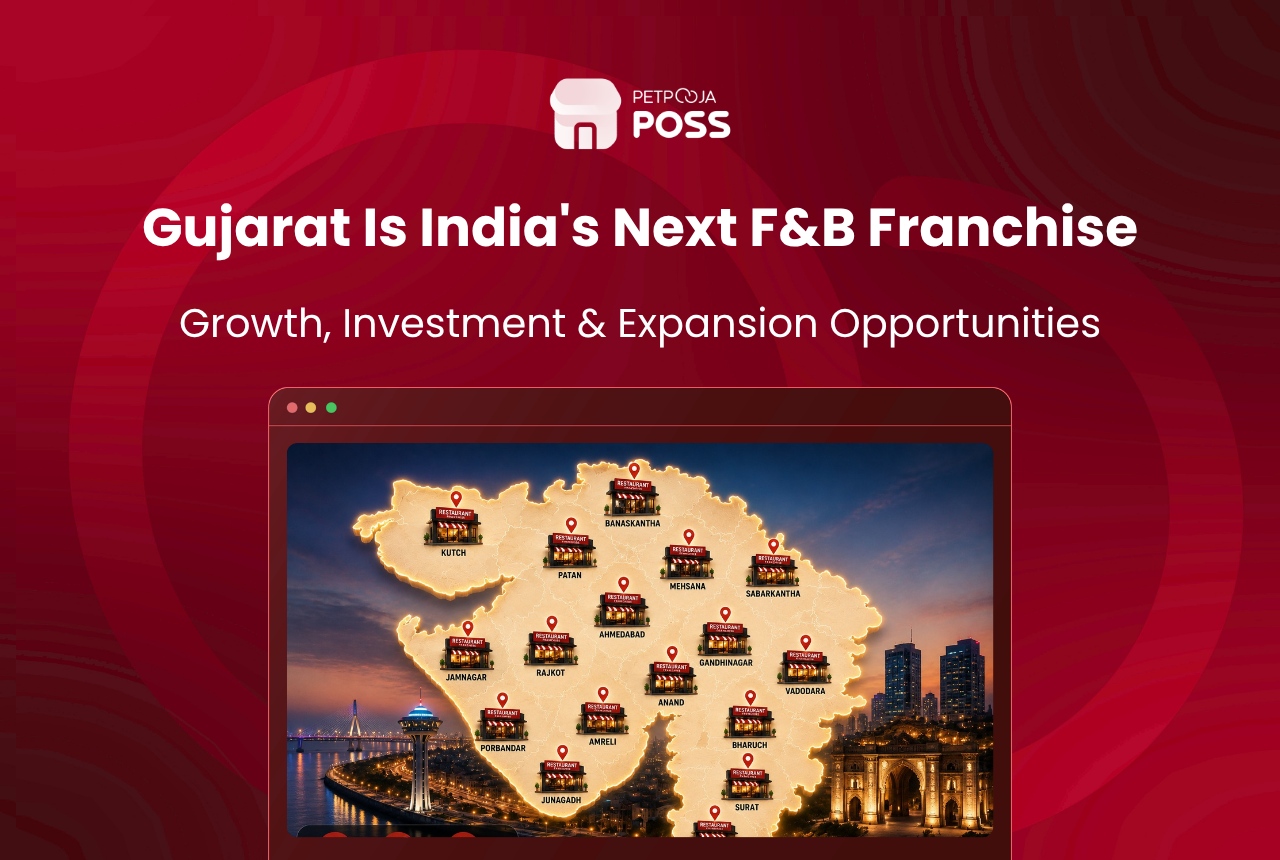
Gujarat has 450+ active F&B franchise opportunities right now. The state’s GSDP crossed Rs 29.82 trillion in FY26, per capita income sits at Rs 3 lakh+ (1.6 times the national average), and the population punches well above its weight: over 8% of India’s GDP from under 5% of the people. If someone asked us which state will mint the most new food franchise millionaires between now and 2030, the data points to Gujarat before anywhere else.
Most people still associate this state with diamonds and textiles. Fair enough. Surat does cut and polish over 90% of the world’s diamonds. But that same Surat has 70 lakh+ people, 839 corporate offices, and a working population whose lunch budget has tripled in a decade. India’s franchise industry is valued at USD 47-48 billion (IBEF), food is the most franchised sector, and Gujarat’s cities are where the next wave of openings is landing.
Key Takeaways
- Gujarat’s GSDP crossed Rs 29.82 trillion in FY26 at a 10.16% CAGR over the last decade (IBEF)
- Per capita income at Rs 3 lakh+ is 1.6 times the national average
- 450+ F&B franchise slots are active across the state
- Thousands of crores committed to Commonwealth Games 2030 infrastructure in Ahmedabad
- GIFT City has 1,034+ registered financial entities and 71,000 finance professionals nearby
- Petpooja Franchise Conclave on 20-21 June 2026 brings 50+ F&B brands and 6,000+ investors to Ahmedabad
How Does Gujarat’s Wealth Actually Translate to Restaurant Spending?
A dry GDP number does not fill restaurant tables. But per capita income does, because it determines how often a family eats outside the house and what they are willing to pay for a plate of paneer tikka on a Wednesday.
| Metric | Gujarat | India Average |
|---|---|---|
| GSDP (FY26) | Rs 29.82 trillion | – |
| Per capita income | Rs 3 lakh+ | Rs 1.85 lakh (approx.) |
| GDP contribution | 8%+ of national GDP | – |
| Population share | Under 5% | – |
| 10-year GSDP CAGR | 10.16% | – |
| FDI inflows (Oct 2019-Jun 2025) | Rs 4,08,212 crore | – |
A textile merchant in Ring Road, Surat, who bills Rs 15-20 lakh a month does not eat dal-chawal at his desk. He takes clients out three times a week, and the table is never below Rs 350 a head. Multiply that behaviour across 839 corporate offices in Surat alone, and the city’s F&B demand starts making sense without needing a single tourism statistic.
Gujarat also has 16,700 operational startups, per FranchiseBazar. Young founders and their teams cluster around Vastrapur and Prahlad Nagar in Ahmedabad. The co-working crowd that orders from Swiggy by 12:45 PM and grabs chai at 4 PM is a reliable, recurring customer base for any QSR or cafe franchise within a 2 km radius.
Where Exactly in Gujarat Should a Franchise Investor Look?
The obvious answer is Ahmedabad. The less obvious answer is that Rajkot, Bhavnagar, and even Mehsana are producing returns that Ahmedabad franchisees would envy.
| City | Population | What Drives F&B Demand |
|---|---|---|
| Ahmedabad | 6.36 million | GIFT City professionals, CWG 2030 construction crews, 1,472 corporate offices |
| Surat | 70 lakh+ | Diamond/textile trade income, 839 corporate offices |
| Vadodara | 1.82 million | MS University student crowd, middle-class families, 757 corporate offices |
| Rajkot | 1.39 million | New airport, 2,700+ manufacturing units, 710 corporate offices |
| Bhavnagar | 0.61 million | Ship-breaking industry money, 411 corporate offices, almost no branded food competition |
Across Petpooja’s 1,00,000+ restaurant network, the billing data tells a story that surprises people. A pizza franchise in Rajkot that opened in January 2025 was printing 120+ KOTs a day by March. A similar outlet in Bandra took five months to reach the same daily ticket count. The rent in Rajkot was a third of Bandra’s. The staff cost was half.
Junagadh, Nadiad, Morbi (India’s ceramic capital), and Mehsana are the next tier. A chai franchise that would pay Rs 2 lakh/month on SG Highway in Ahmedabad can find a main-road location in Mehsana for under Rs 40,000 and get comparable walk-in traffic from the dairy belt workforce that surrounds the town.
What Infrastructure Is Feeding Gujarat’s F&B Demand Until 2030?
The infrastructure pipeline is what separates a one-time opportunity from a decade-long trend.
Thousands of crores are going into Commonwealth Games 2030 infrastructure in Ahmedabad. A Rs 5,000-6,000 crore sports enclave, metro extensions, athlete villages, new roads connecting the outskirts to the city centre. Construction workers alone will create demand for affordable meals near every site. And the venues that come up will need food courts and QSR outlets that stay open long after the closing ceremony. Delhi’s CWG 2010 complexes still have packed food courts in 2026, sixteen years on.
GIFT City is a different kind of demand entirely. 1,034+ registered financial entities, 194 fund management firms, and 71,000 finance professionals across Gujarat. These are not tourists. They show up Monday through Friday, and between 11:30 AM and 2 PM, every one of them needs lunch. Cloud kitchens and delivery brands operating within a 3 km radius of GIFT City have a captive weekday audience that most Indian cities cannot offer.
The bullet train corridor from Mumbai to Ahmedabad, expected by 2028, will compress 508 km into under two hours. A Mumbaikar visiting family in Ahmedabad for the weekend becomes a Mumbaikar visiting Ahmedabad for a Saturday brunch. The footfall math on SG Highway and Prahlad Nagar’s restaurant strips shifts overnight.
Gujarat’s state budget gave a significant push to tourism in FY26, with increased allocation for new circuits, pilgrim infrastructure, and tourist transport. More tourist circuits, more buses, more infrastructure at pilgrimage sites like Somnath and Dwarka. Tourists eat out. That is not an assumption; that is the entire revenue model of food stalls around every temple town in India.
Why Not Just Invest in Mumbai or Bangalore Instead?
Because the rent will eat the franchise alive before the first review appears on Zomato.
For example, take a momo franchise costing Rs 25 lakh to set up. In Andheri West, Mumbai, a 400 sq ft shop costs Rs 1.5-2 lakh/month in rent. The identical brand in Prahladnagar, Ahmedabad, pays Rs 50,000-70,000 for comparable footfall and better parking. Staff salaries run 30-40% lower. The net margin gap between the two locations can be 8-12 percentage points. That is the difference between a franchisee who recovers capital in 14 months and one who is still borrowing at month 22.
There is also a cultural layer that spreadsheets miss. Gujarat has the highest proportion of self-employed individuals in urban India across multiple CMIE surveys. Business owners and traders eat out more than salaried employees do. They entertain clients at restaurants. A garment wholesaler in Ashram Road does not flinch at a Rs 400 lunch bill. The same spend would feel like a splurge for a mid-level IT employee in Whitefield, Bangalore, who packs lunch from home four days a week.
The vegetarian preference across Gujarat is worth calling out separately. Franchise brands in the veg QSR, cafe, bakery, and dessert categories find a natural fit here that does not exist in meat-heavy food markets. A pizza brand that sells 60% veg in most Indian cities sells 85-90% veg in Ahmedabad. Menu wastage drops. Procurement simplifies. The kitchen runs leaner.
How Do Investors Meet These Brands in Person?
Petpooja Franchise Conclave is happening on 20-21 June 2026 at Shree Shakti Convention Centre, Ahmedabad. Fifty-plus curated F&B brands. Over 6,000 pre-screened investors. B2B matchmaking, live food demos, and a gala dinner. NRAI supports the event.
Confirmed brands include Kake Da Hotel, La Pino’z, The Burger Company, Marky Momos, Bombay Kulfi, Italios Pizza, Rolls King, and Samocha.
Tickets are Rs 299 (one day) or Rs 499 (both days) on AllEvents.in. No walk-ins. Read our investor prep guide for the Conclave before you go.
Conclusion
Gujarat produces 8% of India’s GDP with under 5% of the people. Per capita income runs 1.6 times the national figure. Construction crews are laying the ground for a Commonwealth Games that will reshape Ahmedabad’s food economy, GIFT City’s 71,000 professionals need lunch five days a week, and the bullet train will put Mumbai’s spending crowd within brunch distance of SG Highway. The smaller cities, Rajkot with its new airport, Bhavnagar with its ship-breaking wealth, Mehsana with its dairy belt workforce, are following the same arc at rents that would make a Mumbai franchisee weep. The brands are ready, the capital is sitting in Gujarat’s bank accounts, and on 20-21 June both sides walk into the same room at the Franchise Conclave in Ahmedabad.
FAQs
450+ active slots across QSR, cafe, cloud kitchen, bakery, dessert, and fine dining. Ahmedabad and Surat attract the most brand interest. Rajkot and Vadodara are catching up.
Rs 3 lakh+. That is 1.6 times the national average. The textile trader in Surat and the finance professional near GIFT City both eat out three to four times a week without budgeting for it.
Surat for diamond-trade wealth and 70 lakh+ people. Vadodara for its university crowd and 757 corporate offices. Rajkot for a new airport and 2,700+ manufacturing units generating daily lunch demand. Mehsana and Morbi for rents under Rs 40,000/month on high-footfall streets.
F&B-only franchise expo, 20-21 June 2026, Shree Shakti Convention Centre, Ahmedabad. Fifty-plus brands, 6,000+ investors, B2B matchmaking. Tickets Rs 299-499 on AllEvents.in. Read the investor prep guide first.
Rent in Prahladnagar, Ahmedabad, runs Rs 50,000-70,000 for a 400 sq ft shop. The same space in Andheri West, Mumbai, costs Rs 1.5-2 lakh. Staff salaries are 30-40% lower. The consumer spending power is comparable. That margin gap, 8-12 percentage points, is what separates a franchisee who recovers capital in 14 months from one still underwater at month 22.