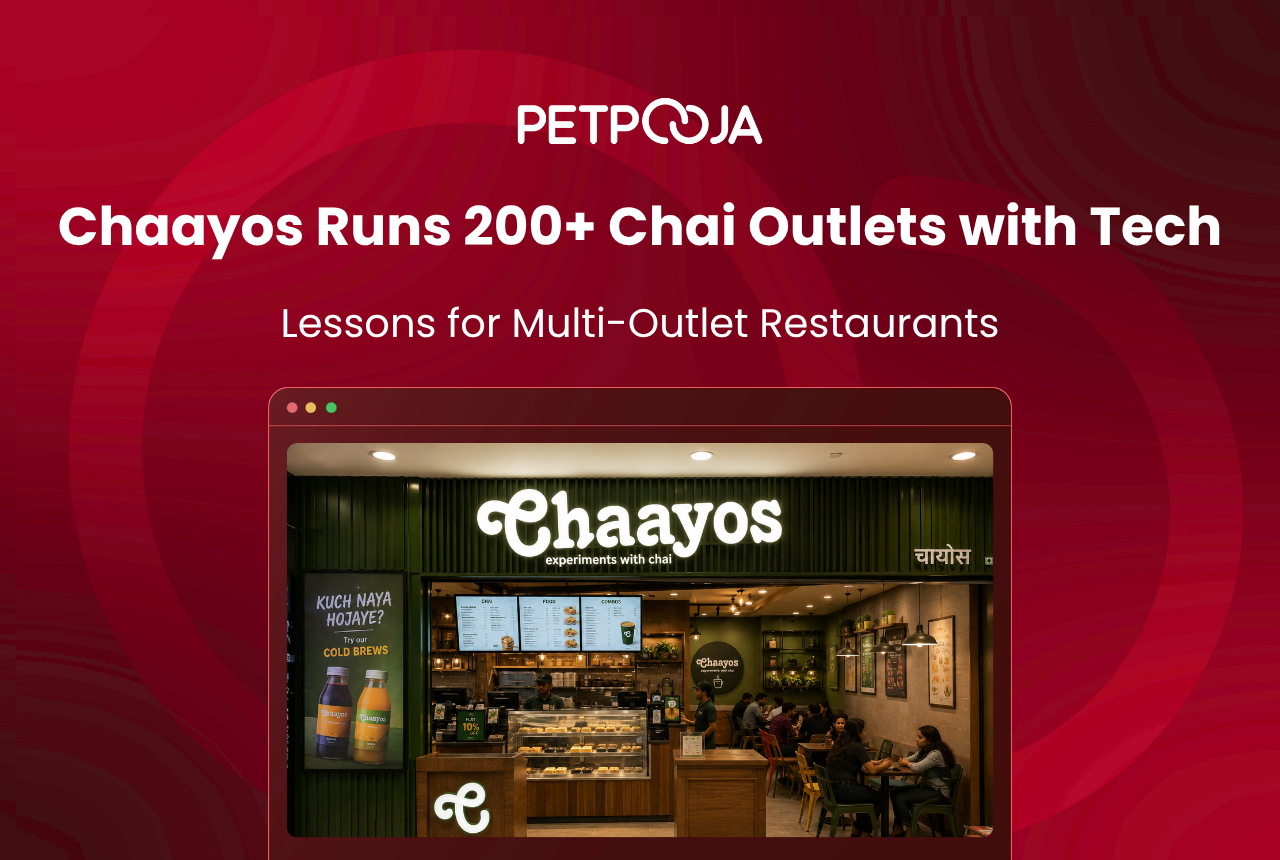
Chaayos sells chai, but it runs like a software company. Founder Nitin Saluja has said the business puts about a fifth of its head-office budget into engineering. That is what a product startup spends, not a cafe chain.
That choice shows up in the numbers. Chaayos crossed ₹310.6 crore in revenue in FY25, up 25% from ₹248.6 crore. Losses fell 53% to ₹25.4 crore in the same year, according to its ROC filings.
This piece looks at what Chaayos actually built, what it cost them to get wrong, and which parts a smaller chai or cafe brand can borrow without a engineering team.
Key Takeaways
- Chaayos runs 200+ outlets, from one store opened in Gurugram in 2012.
- Chai Monk, its in-house brewing machine, handles about 80% of the brew and supports roughly 80,000 combinations.
- Face-based login cut repeat ordering from two minutes to 20 seconds, then drew a privacy backlash.
- FY25 revenue reached ₹310.6 crore, with EBITDA of ₹37 crore.
What Chaayos Built, in Numbers
Nitin Saluja and Raghav Verma opened the first Chaayos in Gurugram in 2012. Saluja, an IIT Bombay engineer, ran that first store himself as its manager, working 8am to 11pm.
The table below pulls together the figures the company and its filings have put on record.
| Chaayos at a Glance | What Is On Record |
|---|---|
| Founded | 2012, first outlet in Gurugram |
| Founders | Nitin Saluja and Raghav Verma |
| Outlets | 200+ across Delhi-NCR, Mumbai and Bengaluru |
| Stated expansion goal | 400 outlets |
| FY25 revenue from operations | ₹310.6 crore |
| FY24 revenue from operations | ₹248.6 crore |
| FY25 loss | ₹25.4 crore, down 53% |
| FY25 EBITDA | ₹37 crore, margin of 11.85% |
| Brewing machine | Chai Monk, built in-house, introduced 2016 |
Two things stand out. The revenue jump came with a sharp fall in losses, which is unusual for a chain still opening stores. And the technology is owned rather than bought, which is rarer still in Indian food service.
Scale is why both of those matter. A chai cafe sells a cheap item many times a day. The margin on one cup is thin, so volume carries the business.
At that size, small savings add up fast. A few seconds cut from each order, or a few grams of tea leaf saved per cup, repeats across every counter every day of the year.
The Chaayos Technology Problem: Customisation at Scale
Chaayos was built on a promise that is easy to make and very hard to keep. The chai is made the way each customer wants it, which the brand calls Meri Wali Chai.
At one outlet, a trained person can hold that promise in their head. At two hundred, they cannot. Sugar, strength, milk, masala and add-ons stack up into roughly 80,000 combinations. No amount of staff training holds that in memory.
This is the same wall most growing food brands hit, whichever category they sit in. Our guide on managing chain restaurants covers why consistency breaks first when outlet count rises.
Chai Monk: The Machine Behind the Chai Outlets
Chaayos answered the consistency problem with hardware. In 2016 it introduced Chai Monk, designed in-house rather than bought off a supplier’s catalogue.
Chai Monk is an IoT brewing machine that makes each cup to a saved customer preference. Being connected lets head office see and set what every unit is doing.
The split matters more than the machine. About 80% of the brewing is done by Chai Monk and 20% by the person at the counter. The recipe now sits in the equipment, not in a staff member’s memory.
That changes what hiring looks like. A new joiner in Vastrapur does not need six weeks to match a store in Saket. The machine holds the recipe steady while the person handles service.
It also changes what a bad day costs. When the person who knows the recipe calls in sick, the chai does not change with them.
Most brands will not build hardware. The transferable idea is narrower: find the one step where quality slips as you grow, then move that step out of memory and into a system. For many kitchens that step is portioning, and a food cost calculator is where the gap first becomes visible.
How Chaayos Cut the Ordering Journey to 20 Seconds
The second problem was the queue. A regular customer had to state their order, confirm a phone number, wait for an OTP and then pay, which took about two minutes at the counter.
Chaayos put face-based login in front of that. A recognised regular could repeat their last order and pay in roughly 20 seconds, as Inc42 reported at the Bengaluru launch.
The ticket size here is small and the queue is the real limit. Cutting a hundred seconds off each repeat order lets the same counter serve more people in the same hour.
The Part That Went Wrong
In 2019 the feature drew a public backlash. Customers said their photographs had been captured without being asked first, and privacy researchers used the episode to argue for stronger data protection law.
Chaayos said the data was encrypted, was not shared with third parties, and could be deleted at any time. It kept the feature but positioned it as a choice, telling Inc42 that customers could decline it and use their phone number instead.
The operating lesson is worth taking on its own terms. Customer data taken without a clear ask turns into a risk the moment someone notices. Asking first is also cheaper than fixing it later, and any brand running a loyalty programme holds the same kind of data.
What the FY25 Numbers Say About the Technology Bet
Saluja gave that one-fifth budget figure on the Founder Thesis podcast. Spending at that level only makes sense if the unit economics move. In FY25 they did.
Revenue from manufactured goods accounted for about 96% of the total, which tells you the chai itself is carrying the business rather than packaged retail lines.
The pattern we see most often at Petpooja is the opposite of this one. Revenue climbs with new outlets while margin quietly leaks, because nobody is reading the profit and loss report per outlet until the year closes.
What Smaller Chai and Cafe Brands Can Copy
The lesson from Chaayos is not the brewing robot. It is finding the one step that slips as outlet count rises, then moving that step out of human memory and into a written system. For most kitchens that step is portioning or menu sync, not brewing.
Four Steps That Transfer to a Smaller Brand
None of the four below needs a robot or funding.
- Decide what must never vary, then take it off human memory. For Chaayos that was the brew. For a bakery it might be portion weight. Write it down before you automate anything.
- Consider a small example. Say a chai brand runs three outlets in Pune and each manager orders milk on instinct. Wastage differs at every store and nobody can explain why. A shared purchase list fixes more than a new machine would. This scenario is an illustration, not a real business.
- Put the menu in one place. A price changed at head office should reach every counter the same day. Our guide to multi-outlet menu management covers how that sync usually breaks.
- Measure service time, not just sales. Chaayos treated 100 seconds at the counter as a cost worth engineering away. Most owners never measure it at all, though customer wait time is one of the few numbers that moves both revenue and reviews.
Where the System Does the Remembering
Those steps need somebody to decide which one is breaking. That is a different kind of work from buying software and hoping it sorts itself out.
For chains, the practical version of the Chaayos idea is a single system holding billing, stock and reporting across every outlet. Petpooja POSS does that for over 1,00,000 restaurants, which is the same job Chai Monk does for the cup, applied to the books instead.
Where to Hear Nitin Saluja Speak
Saluja is listed as a speaker at the NRAI Food Delivery Summit 2026 on Thursday 20 August 2026, at The Forum Hotel & Convention in Shela, Ahmedabad. The theme this year is Delivering Growth Through Technology, which is close to the ground he has spent a decade on.
Our summit speaker planner groups the announced line-up by the business problem each speaker is closest to, and the venue and registration guide covers passes and travel.
Conclusion
The interesting thing about Chaayos is not that it uses technology. It is that the company treated a cup of chai as a repeatability problem. Then it spent real money solving that problem, instead of hoping training would hold as outlets multiplied.
You do not need a brewing robot to take that idea seriously. You need to know which single step in your operation breaks first when you grow, and then move that step into a system that does not forget.
Once that step is stock, billing or per-outlet profit, the system doing the remembering is usually your POS. Petpooja POSS covers billing, inventory, multi-outlet management and reporting from one screen.
Frequently Asked Questions
Chaayos runs more than 200 outlets across Delhi-NCR, Mumbai and Bengaluru, and has said it is working towards 400. It started with a single store in Gurugram in 2012.
Chai Monk is the IoT brewing machine Chaayos designed in-house and introduced in 2016. It brews to a customer’s saved preference, with about 80% of the work done by the machine and 20% by the counter staff.
Revenue from operations reached ₹310.6 crore in FY25, against ₹248.6 crore in FY24. Losses narrowed 53% to ₹25.4 crore and EBITDA came in at ₹37 crore, per filings with the Registrar of Companies.
No. The point is not the machine but what it protects: a steady product and a predictable service time. Written recipes, portion control and one shared menu across outlets get a smaller brand most of the way. Tracking kitchen success metrics shows which step to fix first.
He is listed on the official summit line-up for the NRAI Food Delivery Summit 2026 on 20 August 2026 in Ahmedabad, where the theme is Delivering Growth Through Technology.