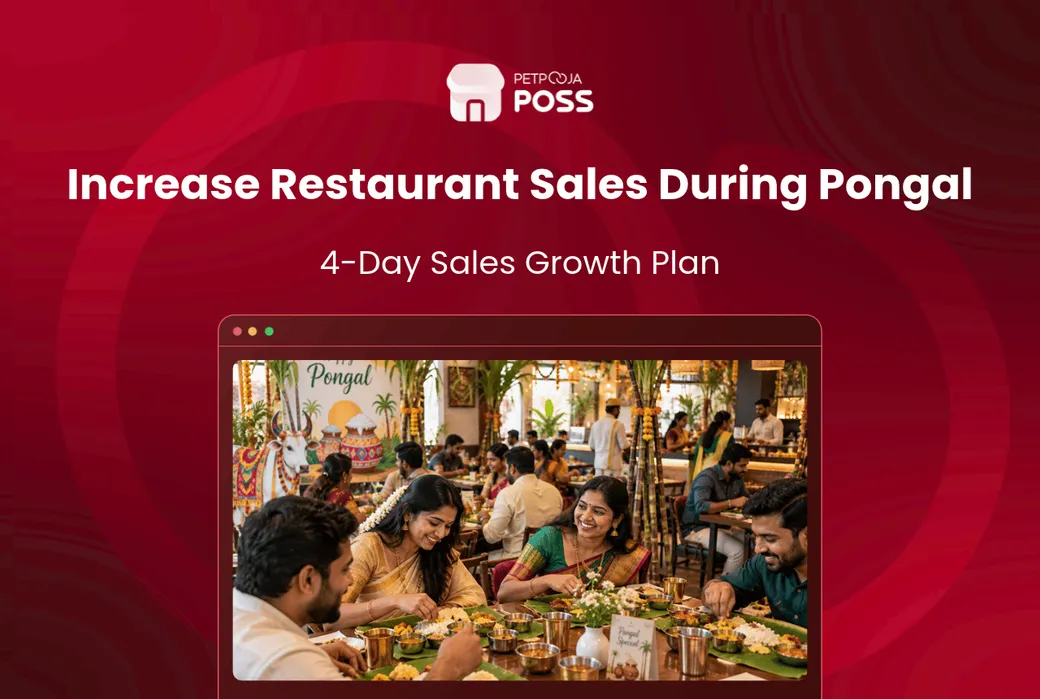



How do you increase restaurant sales during Pongal? Give guests a festive reason to come in. Sell a Pongal meal built around Sakkarai Pongal, take pre-orders for family packs, and book tables for the last day. Price each one to add to the bill, not to cut it.
This is not a Tamil Nadu sale alone. Searches for a South Indian restaurant nearby nearly doubled across India between 2023 and 2025. Mumbai now logs five times as many as Chennai does. For a South Indian restaurant in any city, Pongal is a festival its menu was made for.
This post covers why Pongal matters beyond Tamil Nadu, what to sell where you are, and a 4-day plan for what to sell on each day. It also covers what each offer costs you and how to set up your system before the festival.
Key Takeaways
- Pongal is a sales moment for South Indian restaurants across India. Searches for one nearby nearly doubled in two years.
- Outside Tamil Nadu, a Pongal meal sells to Tamil families missing home and to dosa fans who have never tried Sakkarai Pongal.
- The best offers add to the bill. A flat discount needs far more guests to earn the same.
Why Pongal Can Increase Restaurant Sales Beyond Tamil Nadu
Pongal can increase restaurant sales beyond Tamil Nadu because South Indian food has a large and growing following in cities far from the South. This section shows where people search for it, what has happened when South Indian restaurants opened in the north and west, and where Pongal is celebrated.
Where India searches for South Indian food
Searches in India for “south indian restaurant near me” nearly doubled in two years. They averaged about 99,000 a month in 2023 and about 1,93,000 a month in 2025. Searches for “dosa near me” grew faster, from about 86,000 to 2,13,000 a month.
These figures come from Google’s search volume data.
Split by city, the biggest numbers today are not in Tamil Nadu.
Mumbai 22,200 Bengaluru 22,200 Pune 14,800 Delhi 12,100 Ahmedabad 12,100 Chennai 4,400 Monthly Google searches for “south indian restaurant near me”, by city (Google search data, pulled in October 2026).Chennai’s low number does not mean it eats less South Indian food. Most restaurants there likely serve it already, so people rarely need to type the words.
The other cities do show a large crowd in Mumbai, Pune, Delhi and Ahmedabad looking for South Indian food. Pongal gives a restaurant near them something new to offer.
South Indian restaurants opening in Delhi and Mumbai
Recent South Indian restaurant openings in Delhi and Mumbai point the same way. Here are two from the past year.
- Delhi. Benne, a Bengaluru-style darshini, opened in GK M Block on 31 December 2025. Two weeks later, guests were still told to wait at least an hour and a half, ThePrint reported.
- Mumbai. The Rameshwaram Cafe opened an 8,000 sq ft outlet in Churchgate and served over 20,000 guests in four days of trial runs, Indian Retailer reported in March 2026.
Both sell everyday South Indian food. Pongal gives restaurants like these a festive menu to sell for the four days of the festival.
Where Pongal is celebrated
Pongal is Tamil Nadu’s harvest festival. Tamil Nadu Tourism says it is also celebrated in Karnataka, Andhra Pradesh and Puducherry, and by Tamil families around the world.
Many Tamil families also live and work in other Indian cities. For them, Pongal away from home can mean no festive meal at all, unless a restaurant nearby serves one.
How to Increase Restaurant Sales During Pongal
How you increase restaurant sales during Pongal depends on where your restaurant is. A restaurant in Tamil Nadu sells to people celebrating at home. A restaurant in another city sells to people missing the festival, and to people meeting it for the first time.
For South Indian restaurants in Tamil Nadu
In Tamil Nadu, guests already know the dishes. Your job is to make your restaurant part of their four days. Five offers do this:
- A Pongal festive meal. Put the festival’s dishes on one plate at one price. Build it around Sakkarai Pongal, which Tamil Nadu Tourism describes as new rice cooked with milk, jaggery and cardamom. Add Ven Pongal (the savoury version) and vadai, on a banana leaf if your format allows it.
- Pre-orders for family packs. Say a restaurant in Coimbatore takes 60 pre-orders at ₹549, with 30% paid upfront. It has ₹32,940 of sales booked and ₹9,882 in hand before the day (an example). Guests collect them on Thai Pongal, the main festival day.
- A family set menu for the last day. A table of eight at ₹349 a head is a ₹2,792 booking you know about in advance (an example).
- A free sweet on bigger bills. Give one portion of Sakkarai Pongal free on bills above a set amount, such as ₹1,000. Restaurant owners tell us groups often add a dish to reach it.
- A greeting in Tamil to your regulars, with a coupon for a quieter day before the festival starts.
For South Indian restaurants in other cities
Outside Tamil Nadu, the same meal sells to two different groups. One is Tamil families living in the city, who want a festive meal close to home. The other is your regulars who order dosa and idli but have never tried Pongal dishes.
- Sell the Pongal meal for the four days. Tamil families nearby are looking for it, so tell them you have it. Message the guests in your customer list and put it on your own website.
- Explain each dish on the menu. A diner in Pune may not know Ven Pongal from Sakkarai Pongal. One line under each name, in plain English, turns a question into an order. A digital menu display lets you add these for the festival and take them down after.
- Sell Sakkarai Pongal on its own as a dessert. It is the easiest way for a first-timer to try the festival.
- Take pre-orders from families who are cooking at home but want a pack of the harder dishes.
A South Indian restaurant in Vastrapur, Ahmedabad could run the Pongal meal for the four days, and offer Sakkarai Pongal as a dessert at every table (an example).
In Karnataka and Andhra Pradesh, the same week is Makar Sankranti. A restaurant there can run the same meal and pre-orders under that name, with the local festive dishes.
These ideas sit inside a wider plan for the season, covered in our guide to festive season sales.
A 4-Day Plan to Increase Restaurant Sales During Pongal
The 4-day plan gives each day of Pongal its own sale, because each day is celebrated in its own way. Tamil Nadu Tourism says the festival is usually celebrated between 13 and 16 January. Check the dates for the year when the state’s holiday list comes out.
The four days are Bhogi, Thai Pongal, Mattu Pongal and Kaanum Pongal. Thai Pongal is the main day. It marks the start of Thai, a month in the Tamil calendar.
DAY 1 Bhogi Start the Pongal menu, close pre-orders DAY 2 Thai Pongal Pre-orders, festive meal, no discounts DAY 3 Mattu Pongal Festive meal, free sweet on bigger bills DAY 4 Kaanum Pongal Booked family set menus, no discounts What to sell on each of Pongal’s four days.The days, in order:
- Bhogi is the day people throw out old things and replace them with new ones, as Tamil Nadu Tourism puts it. Start serving the Pongal menu, and close your pre-order list so the kitchen knows its numbers.
- Thai Pongal is the day the Sun God is worshipped. Hand over pre-orders in the morning and sell the festive meal at lunch. Keep discounts off this day.
- Mattu Pongal is the day cattle are honoured. Keep the festive meal on, and push the sweet offer to lift the average table.
- Kaanum Pongal is the day families get together for a big meal. Sell booked family set menus, with no discounts. Our guide to managing restaurant reservations covers how to avoid double bookings on a full day.
Start early. Searches in India for “Pongal offers” rose from 880 in December 2025 to 5,400 in January 2026, then fell to 40 in February, in Google search data pulled in October 2026. Announce your Pongal menu and open pre-orders in late December.
Which Pongal Offers Increase Sales and Keep Your Margin?
A Pongal offer increases sales and keeps your margin when it adds dishes to the bill instead of cutting the price. This section compares a discount on one meal with a festive meal built around it, so you can see the gap.
Here is a restaurant in Mylapore, Chennai, selling a Pongal meal at ₹299 (an example). The food in it costs ₹104, so it keeps ₹195 on each meal before rent and wages. Prices are before GST.
| Pongal Offer on One Meal | Guest Pays | Food Cost | You Keep |
|---|---|---|---|
| No offer | ₹299 | ₹104 | ₹195 |
| 20% off | ₹239.20 | ₹104 | ₹135.20 |
| Meal with Sakkarai Pongal and filter coffee | ₹379 | ₹140 | ₹239 |
Bought separately, the meal, the Sakkarai Pongal and the filter coffee sell for ₹299, ₹79 and ₹49, which is ₹427. Against buying all three separately, the guest saves ₹48. The sweet costs ₹22 to make and the coffee ₹14, so the food cost rises to ₹140.
No offer ₹195 20% off ₹135.20 Festive meal at ₹379 ₹239 What you keep per meal (an example) What the restaurant keeps per meal with no offer, with a discount and with a festive meal (an example).To see how many more meals a discount needs, divide what you keep now by what you keep with the offer. At 20% off, ₹195 ÷ ₹135.20 = 1.44, so you need about 44% more meals just to earn the same.
The festive meal keeps ₹44 more than the plain meal, even though the guest saves ₹48. Check your own food cost ratio on each dish before you set a price. Our guide to restaurant food cost shows how to work it out.
How to Set Up Your POS to Increase Pongal Sales
You set up your POS for Pongal by putting each meal, pack and price into your billing system before Bhogi. This section covers the four parts of that setup.
Add each offer as its own item
Create the Pongal meal and each pre-order pack as a menu item with its own price, and give it an end date after Kaanum Pongal. Do not ask staff to ring up each dish separately and take a discount off by hand.
Petpooja‘s Android POS lets you set a limit on discounts, both on offers that apply to the whole bill and on discounts staff give at the counter.
A fixed meal price also keeps the GST simple. GST is charged on the price the guest pays, so a meal sold at ₹379 is taxed on ₹379. The CBIC valuation guide says that if you do give a discount and show it on the invoice, it is left out of the value GST is charged on.
Print bills in Tamil
The same Android POS can print item names in the local language, so the Pongal dishes can appear in Tamil on the bill. The POS works in 18+ Indian languages.
Track pre-orders and part-payments
On a busy morning, you need to see who has paid what. The Android POS shows the amount paid and the balance pending on each advance order, on the screen and on the printed bill. Hand-over on Thai Pongal morning then takes one look, not a phone call.
Send offers from the same customer list
The regulars you tag in the billing system are the ones you message, in Tamil Nadu or in Pune. A restaurant loyalty tool keeps the list, and a restaurant marketing app can design the Pongal greeting.
To send that greeting on WhatsApp, use Petpooja’s Marketing Manager, its marketing automation tool. Pick one of its ready-made festival templates and add your Pongal meal, the pack prices and the last pre-order date. It groups your customers by their visits and spending. So send the menu to your regulars first, and a reminder to guests who have not visited recently. The dashboard shows each campaign’s WhatsApp read rate, so you can see whether the greeting was opened before Bhogi. Marketing Manager works on every Petpooja POS version except Local.
What I could recommend from my end. Add the Pongal meal and each pack as their own items with an end date. Then switch on a discount cap. Each evening, the item and discount reports show which day and which offer sold the most. Those reports become next year’s Pongal plan.
How to Tell If Pongal Increased Your Restaurant Sales
You can tell Pongal increased your restaurant sales if orders and the average bill rose on the four days, without discounts eating what you kept. This section covers the numbers to compare, and the mistakes owners tell us cost them most.
Compare each of these with the same four days last Pongal, not with an ordinary week. If this is your first Pongal menu, use the same dates last year:
- Orders per day. Which of the four days brought the most people in?
- Average bill. Did the sweet on bigger bills lift it?
- Pre-orders. How many came in, and how many were collected?
- New guests. Outside Tamil Nadu, how many first-time guests came for the Pongal meal?
- What you kept. What guests paid, minus food cost and discounts.
Pull these from your POS item and discount reports rather than from memory. To see whether the new guests came back, our guide to CRM reports shows how to check how often each one visits.
Restaurant owners tell us two mistakes cost the most. None of this is survey data. It is what they say when they look back at a festival that was busy but not profitable.
- Discounting the busy days. Thai Pongal and Kaanum Pongal tend to fill without a discount.
- Taking pre-orders without a part-payment. Families change plans, and uncollected packs go to waste.
Conclusion
You increase restaurant sales during Pongal by adding value, not cutting price.
Sell more with a festive meal, pre-orders and booked family tables, instead of a flat discount. At 20% off, you need about 44% more meals just to earn the same.
The festival is not a Tamil Nadu sale alone. If you run a South Indian restaurant in Mumbai, Pune, Delhi or Ahmedabad, sell the Pongal meal to Tamil families nearby. Then explain it to the regulars who have never tried it.
Set up every Pongal item and pre-order before Bhogi. Your restaurant POS then shows you which part of your Pongal menu earned the most.
Frequently Asked Questions
Should my Pongal offers run on delivery apps too?
Check your agreement with each platform first, because offers on their apps run under their own terms. You can keep your Pongal meal and pre-orders for dine-in, takeaway and your own website.
Can a restaurant that does not serve South Indian food sell during Pongal?
Yes, in a small way. Add one dish, such as Sakkarai Pongal as a dessert special, for the four days. Do not build a full Pongal meal your kitchen has never cooked.
Can I sell gift vouchers for Pongal?
Yes. A voucher bought before Pongal gives the guest a reason to come back after it, and you can sell them in bulk to companies giving staff gifts. Our guide to restaurant gift cards covers how to run them from the POS.
Thanks. This helps us make the next article better.

Nisarg Kansara is Senior Marketing Manager at Petpooja. What he brings to table is the tactical layer, meaning the features most users never find, the automations that remove a daily chore, and the exact fix for a workflow that keeps breaking. He spends his weeks with Indian business owners working out where billing, purchase entries and task follow-ups fall apart in practice, and that input shapes how the products change. India has over 1.5 crore active GST registrations, and most of those businesses still handle compliance by hand. Nisarg writes for the owners trying to change that, with a focus on where AI removes manual work rather than adding another button.