



What items should a kirana store stock? This kirana store items list covers 110 products in 12 categories, from atta and dal to soap, diapers and agarbatti. Start with the staples families buy every week, then add packaged foods and household goods.
What you stock first depends on your street, your budget and how many families live nearby. Staples take the biggest share of the opening budget, so get those right before anything else.
People in India search for “kirana store items list” about 1,000 times a month (Google search data, 12-month average, October 2026). This list is for small Indian business owners stocking a shop, not for a family’s monthly shopping.
For each category you get the items, and for the staples, how to sell them loose or packed. After the list come an opening stock budget, a shelf layout, the GST changes, the labelling rules and the billing setup.
Key Takeaways
- This list runs to 110 products, but staples and edible oils take about half the budget in our example.
- Many packaged foods and toiletries moved to 5% GST in September 2025, so an old item list prints the wrong tax.
- Loose dal and a 1 kg pack are two billing items, not one. Set up both and every bill comes out right.
The Full Kirana Store Items List, Category by Category
The list below groups 110 kirana store items into 12 categories, starting with the staples. Common Hindi names are in brackets, because customers often ask for items by those names.
Suggested 12 categories:
- Staples (atta, rice, dal, pulses)
- Edible oils and ghee
- Spices and masalas
- Sugar, salt, jaggery
- Packaged foods and snacks
- Beverages (tea, coffee, soft drinks)
- Dairy, bread and eggs
- Personal care
- Household cleaning
- Baby and feminine care
- Pooja items
- Daily needs (batteries, matches, stationery)
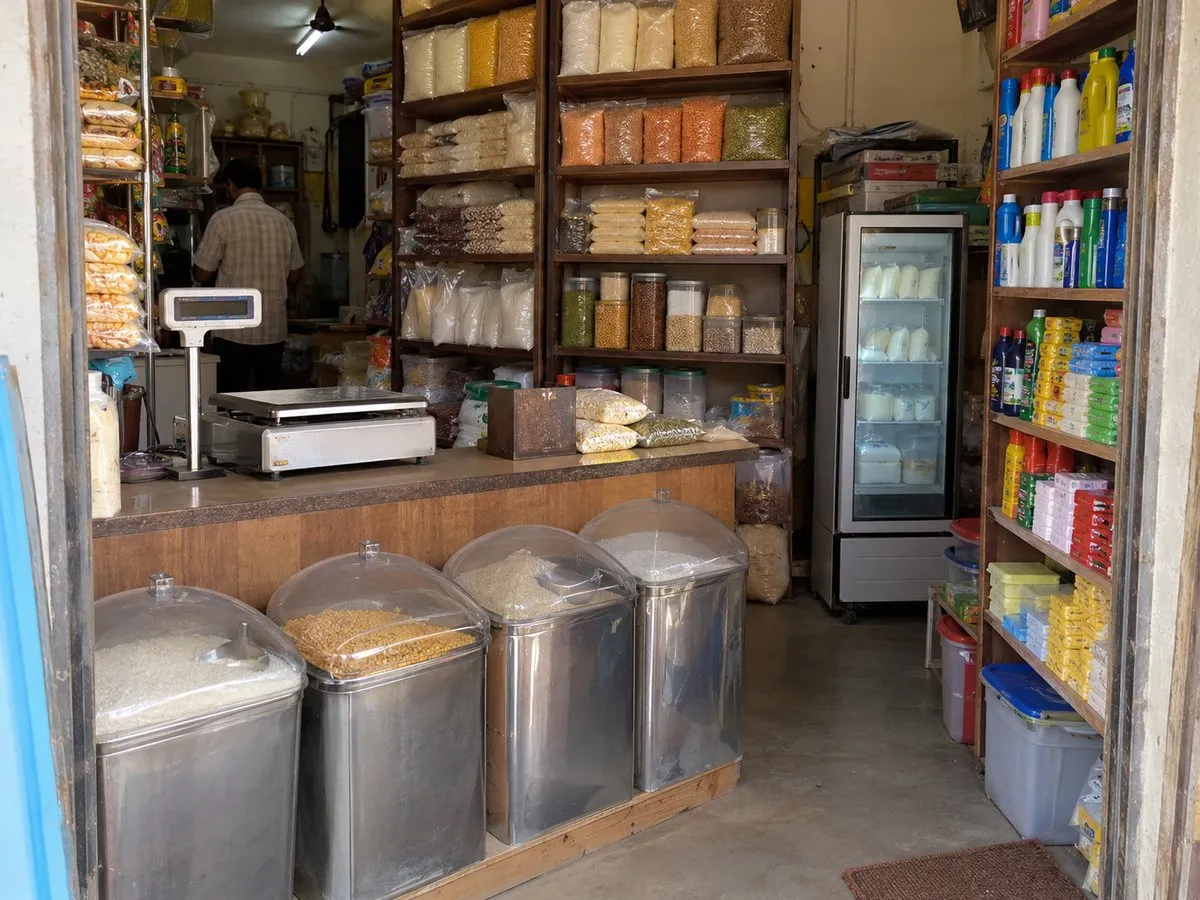 A typical kirana: loose staples near the counter, packed goods on the shelves behind.
The first four categories are kitchen staples. They bring families in every week, so they come first.
1. Staples (Atta, Rice, Dal, Pulses)
These 22 items are the base of the shop. Families buy them every week or in one big shop at the start of the month.
Atta, rice and other grains:
- Wheat atta
- Basmati rice
- Everyday rice (sona masoori, kolam or similar)
- Poha (flattened rice)
- Suji or rava (semolina)
- Maida (refined flour)
- Besan (gram flour)
- Jowar atta
- Bajra atta
- Ragi flour
- Dalia (broken wheat)
- Sabudana
Dal and pulses (add regional favourites your area asks for):
- Toor dal (arhar)
- Moong dal
- Masoor dal
- Chana dal
- Urad dal
- Rajma
- Kabuli chana
- Kala chana
- Whole moong
- Lobia (black-eyed beans)
Sell it as: loose by the kilo from a bin, and also in packs. Grains sell in 1 kg and 5 kg packs, dal in 500 g and 1 kg. Some customers want the packed brand, while others want to see the grain. Keep the loose bins covered and close to the counter, where you weigh.
2. Edible Oils and Ghee
Oil is a high-value item, so a small mistake in stock here costs more than in most categories. Start with the oils your region cooks in.
- Mustard oil
- Groundnut oil
- Sunflower oil
- Soybean oil
- Rice bran oil
- Coconut oil
- Til oil (sesame)
- Ghee
- Vanaspati
Sell it as: packs and bottles from 500 ml to 5 litres, and tins for families who buy in bulk.
3. Spices and Masalas
Spices take little shelf space but sell every day. These 13 cover most Indian kitchens.
- Haldi (turmeric)
- Red chilli powder
- Dhania powder (coriander)
- Jeera (cumin)
- Rai (mustard seeds)
- Garam masala
- Kali mirch (black pepper)
- Hing (asafoetida)
- Ajwain
- Methi seeds
- Elaichi (cardamom)
- Laung (cloves)
- Ready masala packs (chhole, sambar, pav bhaji)
Sell it as: small packets from 50 g to 200 g. A row of small sachets near the counter suits customers who buy for one meal.
4. Sugar, Salt, Jaggery
Every kitchen uses these four daily, so they move fast. Give each one a reorder level, so you buy again before the shelf is empty.
- Sugar
- Salt
- Gur (jaggery)
- Honey
Sell it as: sugar loose and in 1 kg packs; salt, jaggery and honey in packs.
The next three categories are ready-to-eat foods, drinks and daily fresh items.
5. Packaged Foods and Snacks
Snacks are where children and impulse buyers spend. Several of these 14 moved to a lower GST rate in 2025, as the GST table later in this post shows.
- Biscuits
- Namkeen and bhujia
- Chips
- Instant noodles
- Seviyan and pasta
- Cornflakes and other breakfast cereals
- Ketchup and sauces
- Achar (pickles)
- Papad
- Jam
- Rusk
- Toffees and chocolates
- Dry fruits (almonds, raisins, dates)
- Ready-to-cook mixes (idli, dosa, gulab jamun)
6. Beverages (Tea, Coffee, Soft Drinks)
Tea and coffee sell with the morning and evening cup. Water and soft drinks sell best cold, so give them some fridge space in summer. Stock these nine.
- Tea leaves
- Tea bags
- Instant coffee
- Filter coffee powder
- Packaged drinking water
- Soft drinks
- Fruit juices
- Sharbat and squash
- Malt health drinks
Sell it as: tea and coffee in packs and jars; drinks by the bottle or carton.
7. Dairy, Bread and Eggs
These seven bring a customer in daily, even if they buy their atta elsewhere.
- Milk packets
- Dahi (curd)
- Paneer
- Butter
- Cheese slices
- Bread
- Eggs
Sell it as: by the piece, from a fridge. Order these in small daily lots, because they spoil in days.
The last five categories are non-food goods. They save your customers a second stop at another shop.
8. Personal Care
These 10 are steady sellers that families buy every month.
- Bathing soap
- Shampoo
- Hair oil
- Toothpaste
- Toothbrush
- Face cream
- Talcum powder
- Shaving cream and razors
- Deodorant
- Hand wash
9. Household Cleaning
Keep these 10 on a separate shelf, away from food.
- Detergent powder
- Detergent bar
- Dishwash bar
- Dishwash liquid
- Floor cleaner
- Toilet cleaner
- Phenyl
- Scrubbers
- Garbage bags
- Mosquito repellent
10. Baby and Feminine Care
Five baby basics and sanitary pads are enough to start. Customers will ask for more if they need it.
- Baby diapers
- Baby wipes
- Baby soap
- Baby oil
- Cotton wool
- Sanitary pads
Do not stock medicines unless you hold a drug licence. Selling them without one is an offence under the Drugs and Cosmetics Act, 1940.
11. Pooja Items
Families buy these three for daily pooja, and more of them in festival weeks.
- Agarbatti
- Kapoor (camphor)
- Candles
12. Daily Needs (Batteries, Matches, Stationery)
These three fill the small gaps a customer would otherwise make a second trip for.
- Batteries
- Matchboxes
- Notebooks and pens
That makes 110 items. Our grocery store operations guide covers the daily running of the shop once the shelves are full.
How Much Opening Stock Does a Kirana Store Need?
In our worked example, a small kirana opens with about ₹2.35 lakh of stock. Your figure will move with the shop’s size, your area and how wide a range you carry.
The shop (an example) is a 250 sq ft kirana in Kharadi, Pune, serving the housing colonies around it. Here is how its first order splits by category.
| Opening Stock Category (an example) | Budget for the Pune Kirana |
|---|---|
| Staples (atta, rice, dal, pulses) | ₹85,000 |
| Edible oils and ghee | ₹35,000 |
| Packaged foods and snacks | ₹25,000 |
| Beverages (tea, coffee, soft drinks) | ₹20,000 |
| Personal care | ₹18,000 |
| Spices and masalas | ₹14,000 |
| Household cleaning | ₹14,000 |
| Sugar, salt, jaggery | ₹9,000 |
| Baby and feminine care | ₹8,000 |
| Dairy, bread and eggs | ₹4,000 |
| Pooja items | ₹1,500 |
| Daily needs (batteries, matches, stationery) | ₹1,500 |
| Total opening stock | ₹2,35,000 |
The 12 lines add up to ₹2,35,000. Dairy is small because it is bought fresh every day, not stocked.
Staples (atta, rice, dal, pulses) ₹85,000 Edible oils and ghee ₹35,000 Packaged foods and snacks ₹25,000 Beverages (tea, coffee, soft drinks) ₹20,000 Personal care ₹18,000 Spices and masalas ₹14,000 Household cleaning ₹14,000 Sugar, salt, jaggery ₹9,000 Baby and feminine care ₹8,000 Dairy, bread and eggs ₹4,000 Pooja items ₹1,500 Daily needs (batteries, matches, stationery) ₹1,500 Opening stock budget of the Pune kirana (an example) by category, largest first. The two shaded bars (staples and edible oils) are about half of the ₹2,35,000 total.Staples and edible oils together come to ₹1,20,000, about half the budget. Get firm quotes from two wholesalers on those two before you place the rest of the order.
Once the shop is open, set the same kind of reorder level for every fast seller. Our stock management template gives you a sheet to track it.
Where to Place Kirana Store Items on the Shelf
A good kirana layout puts loose staples near the counter, food on two walls and cleaning goods on a wall of their own. That keeps weighing quick and the shop safe.
Here is one way to lay out a small shop:
- Back wall: packaged foods, breakfast items and drinks. Customers walk past the other shelves to reach them.
- One side wall: oils, ghee and spices, with the fridge at the counter end for milk, curd, paneer and butter.
- The other side wall: soaps, shampoo and cleaning goods, kept away from food.
- The middle: covered loose bins of rice, dal and sugar, close to the scale.
- The counter: the scale, billing and small impulse buys like toffees and chips.
Impulse items at the counter catch the eye while the customer waits for the bill. Our retail store setup checklist covers the rest of the fit-out.
GST on Kirana Store Items After the 2025 Rate Changes
Many kirana store items now carry 5% GST after the rate changes of 22 September 2025. The GST Council’s 56th meeting release lists the changes, and these are the ones a kirana sells.
| Kirana Store Item | GST Before 22 September 2025 | GST From 22 September 2025 |
|---|---|---|
| Ghee and butter | 12% | 5% |
| Namkeen and bhujia, pre-packed and labelled | 12% | 5% |
| Almonds, dates and other dried fruit | 12% | 5% |
| Pasta and noodles | 12% | 5% |
| Jam and fruit juices | 12% | 5% |
| Biscuits, chocolates and cornflakes | 18% | 5% |
| Bathing soap bars, shampoo, hair oil and toothpaste | 18% | 5% |
| Toothbrushes and talcum powder | 18% | 5% |
| Candles, matchboxes and baby diapers | 12% | 5% |
| Packaged drinking water in 20 litre bottles | 12% | 5% |
| Ultra-High Temperature (UHT) milk and pre-packed, labelled paneer | 5% | Nil |
| Aerated soft drinks | 28% | 40% |
The UHT milk change brings it in line with other dairy milk. The GST Council’s rate FAQ says all other dairy milk was already exempt.
These rates still apply. The Council’s 57th meeting, on 8 October 2026, dealt mainly with process changes, and none of its rate changes touch these items.
Items that look alike can carry different rates. Check each item before you set its rate, using our GST rate finder.
Kirana Store Items: Label, Scale and FSSAI Rules
Every packed item you sell must carry a set of declarations, and you cannot sell above its printed price. This section covers those rules, the weighing scale and the food licence.
What a Pre-Packed Item Must Show
The Delhi Legal Metrology department’s FAQ page lists what a pre-packed item must declare. These include:
- Name and full address of the maker, packer or importer
- Net contents by weight, volume or number
- Month and year of manufacture, packing or import
- Maximum Retail Price (MRP), inclusive of all taxes
- The common or generic name of the product
- Customer care details
The same page says charging more than the MRP is an offence. The Legal Metrology rules also bar selling a pack without these details, so check new stock before it goes on the shelf.
The Weighing Scale Must Be Stamped
Any scale you use to sell loose goods must be verified and stamped. The Delhi Legal Metrology FAQ linked above says an electronic scale’s stamp lasts one year in Delhi. There, a scale not verified on time brings a fine of ₹5,000, and using a faulty scale again can mean prison.
Check the period and fines with your own state’s Legal Metrology office.
FSSAI Registration for a Kirana
A kirana sells food, so it needs FSSAI registration. Under FSSAI’s March 2026 order, basic registration covers a food business with turnover up to ₹1.5 crore. A kirana below that turnover needs only the basic registration, not a licence.
How Indian Retailers Set Up Kirana Store Items in Billing
Setting up billing for a kirana comes down to three choices for each item: its unit, its code and its tax. Get them right once, and every bill after that is right too.
Per-Kg Items and Per-Piece Items
A loose item is billed by weight. A packed item is billed by the piece. The same dal can be both, so it needs two entries.
Loose: sold by the kg Item: Toor dal (loose) Unit: kg Scale reads 1.250 kg × ₹160 per kg Bill: ₹200 Packed: sold by the piece Item: Toor dal, 1 kg pack Unit: piece, scanned by barcode Price: MRP printed on the pack Bill: ₹172 The same dal entered twice (an example): once by weight, once by the piece.In this example, loose toor dal at ₹160 a kg and a scale reading of 1.250 kg make a bill of ₹200. The 1 kg pack is a separate item at its printed MRP of ₹172, scanned by its barcode.
Item Codes and Barcodes
Once you register for GST, give each item its Harmonised System of Nomenclature (HSN) code. If your turnover is up to ₹5 crore, your invoices to other businesses must show at least a 4-digit code, under Notification 78/2020. Our HSN code finder helps you look them up.
Most packed goods already carry a barcode. For loose items and your own packs, our barcode setup guide shows how to make your own stock-keeping unit (SKU) codes.
What the Billing System Should Handle for Shop Owners
The Petpooja Invoice product page lists weighing scale integration, barcode scanning and custom categories for your item list. It also lists due management, for tracking money customers still owe.
Packaged foods and dairy expire, so a kirana should sell the stock that expires first. That is first expiry, first out (FEFO). The same page lists first in, first out (FIFO) and FEFO stock management, which help you track what to sell first.
What I could recommend from my end. Enter each loose item by the kilo and each packed one by the piece before you open, and put both under the same category.
After two weeks, open the sales report and filter it by category. It shows which categories sell well and which you can cut back on the next order.
Conclusion
A kirana store items list starts with staples. Atta, rice, dal and oils bring families in every week, and they take the biggest share of the money you spend on opening stock.
Price those first, check every packed item’s label and set up a stamped scale. Then load each item into billing with the right unit, code and GST rate.
For small Indian business owners, that item list is also the first thing a billing system needs. Petpooja Invoice keeps the list, the stock and the GST on every bill in one place, from the first sale.
FAQs
Can I Take Kirana Orders on WhatsApp?
Yes, you can take kirana orders on WhatsApp. Ask regular families to send their monthly list on WhatsApp, then pack it before they arrive or send it home. Billing software that takes WhatsApp orders saves you from typing each list again at the counter.
Can I Add Vegetables and Fruit to a Kirana?
Yes, if you have the space and a supplier who delivers every morning. Fresh produce spoils in days, so start with onions, potatoes and tomatoes, and bill them by weight on the same stamped scale.
How Often Should I Count My Stock?
A full count once a month catches most mistakes, and our guide to inventory control methods helps you pick a routine. Count fast sellers like atta, oil and sugar every week. Our inventory audit checklist walks you through it.
Should I Give Goods on Credit to Regular Customers?
If you do, set a limit per family and record every sale against their name. Settle the balance on a fixed date each month, so one slow payer does not tie up your cash.
What If a Customer Asks for an Item I Do Not Stock?
Write it down and tell them when to come back. If three customers ask for the same item in a month, add it to your next order. That is how a kirana list grows to fit its own street.
Thanks. This helps us make the next article better.

Avani Joshi is a Content Writer at Petpooja, where she writes about payroll, billing, and the everyday software that keeps Indian SMEs running. She has a knack for taking complicated topics and explaining them in plain language for business owners who don't have time to decode jargon.


Comments
Loading comments…