
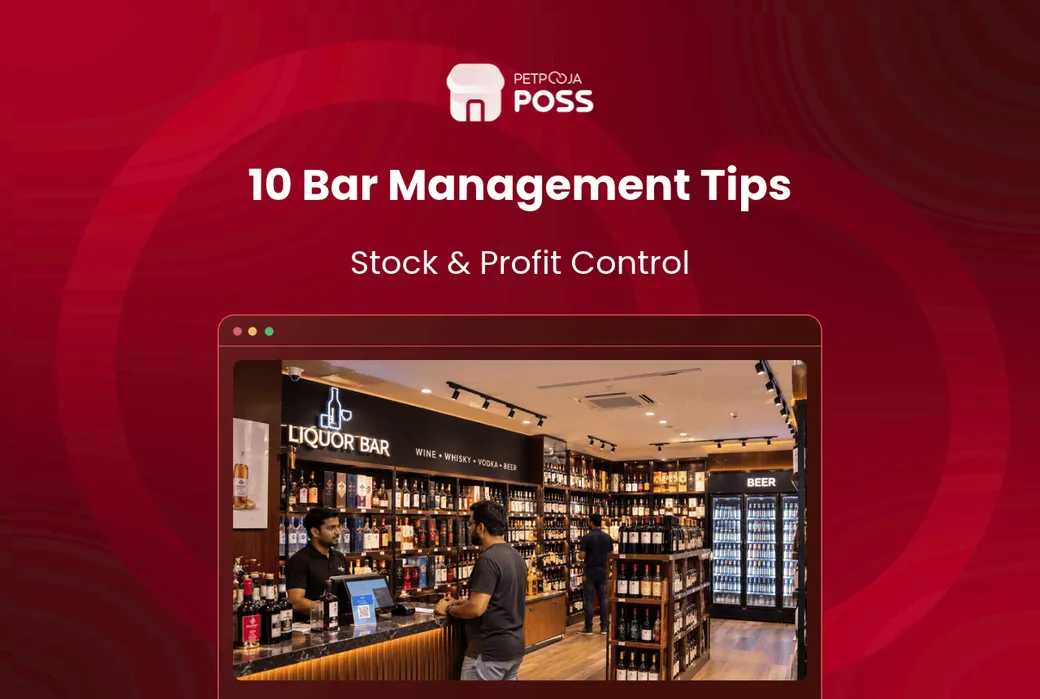



Good bar management starts with one habit.
You count what you pour, and you match it to what you billed.
Many bars lose money one peg at a time, through a free pour, an unbilled drink or a bottle marked as “broken”. None of it shows up until you count.
This guide gives you 10 bar management strategies, and about half of them close those leaks. The rest keep you stocked, compliant and earning more from every night you open. They are written for a bar, pub or restaurant with a liquor licence in India.
Key Takeaways
- Start by counting spirits by the peg, so a missing drink shows that night.
- Then cost every peg, set par levels and pour with stamped measures.
- Next, match the excise register to sales and keep bar and food on separate lines or bills.
- Then check stock variance weekly and push high-margin drinks.
- And fill slow nights with events and train staff to serve responsibly.
What Is Bar Management?
Bar management is running the stock, money, people and paperwork of a bar.
It covers four jobs:
- Stock: what you buy, store and pour.
- Money: what each drink costs and what it earns.
- People: who pours, who serves and how they are trained.
- The law: your licence, your registers and your measures.
Handle all four well, and you protect your margin.
Why Do Bars Lose Money Without Good Bar Management?
Liquor is usually the costliest stock a bar holds, so small losses add up fast. Each one looks small on the night, but a month of them is real money.
The fix is simple. Count often, compare the count with your sales, and act on the gap.
10 Bar Management Strategies That Work in India
These 10 bar management strategies are in the order most bars can set them up. Start with stock and cost, then the law, then losses, sales and staff.
1. Count Spirits by the Peg Every Night
Count your spirits in pegs, because that is how you sell them.
Counting in pegs lets you match your stock with your bills, drink by drink.
Count Spirits Daily and Everything Else Weekly
Count spirits in pegs at closing every night, and match the count to the night’s bills.
Beer, wine and mixers can wait for a weekly count, in bottles.
Count at the same time each day, so the numbers stay comparable. Ask someone other than the person who poured to do the count.
Measure Open Bottles in Tenths
Open bottles are where counts go wrong.
Look at each open bottle and note how full it is, in tenths. A bottle a little under three-quarters full counts as 0.7, which in a 750 ml bottle is about 17 small pegs.
Pour from the oldest open bottle first. It keeps your counts simple.
Our bar inventory guide goes deeper on counting methods.
2. Work Out the Cost of Every Peg
Work out the cost of every peg before you set its price.
Use the Pour Cost Formula
Pour cost tells you what share of a drink’s price goes on the liquor.
First, find the cost of one peg:
Cost per peg = bottle cost ÷ pegs in the bottle
A 750 ml bottle holds 25 pegs of 30 ml.
Then work out the pour cost:
Pour cost % = cost per peg ÷ selling price × 100
Say a 750 ml bottle costs you ₹1,500 (an example). Each 30 ml peg costs ₹60. If you sell that peg for ₹240, your pour cost is 25%.
Selling price of one 30 ml peg: ₹240 ₹60 ₹180 left per peg Liquor cost per peg (₹1,500 ÷ 25 pegs) What the peg earns before other costs Pour cost = ₹60 ÷ ₹240 = 25% (an example; use your own bottle cost) How one peg’s price splits into liquor cost and what is left, using an example bottle cost of ₹1,500.Use the selling price before tax. The “₹180 left” still has to pay for staff, rent, ice, mixers and glassware.
Compare Each Peg’s Cost With Its Price
Run the formula for every brand you stock.
Then look at the rupees each peg leaves after its cost, like the ₹180 in the example.
Rank your drinks by that figure. A premium peg with a higher pour cost can still leave more rupees.
The drinks at the top are the ones to push, which strategy 8 covers.
For the prices themselves, see our guide to setting liquor prices.
3. Set Par Levels So the Bar Never Runs Dry
A par level is the amount of each brand you keep in stock.
Set it from your usage. Count how many bottles of a brand you use in a normal week, then add a small buffer for busy nights.
Say a bar in Koramangala uses 12 bottles of a brand in a week (an example). It might keep 15 bottles.
At each weekly check, reorder enough to bring every brand back up to par.
Running out of a popular brand on a Saturday costs you sales. Holding too much ties up cash.
Par levels work with your stock counts. Your latest count tells you what is left, and the par tells you how much to order.
4. Pour Only With Stamped 30 ml and 60 ml Measures
Most Indian bars serve spirits by the peg: a 30 ml small peg and a 60 ml large peg.
Your peg measure decides how much liquor a guest gets for the price. So the law treats it as a measure used in trade.
The law expects those measures to be checked and stamped. A Telangana legal metrology office puts it simply: “Only verified and stamped weights and measures are used by the traders in all transactions.”
The rule comes from the Legal Metrology Act, 2009. Your state’s legal metrology office does the stamping.
Stamped measures help you too. Every peg is the same size, so your counts and your pour cost stay accurate.
5. Match the Excise Register to Your Sales Daily
Your licence comes with registers, and your excise inspector can ask to see them.
Delhi is one example. Rule 61 of Delhi’s excise rules, notified in October 2010, says the licensee shall keep a stock register, a daily sale register and an inspection book.
Other states set their own formats.
Match the register with your POS sales every day.
The register is your excise record of the stock that came in and went out. Your bills show what was paid for. If the two do not match, find out why the same day.
This is a paperwork check. The count in strategy 1 is the shelf check.
Our liquor licence guide covers the licence side.
6. Keep Bar and Food Separate, From Order to Bill
Keep drink and food orders apart, from the first ticket to the final bill, because liquor and food are taxed differently.
GST does not apply to liquor. The Central GST Act, section 9, leaves out “the supply of alcoholic liquor for human consumption”. Food on the same table carries GST, and your state taxes liquor under its own laws.
Start with the order. Send drink orders to the bar and food orders to the kitchen on separate order tickets. The bar sees only drinks, and the kitchen sees only food.
Then, for tax, keep liquor and food as separate lines with their own tax, or print a separate bill for each. Either way, your tax records stay clean, even when guests split a bill or run a tab.
7. Catch Liquor Losses Before They Grow
Strategy 1 compares your count with your bills each night. This weekly check looks at each brand across the whole week, so you can spot a gap that keeps growing.
Watch Your Stock Variance Every Week
Variance is the gap between what your count says you poured and what your bills say you sold.
Work it out every week, brand by brand.
Say a bar pours 25 pegs from a 750 ml bottle but bills only 22 (an example). Three pegs from that bottle are unaccounted for.
Pegs poured from one 750 ml bottle 25 pegs Pegs billed on the POS 22 pegs 3 3 pegs unaccounted for (an example) Variance in one bottle: 25 pegs poured against 22 billed leaves a gap of 3 pegs to explain.A peg or so per bottle can be normal spillage. A gap that stays above that, or grows week after week, needs a conversation with your bar team.
Spot the Three Common Ways Liquor Goes Missing
- Free pours: a bartender pours without a measure, so pegs run large. This is a common form of liquor pilferage.
- Unbilled pegs: a drink is served but never rung up.
- “Breakage”: a bottle is written off as broken, with no proof it broke.
Our guide to preventing bar liquor theft covers the warning signs and fixes. Our bar inventory reports post shows which reports reveal the gap.
A weekly check is faster when your POS already tracks pilferage. Our guide to bar POS for pilferage control explains what to look for.
8. Put High-Margin Drinks Where Eyes Land First
Use the ranking from strategy 2 to find the drinks that leave the most rupees per peg. Then make them easy to choose.
Put them at the top of each section on your bar menu. Give them a short, clear description.
Brief your staff too. When a guest asks what is good, your staff should suggest one of these drinks first.
Review the ranking every month, because bottle costs change. A drink at the top today may drop after a price rise from your supplier.
For layout ideas, read our bar menu tips.
9. Fill Slow Nights With Happy Hours and Events
Use your quiet hours for happy hours and events.
A happy hour on weekday evenings can bring in guests who might not come otherwise. A quiz night, a match screening or live music does the same on slow nights.
Check two things before you plan:
- Your state’s excise rules. Some states limit liquor discounts. Delhi’s rules, for example, say a licensee shall not give a “concession, rebate or discount” on the sale price of liquor (rule 53). So a happy hour there may need to focus on food or events.
- Dry days, when liquor sales stop or are restricted. Your state excise department announces the list, and what your bar may do on those days depends on your licence.
Our happy hour guide has ideas you can copy.
10. Hire for Attitude and Train for Responsible Service
Hire people with the right attitude, then train them on the skills.
In the interview, ask how they would handle a guest who wants a free drink. Then ask what they would do if their own friend asked for an extra-large peg. Their answer gives you a good idea of how they will behave behind the bar.
Train every new hire on three things:
- Pour with a measure, every time.
- Ring up every drink before it leaves the bar.
- Know when to stop serving a guest who has had too much.
See our guides to hiring the right bar staff and training your bar staff.
How Do You Manage a Bar Daily, Weekly and Monthly?
You manage a bar with a fixed routine of checks.
Here are the checks above, turned into a schedule:
| How often | Bar checks to run |
|---|---|
| Every night | Count spirits by the peg and match the count to the night’s bills. Match the excise register to the day’s sales. Check drinks and food were billed as separate lines or separate bills. |
| Every week | Count beer, wine and mixers. Work out stock variance by brand. Reorder anything below par. |
| Every month | Review pour cost for each brand. Update the bar menu. Plan happy hours and events around dry days. |
| Before the stamp runs out | Get your peg measures re-stamped. |
| As needed | Train new staff before their first shift. |
Stick to the routine. The checks only work if they happen every time.
Re-stamping is easy to miss. In Delhi, a peg measure’s stamp lasts one year, according to the legal metrology department. Ask your state office for its period.
How Does Petpooja Help With Bar Management?
Petpooja is restaurant management software that runs billing, inventory and reports for restaurants and bars across India.
Here is how its bar and brewery POS fits the strategies above:
- Liquor stock: it records liquor stock item by item and tracks consumption and pilferage, so your counts have something to match against.
- Separate counters: it bills the bar from one counter and food from another, with station-wise kitchen order tickets (KOTs), so orders do not overlap.
- Split bills and tabs: guests can split one common tab by percentage, price or proportion. They can also get separate bills for food and drinks.
- Happy-hour reports: it tracks the drinks sold and order-wise sales during happy hours.
- Waiter performance: it tracks how each staff member performs, so you know who to reward.
- Captain app: waiters take orders at the table on an Android phone, and its AI upsell suggests add-ons at the table, so staff can offer a second drink alongside the drinks you rank in strategy 8.
You can also ask its AI assistant, Ask Me Anything, plain questions such as “What were my top-selling items yesterday?”
What I could recommend from my end: set up the 30 ml and 60 ml pegs of each brand as separate items. Then you can check the item-wise sales report against your nightly peg count, counting each large peg as two small ones.
To see it on your own bar, book a free demo.
Which Free Templates Help You Manage a Bar?
Two free Petpooja templates cover the counting side of these strategies:
- Stock and inventory management template (Excel) for your nightly and weekly counts.
- Inventory audit checklist (PDF) for a periodic full stock audit.
Download the one you need first, and fill it in with your own brands.
Conclusion
Most of these 10 bar management strategies come back to one thing: counts.
Count by the peg and know what every peg costs. Then match your register to your sales and act on the gaps you find.
Do it on a fixed routine, and you will see where the leaks are. A bar POS that records liquor stock item by item gives those counts something to match against.
Frequently Asked Questions
What are the four parts of a bar?
A bar is usually described in three parts, with an optional fourth. The front bar is the counter where guests order. The back bar displays and stores bottles and glasses. The under bar is the bartender’s work area below the counter, with ice, mixers and tools. Many bars add a fourth part, the over bar: the rack above the counter where glasses hang.
What licences does a bar need in India?
A bar needs a liquor licence from the state excise department, plus the licences any restaurant needs, such as an FSSAI licence or registration, depending on your turnover. The type of liquor licence depends on your state and your format. Our free bar and microbrewery licence guide lists them.
How do I market my bar?
Start with what makes your bar different, such as a signature drink, live music or a match screening. Then promote it where your local guests look, like your Google Business Profile and Instagram. Our guide to bar marketing has more ideas.
Thanks. This helps us make the next article better.

Comments
Loading comments…