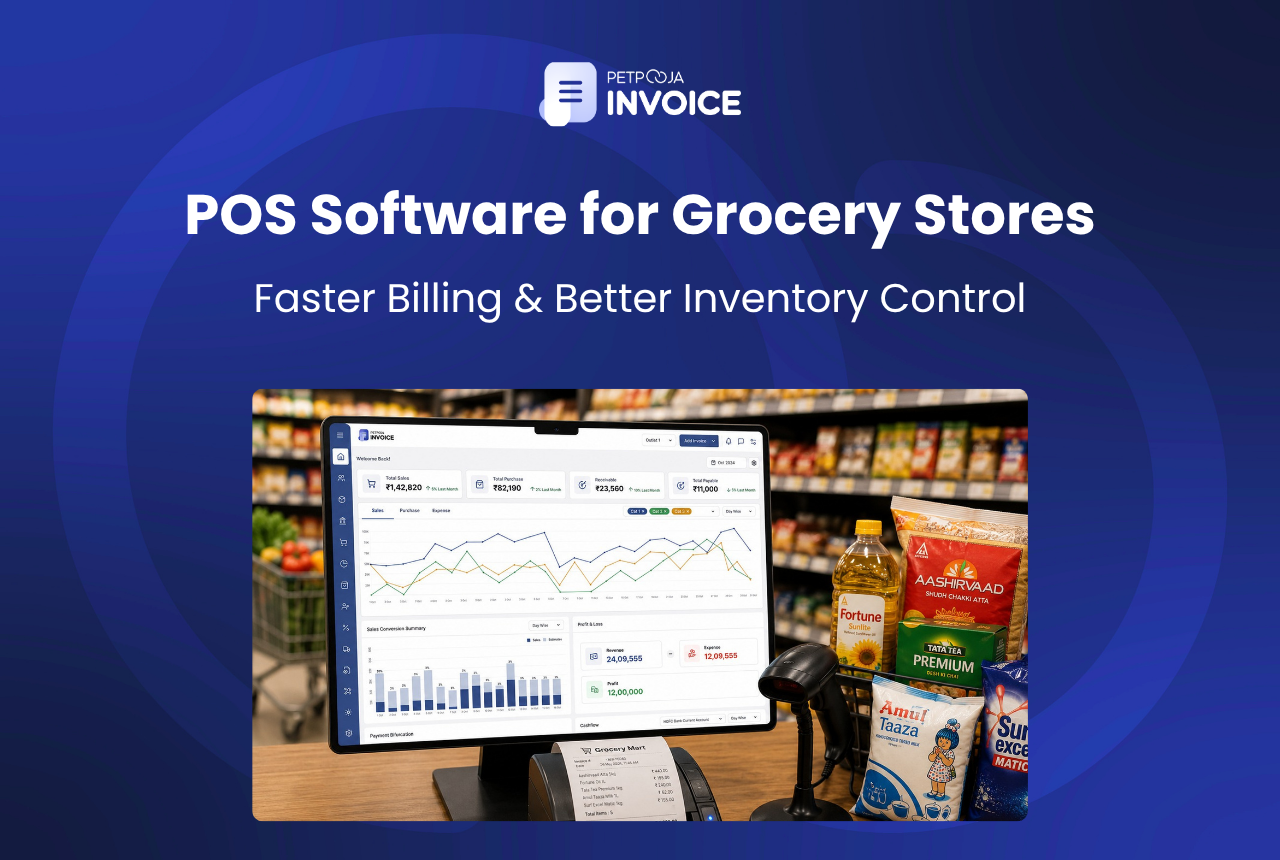
Petpooja Invoice, GoFrugal, and LOGIC ERP are the three strongest POS options for grocery stores in India right now. Each one handles barcode billing, real-time inventory, GST compliance, and expiry tracking, but they sit at different price points and target different store sizes. Petpooja Invoice runs on a flat annual fee with no per-counter charges. GoFrugal starts at ₹8,999/year and scales well for supermarket chains. LOGIC ERP suits stores that want an on-premise setup backed by 30+ years of grocery-specific development.
Which one fits depends on the store. A standalone kirana in Bopal stocking 800 items is not solving the same problem as a 4-outlet supermarket chain in Nagpur billing 400+ customers a day. India’s grocery market is projected to grow by USD 404.6 billion between 2025 and 2030 at a 9% CAGR (Technavio, 2025), and as more stores digitise, the POS they pick needs to understand grocery, not just retail.
Key Takeaways
- Petpooja Invoice, GoFrugal, and LOGIC ERP lead for grocery POS in India across different store sizes
- Expiry tracking and weighing scale integration are grocery-specific features most general POS tools skip
- Shrinkage costs Indian grocery retailers 1-3% of net sales annually (Patron Accounting)
- A grocery POS must handle barcode billing, real-time stock deduction, batch tracking, and GST filing
What Should a Grocery POS Do That a Cash Register Cannot?
A cash register prints receipts. That is about where its job ends. A grocery POS connects the billing counter to the stockroom, the purchase register, and the GST filing system in one loop.
Consider this example: a customer at a supermarket in Jaipur buys 2 kg basmati rice, 500 g toor dal, and a bottle of mustard oil. The POS scans each barcode, applies the correct GST slab per item, deducts stock in real time, and flags the rice if it is within 30 days of its best-before date. A cash register would have printed a total and moved on. By closing time, the store owner looking at the POS dashboard can tell which categories moved, which ones sat still, and what needs reordering before the weekend rush.
That gap between the two widens as transaction volume climbs. At 20 bills a day, a register holds up. At 80 bills across two counters with 1,500 SKUs and three GST slabs, the store needs software that tracks every unit sold, every batch received, and every invoice generated.
5 Best POS Software for Grocery Stores in India
The table below compares the five most relevant options based on features grocery and supermarket stores actually need. Pricing is from official vendor websites and aggregator listings as of May 2026.
| Software | Starting Price | Deployment | Grocery-Specific Strengths | Best For |
|---|---|---|---|---|
| Petpooja Invoice | Flat annual fee | Cloud | Barcode billing, inventory, e-invoice, Tally sync, multi-counter | Mid-size grocery and FMCG stores |
| GoFrugal | ₹8,999/year | Cloud + offline | Weighing scale integration, batch tracking, multi-store dashboard | Supermarket chains |
| LOGIC ERP | Custom pricing | On-premise + cloud | Expiry alerts, purchase management, warehouse module | Large grocery retailers |
| Marg ERP | ₹4,800-₹6,900/year | On-premise | Batch tracking, FMCG-specific HSN codes, distribution module | Pharma + grocery combo stores |
| RetailPOS | Custom pricing | Cloud | Multi-format retail, e-commerce integration, loyalty programmes | Hypermarkets and minimarts |
Pricing was correct at the time of writing. Vendors change their plans, so check the current pricing on each vendor’s own website before you decide.
Verify pricing directly with vendors before purchasing. GoFrugal pricing per aggregator listings; Marg ERP per IndiaMART.
Petpooja Invoice charges a flat annual fee regardless of counters or outlets. Across Petpooja’s 8,000+ retail clients, grocery stores that add a second or third billing counter during Diwali or festival weeks don’t get hit with per-counter surcharges. The software connects billing to inventory and pushes data into Tally without manual re-entry.
GoFrugal has built its name in the supermarket space. What sets it apart for grocery is the weighing scale integration. A provision store in Surat selling 200 grams of jeera or 1.5 kg moong dal needs the scale to talk to the billing screen directly. GoFrugal handles that without manual weight entry at the counter.
LOGIC ERP comes from a company with 30+ years in retail software. The on-premise deployment option appeals to grocery chains in tier-2 cities where internet reliability is patchy and the owner wants data sitting on a local server. Their warehouse module handles stock transfers between a central godown and individual store branches.
Marg ERP dominates pharma distribution but works well for FMCG and grocery too. Batch-wise tracking with HSN codes and expiry management is its core. Stores in smaller towns that double as a pharmacy and a grocery counter find this combination practical.
RetailPOS targets supermarkets and hypermarkets with integrated e-commerce and delivery modules. Stores that sell through quick-commerce platforms like Swiggy Instamart alongside their physical counters are the target audience here.
Why Grocery Billing Differs From General Retail
Most POS comparisons lump garment showrooms, electronics shops, and grocery stores into one category. They are not the same. Grocery stores carry three complications that general retail software often skips.
Perishability. A textile store’s unsold stock from March is still sellable in September. A grocery store’s unsold paneer or bread from Monday is waste by Wednesday. Batch-wise expiry tracking is not a bonus feature for grocery. It is the line between selling stock and writing it off. Shrinkage in organised Indian grocery retail runs 1 to 3 percent of net sales, and expired goods account for over a third of that loss.
Loose-item billing. Grocery stores sell dal, rice, spices, and sugar by weight, not by unit. The billing software must connect to a weighing scale so the weight feeds directly into the invoice line item. Without that link, counter staff type the weight manually, and rounding errors across 200 transactions a day add up to stock mismatches by month-end.
SKU density on thin margins. A grocery store in Indore carrying 2,000 SKUs sells most of them at 8 to 15 percent gross margin. At that margin, a 2 percent inventory discrepancy wipes out profit on those items entirely. Stores that ignore these leaks discover the damage at the year-end audit, if at all.
India still has over 12 million kirana stores, accounting for roughly 80% of FMCG sales in the country (Invest India). As these stores modernise, the gap between general retail POS and grocery-specific POS will only widen.
What to Check Before Signing Up
Four questions that filter out the wrong choice before a store signs a contract.
Does it handle barcode and weighing scale from the same screen? Some POS tools manage barcodes well but treat loose-item billing as a workaround. For a grocery store, both need to work natively. Test this during the demo with actual items, not sample data.
Can it track batches and flag expiry dates on its own? Software that treats all stock as one big pool, without distinguishing between batches received on different dates, gives a grocery store no way to enforce first-in-first-out. No FIFO means no expiry alerts, and that directly translates to spoilage losses. A detailed guide to POS software for retail shops covers this in more depth.
Is Tally integration included or billed separately? Most grocery store owners in India don’t file their own returns. The CA does. If the POS can not export data into a format Tally reads, someone in the store spends two to three days each month re-entering sales numbers by hand. That time cost is invisible but real.
What happens when the WiFi drops? Cloud POS tools that freeze during outages are a poor fit for grocery stores in tier-2 and tier-3 cities where connectivity is unreliable. The software should bill locally and sync when the connection comes back. Ask about offline billing mode before anything else.
Conclusion
Grocery stores in India need POS software that manages barcode scanning, loose-item weighing, batch tracking, and expiry alerts alongside GST invoicing. General retail tools miss at least one of those, and that gap surfaces as inventory loss, compliance delays, or billing bottlenecks during peak hours.
For grocery stores that need GST invoicing, inventory tracking, e-invoice generation, and Tally integration on a flat-rate subscription with no per-counter charges, Petpooja Invoice is built for that setup.
Frequently Asked Questions
Depends on counter count. A single-counter kirana with under 500 items and 30 daily bills fits Marg ERP or Vyapar in the ₹3,500 to ₹6,900 range. Past 1,000 SKUs or a second counter, Petpooja Invoice or GoFrugal handles the load without a per-counter price jump. This billing software comparison covers more options across price points.
GoFrugal and LOGIC ERP connect to standard weighing scales used in Indian grocery stores. The scale passes weight directly to the invoice line so staff skip manual entry. Not every vendor supports this, so confirm during the demo.
Yes. Most cloud POS tools bill locally during outages and sync once connectivity returns. No sales data gets lost.
₹4,800 to ₹33,000 per year. Marg ERP starts at ₹4,800. GoFrugal’s starter plan runs ₹8,999/year. Petpooja Invoice charges a flat annual fee regardless of counter count. For a full price breakdown, see the retail billing software comparison.
Grocery stores with more than 10 staff usually do, especially for PF/ESIC compliance and shift scheduling. The best payroll software for supermarkets guide covers options that pair well with grocery POS tools.