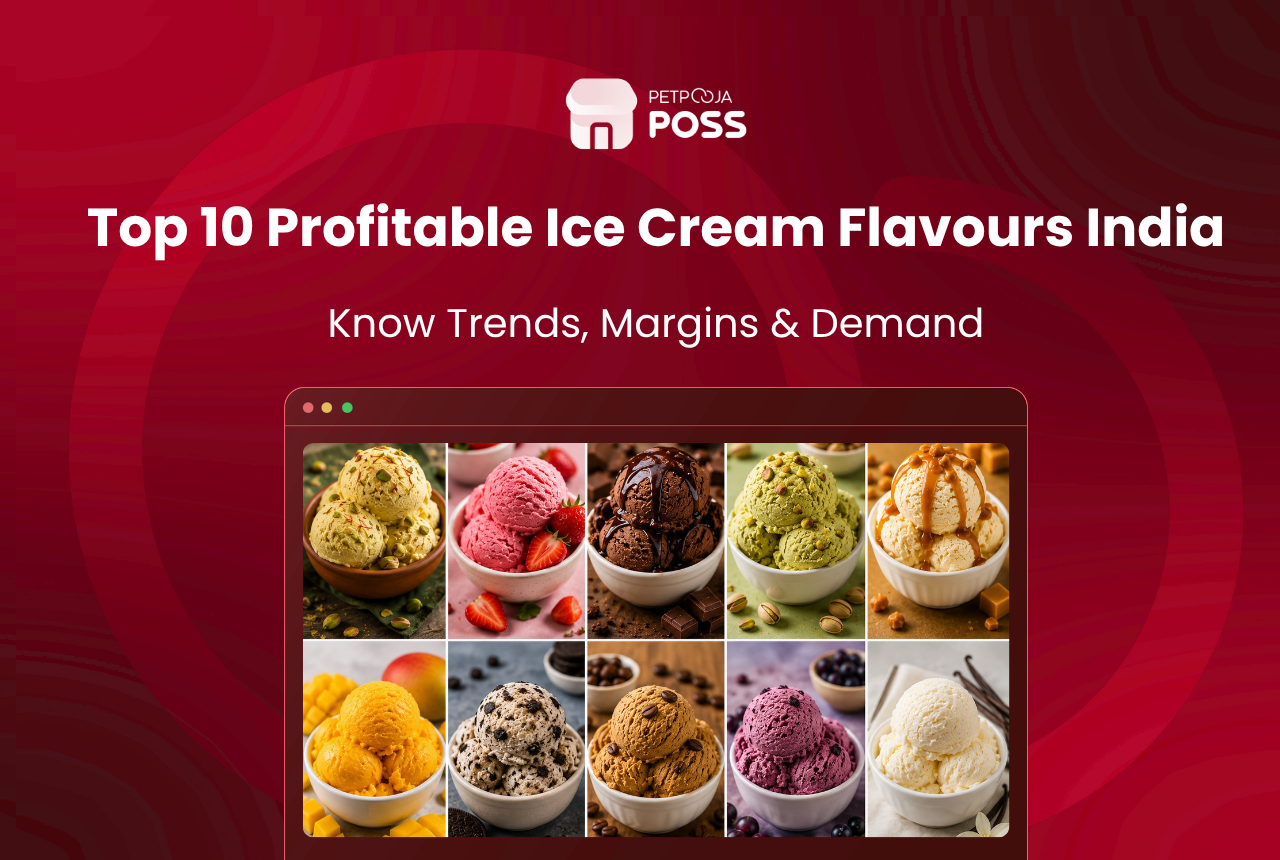
The most profitable ice cream flavours for Indian parlour owners are vanilla (28% of market revenue, lowest ingredient cost), chocolate variants (31% revenue share, 70% gross margin on premium variants), Alphonso mango (15-25% seasonal price premium), kesar pista (65%+ gross margin per scoop), and butterscotch (year-round sales with minimal wastage). Rounding out the top 10: paan, tender coconut, strawberry, malai kulfi, and kunafa.
Your flavour menu decides your profit margin more than your rent does. India’s ice cream market crossed INR 312.76 billion in 2025 (IMARC Group, 2025) and is expected to hit INR 1,192 billion by 2034 at 16.03% CAGR. The NRAI’s India Food Services Report projects ice cream parlours among the fastest-growing food service segments at 15% growth between 2024 and 2028 (Business Standard, 2024).
But that growth doesn’t spread equally across every flavour. Pick the wrong twelve for your cabinet and you’re staring at unsold tubs every Monday morning. Pick the right ten and your freezer empties before the weekend ends.
Key Takeaways
- Vanilla and chocolate together pull in nearly 60% of flavour revenue in India’s ice cream market
- Seasonal picks like Alphonso mango and tender coconut let you charge 15-25% more per scoop
- Kesar pista and paan deliver the fattest per-scoop margins among Indian-origin flavours
- Parlours tracking flavour-wise sales through POS reports stock smarter and waste less
1. Vanilla Outsells Everything Else in Your Freezer
Nobody photographs vanilla for Instagram. And still, it outsells everything.
The reason isn’t taste. It’s versatility. Vanilla goes into milkshakes, brownie plates, waffle combos, sundaes, and at least half the dessert pairings any parlour offers. One tub of vanilla empties before your third scoop of Belgian chocolate even gets ordered. At a parlour in Vastrapur, Ahmedabad doing 85 scoops a day, roughly 22-25 are vanilla or vanilla-based combos on an average Wednesday.
Vanilla accounts for roughly 28% of India’s total ice cream flavour revenue (MarkNtel Advisors, 2026), the second-largest segment after chocolate. Ingredient cost per scoop sits below ₹20 for most parlours. There’s no off-season dip, no wastage risk, and every “vanilla with hot fudge” order quietly converts a ₹60 scoop into a ₹140 dessert plate. Its low cost, zero seasonality, and role as a base for sundaes, shakes, and dessert combos make vanilla the single most important SKU in any Indian ice cream parlour.
2. Why Do Chocolate Variants Earn More Than Plain Chocolate?
Chocolate commands 31.05% of flavour revenue across India’s ice cream market (MarkNtel Advisors, 2026). But the real money isn’t in plain chocolate. It’s in what you can turn plain chocolate into without changing your base recipe.
| Variant | Price per scoop | Cost to make | What’s left |
|---|---|---|---|
| Plain chocolate | ₹70 | ₹22-28 | ~63% gross |
| Choco brownie fudge | ₹110 | ₹30-38 | ~68% gross |
| Dark chocolate truffle | ₹120 | ₹32-40 | ~70% gross |
| Belgian chocolate | ₹130 | ₹35-42 | ~70% gross |
Brownie chunks, cocoa nibs, a drizzle of ganache. Same freezer shelf, same base batch, but you’re billing 57-85% more per scoop. Plain chocolate scoops at ₹70 carry a 63% gross margin, while premium variants like Belgian chocolate at ₹130 push that to 70% using the same base recipe. Kwality Wall’s clearly spotted this gap when they launched the Dairy Factory slow-churned premium range in 2025 and led with chocolate variants. If a national brand is building a premium line around one flavour family, parlour owners should take note. Tracking which variant sells best at your shop requires item-wise POS data broken down by SKU.
3. What Makes Alphonso Mango a Seasonal Cash Machine?
Something strange happens in western and southern India when Alphonso season opens. Customers who’ve been ordering vanilla all winter suddenly won’t touch anything that isn’t mango. A shop near Pimpri in Pune or one on Linking Road, Mumbai can see Alphonso jump to 30-40% of daily sales during peak April.
Pricing shifts with it. A scoop at ₹100-120 in April gets zero pushback. Vanilla, sitting at ₹70 on the same menu board, suddenly looks like the budget option. Customers pay the premium because Alphonso feels scarce, limited, and worth bragging about on a group WhatsApp. Scarcity sells. Always has, always will. And with ice cream, a 15-25% price bump on a seasonal flavour meets zero resistance.
Naturals Ice Cream built their entire 145+ outlet chain on this single flavour. During peak summer months, Alphonso footfall alone covers their fixed costs at most locations. India’s organised ice cream segment holds 60-65% of the market (IBEF, 2025), and seasonal Alphonso is one of the flavours that keeps organised parlours ahead of local vendors during summer.
But timing matters more here than with any other flavour on this list. Over-order in February and you’ll be sitting on mango stock nobody wants by late June. Under-order in March and you’ve missed the biggest revenue window of the year.
4. Why Does Butterscotch Outsell Chocolate in Tier 2 Cities?
No food blogger has ever posted a reel about butterscotch ice cream. It doesn’t trend. It doesn’t go viral. And yet, when we pull POS sales data from ice cream parlours across Gujarat and Maharashtra at Petpooja, butterscotch consistently sits in the top 3 for year-round sales. Month after month, regardless of season.
Families drive those numbers. Walk into any parlour in Surat or Rajkot on a weekday evening and watch what happens when a parent orders for two or three kids. At least one of those orders is butterscotch. The crunchy bits, the mild sweetness, the familiar golden colour. Kids don’t need convincing.
Ingredient cost lands between vanilla and chocolate, but perception doesn’t follow the same order. Customers in Tier 2 and Tier 3 cities treat butterscotch as a notch above both. Parlours in Nagpur and Bhopal report it outsells chocolate during weekday family hours. Cheaper to make, perceived as equal in value. If you’re ignoring butterscotch in your top 5, your competitors in the next lane probably aren’t.
5. Why Does Kesar Pista Have the Fattest Margin Per Scoop?
Talk to a Naturals or Havmor outlet manager about which flavour has the fattest margin per scoop. Almost always, they’ll say kesar pista.
Saffron is expensive. Pistachio prices have been climbing for three years straight. Even so, kesar pista delivers a gross margin above 65% per scoop, priced at ₹100-130 against an ingredient cost of ₹35-45. Chocolate sits at 63%. Strawberry barely touches 58%. Kesar pista beats both without needing a special promotion or a trending reel.
North India alone holds roughly 35% of the country’s ice cream revenue (MarkNtel Advisors, 2026), and kesar pista over-indexes heavily in that region. Vadilal expanded its catalogue to over 150 varieties in November 2025, with kesar pista and Rajbhog leading the premium segment.
Culture plays a role here that’s easy to underestimate. In Gujarat, Rajasthan, and parts of Maharashtra, kesar pista isn’t just another flavour sitting in the cabinet. People order it during Diwali gatherings. Wedding season drives demand up. First-time visitors to a new parlour often pick it because it signals quality. Legacy brands like Vadilal don’t double down on a flavour unless the margin data justifies it.
6. How Does Tender Coconut Justify a ₹100+ Price Tag?
India’s per capita ice cream consumption grew from 400 ml in 2011 to 1.6 litres by 2023 (IBEF, 2025), and a growing slice of that consumption is health-positioned. Tender coconut benefits from this shift more than any other flavour on this list because it carries the “natural” label without needing to prove anything on a nutrition panel. It sells at ₹100-110 per scoop against a making cost of ₹30-40, and Naturals Ice Cream has added it as a permanent offering that now ranks among their top 5 across southern and western outlets.
These figures were correct at the time of writing. Confirm the current fees and investment with the franchisor’s own website before you commit.
What’s genuinely interesting about this flavour, though, is that it’s shedding its summer-only tag. Two years ago, parlours in Electronic City, Bangalore stocked tender coconut from March to July and then shelved it. Now? Repeat customers order it in November. If your cabinet has space for one “healthy-ish” option, tender coconut is the safest bet because it sells in winter too.
7. How Did Paan Ice Cream Become a Permanent Menu Item?
Back in 2020-2021, paan ice cream was what parlour owners added to get a reaction. Something different on the menu board. A conversation starter, nothing more.
Fast forward to 2026, and it’s a permanent fixture at mid-range and premium parlours across north India. Making it costs about the same as butterscotch. Selling it at a 20-30% premium over regular scoops is standard because no packaged brand (not Amul, not Kwality Wall’s, not Mother Dairy) offers a credible paan option in supermarkets. Your parlour has zero shelf competition on this one.
The impulse ice cream segment accounts for 60.59% of India’s total ice cream revenue (MarkNtel Advisors, 2026), and paan falls squarely into that impulse category. Delhi NCR, Lucknow, and Jaipur move 15-20 paan scoops daily at the ₹90-110 price point. Paan also has a behavioural trigger that other flavours lack: it doubles as a post-meal palate cleanser. Groups leaving a restaurant at 9:30 PM, with no intention of buying ice cream, stop for a paan scoop because it feels like a natural end to dinner. You didn’t market to them. They just walked in.
8. Why Do Parlour Owners Keep Stocking Strawberry?
Pink. That’s the real reason strawberry works.
A six-year-old points at the bright pink tub without reading a word. Parents don’t argue. Teenagers order it because it photographs well. And parlour owners keep stocking it because outside of mango season, strawberry carries the fruit-based segment, which holds 24.63% of India’s ice cream flavour revenue (MarkNtel Advisors, 2026).
Margin per scoop won’t match kesar pista or kunafa. But strawberry does something those premium flavours can’t: it moves reliably every single day without a promotion, a season, or a social media push. Pair it with waffle combos or pancake desserts and you’ve got a ₹180 order built around a ₹75 scoop. Dead stock risk is close to zero because demand barely fluctuates between January and December.
9. Malai Kulfi: ₹15 to Make, ₹55 to Sell
Technically not ice cream. But kulfi lives in that overlap between organised parlour and street-food tradition, and skipping it means leaving money on the counter. Walk into any parlour in India that doesn’t stock malai kulfi and you’ll notice.
The organised segment holds 60-65% of India’s frozen dessert market (Expert Market Research, 2026). Malai kulfi sticks, costing ₹15-20 to produce and selling at ₹50-60, deliver a 65-70% gross margin with zero portion guesswork since each unit comes pre-set in a mould. Near Chandni Chowk in Delhi or around Manek Chowk in Ahmedabad, kulfi outsells regular ice cream between 7 and 10 PM when the evening crowd peaks.
Pre-set moulds mean zero scooping waste, no half-empty tubs at closing time, and perfectly consistent portions every single time. Amul, Kwality Wall’s, and Mother Dairy have never managed to replicate the parlour kulfi experience in a supermarket pack, which means your local competition on this format is essentially other kulfi sellers on the same street. And then there’s nostalgia. Customers above 35 grew up buying kulfi from cycle-cart vendors near their school or colony gate. You don’t need to run ads for a product that already lives in someone’s childhood memory.
10. Kunafa Is Charging ₹130-160 Per Scoop While the Trend Lasts
Kunafa ice cream exploded across Indian cities in 2025. A handful of Dubai-inspired dessert shops in Bandra and Indiranagar started it. By early 2026, parlours in Indore, Coimbatore, and Bhopal had added it to their menus.
Middle Eastern kunafa pastry texture mixed with creamy ice cream, sweet syrup, and crushed nuts. Parlours pricing it at ₹130-160 per scoop report that this single SKU generates 10-15% of their daily revenue. One flavour, pulling more than a tenth of the day’s earnings. No other item on a typical 15-flavour menu does that.
But trend flavours carry a shelf life that classics don’t. Kunafa is still climbing in most Indian cities as of May 2026. The smart move: start with one tub. Check your daily POS report after the first week. Clearing 15-20 scoops a day? Order a second tub. Plateauing at 5-8 after two weeks? Keep it as a weekend special and redirect your budget to flavours with steadier demand. Overproducing a trend flavour is one of the fastest ways to turn a high-margin item into dead inventory.
How Should You Pick the Most Profitable Flavour Mix?
Listing every flavour you can make is not a menu strategy. What works in Salt Lake, Kolkata (more mango, more malai kulfi) will flop in Aundh, Pune (where butterscotch and Belgian chocolate move faster). Your cabinet should reflect what your specific customers buy, not what looks good on a printed menu card.
A split that works as a starting framework:
| Category | Flavours | Menu share | Role |
|---|---|---|---|
| Volume drivers | Vanilla, Chocolate, Butterscotch | 30-35% | Cover fixed costs, high turnover |
| Premium earners | Kesar Pista, Paan, Kunafa | 20-25% | Fat margin per scoop |
| Seasonal stars | Alphonso Mango, Tender Coconut, Sitaphal | 15-20% | Revenue spikes March-June |
| Broad appeal | Strawberry, Malai Kulfi, Cookies & Cream | 20-25% | Steady daily movement, low waste |
Knowing what to stock more of (and when to cut back) requires flavour-wise sales tracking. Petpooja POSS generates item-wise reports broken down by flavour, quantity sold, time of day, and average bill value. That data shows you when to ramp up Alphonso in March, scale back strawberry during monsoon, and whether your new Kunafa experiment deserves a reorder or a quiet retirement from the menu.
Across 1,00,000+ food businesses on Petpooja, we’ve seen parlours cut wastage by 12-18% in their first quarter after switching from gut-feel ordering to POS-driven restocking.
Conclusion
India’s ice cream market is growing above 16% a year. Parlour owners making the most from that growth aren’t the ones with the longest menus. They’re the ones who know exactly which flavours to stock heavily and which ones to scale back.
- Vanilla and chocolate are your rent payers. They cover fixed costs and move volume.
- Kesar pista, paan, and kunafa deliver the widest margin per scoop.
- Alphonso mango and tender coconut spike revenue during their seasons, but need careful stock control.
- Track flavour-wise sales daily and let the numbers drive your next production batch.
Frequently Asked Questions
Chocolate pulls 31.05% of total flavour revenue, with vanilla close behind at 28.42% (MarkNtel Advisors, 2026). Volume-wise, vanilla actually moves more scoops because parlours use it as a base for shakes, sundaes, and dessert combos.
Most parlours land between 60% and 70% gross margin per scoop. Sell a scoop at ₹80, and your ingredient and packaging cost is ₹25-35. Premium flavours like kesar pista widen that gap further because customers willingly pay ₹100+ without comparing it to vanilla.
Vanilla, chocolate, butterscotch, strawberry, and one regional pick like kesar pista or Alphonso mango. Stock those five first, track what sells for 30 days, and then add premium or trendy options based on what your specific location’s customers actually order.
A POS system with item-wise sales reports is the only reliable way. Pull flavour-wise revenue, subtract your per-scoop cost for each one, and rank by actual profit contribution. You’ll often find that your best-selling flavour isn’t your most profitable one.
Yes, but with guardrails. Alphonso mango and tender coconut let you charge 15-25% more per scoop compared to year-round options. Watch weekly sales data, scale up when demand climbs, and pull back the moment it dips. Overstocking seasonal flavours past their peak is how parlours end up with dead inventory.