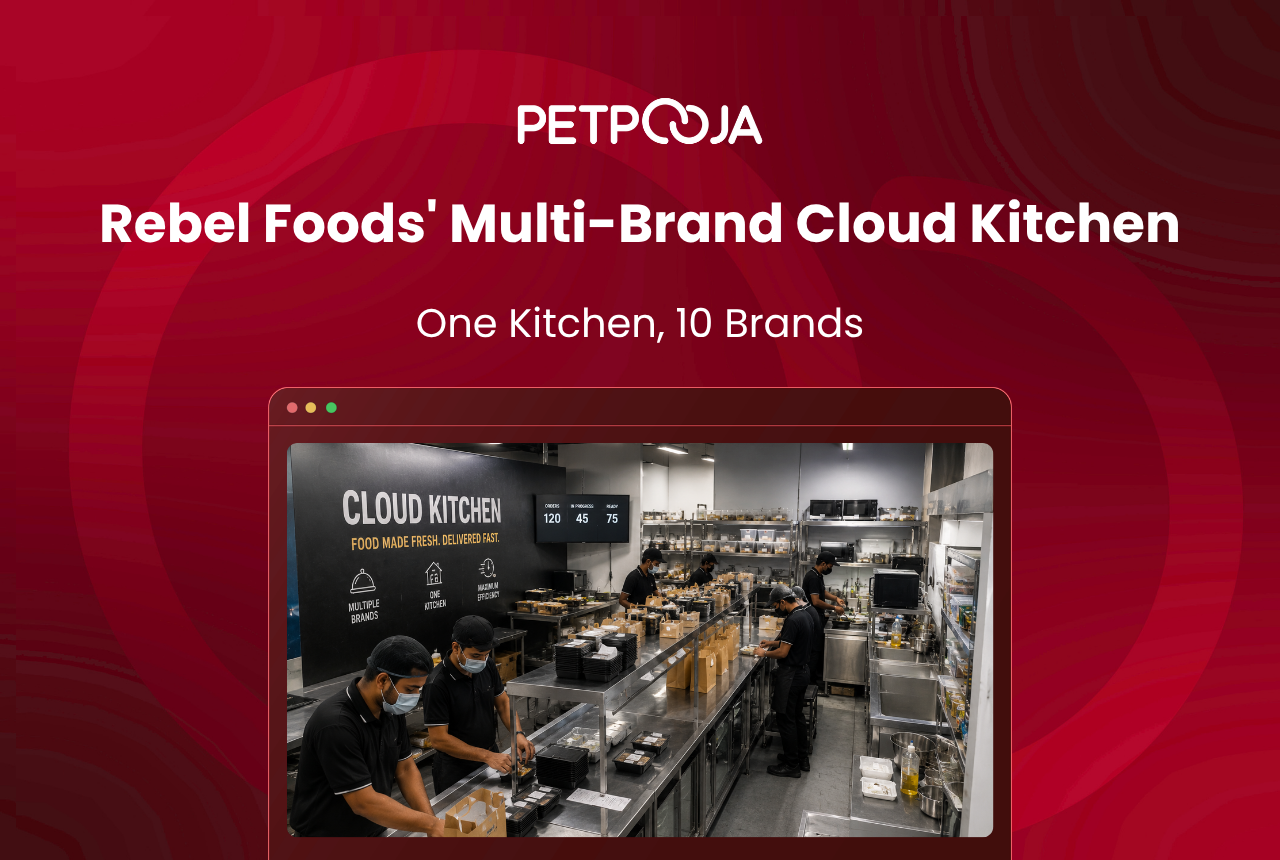
Most restaurant owners think of a kitchen as belonging to a restaurant. Rebel Foods flipped that. It treats the kitchen as a factory floor that many brands rent time on.
The company says it runs 450 kitchens across 75 cities in three countries, and that those kitchens produce about 4,000 internet restaurants, per its own site. Divide one by the other and each kitchen is carrying roughly nine brand storefronts on average.
This piece covers how that actually works, what the FY25 accounts say about it, and which parts a smaller cloud kitchen can borrow.
Key Takeaways
- Rebel Foods runs 450 kitchens in 75 cities, producing around 4,000 internet restaurants.
- Co-founder Ankush Grover became global chief executive in July 2025.
- Its own brands number 25+, including Faasos and Behrouz Biryani.
- FY25 revenue was ₹1,617 crore, up 14%, with losses down 12% to ₹336 crore.
- Cost per rupee of revenue improved from ₹1.31 to ₹1.23.
What Rebel Foods Actually Runs
Rebel Foods started life as Faasos, a wraps brand. Ankush Grover joined in 2012 and became a co-founder of what the business grew into.
The table below sets out the figures the company and its filings put on record.
| Rebel Foods at a Glance | What Is On Record |
|---|---|
| Kitchens | 450 |
| Cities | 75 |
| Countries | 3 |
| Internet restaurants | About 4,000 |
| Own brands | 25+ |
| FY25 revenue from operations | ₹1,617 crore |
| FY24 revenue from operations | ₹1,420 crore |
| FY25 loss | ₹336 crore, down about 12% |
| Cost per rupee of revenue | ₹1.23 in FY25, from ₹1.31 in FY24 |
Two numbers deserve attention. Revenue grew 14% while the loss shrank, which is the harder combination to pull off. And the cost per rupee earned fell by eight paise, which on this revenue base is the difference between a slow bleed and a business that eventually works.
How One Kitchen Runs Many Brands
The idea is simpler than it sounds. A biryani brand, a pizza brand and a wraps brand do not each need their own rent, their own manager or their own delivery rider queue.
What they need is the same kitchen running different recipes at different moments of the day. Rebel calls this one kitchen, multiple brands, and it is the reason the company can list far more storefronts than physical sites.
An internet restaurant is Rebel’s term for one brand operating out of one kitchen. The same kitchen serving four brands counts as four internet restaurants, which is how 450 sites produce roughly 4,000 of them.
Why the Maths Works
The commercial logic sits in the fixed costs. Rent, electricity and the core kitchen team are paid once, then divided across every brand operating from that address.
There is a second benefit that owners underrate. A wraps brand peaks at lunch and a dessert brand peaks late at night, so stacking them smooths out the quiet hours a single-brand kitchen simply loses.
Why It Also Changes Brand Testing
Opening a restaurant to try a cuisine costs lakhs and takes months. Adding a storefront to a kitchen that already runs costs a menu, a listing and some packaging.
That is why Rebel carries more than 25 of its own brands. Some were built to work, and some were built to find out whether they would.
Rebel OS: The System Behind the Cloud Kitchen Playbook
None of that survives contact with reality without a system. Rebel built one in-house and calls it Rebel OS. It rests on three parts.
- A Culinary Innovation Centre. This turns complicated dishes into steps an ordinary kitchen hand can repeat. Biryani is the standing example, because it is the dish most likely to differ from cook to cook.
- A shared supply chain. One procurement and stocking operation feeds the whole network, which is what lets a regional dish launch across many cities at once rather than one kitchen at a time.
- A tech stack that runs the floor. Orders, inventory and fulfilment sit in one system, so a kitchen taking orders from nine storefronts is not juggling nine separate screens.
The third part is the one small operators feel first. Our guide on POS for multiple brands covers the same problem at a smaller scale.
Deskilling Is the Part Most Owners Skip
Rebel has also rented the system out to other companies. When it partnered with Wendy’s, the chain went from a handful of Indian locations to around 90 inside a year. That says more about the operating system than about the burgers.
The deskilling part deserves a second look, because it is the piece most owners skip. If a dish only tastes right when your best cook is on shift, it cannot travel to a second kitchen. Writing the recipe down as timed steps is unglamorous work, and it is what makes everything after it possible.
What the FY25 Numbers Say About the Cloud Kitchen Model
Scale alone proves nothing. The accounts are where a model is tested.
Revenue from operations reached ₹1,617 crore in FY25, up 14% from ₹1,420 crore, while the loss narrowed to ₹336 crore, according to its filings.
Look at the brokerage and commission line. At ₹243 crore it sits close to the entire employee bill, which is the plainest evidence that aggregator economics shape this business as much as cooking does. Owners can measure their own version of that with a delivery commission calculator.
Where the Model Gets Hard for Everyone Else
The playbook reads cleanly. Copying it is another matter, and most attempts fail at the same three points.
Menus that share nothing. If your biryani brand and your pizza brand have no common ingredients, you have not built one kitchen with two brands. You have built two kitchens sharing a rent bill. Stock doubles, waste doubles, and the saving you expected never arrives.
Kitchen sequencing. Nine storefronts sending orders into one pass will collide unless something decides the order of work. This is where a kitchen display system stops being optional. Without one, the newest brand usually gets served last, which is the brand least able to survive bad reviews.
Blended reporting. When every brand lands in one profit figure, a loss-making brand hides inside a profitable one for months. Our piece on why cloud kitchens lose money covers how that plays out.
The Trap That Is Easiest to Miss
Each new brand carries its own commission rate, its own discount schemes and its own packaging. Two brands on the same aggregator can return very different money on the same order value, and an owner who never separates them will not notice for a year.
What a Smaller Cloud Kitchen Can Copy
You do not need 450 kitchens to use the logic. Four parts of it scale down.
- Start from shared ingredients, not from brand ideas. Pick your second brand because it uses the rice, gravy base or dough you already stock. The overlap is the whole point.
- Consider a small example. A kitchen in Wakad runs a North Indian brand at lunch, then adds a dessert brand for the 9pm to midnight window. Rent and the head cook are already paid. The dessert brand only has to cover ingredients and packaging. This scenario is an illustration, not a real business.
- Read profit per brand, not per kitchen. One combined number will hide your worst performer. Outlet management reporting is what separates the two.
- Fix sequencing before adding brand number three. Two brands can be managed by memory on a slow day. Three cannot, and the failure shows up as late orders rather than as a spreadsheet problem.
Where the System Fits
For an operator running two or three brands from one address, the practical version of Rebel OS is a single system holding online orders, stock and per-brand reporting. Petpooja POSS does that job for over 1,00,000 restaurants.
If you are still at the planning stage, our guide to starting a profitable cloud kitchen covers the setup decisions that come before any of this.
Where to Hear Ankush Grover Speak
Grover became global chief executive of Rebel Foods in July 2025, after leading the India business from 2023. Co-founder Jaydeep Barman moved to chairman and group chief executive, as YourStory reported.
He is listed on the line-up for the NRAI Food Delivery Summit 2026, on Thursday 20 August 2026 at The Forum Hotel & Convention in Shela, Ahmedabad. Our summit speaker planner groups the announced names by business problem, and the venue and registration guide covers passes and travel.
Conclusion
Rebel Foods did not win by inventing better food. It won by treating a kitchen as an asset to be filled, rather than a room attached to one brand. Then it built the systems that let it be filled safely.
The company is still loss-making, so this is not a finished story. But the direction in FY25 was right, and the cost per rupee earned is moving the way it needs to.
For a smaller kitchen the lesson is narrower and more useful. Add the brand that shares your ingredients, then make sure you can see what each one earns. Petpooja POSS brings online orders, inventory and per-brand reporting into one screen, alongside multi-outlet management.
Frequently Asked Questions
Rebel Foods states 450 kitchens across 75 cities in three countries, producing about 4,000 internet restaurants. Its own brands number more than 25, including Faasos, Behrouz Biryani, Oven Story Pizza and Mandarin Oak.
It is the operating system Rebel built to run a multi-brand kitchen. Three parts hold it up: a Culinary Innovation Centre that makes complex recipes repeatable, a shared supply chain across the network, and a tech stack covering orders, inventory and fulfilment.
Not yet. FY25 revenue from operations was ₹1,617 crore against ₹1,420 crore in FY24, with a loss of ₹336 crore. The loss narrowed by about 12% and cost per rupee of revenue improved from ₹1.31 to ₹1.23.
Yes, and many already do. The limit is rarely brand count. It is whether the menus share ingredients, whether orders from multiple storefronts can be sequenced, and whether you can read profit per brand. Tracking kitchen success metrics shows which of the three is failing.
A co-founder of Rebel Foods and its global chief executive since July 2025, having led the India business from 2023. He joined in 2012, when the company was still Faasos, and is listed as a speaker at the NRAI Food Delivery Summit 2026.