


When you want to order food from a restaurant, what do you do? Open a delivery app, or order from the restaurant directly? Before the introduction of online food aggregators, when people wanted to order food delivery, they just called the restaurant. Now, it isn’t easy to imagine a world of online ordering without these apps.
In a world with an increasing number of customers ordering food online, restaurateurs are constantly struggling to finalise the online delivery model that works for them. Aggregators offer publicity and access to a ready customer base, while your own app or website keeps the customer relationship with you.
Not sure which route is better for you? Don’t worry; we are here to help you! This blog covers the advantages and disadvantages of both models.
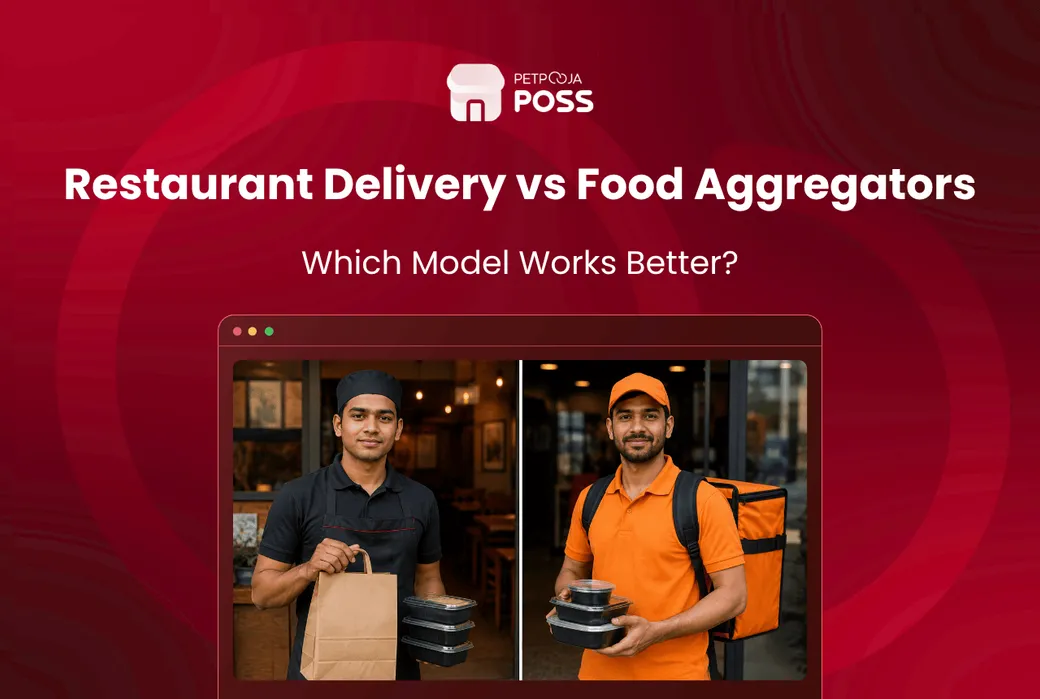
 Every delivery order reaches the customer through one of two routes: a third-party aggregator, or a fleet the restaurant runs itself.
Food Delivery By Aggregators
Food Aggregators are dominating the market share in online food delivery. Customers place an order on these platforms, which then pass it through to your kitchen. As more and more restaurants are opening up, the size of these aggregators is expanding even further. New restaurants register themselves with food aggregators to get easy access to customers.
The registration process with these apps doesn’t take much time if you have all the required documents ready. If you plan to list on more than one, our guide to managing multiple delivery partners covers what changes once you do.
Advantages
- Easy Entry Into the Market: When you integrate your online delivery services with a third-party aggregator, you get access to an existing customer base. You become visible to all the customers who use these apps to order restaurant delivery. You simply need to follow the registration process instead of investing the time and labour required in building your website/app.
- Direct Visibility: As the food aggregators have access to a large customer base, you directly get visibility into that market by integrating with them. You can also invest in running pay-per-click ads on these platforms and area-based marketing. These platforms can give you access to a massive customer base if used well. In contrast, your restaurant delivery fleet will take a long time to develop a loyal customer base.
- Organised Delivery: Food aggregators already have an organised delivery service with user-friendly platforms and delivery agents. Using them saves you the time and labour of setting up one of your own and managing it.
Disadvantages
- Commission on Every Order: The reach and the delivery fleet are not free. Every order placed through an aggregator carries a commission, and the rate that applies to you sits in the partner agreement you sign. Work the figure out on your own contract before you compare the two models, because it is the only rate that describes your business.
- The Customer Relationship Sits Elsewhere: In this model the order arrives through the platform, so the ongoing relationship with that customer is held there rather than by you. Building your own repeat-order list is harder when the channel in between owns the introduction.
- Customer Experience: A considerable chunk of shaping a restaurant delivery experience for a customer is the time it takes for the food to be delivered and the quality of the food when it reaches the customer’s doorstep. In this model those final steps happen outside your kitchen, so part of the impression your brand makes is shaped beyond your own control.
 Keeping the online ordering process entirely in-house, however, would mean that you have to manage the website, payments, and deliveries, all on your own, making you entirely responsible for the customer experience.
Restaurant’s Own Delivery Fleet
To set up your restaurant delivery fleet, you can design a website or app that takes customers’ online orders. Your website allows you to take orders directly from customers as they come, keeping the process entirely in-house.
Advantages
- Customer Experience: Unlike integrating with food aggregators, running your website gives you complete control over the customer experience. You will directly contact the customers, managing their requests and complaints. You control the customer experience and access the entire customer data required to improve your services and marketing.
- Exclusive Choice: Customers spend a long time browsing dozens of restaurants on a delivery app before deciding where to order from. On the other hand, when they use your website, you are their only choice. Take the example of McDonald’s and Domino’s, whose delivery apps are popular amongst the masses.
- Long-Term Benefits: An aggregator order carries a commission; a direct order carries your payment gateway charge and whatever the delivery itself costs you. Run both against your own numbers, because which one leaves more on the table depends on your volume and your delivery distances. The customer data that comes with a direct order is the other half of the calculation.
Disadvantages
- Costs and Investment: In the case of food aggregators, you only need to register yourself with them, while for your website, you need to put in a hefty cost, time and labour investment. Building your delivery fleet is capital intensive and is not viable for small restaurants and cloud kitchens.
- Responsibility & Accountability: With your delivery platform, you are responsible and accountable for the entire customer experience. You and you alone need to ensure a smooth app experience, resolve consumer complaints, and timely and proper deliveries.
Given the above advantages and disadvantages of both the options, it is ultimately the restaurant’s call to decide how they want to carry out their food deliveries. We hope this blog helps you make that decision!
Your restaurant website for managing food delivery may sound overwhelming. But worry not, Petpooja’s POS is there for you! With the help of this POS, you can toggle menu items on and off when ingredients run out, update your menu in one place, and integrate with all the major online order aggregators.
Don’t forget to subscribe to our newsletter and follow us on Instagram for regular restaurant-related updates!
Thanks. This helps us make the next article better.