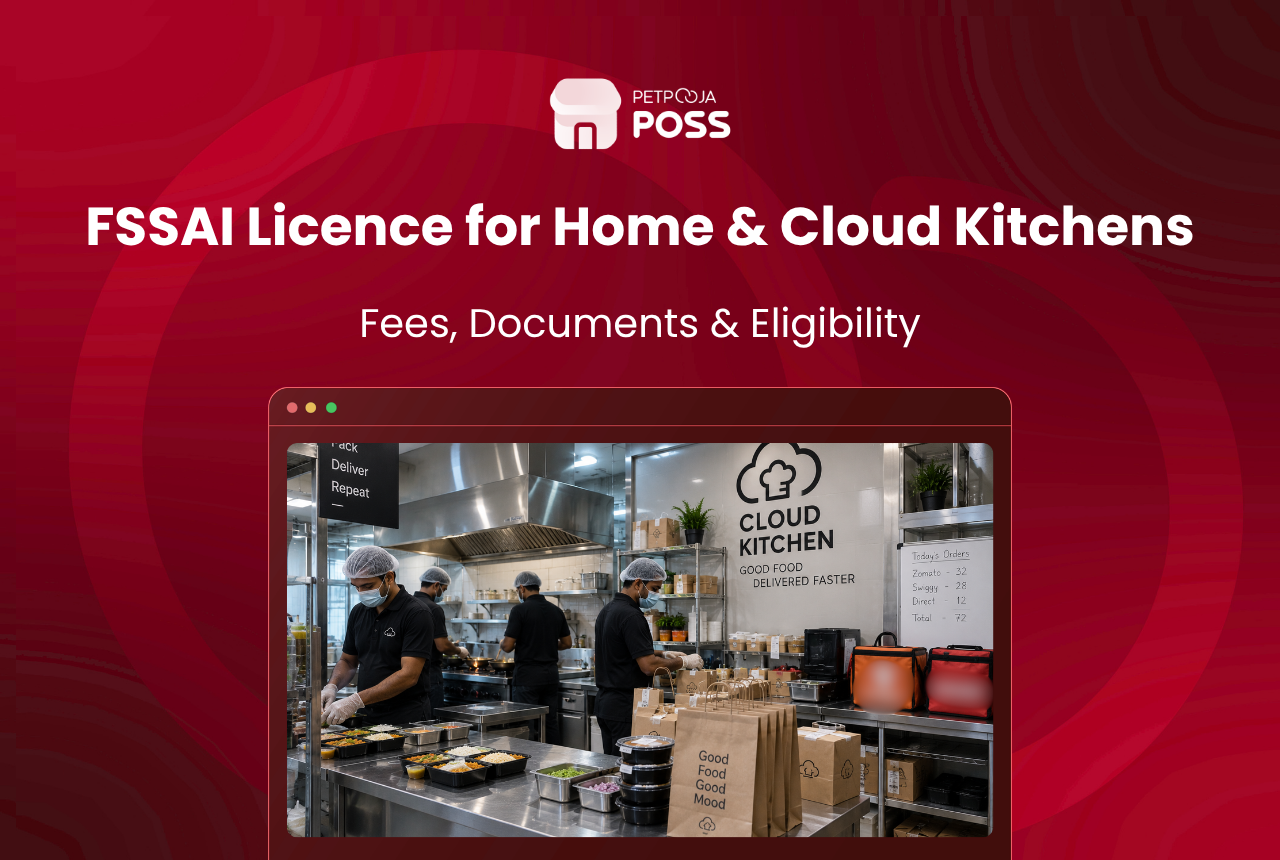
A home kitchen or cloud kitchen turning over up to ₹1.5 crore a year needs FSSAI Registration, not a licence. It costs ₹100 a year. Cross ₹1.5 crore and it becomes a State Licence at ₹5,000 a year.
That single threshold decides almost everything else: the form you file, the documents you gather, and how long approval takes. It changed on 1 April 2026, when the registration ceiling moved up from ₹12 lakh.
There is one trap in the tiers, and it catches people who describe themselves loosely. Call your business catering rather than a kitchen and the cheap tier disappears. This guide covers which tier applies, what it costs, the six documents to keep ready, and the timeline.
Key Takeaways
- Up to ₹1.5 crore turnover: Registration at ₹100 a year, not a licence
- ₹1.5 crore to ₹50 crore: State Licence at ₹5,000 a year
- Caterers have no registration tier and start at State Licence
- FSSAI has no separate cloud kitchen category; a delivery-only kitchen is a restaurant
- Licences no longer expire, but the fee is still charged per year
Which FSSAI Tier Does a Home or Cloud Kitchen Need?
FSSAI sets eligibility by Kind of Business and annual turnover. Its Kind of Business eligibility list, updated 1 April 2026, is the document that decides your tier.
Here is how the categories a home or cloud kitchen falls into actually read.
| Kind of business | Up to ₹1.5 crore | ₹1.5 crore to ₹50 crore | Above ₹50 crore |
|---|---|---|---|
| Restaurants, including delivery-only kitchens | Registration, ₹100 | State Licence, ₹5,000 | Central Licence, ₹7,500 |
| Home Based Canteens and Dabba Wallas | Registration, ₹100 | State Licence, ₹5,000 | Not stated separately |
| Caterer | State Licence, ₹5,000 | State Licence, ₹5,000 | Central Licence, ₹7,500 |
| Club or canteen | Registration, ₹100 | State Licence, ₹5,000 | Not stated separately |
For the two rows marked “not stated separately”, the list gives one threshold only, at ₹1.5 crore, with a State Licence above it. Past ₹50 crore on either, ask your licensing authority rather than reading a tier across from the restaurant row.
The Caterer Row Is the One to Check
Read the caterer row again. A caterer has no registration tier at all, so a small operator who registers as a caterer pays ₹5,000 a year where a home-based dabba service pays ₹100.
The difference is what you do, not what you call yourself. FSSAI defines a caterer as preparing and serving food for a group at a venue for a ceremony or celebration.
A dabba service distributing packed meals is a different category with a different fee, so describe the work accurately on the form.
What Changed on 1 April 2026
If you read a guide written before this year, its numbers are wrong. The old regulations set the petty food business ceiling at ₹12 lakh of annual turnover, which put most small kitchens straight into a State Licence.
The revised eligibility list moved that ceiling to ₹1.5 crore. A kitchen doing ₹40 lakh a year that would have paid ₹5,000 under the old rules now pays ₹100.
Licences also stopped expiring at the same time, so the old renewal cycle no longer applies.
FSSAI reports 74.33 lakh active licences and registrations under the Act. The direction of these changes is to pull small operators into that count rather than leave them outside it.
Why There Is No Separate Cloud Kitchen Category
Search the FSSAI eligibility list for the words cloud kitchen and you will not find them. The term does not appear anywhere in the document.
That is not an oversight. FSSAI’s definition of a restaurant covers you already: a food service operation where “many restaurants also offer take-out and food delivery services, and some offer only take-out and delivery”.
A delivery-only kitchen is therefore a restaurant for licensing purposes. Apply on that row, not under a category you have invented to describe the model.
A kitchen inside a shared facility follows the same logic. Sharing premises does not change your Kind of Business, though it does change the paperwork you need for the address.
What Does It Cost?
Registration is ₹100 a year. A State Licence is ₹5,000 a year for the categories above, and a Central Licence ₹7,500.
Two things surprise people. The first is that these are annual figures even though licences no longer expire. FSSAI confirmed the shift to perpetual validity, which removed the renewal application, not the yearly fee.
The second is that the fee varies by Kind of Business, not by kitchen size. Our FSSAI fee breakdown sets out every figure by category if yours is not in the table above.
Street food vendors and hawkers are a separate case. The same announcement confirms they are exempt from the registration fee entirely and can obtain a five-year certificate free of charge.
6 Documents a Home or Cloud Kitchen Needs
At the registration tier the list is short. The regulations name two of these directly and FoSCoS asks for the rest when you fill the form in.
- Form A, completed and signed. This is the registration application named in the regulations.
- A self-attested declaration confirming you follow the basic hygiene and safety requirements in Part I of Schedule 4. The format sits in Annexure-1 of Schedule 2.
- Government photo identity and address proof for the proprietor, partners or directors.
- A passport-size photograph of the applicant.
- Proof that you occupy the premises, such as a rent agreement, ownership document or electricity bill.
- A constitution document where the business is not a proprietorship, meaning a partnership deed or certificate of incorporation.
Why Premises Proof Is the Hard One
Number 5 is where home and cloud kitchens differ from a restaurant. Among the kitchens we set up, the address on the FSSAI certificate and the address the kitchen actually trades from do not always match, which usually traces back to premises paperwork done in a hurry.
If you cook from a rented flat, the tenancy has to permit it, and most landlords want to be asked.
A shared facility adds a step. Your address on the application is the facility’s, so you need the operator’s consent letter naming your business, and you need it before you file.
As an example, a two-brand kitchen renting a bay in a shared facility in Kharadi, Pune files one registration for the address it cooks from, not one per brand. The brands are trading names; the licence attaches to the premises and the operator.
A State Licence asks for considerably more, including a layout plan with dimensions, an equipment list with installed capacity, and a water analysis report where water is used as an ingredient. The full list sits in the FSSAI licensing regulations.
How Long Does Registration Take?
The regulations put a clock on the authority, which is worth knowing before you chase anyone.
Once you file, the registering authority has 7 days to grant registration, reject it with written reasons, or order an inspection. Where an inspection is ordered, registration follows within 30 days if the premises satisfies the Part I Schedule 4 hygiene requirements.
There is a provision most operators never hear about. If no decision reaches you within those timelines, you may begin trading, though you remain bound to carry out any improvement the authority asks for later.
That is not a licence to skip standards. An inspection can still follow, and our restaurant pre-inspection checklist covers what an officer looks at when they arrive.
Our review of food safety drives sets out the failures that come up most often on these visits.
What Else a Kitchen Needs Alongside FSSAI
FSSAI is one of several approvals, and the others depend on your premises rather than your turnover.
A kitchen operating from commercial premises usually needs a health and trade licence from the municipal body, shop and establishment registration, and GST once you cross the turnover limit. A fire NOC applies where the premises calls for one. Our cloud kitchen licences guide sets out all five.
Once the certificate is issued, the number has to appear where customers can see it. Our FSSAI logo rules guide covers packaging and menus, and you can download the certificate from FoSCoS once it comes through.
Billing matters here too, because the turnover figure that sets your tier has to come from somewhere defensible. A cloud kitchen POS that records every order across delivery apps and direct channels gives you one number to quote rather than three partial ones.
Conclusion
For most home and cloud kitchens the answer is simpler than it looks. Under ₹1.5 crore you need Registration, it costs ₹100 a year, and six documents cover it.
Two things are worth getting right at the start. Pick the Kind of Business that matches what you actually do, because the caterer category costs fifty times more at small scale.
Then sort the premises proof early. A tenancy that does not permit cooking, or a facility that will not issue a consent letter, stops the application dead.
The rest is process. Applications go through the FoSCoS portal, and our FoSCoS walkthrough covers the screens.
A POS built for cloud kitchens keeps the sales record your turnover declaration rests on.
Frequently Asked Questions
Yes, with FSSAI registration. A home-based operator turning over up to ₹1.5 crore falls in the registration tier at ₹100 a year. The practical constraint is usually the premises rather than the food licence, because your tenancy or society rules have to permit commercial cooking.
No. FSSAI has no cloud kitchen category. Its definition of a restaurant already covers operations that offer only take-out and delivery, so a delivery-only kitchen applies on the restaurant row at the same thresholds as any other food service business.
You move to the State Licence tier. Apply for the licence rather than continuing on registration, because the tier is set by annual turnover and trading above it on a registration leaves you operating outside the terms you were granted.
No. Perpetual validity removed the renewal application, so a licence now runs until it is suspended, cancelled or surrendered. The annual fee still applies. You can verify any licence and its status on the public search.
₹100 a year while turnover stays under ₹1.5 crore, since that is registration rather than a licence. Above that it is ₹5,000 a year for a State Licence. Neither figure depends on how large the kitchen is or how many brands you run from it.