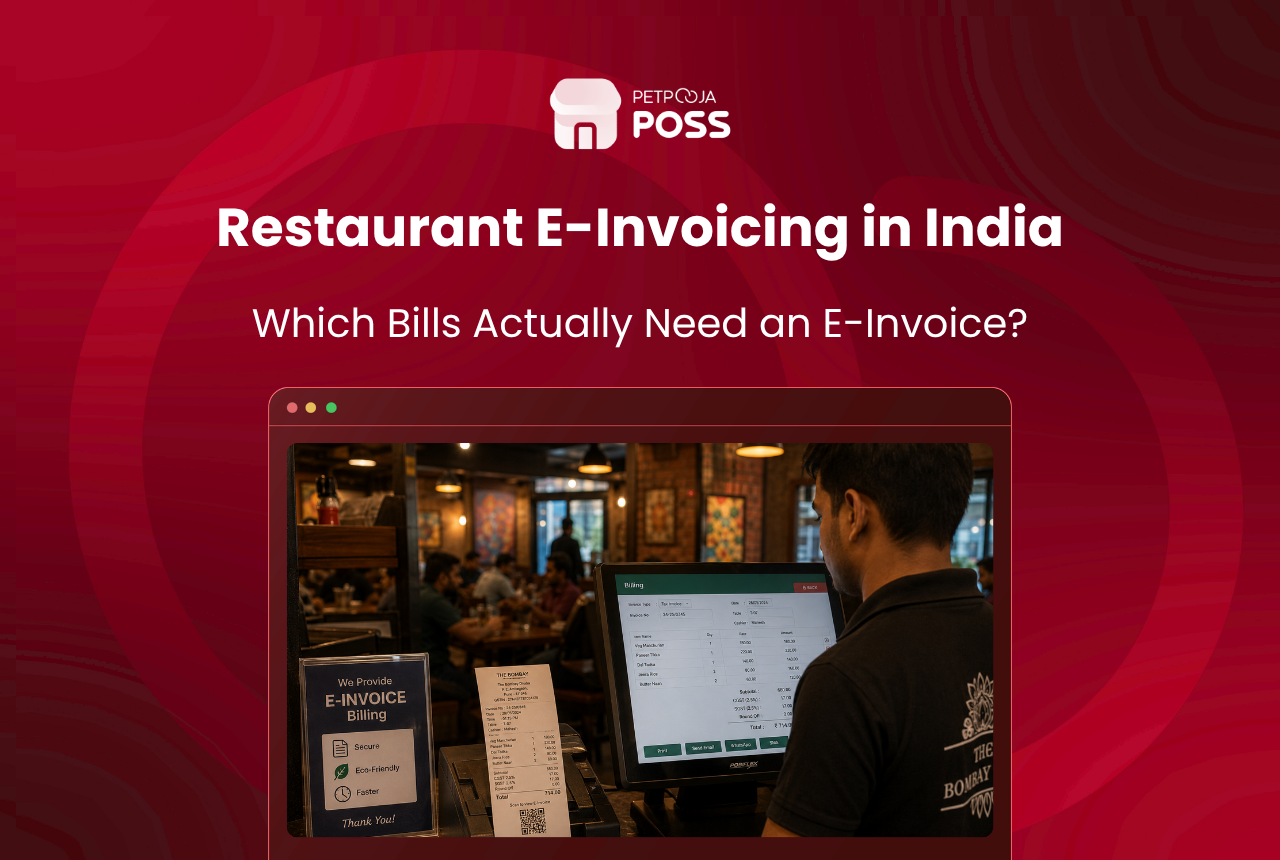
If your restaurant’s turnover has crossed ₹5 crore, you may be worried that every bill now needs an e-invoice. For most restaurants, it does not. E-invoicing under GST covers B2B sales, supplies to SEZ units, exports, and deemed exports. It does not cover B2C sales.
Almost every bill a restaurant raises is B2C. A diner at a table, a takeaway parcel, an order taken on your own phone line: none of them is a registered business buying from you.
Petpooja processes around 60 lakh bills a day across its restaurants. Bills of exactly this kind make up almost all of that volume.
What you do need to catch are the few bills that are B2B, such as a corporate catering order billed to a company’s GSTIN. This guide covers the turnover test, which bills count, where the e-way bill fits in, and what your POS does about it.
Key Takeaways
- The turnover test and the bill test are different. Crossing ₹5 crore makes you liable. Whether a given bill needs an e-invoice depends on who the customer is.
- B2C is out of scope, so dine-in and takeaway bills need no e-invoice at any turnover.
- Your Swiggy and Zomato sales still count towards the ₹5 crore test, even though the aggregator raises those bills, not you. Miss this and you can wrongly think you are under the limit.
- Restaurants are not on the exemption list. Banks, goods transport agencies, and multiplexes are. Food service is not, so your B2B bills count.
- An e-way bill follows goods, not meals. It turns up in your central kitchen, not at your tables.
What Should You Check First?
Here are the five things to work through, each explained in the sections below.
- Add up your turnover properly. Every GSTIN on the same PAN, every year since 2017-18, aggregator sales included.
- Split your bills into two piles. Anything billed to a customer’s GSTIN is B2B. Dine-in and takeaway are B2C.
- Brief your billers. A customer asking for a GSTIN gets flagged, not billed as a normal table.
- Fix your GST rates first. An e-invoice carries whatever the bill says, and a wrong rate on a portal is harder to undo than a wrong bill.
- Confirm your POS can do it. E-invoice support is not the same on every POS type, so check before you need it.
Does Your Restaurant Need to Issue an E-Invoice?
The test is your aggregate annual turnover, not your profit or your outlet count. E-invoicing is mandatory for registered persons whose turnover, based on PAN, crossed the prescribed limit in any preceding financial year from 2017-18 onwards. That wording was set by Notification 70/2020, which also brought exports into the net.
That limit is ₹5 crore. The GST e-invoice system puts it plainly: e-invoicing “applies to B2B transactions for businesses with turnovers above ₹5 crore”. Being PAN-based, it adds up across all your GST registrations rather than per outlet.
It also looks at any preceding year. Crossing ₹5 crore midway through this year makes you liable from the next one. Dropping back below the limit later does not take you out again.
One part of the sum gets missed. Your Swiggy and Zomato sales count towards it, even though the aggregator raises those bills. The CBIC says so plainly: aggregate turnover includes supplies made through ECOs for threshold purposes. Bill ₹3 crore directly and ₹2.4 crore through aggregators, and you have crossed.
Being liable is only half the answer, because it decides whether the rule applies to you. A separate test decides whether it applies to a given bill, and that is where most restaurants find they have little to do.
Why Do Most Restaurant Bills Not Need an E-Invoice?
E-invoicing applies to supplies made to a registered person. That is what B2B means here. Your dine-in guest and your walk-in parcel buyer are end consumers, so their bills are B2C and sit outside the rule.
The GST e-invoice system page mentioned earlier is direct about it. It “currently mandates e invoicing only for B2B transactions”. So a restaurant that only serves consumers can cross ₹5 crore and still raise no e-invoice at all.
This may not hold forever. B2C e-invoicing is under consideration by the GST Council, which began discussions at its 54th meeting on extending the mandate to B2C. No date has been set, so check the position each year.
You still issue a normal tax invoice for those bills, with the correct GST charged and recorded. Nothing at your billing counter changes. Only the e-invoice step, the reporting of the bill to the government portal, does not apply.
When Must a Restaurant Raise an E-Invoice?
Once you are past ₹5 crore, the bills to watch are the ones where a business is the customer. These are uncommon in a restaurant, which is exactly why they get missed. The main ones:
- Corporate catering or bulk orders billed to a company that gives you its GSTIN.
- Any bill where the customer asks for a GST invoice in their company’s name, so they can claim input tax credit.
- Tie-ups with an office, hotel, or event company that buys from you as a registered business.
- Catering to a unit inside an SEZ, which is covered whether or not tax is paid on it.
The trigger is easy to spot at the counter. If someone asks you to put a GSTIN on the bill, that bill is B2B.
Restaurants are also not on the e-invoicing exemption list, so your B2B bills carry the same duty as any other trade’s. Note the direction of travel on SEZs: an SEZ unit does not have to issue e-invoices, but a bill you raise to one does need it.
An Example of Which Bills Need an E-Invoice
The following is an example, not a real client. Picture a 40-seat restaurant in Aundh, Pune, with a turnover of ₹6.2 crore last financial year, counting aggregator sales. It has crossed the limit, so it is liable.
In a normal week it raises roughly 1,900 bills of its own, nearly all dine-in and takeaway. Then a nearby IT company books lunch for a training session and asks for the bill in its name with a GSTIN.
That one bill is B2B, so it must carry an IRN. The whole week’s duty rests on catching one bill out of 1,900. The example is made up, but the pattern is the point: tiny volume, easy miss.
What Is the 30-Day Limit for Reporting an E-Invoice?
There is a second rule that only applies to larger groups. Since 1 April 2025, a business with an aggregate annual turnover of ₹10 crore or more cannot report a document to the portal more than 30 days after the document date.
That comes from a GST Network advisory, and it covers invoices, credit notes, and debit notes.
The advisory is clear that businesses below ₹10 crore have no such reporting restriction for now. Between ₹5 crore and ₹10 crore, you must e-invoice your B2B bills, but you are not on the 30-day clock yet.
Past ₹10 crore, a forgotten catering bill turns into rework. Once 30 days pass the portal will not take that document, and you have to raise a fresh invoice and report that one instead.
Where Does the E-Way Bill Fit In for Restaurants?
An e-way bill is a different document with a different trigger. It follows the movement of goods, not the raising of a bill. CBIC’s Rule 138 requires one when a registered person moves goods worth more than ₹50,000. That covers a move “in relation to a supply” and a move “for reasons other than supply”.
The word goods keeps most restaurant activity out. Food supplied as part of a meal counts as a supply of service under Schedule II of the CGST Act, not a sale of goods. Serving meals creates no e-way bill duty.
Sealed packaged items sold over a counter, such as mithai boxes or bottled drinks, can still be goods. Check those with your accountant.
When Does a Restaurant Need an E-Way Bill?
The duty turns up away from your tables, in the part of the business that moves stock rather than serves it. Raw material going from a central kitchen to an outlet moves for a reason other than supply. Above the threshold, it needs an e-way bill on a delivery challan.
That ₹50,000 is the limit for movement between states. Several states set a higher one for movement inside the state, and they revise it by notification from time to time. Confirm your own state’s current figure with your accountant rather than assuming ₹50,000 everywhere.
One case is worth raising with your CA. A chain may move stock between two GST registrations of the same company in different states. That can count as a supply to a registered person, which may bring e-invoicing into play alongside the e-way bill.
How Does Your Restaurant POS Handle E-Invoicing?
The practical job is not the rule. It is catching the right bill and reporting it without a manual detour to the portal. On Petpooja POSS, e-invoicing runs as an add-on service that generates the IRN for a bill in line with GST regulations.
There is also a GSTIN IRN Report, showing the IRN generated against each e-invoice. That is the record your accountant works from at filing time, instead of pulling bills off the portal one by one.
For stock movement, e-way bill generation sits in the inventory module, where central kitchen transfers already live. Keeping both alongside your billing means the buyer’s GST details captured on a B2B bill are the ones reported.
Conclusion
For most restaurants, e-invoicing is a smaller job than it first sounds. Crossing ₹5 crore makes you liable, but the rule only bites on B2B bills, and a restaurant raises very few of those. Dine-in and takeaway stay out of scope.
The risk is not volume, it is attention. Count your aggregator sales when you test your turnover, or you may not realise you are liable at all. After that, a single catering bill with a GSTIN is the one that counts, and it looks like every other bill until someone asks.
To check how this would run on your setup, the Petpooja POSS team can take you through it. Rules do change, so confirm your own position with your CA.
Frequently Asked Questions
No. E-invoicing covers B2B supplies, supplies to SEZs, exports, and deemed exports. Dine-in and takeaway bills are B2C and stay out of scope at any turnover. Only bills raised to a GST-registered customer, such as a corporate catering order, need one.
No. Food service does not appear on the exemption list, which covers insurers, banks and NBFCs, goods transport agencies, passenger transport, multiplex cinemas, SEZ units, and government departments.
No, and not for the reason most owners assume. Since 1 January 2022, restaurant service through an aggregator is notified under Section 9(5). The aggregator is treated as the supplier and issues that bill to the diner, so you never raise it and there is nothing to e-invoice. You report those supplies in Table 8 of GSTR-1 and Table 3.1(c) of GSTR-3B, and they still count towards your ₹5 crore test.
Below ₹10 crore there is no reporting deadline at present, so you can still report it. At ₹10 crore or above the 30-day limit applies and the portal will not take that document afterwards. A bill without an IRN is not a valid invoice, so your customer cannot claim credit until you raise a fresh one.
No. An e-way bill follows the movement of goods above ₹50,000, and food supplied as part of a restaurant service counts as a service under GST. It matters for raw material moving between your central kitchen and outlets. The e-way bill checklist covers what to keep ready.
No. You still raise a normal GST invoice for every sale. An e-invoice is that B2B invoice additionally reported to the Invoice Registration Portal, which returns an IRN and a signed QR code. The portal does not create the bill, it only registers it.