
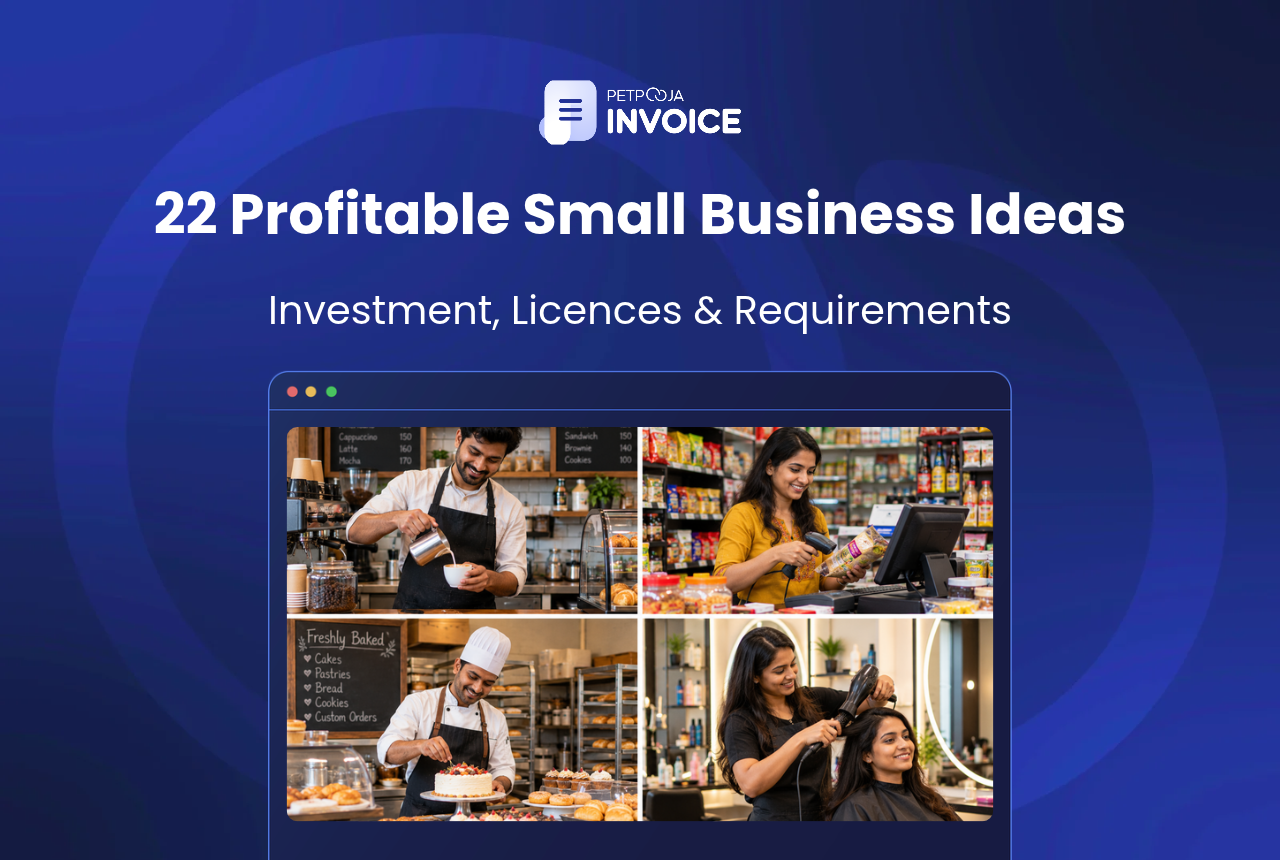
What small business can you start in India? This list gives you 22 shop and service businesses. By our estimate, nine open for under ₹5 lakh and five need ₹10 lakh to ₹20 lakh. Most are shops or simple services that small Indian business owners can run themselves.
Which idea suits you comes down to your budget, your street and what you already know. Rent, opening stock and any equipment decide most of the cost. Licences decide how fast you can open.
You are not alone in asking. People in India search for “small business ideas” about 22,200 times a month (Google search data, 12-month average, October 2026).
Picking the idea is often the easy part. For each one, you also get the cost lines, the licences and one billing or stock tip. A table of all 22 comes first, then the ideas by budget, how Indian retailers choose and the first steps every new shop takes.
Key Takeaways
- Tiffin, photocopy, stationery and repair shops are among nine ideas under ₹5 lakh, but those are our estimates, so price your own costs first.
- Licences can rule an idea out before money does. A medical store cannot open without a registered pharmacist.
- Your location can decide the idea. A stationery shop with no school nearby struggles, however good its stock.
22 Small Business Ideas at a Glance
The table below puts all 22 small business ideas side by side, so you can shortlist by budget first. We grouped them into three bands that roughly follow the loan categories of MUDRA (Micro Units Development and Refinance Agency), a government agency.
Shishu covers loans up to ₹50,000 and Kishor covers loans above that, up to ₹5 lakh. Tarun covers ₹5 lakh to ₹10 lakh. TarunPlus covers ₹10 lakh to ₹20 lakh, but only for those who have taken and repaid an earlier Tarun loan.
The bands are our rough estimates for one small outlet in a mid-sized city. They are not quotes. Your rent, opening stock and equipment will decide where you really land.
| Small Business Idea | Setup Band (Our Estimate) | Key Licence or Rule Beyond GST and Shop Registration | Best For |
|---|---|---|---|
| 1. Tiffin service | Under ₹5 lakh | FSSAI registration | Home cooks with a steady office crowd nearby |
| 2. Printing and photocopy shop | Under ₹5 lakh | None extra | Spots near colleges and courts |
| 3. Stationery shop | Under ₹5 lakh | None extra | Streets near schools |
| 4. Mobile and electronics repair | Under ₹5 lakh | None extra | People with repair skills |
| 5. Gift shop | Under ₹5 lakh | None extra | Busy markets with festival footfall |
| 6. Tailoring and alteration shop | Under ₹5 lakh | None extra | Trained tailors |
| 7. Cosmetics shop | Under ₹5 lakh | None extra | High streets with young shoppers |
| 8. Pet supplies shop | Under ₹5 lakh | None extra | Housing societies |
| 9. Book shop | Under ₹5 lakh | None extra | College towns |
| 10. Kirana store | ₹5 lakh to ₹10 lakh | FSSAI registration; stamped weighing scale | Dense housing areas |
| 11. Garment boutique | ₹5 lakh to ₹10 lakh | None extra | People with a design eye |
| 12. Footwear store | ₹5 lakh to ₹10 lakh | None extra | Main market roads |
| 13. Toy store | ₹5 lakh to ₹10 lakh | ISI (Indian Standards Institution) mark on every toy | Family shopping areas |
| 14. Bakery | ₹5 lakh to ₹10 lakh | FSSAI registration; stamped scale if sold by weight | Bakers with a tested recipe |
| 15. Optical store | ₹5 lakh to ₹10 lakh | Check state rules on eye tests | Near clinics and hospitals |
| 16. Mobile phone shop | ₹5 lakh to ₹10 lakh | None extra | Owners with brand dealer ties |
| 17. Home decor shop | ₹5 lakh to ₹10 lakh | None extra | New housing areas |
| 18. Medical store | ₹10 lakh to ₹20 lakh | Drug licence (Form 20 and 21) | Families with a pharmacist |
| 19. Hardware and paint store | ₹10 lakh to ₹20 lakh | Stamped weighing scale | Growing suburbs |
| 20. Electronics and appliances | ₹10 lakh to ₹20 lakh | None extra | Owners who can fund costly stock |
| 21. Mini supermarket | ₹10 lakh to ₹20 lakh | FSSAI registration; stamped weighing scale | Large housing societies |
| 22. FMCG (fast-moving consumer goods) distributor | ₹10 lakh to ₹20 lakh | E-way bills on large loads | People with retailer contacts |
Read “None extra” with care. It means no licence beyond the basic ones, not no licence at all.
Only two of the 22 cook or bake food, because our food business ideas and coffee shop ideas posts already cover that trade.
Small Business Ideas Under ₹5 Lakh
By our estimate, you can open any of these nine small business ideas for less than ₹5 lakh. They fit in small premises and need modest opening stock, or they sell a skill. A few can begin from home.
1. Tiffin Service
A tiffin service cooks home-style meals and delivers them to offices, students or families on a daily plan. Your main costs are a bigger cooking setup, steel or sealed boxes, and a delivery person or two-wheeler.
You need FSSAI registration before you sell any food. Under FSSAI’s March 2026 order, basic registration covers a food business with turnover up to ₹1.5 crore. A home tiffin service sits well inside that.
Bill your regulars once a month, not daily. Keep a note of skipped meals, so the month-end bill matches what they ate.
2. Printing and Photocopy Shop
Picture a photocopy counter outside a district court in Lucknow. The line forms at 10 am, and most jobs are under ₹50 each.
To price this idea, list the copier, a colour printer, a lamination machine, a binding machine and a counter near the gate. The shop sells a service, so no product licence applies.
Turn each job into its own item: A4 black and white copy, A4 colour copy, lamination, spiral binding. A bill with these lines shows you which job earns most at the end of the month.
3. Stationery Shop
A stationery shop sells pens, notebooks, files, craft items and school supplies. It does best within walking distance of two or three schools.
The cost is mostly opening stock, because hundreds of small items fill the shelves. We price this idea in full in the “how to choose” section below, as a worked example.
Scan barcodes where items carry them. Most packed items show a maximum retail price (MRP). Set each item’s price in your billing software at or below its MRP, and every scanned bill will follow it.
4. Mobile and Electronics Repair Shop
This one is for people who can already fix phones, laptops or TVs. A small shop is often enough, with a workbench, tools, a soldering station and a stock of common spare parts.
There is no special licence for repair work. Basic shop registration and GST, once you cross the limit, are enough.
Keep spare parts and labour on separate bill lines. Parts are stock that runs out, while labour is a service. Mixing them hides which one actually pays the rent.
5. Gift Shop
A gift shop sells photo frames, showpieces, soft toys, greeting cards and festival hampers. Footfall swings hard around Rakhi, Diwali and the wedding season.
Your cost lines are display shelves, a gift-wrap table and stock bought ahead of each festival. No product licence applies.
Buy festival stock in small rounds. Leftover Rakhi stock is hard to sell in September, and it turns into dead stock that locks up cash for a year.
6. Tailoring and Alteration Shop
A tailoring shop stitches new clothes and alters ready-made ones. It needs two or three sewing machines, an overlock machine, a cutting table and a trial room.
- Who it suits: trained tailors, or owners who can hire one.
- Licences: shop registration, and GST once your service turnover crosses the limit.
- Billing tip: take an advance at the order and print the delivery date on the slip.
Keep a fixed rate list for common jobs, like a trouser hem or a blouse fitting. Customers trust a printed rate more than a spoken one.
7. Cosmetics Shop
A cosmetics shop sells make-up, skincare and hair care from several brands. A 150 square foot shop on a high street in Madhapur, Hyderabad would need glass display units, good lighting and a mirror counter.
Stock is where the money goes. One lipstick range can come in 20 shades, and each shade is a separate stock line.
Record expiry dates when the stock comes in. Creams and lotions go off on the shelf, and an expired product sold is a complaint you did not need.
8. Pet Supplies Shop
A pet supplies shop sells food, toys, collars, beds and grooming items. This idea is about supplies only, since selling live animals brings its own rules.
It works best near large housing societies in places like Vastrapur in Ahmedabad or Salt Lake in Kolkata. Price shelving, a chiller if you stock wet food, and opening stock across dog, cat and bird ranges.
Pet food comes in many bag sizes. Set up 1 kg, 3 kg and 10 kg packs as separate items, so you know which size sells.
9. Book Shop
A small book shop sells school books, exam guides, novels and children’s books. College towns and areas near coaching centres give the steadiest sales.
The cost lines are shelving, a small reading corner and stock, which you can partly buy on return terms from distributors. No product licence applies.
Most books carry an International Standard Book Number (ISBN) barcode, so scan rather than type. It makes the end-of-term return to the distributor quick to count.
Small Business Ideas From ₹5 Lakh to ₹10 Lakh
These eight small business ideas need ₹5 lakh to ₹10 lakh, mainly because the stock is wider or the fit-out is heavier.
10. Kirana Store
A kirana store is the neighbourhood grocery shop. It sells rice, dal, oil, spices, snacks, soap and daily needs, often on credit to regular families.
Price the racks, a fridge for dairy, a weighing scale, a billing counter and opening stock across hundreds of items. Rent decides a lot here, because a kirana needs a spot inside a housing area.
Any scale you use in trade must be verified and stamped. In Delhi, the Legal Metrology department says a stamp on an electronic scale is valid for one year. Using an unstamped scale is not allowed.
A kirana sells food, so it also needs FSSAI registration, the same as a tiffin service.
Loose items like rice and sugar are sold by weight. Set them up as per-kg items, so the bill works out the price from the weight. Our grocery store POS guide covers the counter setup in detail.
11. Garment Boutique
A garment boutique sells ethnic wear, western wear or both, often with some designs of its own. It suits people with a strong design eye and a loyal circle of buyers.
Here is how the stock adds up (an example). One kurti design in five sizes and three colours makes 15 separate stock lines. Ten designs make 150 lines before you add a single dupatta.
So treat size and colour as part of the item from day one. Our clothing retail planning guide helps you plan stock for each season.
Licences are the basic shop registrations and GST. No product licence applies.
12. Footwear Store
A footwear store sells chappals, school shoes, sports shoes and formal pairs. Main market roads work best, because people like to try before they buy.
Most of the money goes into stock in full size runs. A design that sells needs sizes 6 to 10 on the shelf, not just the popular 8.
Watch for broken size sets. When only size 6 and size 10 are left of a design, clear them at a discount and reorder the design in full.
13. Toy Store
A toy store sells games, puzzles, dolls, ride-ons and educational toys. Family shopping areas and malls near schools bring the footfall.
The rule to know is about the stock, not the shop. A government order says no person may sell or stock any toy without the ISI mark. That is the toy ISI rule, and it applies to shops as well as makers. So check the mark when you buy, not when a customer asks.
Group toys by age band, like 0 to 3 and 4 to 7. Parents shop by age, and your sales report should too.
14. Bakery
A bakery bakes and sells bread, cakes, cookies, puffs and rusks. Your main cost is the equipment: an oven, a planetary mixer, a dough sheeter, display chillers and a work table.
- Licence: FSSAI registration or licence, depending on turnover, as with the tiffin service above.
- Scale: if you sell cookies or rusk by weight, the scale must be stamped like a kirana’s.
- Billing tip: set up whole cakes, slices and per-kg items as different items.
Our bakery startup guide lists the equipment and steps in order.
15. Optical Store
An optical store sells frames, lenses, sunglasses and contact lenses. It works well near clinics, hospitals and schools.
The cost lines are frame display walls, a lens edging machine, testing equipment and stock across many frame styles. If you plan to offer eye tests, check your state’s rules on who may test eyes before you start.
Most orders are made to a prescription. Take an advance, record the lens order on the bill and give a delivery date.
16. Mobile Phone Shop
A mobile phone shop sells handsets, covers, chargers, earphones and screen guards. Owners usually get stock from brand distributors in their area.
Handsets cost a lot each, so your stock money goes fast. Accessories cost less each and keep the counter busy between phone sales.
Every phone carries an IMEI (International Mobile Equipment Identity) number. Record it on the bill for each handset sold. It is how you trace a phone if a warranty claim or a return comes back.
17. Home Decor Shop
A home decor shop sells curtains, cushions, rugs, wall art, lamps and small furniture. New housing areas, where families are moving in, give the best sales.
The cost lines are display space, which needs to be larger than most shops, plus sample books and stock.
Some items sell by length. Curtain fabric, for one, is billed per metre. Set those items up with metre as the unit, so the bill matches what you cut.
Small Business Ideas Needing ₹10 Lakh to ₹20 Lakh
The last five ideas sit in the ₹10 lakh to ₹20 lakh band, mostly because their opening stock costs more.
Keep the loan limit in mind here. As the MUDRA bands above show, a first-time borrower can get up to ₹10 lakh. Plan to fund the rest yourself or from another loan.
18. Medical Store
A medical store sells prescription medicines, over-the-counter products and health items. It is one of the most regulated small businesses on this list.
You need a drug licence before you sell any medicine. In Delhi, the drugs control department issues Form 20 for retail sale of allopathic drugs and Form 21 for drugs in Schedule C and C(1). It asks for premises of at least 10 square metres and proof of a registered pharmacist.
Every medicine has a batch number and an expiry date. Sell the earliest expiry first, and check what a chemist’s bill must show in our pharmacy billing guide.
19. Hardware and Paint Store
A hardware store sells tools, pipes, fittings, locks, electricals and paint. Growing suburbs like Hosur near Bengaluru keep it busy, because new houses are always being built.
Few shops carry more stock lines. One store can hold thousands of items, sold by the piece, by the kg and by the litre.
Nails and wire are often sold by weight, so the scale needs a stamp. Set a reorder level for fast movers like cement bags and PVC elbows, so you see the gap before a contractor does.
20. Electronics and Appliances Store
An electronics store sells TVs, fridges, washing machines, fans and small appliances. Each item costs a lot, so this idea ties up a lot of money in stock.
Customers ask about warranty, delivery and paying in parts. Record the serial number of each unit on the bill, along with the warranty period.
21. Mini Supermarket
A mini supermarket is a self-service grocery store, larger than a kirana. Customers pick items from open shelves and pay at the counter.
You will need open racks, chillers, trolleys or baskets, two or more billing counters and a wide opening stock. It needs FSSAI registration too, because it sells food. A large housing society in Sarkhej, Ahmedabad could keep one busy.
Speed at the counter matters most here. Barcode scanning keeps the queue short, and fruit and vegetables on a stamped scale can print a price label.
22. FMCG Distributor
An FMCG distributor buys from brands and supplies packed goods to local shops. It suits people who know the retailers in their area well.
Price a small warehouse, a delivery vehicle, a sales person and stock bought on the brand’s terms. Most of your buyers will be GST-registered shops, so you bill business to business.
A registered business moving goods worth more than ₹50,000 in one consignment generally needs an e-way bill under Rule 138 of the CGST Rules. Some states set a higher limit for moves within the state, so check yours.
Put the buyer’s GST Identification Number (GSTIN) on every invoice, so they can claim their tax credit.
How Shop Owners Can Choose a Small Business Idea
Three checks help shop owners choose: budget, location and skills. Run each idea on your shortlist through all three before you sign a lease.
Budget: Price Every Line, Not a Round Number
Write down every line you will pay before the first sale. A round guess like “about ₹3 lakh” hides the rent deposit and the working capital you need while sales build up.
Here is a stationery shop in Aundh, Pune, priced line by line (an example):
| Setup Cost Line | Stationery Shop in Aundh (an example) |
|---|---|
| Rent deposit (3 months at ₹20,000) | ₹60,000 |
| Shelving and counter | ₹45,000 |
| Opening stock | ₹1,20,000 |
| Computer, printer and barcode scanner | ₹38,500 |
| Signboard | ₹12,000 |
| Working capital for the first months | ₹50,000 |
| Total | ₹3,25,500 |
The total sits inside the under ₹5 lakh band. Run the same lines for your own idea, then use our profit margin calculator to see what each sale must earn.
Location: How Indian Retailers Match the Idea to the Street
Your street often decides the idea. A stationery shop needs schools nearby, while a hardware store needs new building work. Stand outside the spot at 8 am, 1 pm and 7 pm on a weekday, and count who walks past.
Skills: Start Where You Already Know the Trade
A trained tailor, a pharmacist or a repair hand starts with an edge. If you know none of these trades, pick an idea where the skill is buying and selling, like a kirana or a gift shop. Our retail store setup checklist walks you through the rest.
What If a Small Business Idea Runs Without a Licence?
Running one of these small business ideas without the licence it needs can cost you a fine, your stock or, in the worst cases, a prison term. This section covers the three licences on this list that carry the most risk.
- Medicines: selling drugs without a valid licence is punishable under Section 27(b)(ii) of the Drugs and Cosmetics Act, 1940. The term is three to five years in prison, plus a fine of at least ₹1 lakh or three times the value of the drugs seized, whichever is more.
- Food: a small food business needs FSSAI registration, and a bigger one a licence. Running without a required licence falls under Section 63 of the Food Safety and Standards Act, 2006. This post does not quote the fine, because the Jan Vishwas Act, 2023 changed it, notified on 7 November 2023. Check the current amount on India Code.
- Scales: the Delhi Legal Metrology FAQ mentioned earlier says a scale not verified on time brings a fine of ₹5,000 and can be seized. It adds that a repeat offence with faulty weights can lead to prison.
Each of these is cheaper to get right before opening day than to fix after an inspection.
First Steps for Small Indian Business Owners
Every idea on this list goes through the same four steps: registrations, Udyam (optional), a bank account and billing. GST registration comes once your turnover crosses the limit. Udyam is fully online, while GST and shop registration timing depends on your state’s offices.
The top row applies to most ideas run from a shop; a home tiffin service may not need Shop and Establishment registration. The four boxes show common extras, and the table above lists the rest, like e-way bills for a distributor. Step 1 below explains the top row.
Step 1: GST and Shop Registration
GST registration depends on your turnover and your state. Under Section 22 of the CGST Act, the basic limit is ₹20 lakh of turnover a year.
The GST Council’s registration guide says a ₹10 lakh limit now applies only in Manipur, Mizoram, Nagaland and Tripura. If you sell only goods, the limit can be ₹40 lakh, but only in states that have chosen it. Check your state’s limit.
A repair shop sells parts as well as labour, so it is not goods-only. The ₹20 lakh limit (₹10 lakh in those four states) applies to it, as to any shop that sells a service.
You can also register before the limit, which helps if your buyers are shops that want GST invoices. Our GST registration checklist lists the papers you need.
Small traders can choose the composition scheme, which charges a low flat rate on turnover. The trade-off, under Section 10 of the CGST Act, is that you cannot collect tax from customers or claim credit on your purchases.
Shop and Establishment registration is a state law, so the form, fee and rules differ by state. Your city may also ask for a trade licence from the municipal office. Ask both offices before you open.
Step 2: Udyam Registration (Optional)
Udyam registration records your shop as a micro or small business with the Ministry of Micro, Small and Medium Enterprises (MSME). The Udyam portal says it is free, paperless and based on self-declaration. It does not need renewal, and it helps when you apply for a business loan.
Step 3: A Separate Bank Account
Open a current account in the shop’s name, or use one savings account only for the business. Keep every supplier payment and every UPI receipt in that one account. At year end, your accountant can then match the bank to your bills without guessing.
Step 4: Billing and the Item List
Set up your billing and build your item list before opening day, not after the first busy month. Each item needs a name, a selling price and a unit (piece, kg, metre).
Once you register for GST, give goods their Harmonised System of Nomenclature (HSN) code. Give services their Services Accounting Code (SAC). If your turnover is up to ₹5 crore, your GST invoices to other businesses must show at least a 4-digit code, under Notification 78/2020.
Shops below the GST limit need neither code until they register. Our HSN code finder helps you find the right one.
In billing software such as Petpooja Invoice, the item list is the first thing you set up. A billing system that prints a proper tax invoice and reduces stock with each sale keeps your stock count right as you sell.
What I could recommend from my end. After your first week of sales, open the stock and sales reports and find your ten fastest sellers. Check their stock against what is on the shelf, then reorder those first. One week of real bills tells you more than any guess you made before opening.
Conclusion
This post covered 22 small business ideas, nine of them in the lowest budget band. The right one for you is the one that fits your budget, your street and the skills you already have.
Start by pricing every cost line for your top two ideas. Then check the licences each one needs, because a missing drug licence or an unstamped scale can delay opening day.
For small Indian business owners, the billing setup is the last step before the shutter goes up. Petpooja Invoice gives shop owners GST bills, up-to-date stock levels and GST reports from the first sale, so your new business starts with clean books.
FAQs
Yes, you can start while keeping your job. A tiffin service, tailoring or a book shop can run with a family member at the counter. You can also hire one staff member for your working hours. The registrations do not depend on whether you have a job. Your business income is added to your salary income when you file your income tax return.
You do not. Most small shops in India start as a sole proprietorship, which means the business is you. There is no separate registration for the proprietorship itself. You take GST, shop and other registrations in your own name using your PAN (Permanent Account Number).
You must apply for GST registration within 30 days of becoming liable. This is set out in Section 25 of the CGST Act. Watch your running total each month, so the crossing does not take you by surprise.
You can, for example stationery with a photocopy counter. Both can run under the one GST registration you already hold for that shop. Keep them as separate item groups in your billing, so you can see which side earns more.
Yes, if the idea sells a skill rather than stock. A tiffin service from home, tailoring or mobile repair can start small when you already own the main tools, because they need little opening stock. Price every cost line first, as in the stationery shop example above. If you need a loan, MUDRA’s Shishu category covers loans up to ₹50,000.
Apply online on the Udyamimitra portal, or at a branch of any MUDRA lender. The MUDRA website lists the lenders as commercial banks, regional rural banks, small finance banks, microfinance institutions and NBFCs (non-banking financial companies). Carry your Udyam certificate and a simple cost plan, like the one in the budget section above.








